- Love’s Travel Stops expansion leaps forward with 20 new travel centers and a $1 billion makeover plan—find out how this reshapes the U.S. truck‑stop landscape.
- Discover how the chain is tackling the truck‑parking shortage and rolling out fast‑charging stations under an $83 million federal grant.
- Step inside the New Iberia flagship to see why its 63 truck spaces, Fresh Kitchen, and EV‑ready design signal the future of highway hospitality.
Love Travel Stops’ expansion is accelerating, with the family-owned chain embarking on an ambitious growth plan. In 2025, Love’s plans to add 20 new travel centers across the United States and remodel 50 existing locations. This nationwide expansion drive comes with a $1 billion investment and will add about 1,000 new truck parking spaces for professional drivers. As one of the country’s largest travel center operators, Love’s now oversees over 650 locations in 42 states, and it is modernizing many sites to enhance amenities for truckers, RV travelers, and motorists alike.
As a family-run business thriving in the transportation sector, Love’s story is one among many — for additional stories about family-owned companies making an impact, explore this page.
Love’s Travel Stops Expansion Strategy in 2025: Growth & Upgrades
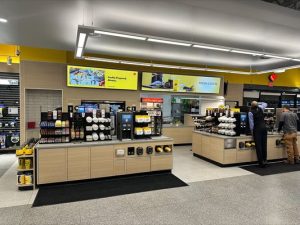
Customer‑service counter inside Love’s New Iberia, Louisiana flagship. Family‑owned Love’s now spans 650+ locations in 42 states.
Love’s Travel Stops has outlined a strategic expansion strategy for 2025 that balances new construction with significant upgrades to older stores. The company’s leadership, including President Shane Wharton, has emphasized introducing “new and updated locations, innovative food and drinks, and continued improvement of services and amenities” to meet evolving customer needs. Under this plan, Love’s will construct 20 new travel stops from the ground up this year and remodel 50 others under its Strategic Remodel Initiative (SRI).

These efforts are expected to boost capacity and comfort for travelers, adding roughly 1,000 truck parking spots to Love’s network in 2025 alone. By investing $1 billion into growth and renovations, Love’s aims to “provide an even better experience” for drivers across its network.
This expansion is not a short-term surge but part of a long-term vision. By 2035, Love’s anticipates that half of its locations nationwide will be newly built or fully remodeled to modern standards. This reflects a proactive approach to replace or upgrade aging facilities (based on factors like foot traffic, sales, and store age) to keep pace with industry trends. Notably, Love’s has nearly 40,000 team members and a strong culture of innovation, which it credits for driving this growth while maintaining customer service excellence. The company’s “highway hospitality” mindset means each new or updated stop is designed as a one-stop shop where professional truck drivers and casual motorists can refuel, refresh, and relax efficiently.
Enjoying our insights?
Subscribe to our newsletter to keep up with the latest industry trends and developments.
Stay Informed
For additional insights into strategic expansion efforts across the transportation industry, visit this link.
Is this Love’s Travel Stops expansion a response to competitors or market demand?
The Love’s Travel Stops expansion in 2025 is largely driven by market demand and the company’s own growth strategy – but it’s also happening amid a fiercely competitive landscape. Major rivals in the truck stop and travel center space, such as Pilot Flying J and TravelCenters of America (TA), are likewise expanding and upgrading their networks. For instance, Pilot Company recently unveiled a massive new flagship travel center in Tennessee (its largest site yet) and reported modernizing over 200 Pilot and Flying J locations under a “New Horizons” initiative.
Pilot has completed dozens of remodels this year, updating restrooms, showers, and dining areas for a more seamless customer experience. It is also opening new stores (e.g., a travel center in Winfield, Alabama) and adding affiliated dealer locations to broaden its reach. On the fuel technology front, Pilot – in partnership with GM and EVgo – now offers EV fast charging at 130+ locations in over 25 states, with plans for chargers at up to 500 sites by 2026.

Love’s commits $1 billion to modernize America’s roadside stops. Twenty new travel centers headline Love’s 2025 growth plan.
TravelCenters of America, which operates around 300 truck stops (and was acquired by BP in 2023), has also been growing. TA’s CEO noted the chain added over 1,100 truck parking spaces in the first half of 2024 through new sites and expansions. TA announced plans to open around 20 new locations in 2024 as it works to serve more drivers. This industry-wide push means Love’s expansion is happening in parallel with competitors’ moves, rather than purely reacting to them. Market demand – especially the nationwide shortage of truck parking and the need for updated facilities – is a primary factor.
Love’s sees opportunity in meeting these needs proactively. “Expanding into new communities and modernizing our locations are key to our strategy,” said Pilot’s COO, reflecting a sentiment shared across the industry. In the same spirit, Love’s is leading with a customer-centric approach, investing heavily to ensure its sites remain attractive stops for truckers and travelers.
In summary, Love’s 2025 expansion is propelled both by the imperative to serve growing demand (and solve pain points like lack of parking) and by the competitive drive to stay ahead of rivals in offering the best “one-stop” experience on the highway. The result is a highly impartial, fact-driven growth plan that keeps Love’s at the forefront of the travel center sector.
For more news and updates on truck stops and travel center developments, check out this page.
New Locations Add Capacity and Amenities for Drivers
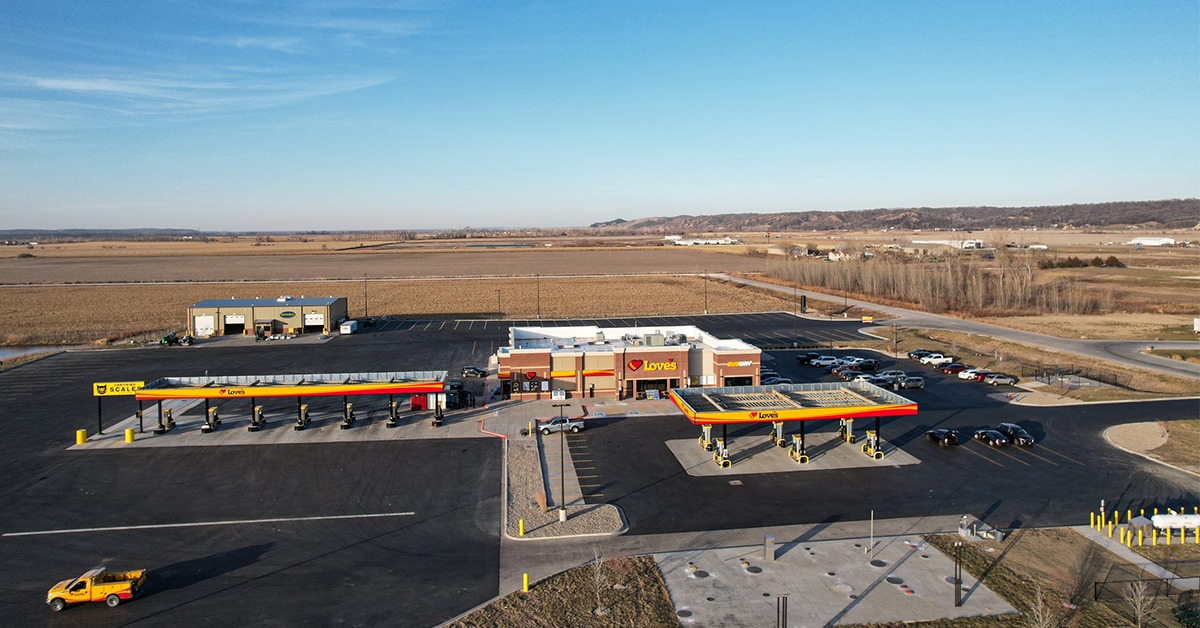
A newly opened Love’s Travel Stop in New Iberia, Louisiana, exemplifies the expansion – it offers 63 truck parking spaces, multiple diesel bays, showers, laundry facilities, and popular dining options. Each new Love’s location significantly boosts capacity and caters to driver comfort. For example, the New Iberia travel stop (opened March 2025 as Love’s 656th store) features a Love’s Fresh Kitchen concept serving fresh sandwiches and salads daily, plus branded restaurants like Dunkin’ and Godfather’s Pizza.
The site provides 63 truck parking spaces, six diesel fueling bays, five showers, laundry machines, and a CAT scale. It created 85 new jobs ranging from store operations to food service. Similarly, Love’s first 2025 opening in Elliston, Virginia, includes 93 truck parking spots, a 9-bay diesel fuel island, seven showers, laundry facilities, and even a dog park and self-checkout kiosks for convenience.

Long‑haul tractors refuel at a freshly built Love’s site. An extra 1,000 truck‑parking spots targets the nationwide shortage.
Many new Love’s Travel Stops are large (often 10,000–15,000+ sq. ft.) and designed with modern layouts that accommodate both heavy-duty trucks and passenger vehicles. They typically offer a mix of quick-service restaurants (QSRs) and Love’s own fresh food programs, ample amenities for professional drivers (showers, driver lounges, truck maintenance shops), and even features for RV travelers such as dump stations and RV hookups at select locations.
Importantly, each new store contributes to easing the strain on truck parking along busy routes. The United States faces a chronic truck parking shortage – there is only one parking space for every 11 trucks on the road – which forces many truckers to park in unsafe or unauthorized areas. By building new travel centers and expanding existing lots, Love’s is adding much-needed capacity in critical corridors.
For instance, its new stop in Cullman, Alabama (opened late 2024) added 82 truck spaces along the busy I-65 corridor, and a new site in Buffalo, Wyoming provided 64 truck spaces at the I-90/I-25 junction. Love’s now operates 10 travel stops in Louisiana alone after the New Iberia opening, showing its commitment to dense coverage in high-traffic regions.
For more news on transportation developments and infrastructure in Louisiana, click here.
By the end of 2025, with 20 new locations online, Love’s total network will exceed 50,000 truck parking spaces nationwide. Each additional location and parking spot helps truck drivers comply with hours-of-service rules and find safe rest, addressing a top industry concern. The new sites also incorporate driver-requested amenities – from abundant food choices to Wi-Fi, secure, well-lit lots, and recreation areas – making them true “home away from home” stops on long hauls.
For additional news about new travel center locations and grand openings, follow this link.
Addressing the Truck Parking Shortage
A cornerstone of Love’s expansion is tackling the truck parking crisis. Truck drivers often struggle to find safe parking, wasting time and fuel hunting for spots, and sometimes resorting to parking on highway shoulders. Love’s has explicitly prioritized parking in its growth plans. “We’re going to add 1,000 new [parking] spaces… by the end of 2025, we’ll have over 50,000 parking spaces helping out the trucking industry,” President Shane Wharton said.

Love’s Speedco trailer parked outside the New Iberia flagship. New Iberia flagship debuts with 63 truck spaces and EV‑ready bays.
This push will slightly alleviate the national shortfall, though the gap remains significant (an estimated 40,000+ parking spaces are still needed across the country to meet demand). Love’s is addressing this by integrating sizable truck lots into every new build and even expanding parking at some existing stores where land allows. For example, some remodel projects are adding overflow truck parking or re-striping lots to fit more rigs.
In 2024, TravelCenters of America similarly reported adding 1,100 truck spaces by mid-year through network growth, underscoring that all major players recognize parking capacity as a critical need. Love’s contribution of 1,000 new spaces in 2025 is a meaningful step. More so, Love’s keeps all locations open during renovations and carefully manages construction phases so that drivers still have access to fuel and parking – a customer-first approach that prevents reducing available parking during upgrades.
By being strategic and “getting customers back on the road quickly,” even amid construction, Love’s strengthens its reputation for driver service. In summary, the expansion directly targets the parking shortage: every new Love’s means fewer trucks parked on ramps or shoulders and more drivers getting a secure rest, which in turn improves safety and efficiency on the highways.
For additional insights into the truck parking shortage and efforts to address it, explore this link.
EV Charging and Alternative Fuel Initiatives
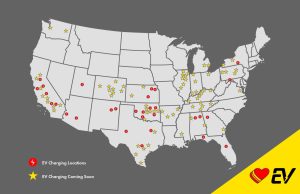
Current and planned Love’s EV‑charging locations across the U.S. EV fast‑charging rollout fueled by an $83 million federal grant.
Another focal point of the Love Travel Stops expansion is preparing for the future of fueling, including electric vehicles and other alternatives. All newly built Love’s locations now allocate space for EV charging stations so that infrastructure can be added quickly in partnership with utilities when local demand materializes. In fact, Love’s is rapidly growing its EV charging network through federal programs. In 2024, the company was awarded $83 million in grants (under the National Electric Vehicle Infrastructure program) to build fast chargers across 13 states. Construction on new high-speed charging stations is expected to begin in eight states in 2025 – including Alabama, Colorado, Illinois, Kansas, Kentucky, New York, Ohio, and Pennsylvania – significantly expanding coverage along major corridors.
“Love’s is honored to play a critical role in… building out the fast-charging EV network across the nation,” Wharton noted, highlighting that Love’s has been involved in EV charging since 2017. As of mid-2024, Love’s had over 100 EV chargers at 28 stores in 11 states, often through partnerships with providers like Electrify America. Those numbers are climbing steadily. Pilot Flying J, for comparison, has a similar initiative with GM to equip up to 500 travel centers with chargers by 2026, indicating that truck stop chains see EV infrastructure as a long-term investment. Love’s own strategy includes both passenger vehicle fast-chargers and exploring electric solutions for medium- and heavy-duty trucks as that technology evolves.
Concept art of a Love’s Travel Stop EV fast-charging station, part of the company’s nationwide infrastructure rollout. Beyond EV charging, Love’s is also investing in alternative fuels. The company has plans to install hydrogen fueling stations and compressed natural gas (CNG) stations at select locations in support of commercial and transit fleets. For example, hydrogen supply is expected to come online at a few pilot sites, and CNG pumps are being added in Pennsylvania and California primarily for transit authorities.
While these won’t initially serve the general public, they signal Love’s preparation for a future where trucks may run on diverse energy sources. Love’s is additionally expanding the availability of renewable diesel and higher biofuel blends (like E15 ethanol) through federal incentive programs. All these efforts ensure Love’s will remain a one-stop fueling hub regardless of how vehicle energy demands shift in the coming years.
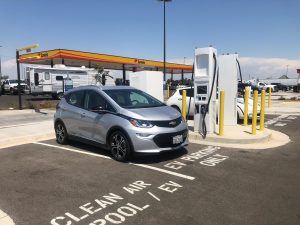
Level‑3 fast chargers now appearing across Love’s Travel Stops. Hydrogen and CNG pilots position Love’s for an alternative‑fuel future.
By integrating EV chargers, alternative fuels, and even traditional services (like bulk DEF, propane, and ethanol) at its stops, Love’s is positioning itself as a forward-looking “energy and convenience provider” rather than just a traditional gas station. This balanced approach helps the company capture emerging markets (such as EV drivers) while still catering to the core diesel trucking segment that forms its customer base.
For the latest updates on EV charging stations and alternative fueling infrastructure, check out this link.
Hydrogen and Natural Gas Fueling Plans
Love’s expansion into alternative fuels isn’t limited to electric vehicles. The company is piloting hydrogen fuel and natural gas options to accommodate future fleet needs. In partnership with energy suppliers, Love’s plans to introduce hydrogen fueling at a few travel stops as the fuel cell truck market develops. Likewise, it will open new CNG (Compressed Natural Gas) stations in states like Pennsylvania and California, primarily to support local transit and trucking fleets seeking cleaner fuel options.
These hydrogen and CNG facilities are expected to come online in the next couple of years, demonstrating Love’s readiness to diversify its energy offerings. While these fuels are nascent for long-haul trucking, Love’s proactive infrastructure build-out means it can quickly scale up service as demand grows. By staying ahead of hydrogen and CNG, Love’s ensures its travel centers remain relevant and useful for all kinds of vehicles – from diesel rigs to electric cars and beyond – in an evolving transportation landscape.
For more news on gas stations and fuel distribution trends, visit this page.
Looking Ahead: Expansion Through 2035

Strategic expansion blends new builds with 50 store remodels. Renovations stay open to ‘get drivers back on the road’ quickly.
With a combination of new builds, remodels, and tech upgrades, Love’s Travel Stops is on track to dramatically modernize its network over the next decade. By 2035, fully 50% of Love’s locations will be either newly constructed or completely remodeled to current standards. This long-term commitment underscores Love’s belief in continuous improvement and growth. The expansion in 2025 – 20 new stores and 50 renovations – is just the beginning of that journey. Each project is chosen strategically based on customer traffic patterns and store age, ensuring investments go where they yield the biggest impact. Love’s impartial, fact-driven approach to expansion means decisions are guided by data on where services are most needed.
As Love’s President Shane Wharton stated, the company will keep focusing on the evolving needs of customers and delivering “an even better experience across our network”. In practical terms, this could include rolling out more of Love’s Fresh Kitchen food offerings, adding modern conveniences like self-checkout at all stores, expanding loyalty rewards, and integrating new technologies for fuel payment or parking reservations.
The travel center industry is entering a new era of innovation and competition, and Love’s is positioning itself as a leader. By investing $1 billion in the present and planning ambitiously for the future, Love’s Travel Stops ensures it will continue fueling America’s truckers and travelers – reliably, efficiently, and with an ever-improving array of products and services – for decades to come.
Key Developments in Love’s 2025 Expansion
- 20 brand‑new locations & 50 remodels slated for 2025, backed by a $1 billion Strategic Remodel Initiative.
- New Iberia, Louisiana, opens as store #656 with 63 truck spaces, Fresh Kitchen, Dunkin’, Godfather’s Pizza, and built‑in EV‑charger bays.
- 1,000 additional truck‑parking spots coming online, pushing Love’s network past 50,000 spaces nationwide.
- $83 million NEVI grant funds high‑speed EV chargers in 13 states; construction starts in eight states this year.
- Goal by 2035: 50 % of all Love’s locations will be newly built or fully remodeled.
- Pilot programs for hydrogen and CNG fueling position Love’s for an alternative‑energy future.
Broaden Your Insight into Truck‑Stop Expansion & Infrastructure
- Read Love’s official announcement of the New Iberia travel stop at Love’s press release.
- Explore Love’s plans for federally supported fast‑chargers in its network at Love’s EV‑charging overview.
- Review the company’s $1 billion remodel initiative in Land Line’s coverage.
- Consult the U.S. DOT’s fact sheet on the NEVI Formula Program that funds highway EV chargers.
- See FMCSA’s findings on the economic impact of the truck‑parking shortage.
- Locate current and planned hydrogen fueling sites via DOE’s Hydrogen Station Locator.
- Get details on Pilot’s 2024 travel‑center growth in its network‑expansion press release.
- Read how TravelCenters of America is adding parking and chargers in Trucking Dive’s report.