- AI freight classification at C.H. Robinson now automates 75%+ of LTL orders, classifies ~2,000 emailed tenders/day in 10s (and 3s after learning), saving 300+ staff-hours/day.
- NMFC 2025 overhaul (effective July 19, 2025) introduced a 13‑sub density scale, reclassified 2,000+ items, retired the legacy lookup, and made ClassIT+ the official source—with Docket 2025‑2 already live.
- Carriers are hardening the data layer: Southeastern Freight Lines added 33 new dimensioners (121 total) and A. Duie Pyle expanded its fleet—underscoring measurement-first LTL ops that complement AI classification.
In response to a significant overhaul of U.S. less-than-truckload (LTL) freight classification standards, global logistics leader C.H. Robinson has rolled out a new AI freight classification agent to help shippers accurately identify the correct class for their freight. This cutting-edge tool uses generative AI to determine the proper National Motor Freight Classification (NMFC) code for LTL shipments, aiming to eliminate errors, speed up shipping processes, and adapt seamlessly to the newly updated classification system.
Early results show it significantly increasing automation in C.H. Robinson’s operations – boosting LTL order processing efficiency to over 75% automated, up from roughly half before this AI deployment. By automating what was once a tedious manual task, the company’s AI agent is helping shippers avoid costly delays from misclassified freight and keep goods moving smoothly through the supply chain. For more news and updates on global supply chain developments, check out this page.
Adapting to New LTL Freight Classification Standards

AI freight classification pushes LTL automation past 75%. (C.H. Robinson — containers & yard operation)
The introduction of C.H. Robinson’s AI tool comes as the National Motor Freight Classification (NMFC) system undergoes its most significant revision in decades. Effective July 19, 2025, NMFC Docket 2025-1 restructured how LTL freight is categorized, moving toward a more streamlined, density-based model. The former classification framework comprised 18 freight classes (ranging from class 50 for very dense goods up to class 500 for very light or bulky items) determined by a combination of density, stowability, liability, and handling characteristics.

The new approach modernizes and condenses this system by grouping similar products and applying a standardized density scale. In fact, over 2,000 commodity items were reclassified under the update, and the traditional 11-tier density scale was expanded to 13 tiers to improve accuracy and granularity in freight classes. These changes mean that many shippers must adapt to new NMFC codes and classes, and errors or uncertainty in freight class identification are likely to increase during the transition. For additional insights into the challenges facing LTL shippers and carriers, explore this page.
Accurately classifying LTL freight is critical because it directly impacts shipping costs and logistics planning. The NMFC system provides thousands of specific classes and numeric codes to help LTL carriers plan how much space and weight a shipment will consume, whether it’s a pallet of heavy auto parts or bulky retail goods like pillows. Misclassifying a shipment can trigger carrier inspections, re-weighs, re-invoicing, and surprise upcharges, not to mention transit delays if freight is held up for correction.
Enjoying our insights?
Subscribe to our newsletter to keep up with the latest industry trends and developments.
Stay Informed
With the stakes so high – and a complex new classification regime rolling out – industry players have been seeking technology solutions to navigate these changes with minimal disruption. The generative AI logistics initiative by C.H. Robinson is one such solution, introduced as a timely response to help shippers (especially small and mid-sized businesses) smoothly comply with the new standards while avoiding costly mistakes. Stay abreast of the latest trends shaping generative AI applications in logistics; click here for more information.
C.H. Robinson’s AI Freight Classification Agent

Email tenders are classified in ~10 seconds—~3 after learning. (C.H. Robinson — technology/workstation visual)
C.H. Robinson’s AI agent is a proprietary freight classification tool designed to take the guesswork out of determining the correct LTL class and NMFC code for each shipment. Unveiled in June 2025, just weeks before the NMFC overhaul took effect, the agent represents a new frontier in the company’s innovation – it’s an AI that works in tandem with other AI-driven processes to automate freight booking from start to finish.
“Many LTL shippers are unaware or uncertain of the classification for their freight,” explained Greg West, C.H. Robinson’s Vice President of LTL, underscoring the need for assistance. “When they email us a tender, the freight class and code might be missing or incorrect. This is bound to increase with the massive overhaul of the national LTL freight classification system. So we built an AI agent that determines the correct class and code for a shipment and assists another of our AI agents in turning that tender into an accurate order in our system.”
In other words, the classification AI works hand-in-hand with C.H. Robinson’s automated order entry agent – one interprets the incoming shipment request (often received by email from the shipper) and the other populates it into the system with all details, now including the proper class code. This multi-agent automation approach marks a significant advancement in how freight brokers leverage AI, essentially creating an ecosystem of specialized bots that handle different steps of the process and even assist each other. For more news and updates on the freight brokerage industry, check out this page.
Automating Freight Class Determination with AI
As part of C.H. Robinson’s expanding fleet of AI-driven solutions, this LTL classification agent focuses on reading unstructured shipment requests (like email tenders) and quickly mapping the described goods to the correct NMFC class. It draws on large language models and the company’s extensive freight data to “reason through” each description – for example, whether a pallet of printed books should be classed differently than a crate of machine parts. The agent factors in weight, dimensions, product type keywords, and any special handling attributes to assign the precise class and NMFC code that LTL carriers require for pricing and loading.

Carriers add dimensioners to tighten freight data at the dock. (FreightSnap FS-5000 — product cutout)
Notably, the AI is generative, meaning it can handle free-form text inputs and improve its understanding over time. For shipments the AI agent encounters for the first time, it may take about 10 seconds to analyze the description and confidently choose a freight classification. After it has seen similar freight and been validated by C.H. Robinson’s LTL experts, the agent becomes even faster – classifying repeat or learned shipment types in as little as 3 seconds. This rapid, adaptive learning process is a stark improvement over purely manual classification, which can require an employee to spend 10–15 minutes looking up the NMFC code for a single emailed tender.
By automating these lookups, the AI not only saves time but also standardizes accuracy, applying the latest NMFC definitions without human error. Unlike a person who can only handle one request at a time, the AI can process hundreds of LTL shipments concurrently, determining the classes for all of them simultaneously. This parallel processing means even large volumes of email tenders can be ingested and classified almost instantly, a capability that has been particularly useful as shippers flood their logistics partners with questions and bookings under the new classification rules. Stay updated on the latest AI innovations in the logistics industry by checking out this link.
Generative AI Speeds Up Classification
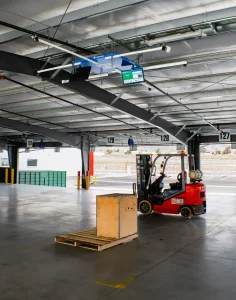
Automation frees 300+ worker-hours daily for higher-value work.. (FreightSnap — automated dimensioning installed at crossdock)
The efficiency gains from C.H. Robinson’s AI classification agent are already tangible. In its first few months of operation (during the lead-up to the NMFC changes), the agent was determining freight classes for roughly 2,000 LTL orders per day. Each of those orders would have otherwise required manual attention. With the AI handling them in seconds, the company estimates it’s saving over 300 worker-hours every day on classification tasks.
Arun Rajan, C.H. Robinson’s Chief Strategy and Innovation Officer, highlighted the impact in a press release, noting that what used to take humans many minutes per shipment is now done in a few seconds or less by the AI. “For shipments, the AI agent is reasoning through for the first time, it can choose a freight classification in about 10 seconds… After getting more training on that type of freight from our LTL experts, it takes only three seconds,” Rajan said, emphasizing the rapid learning curve of the system.
Moreover, by processing many shipments in parallel, the AI achieves a throughput that would be impossible for an individual employee, collectively freeing up those 300+ hours per day that staff can now devote to more strategic work and customer service. The result is that customer requests are handled faster and more consistently. Instead of waiting hours for manual entry, incoming LTL shipment tenders can be recognized, classified, and booked into C.H. Robinson’s system in under 90 seconds. This is particularly beneficial for thousands of small and medium-sized business (SMB) shippers who still rely heavily on email communications.
By June 2025, the company reported that over 75% of all its LTL orders are now fully automated – a leap from about 50% previously – thanks in large part to this new classification AI working alongside other automation tools. Such a dramatic rise in automation reflects both the power of the technology and the importance of the use-case: LTL freight classification was a perfect candidate for AI because of its complexity and the high volume of routine work involved. Understand the strategies being employed to improve operational efficiency in freight operations, explore this link.
Handling High-Volume LTL Shipments Efficiently
Crucially, the AI agent was built to scale with C.H. Robinson’s enormous shipment volumes. As one of North America’s largest third-party logistics providers (3PLs), C.H. Robinson arranges millions of freight moves each year, and it handles more LTL freight than any other 3PL in the region. LTL shipping, by nature, involves multiple customers’ freight sharing trailer space, which makes efficiency and accuracy in classification paramount – carriers base their pricing and space allocation on these class codes. With the NMFC updates, there is even less tolerance for error; shipments must have correct weight and dimensions and be assigned the right class, or carriers may reclassify them and issue costly corrections.

C.H. Robinson moves millions of loads each year—and handles more LTL than any other 3PL in North America. (C.H. Robinson — Chicago Central office)
By deploying an AI agent that can handle the high volume of daily LTL tenders – those ~2,000 shipments per day and potentially more as adoption grows – C.H. Robinson ensures that its operations and its customers’ freight can scale without bottlenecks in the back office. The agent doesn’t get tired or overwhelmed by volume spikes; it can instantaneously process a surge of emails (for instance, when many shippers rushed to beat classification changes or needed clarifications right after July 19).
This level of responsiveness helps keep freight moving on schedule. Shippers benefit because their loads get on the road faster with fewer administrative holdups, and C.H. Robinson’s team benefits because they can reallocate their time to exception management and strategic planning, rather than doing repetitive lookup work. In essence, the AI has become a digital workforce multiplier, handling the heavy lifting of classification so that human experts are free to tackle more complex logistics challenges. For more news and updates on C.H. Robinson, visit this page.
Minimizing Delays and Errors in LTL Shipping
One of the primary advantages of automating freight classification is reducing the risk of errors that lead to shipping delays. Under the old system, if a shipper guessed an NMFC class incorrectly or left it blank, the LTL carrier would often catch the mistake later – either at pickup or at a central terminal – and then put the freight on hold for inspection and re-rating. Such missteps result in reclassification fees, transit delays, and potentially higher charges when the cargo is finally invoiced correctly. C.H. Robinson’s new AI agent virtually eliminates this scenario for its customers by getting the class right from the start.
“Our AI agent cuts down on delays and potentially higher charges, and keeps our customers’ LTL freight moving,” Greg West noted, highlighting how it helps avoid those dreaded notices of correction from carriers. The timing of this tool was particularly critical; as the NMFC overhaul took effect, many in the industry likened it to a “Y2K moment” for LTL – a lot of uncertainty and potential for mistakes as everyone adjusted to the new classifications. To dive deeper into the NMFC 2025 overhaul and its industry implications, follow this link.
By automating the classification step, C.H. Robinson provided its shippers with an extra layer of confidence during the transition. The AI is always up to date with the latest NMFC taxonomy, so the day the new freight classes went live, the agent was already prepared to apply the updated codes correctly on every shipment. This proactive approach meant that C.H. Robinson’s network of LTL carriers didn’t have to waste time holding freight for rework.
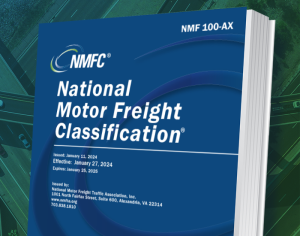
NMFC 2025 introduces a denser 13-tier scale for pricing accuracy. (National Motor Freight Classification (NMFC))
In fact, carriers themselves appreciate such measures; they “don’t want to have to hold a shipment for inspection, reclassify it and adjust their invoice,” West explained, noting that by getting classifications right initially, the AI tool helps carriers as well by cutting down on exceptions and keeping freight flowing through their terminals. Overall, fewer misclassifications translate to a smoother LTL operation end-to-end, with less friction between shippers, brokers, and carriers when it comes to billing accuracy and load planning.
Ensuring Accurate Freight Information
While the AI agent greatly simplifies the classification process, C.H. Robinson has emphasized that shippers still need to provide accurate weight and dimensions for their freight to get the best results. The NMFC classes, especially under the new density-based regime, heavily depend on knowing an item’s density (weight-to-volume ratio). No AI can guess the weight or exact size of a shipment if that information is not supplied or is incorrect. To assist shippers, C.H. Robinson has even collaborated with makers of dimensioner technology – devices that use lasers or sensors to measure a pallet’s dimensions automatically – and arranged discounts for its customers who invest in these tools.
By using a dimensioner, an LTL shipper can quickly capture the precise length, width, and height of every pallet, which the AI can then use along with the weight to pinpoint the proper class code. This partnership indicates the company’s holistic approach: combining AI software with physical measurement technology to improve overall accuracy in freight data. It’s a recognition that good data in equals good outputs – if the AI is given reliable numbers, it will return a reliable classification. Many LTL carriers are also ramping up their capabilities in this area.
For instance, regional carriers A. Duie Pyle in the Northeast and Southeastern Freight Lines in the South have invested in additional dimensioners at their terminals ahead of the NMFC change, ensuring they can verify freight dimensions and catch any discrepancies in class assignments early. By proactively measuring freight, these carriers support shippers in adapting to the new rules and protect themselves from revenue leakage due to under-declared freight. The trend shows that across the industry, there’s a push for better tools – whether AI, hardware, or a mix of both – to handle the complexity introduced by the NMFC update.
Industry-Wide Tech Adaptation

ClassIT+ is now the authoritative NMFC lookup. (ClassIT+ — feature image from NMFTA event)
C.H. Robinson’s focus on an AI classification agent is part of a broader wave of logistics automation sweeping through freight brokerage, 3PLs, and carriers. The LTL sector, in particular, is seeing multiple technology responses to the new classification challenges. Some parties are opting for software solutions (like C.H. Robinson’s AI or NMFTA’s own ClassIT+ lookup interface for NMFC codes), while others emphasize hardware like dimensioners to gather better data. Stay updated on the latest trends in logistics technology and automation by checking out this link.
We’re also witnessing the rise of startups and innovative platforms targeting various freight processes with AI. For example, a San Francisco startup called Augment has developed an AI logistics “teammate” platform that can handle tasks across the full order-to-cash cycle – from quoting and capacity booking to tracking shipments and billing. This kind of AI-powered logistics agent (nicknamed “Augie” by that company) illustrates how quickly AI is being adopted to streamline operations beyond just classification.
It understands shipment context, interacts through email or portals, and works to reduce manual touches and cycle times in a manner similar in spirit to what C.H. Robinson has built in-house. The infusion of AI into freight operations is enabling brokers and carriers to respond faster and more accurately in many areas: instant rating for quotes, automated load building, proactive issue resolution, and more. In the case of freight classification specifically, C.H. Robinson’s achievement of automating three-quarters of its LTL orders with AI sets a high bar for the industry. Explore our news on the NMFTA and its freight initiatives by visiting this link.

NMFTA’s 2025 NMFC update replaced the legacy lookup with ClassIT+ and expanded to a 13-tier density scale. (NMFTA — official logo)
It showcases the potential efficiency gains when traditional, labor-intensive workflows (like looking up class codes) are augmented by artificial intelligence. As other logistics providers observe these outcomes, we’ll likely see even wider adoption of AI-driven tools and 3PL automation initiatives to handle freight data and decision-making. Ultimately, whether through proprietary development or third-party solutions, the goal across the board is the same: to handle the growing complexity and volume in freight logistics with greater speed, accuracy, and minimal manual effort. The LTL classification overhaul of 2025 may prove to be a catalyst that accelerates the freight industry’s embrace of AI, demonstrating its value in keeping goods moving efficiently even amid significant operational changes.
Key Developments — AI Freight Classification & NMFC 2025
- C.H. Robinson launched an AI classification agent (June 19, 2025) as part of a fleet of 30+ AI agents, built to determine the correct NMFC class/code and to assist other agents in turning emailed tenders into accurate orders.
- Automation jump: LTL orders automated rose from ~50% to 75%+, with a particular boost for SMBs that still tender by email.
- Throughput & speed: The agent processes ~2,000 orders/day, selects a class in ~10 seconds on first encounter and ~3 seconds after learning, handles hundreds of shipments in parallel, and is saving 300+ staff‑hours/day.
- Go-live readiness: On July 19, 2025, the agent applied the new NMFC classes/codes on day one. Robinson advises shippers to supply accurate weights and dimensions, and has dimensioner vendor discounts available.
- NMFC reboot (Docket 2025‑1): Effective July 19, 2025, the system moved to a 13‑sub density scale (replacing the prior 11‑sub), reclassified 2,000+ items, and retired the old getclassification.com lookup in favor of ClassIT+.
- What’s next: Docket 2025‑2 is live and accepting feedback; NMFTA signals an ongoing, phased refinement to classification and rules through 2025.
- Carrier preparedness:
- Southeastern Freight Lines installed 33 new dimensioners (now 121 total) to tighten dimensional accuracy ahead of the NMFC shift.
- A. Duie Pyle added 12 more dimensioners (to 22 existing units) and expanded internal research/inspection to smooth the transition.
- Industry signal: NMFTA emphasized that 2,000+ items moved under the new 13‑sub density table on July 19—and more changes are expected, reinforcing the need for automation and precise measurement.
- Tooling shift: ClassIT+ is now the single source of truth for NMFC classification, density, and rules data; organizations should update TMS/BOL/rating tools accordingly.
- Ecosystem context: Other logistics players are leaning into AI for broader workflow automation (quoting, exception handling, procurement decisions), e.g., GoodShip (AI analytics platform) and Transfix (AI‑powered broker tech), while many 3PLs (e.g., Echo) published NMFC guides to help shippers navigate the changes.
Authoritative Resources on AI Freight Classification & NMFC 2025
- C.H. Robinson press release: AI agent for LTL classification and order automation (June 19, 2025)
- C.H. Robinson newsroom: AI surpasses three million shipping tasks—capabilities and scale
- NMFTA official brief: 2025 NMFC changes, ClassIT+ adoption, and density scale updates
- Trucking Dive: How C.H. Robinson’s AI agent supports shippers through the NMFC transition
- Trucking Dive: Southeastern Freight Lines installs 33 new dimensioners for NMFC shift
- Trucking Dive: A. Duie Pyle expands dimensioning and inspections ahead of classification overhaul
- FreightWaves: New LTL freight class rules take effect—scope, timing, and industry impact
- DC Velocity: C.H. Robinson rolls out AI agent for freight classification overhaul
- Supply Chain Connect: Five ways NMFC Docket 2025‑1 will reshape LTL shipping
- Business Insider: GoodShip raises $25M for AI freight analytics—context for sector adoption