Old Dominion Freight Lines’ gross revenues in 2018 grew 20.4 percent over 2017, generating record earnings per share for the less-than-truckload (LTL) carrier.
“Pricing discipline and a consistent philosophy with respect to yield allowed us to strengthen financial position and allowed us to further invest and drive operating efficiencies,” said Adam Satterfield, Old Dominion’s chief financial officer.
Based in Thomasville, N.C., Old Dominion used aggressive capital expenditure to achieve its success, according to industry analysts. Expenditures were more than two times the LTL industry average rate as a percentage of revenue.
David Ross of the investment banking company Stifel projects Old Dominion will have gross revenues of $4.39 billion this year. The company plans capital expenditures of about $590 million this year, although the investment will be weighted more toward technology than tractors and trailers, Ross said.


Old Dominions Fleet & Service Centers
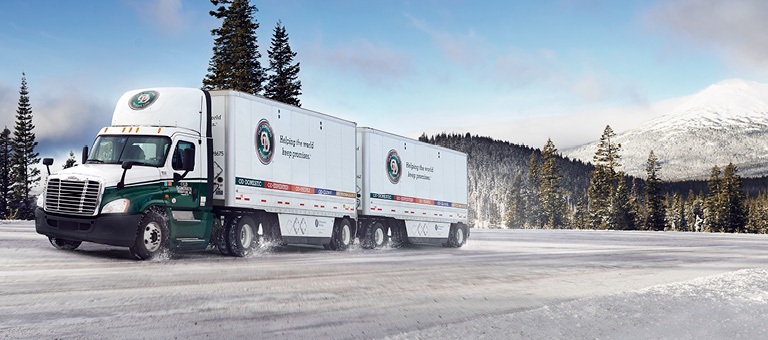
Old Dominion has a fleet of 9,254 tractors and 35,729 trailers. The low tractor-to-trailer ratio represents a significant investment in ‘trailer capital’ that pushes up the velocity of Old Dominion’s network and allows it to absorb surges in freight smoothly, according to analysts. By using twin 28-foot trailers, Old Dominion can flex up its trailer capacity relatively inexpensively.
The other component of the carrier’s capital expenditure is its vast empire of service centers (235 facilities nationwide), a network that grew 18.8 percent between 2007 and 2017, a decade when ArcBest, FedEx Freight, UPS Freight, XPO and YRC all saw the number of their service centers decline. From 2008 to 2018, Old Dominion spent $1.5 billion building service centers. The company plans to add 10 more this year, Satterfield said..
“We like to maintain 20 to 25 percent excess capacity on average, which ensures that our network never limits growth,” Satterfield explained, pointing out that less-efficient competitors are forced to constantly adjust capacity to match volumes.
Old Dominion’s door count is up about 75 percent within the last 10 years, meaning that not only are the number of service centers growing, but average service center size is growing even faster.
What Have Capital Expenditures Done?
What have those capital expenditures done for Old Dominion’s customers? The carrier says on-time delivery rates have been at 99 percent since 2012, up from 94 percent in 2002, and its cargo claims ratio has dropped from 1.5 percent in 2002 to 0.3 percent in 2018.
Cargo claims ratio – the percentage of shipments that have insurance claims levied against them – is an especially important metric for LTL carriers due to the nature of palletized freight. LTL freight is handled much more intensively than truckload freight, as pallets are loaded and off-loaded multiple times. Significantly improving damage control and insurance claims is an unmistakable sign of a smooth operation, according to industry experts.
 No Acquisitions, Rewarding Investors
One expenditure Old Dominion does not make is on acquisitions. The company hasn’t bought another company since 2008. Instead, Old Dominion has started returning cash to shareholders in the form of dividends and share buybacks, beginning with a small dividend in 2014, significant buybacks in 2015 and 2016, a substantial dividend in 2017, and both buybacks and dividends in 2018.
Rewarding investors has made Old Dominion a favorite trucking stock on Wall Street, and its shares are currently priced at $144.69, about 18.5 times Stifel’s estimated 2019 diluted earnings-per-share of $7.81. The rich valuation caused Ross to rate Old Dominion a “hold.”
Old Dominion is trading above its long-term average, and therefore the stock may have more downside than upside at its current price, Ross said. However, a closer examination of the chart reveals a long-term trend upward. It could be the case that as more investors buy into Old Dominion’s growth story, they’ve become willing to pay progressively higher multiples for the company’s earnings, brokers said.
(from FreightWaves)