- The Texas CDL English rule now extends beyond the test room, tying CDL knowledge exams, roadside inspections, weigh-station checks, and out-of-service risk into a single compliance issue.
- For tank and hazmat fleets, English proficiency is becoming more than a driver-qualification standard — it can affect shipping papers, placards, terminal instructions, emergency-response communication, and whether a load stays on schedule.
- Texas’ English-only CDL testing move is part of a broader federal and state enforcement shift, with roadside English checks, trucking-school scrutiny, and cross-border freight impacts now coming into focus.
Texas CDL English Rule: English-Only Testing and Roadside Checks Put Driver Compliance in Focus

“Texas’ testing change puts English proficiency directly into the CDL and CLP knowledge-exam process.” Texas DPS graphic for CDL knowledge testing changes. (Texas Department of Public Safety)
The Texas CDL English rule has moved commercial driver English proficiency from a background qualification standard into a front-line compliance issue for drivers, fleets, training schools, and enforcement officers.
For more coverage of commercial driver licensing issues, see our CDL reporting.
Effective June 1, 2026, the Texas Department of Public Safety said all commercial driver license and commercial learner permit knowledge exams in Texas are administered in English only. Spanish-language versions of those commercial knowledge tests are no longer offered, and interpreters are prohibited for the exams.
For additional updates on knowledge exams, licensing changes, and driver testing requirements, follow our CDL test coverage.
That testing change is important by itself. But for trucking, the larger issue is what happens after a driver is already licensed.
DPS also said commercial vehicle inspectors will continue evaluating English proficiency during traffic stops and weigh-station inspections. Drivers who do not meet the standard may be placed out of service.
For tank transport, the issue is much bigger than licensing. It is now tied to roadside inspections, driver qualification, terminal communication, hazmat documentation, loading-rack instructions, emergency-response information, and customer-site access.
Tank and hazmat drivers may need to communicate with enforcement officers, plant guards, scale-house personnel, loaders, receivers, dispatchers, emergency responders, and customers. If a driver cannot meet the English-proficiency standard at the wrong stop or facility, the result can be more than a failed test. It can mean an out-of-service order, a delayed load, a missed rack appointment, a plant delay, or a more complicated response during an incident.
“For tank and hazmat fleets, English proficiency is no longer just a licensing issue. It is a roadside, terminal, documentation, and emergency-response issue.”
The Texas CDL English rule does not create the federal English-language requirement. Federal rules have long required commercial drivers to read and speak English well enough to converse with the public, understand highway traffic signs and signals, respond to official inquiries, and make required entries on reports and records.
What has changed is enforcement.
Texas is now connecting that long-standing requirement to CDL and CLP knowledge testing, roadside inspections, weigh-station checks, intrastate commercial drivers, trucking-school oversight, and potential out-of-service action.
For broader policy and rulemaking developments affecting carriers, visit our regulations section.
Texas CDL English Rule Turns English Proficiency Into a Roadside Compliance Issue

“For tank fleets, communication is not abstract — it happens beside the trailer, at the rack, during inspection, and at the customer site.” USDOT officials observe tank truck equipment and operating procedures during a tanker ride-along. (Federal Motor Carrier Safety Administration via National Tank Truck Carriers)
The practical shift is that English proficiency is no longer something fleets can treat only as a hiring-file item.
The standard has existed for years under 49 CFR 391.11(b)(2). A commercial driver is qualified only if he or she can read and speak English sufficiently to converse with the general public, understand highway traffic signs and signals in English, respond to official inquiries, and make entries on reports and records.
For more on federal safety rules affecting commercial drivers, browse our Federal Motor Carrier Safety Regulations coverage.
That is the federal baseline. Texas is now pressing that baseline harder.
The state’s move follows a broader federal enforcement push that began in 2025. President Trump signed an executive order in April 2025 directing federal transportation officials to strengthen enforcement of the commercial-driver English-proficiency requirement. FMCSA then issued updated enforcement guidance in May 2025. CVSA added English proficiency to the North American Standard Out-of-Service Criteria, effective June 25, 2025.
For enforcement and inspection updates tied to CVSA activity, see our Commercial Vehicle Safety Alliance coverage.
That sequence changed the roadside consequences.
Under prior federal guidance from 2016, inspectors were generally told not to place a commercial driver out of service solely for a lack of English proficiency. The 2025 enforcement shift reversed that approach. English proficiency is now part of the out-of-service conversation.
For fleets, the issue is no longer whether a driver technically holds a valid CDL. The issue is whether that driver can handle an actual roadside exchange in English.
FMCSA guidance describes a two-step English-language proficiency assessment. The first step is a driver interview. If the driver passes that step, the officer may move to a traffic-sign recognition assessment. If the driver cannot complete the interview, the officer does not need to continue to the sign-recognition portion.
Stay current on federal trucking oversight through our FMCSA news and updates.
FMCSA also has said that translation apps, interpreters, cue cards, telephone translation services, and similar aids should not be used during the driver interview. The driver’s ability has to be evaluated directly.
That matters because many fleets, dispatchers, and terminals may be used to solving language barriers with a bilingual co-worker, a phone call, or a translation tool. Those workarounds may help in daily business, but they do not replace the driver’s own ability during an official roadside English-proficiency assessment.
Texas also moved to close an intrastate enforcement gap.
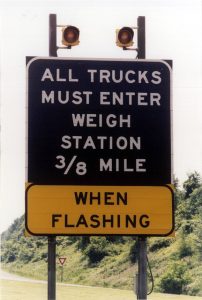
“Roadside English checks turn a long-standing qualification rule into a weigh-station and inspection issue.” A weigh station sign is used in commercial vehicle operations and enforcement. (Delaware Valley Regional Planning Commission)
Gov. Greg Abbott directed DPS to strictly enforce English-proficiency requirements for all commercial drivers operating in Texas, including drivers who operate only within the state. Texas later amended its rules to apply the federal English-proficiency requirement to both interstate and intrastate commerce.
That is especially important for tank transport because many bulk operations are local or regional. Fuel delivery, crude hauling, water hauling, chemical plant service, liquid waste, cement, dairy, and dry-bulk work often move inside Texas without crossing state lines.
A fleet does not have to be operating coast to coast for the Texas CDL English rule to matter.
For more industry news tied to Texas trucking, tank transport, and bulk freight operations, follow our Texas coverage.
What changed with Texas CDL English-only testing?
The latest change in Texas focuses on commercial knowledge testing.
DPS announced that all Texas CDL and commercial learner permit knowledge exams are now administered only in English. Spanish-language versions are no longer offered. Interpreters are prohibited.
The driving-skills portion of the CDL process was already handled in English. Federal testing rules have long required CDL skills tests to be conducted in English, and interpreters are prohibited during those skills tests.
The more important change is on the knowledge-test side.
Federal CDL testing rules have historically allowed knowledge tests to be administered in a foreign language, provided no interpreter was used. Texas has now removed that flexibility for its own commercial knowledge exams.
In plain terms, a Texas CDL or CLP applicant now has to handle the commercial knowledge exam in English.
That affects applicants, schools, fleets, and safety departments. It also gives carriers a stronger reason to evaluate English-readiness before sending drivers into tank, hazmat, petroleum, chemical, food-grade, waste, water, or other bulk operations.
A driver may know how to operate equipment, back a trailer, follow a route, and complete a delivery, but still face a compliance problem if he or she cannot communicate sufficiently in English during an official exchange.
That is where the Texas CDL English rule moves from the licensing counter into daily operations.
Why the Texas CDL English rule matters more for tank and hazmat fleets
Tank and hazmat fleets face higher communication stakes than many general-freight operations.
A dry van driver stopped for a roadside inspection may need to answer questions about origin, destination, hours of service, license status, vehicle equipment, and load paperwork.
A tank or hazmat driver may need to answer all of that, plus questions involving product identity, placards, shipping papers, emergency-response information, loading procedures, unloading instructions, terminal rules, and site-specific safety requirements.
That makes the Texas CDL English rule especially relevant for petroleum, chemical, liquid waste, water, food-grade, and dry-bulk operators.

“In hazmat transportation, communication can become a safety-control issue during inspections, releases, leaks, or emergency response.” Hazmat responders in protective suits walk toward a decontamination area during a training exercise.
Hazardous materials rules are built around clear communication and accurate paperwork. Hazmat shipping papers must properly describe the material being transported. Emergency-response information must be available, accessible, and printed legibly in English.
Those requirements are not just back-office paperwork. They are part of what a driver, inspector, responder, and facility may need during a roadside stop, terminal issue, release, leak, fire, spill, or customer-site dispute.
In tank transport, communication is a safety control.
A driver may need to explain what product is in the trailer, identify the correct shipping paper, confirm the placard, respond to a scale-house question, follow rack instructions, understand a plant gate procedure, describe equipment trouble, or communicate during a spill response.
A communication breakdown can slow the load, complicate the inspection, or create risk during an emergency.
For hazmat fleets, the question is not whether a driver speaks perfect English. The federal standard is functional. The question is whether the driver can communicate clearly enough to satisfy the regulatory standard and safely handle the job.
That is the practical center of the Texas CDL English rule for tank transport.
It affects hiring, onboarding, dispatch, training, driver qualification files, safety meetings, mock inspections, customer-site readiness, and the way fleets evaluate outside CDL schools.
Roadside English checks can disrupt time-sensitive bulk freight
The most immediate business risk is the out-of-service order.
An out-of-service order can sideline the driver, delay the truck, and force the carrier to make operational decisions quickly. Depending on the load, lane, product, and customer, that can create a missed delivery window, a rack delay, a plant delay, a detention issue, a demurrage concern, or a customer-service problem.
For more reporting on roadside enforcement and vehicle checks, review our commercial vehicle inspections coverage.
For fuel carriers, delays can affect station supply and delivery timing.
For chemical carriers, delays can interfere with plant schedules, production timing, or unloading appointments.
For crude and water haulers, delays can disrupt field operations.
For liquid waste and environmental service providers, delays can affect disposal windows, site work, or compliance schedules.
For food-grade tank fleets, delays can raise concerns tied to sanitation, temperature, production windows, or product handling.
That is why the Texas CDL English rule should be treated as an operational risk, not only a licensing issue.

“Fleets now have to look beyond the CDL card and ask whether every driver can handle the real roadside conversation.”
The risk is also not limited to new applicants. Existing CDL holders can be evaluated during traffic stops, roadside inspections, and weigh-station checks. A driver who already has a CDL may still face consequences if the officer determines the driver cannot respond adequately in English.
Fleets also should pay close attention to intrastate operations. Some companies may assume federal roadside enforcement issues mostly affect interstate drivers. Texas has made clear that English-proficiency enforcement applies to commercial drivers operating inside Texas, including intrastate drivers.
There is also a border-zone nuance.
FMCSA guidance recognizes a caveat for a specific U.S.-Mexico border commercial zone. For certain drivers whose current trip is still within a border commercial zone, enforcement personnel may cite an English-proficiency violation without placing the driver out of service.
In Texas, those border commercial zones include areas such as El Paso and several counties in the Rio Grande Valley.
That caveat is important, but fleets should not treat it as a blanket exemption. It is tied to the current trip and the border commercial zone. DPS has continued to warn that drivers who do not meet the English-proficiency standard may be placed out of service.
Carriers operating near border crossings, ports of entry, bridge corridors, and short-haul border lanes should carefully consider that caveat. It is a narrow operational detail, not a broad shield for every cross-border or border-area movement.
The Texas CDL English rule also has cross-border implications. Reuters reported that some Mexican truck drivers serving border freight lanes began English classes after federal enforcement tightened. That shows the rule is not only a domestic licensing issue. It affects border freight, drayage, carrier staffing, shipper expectations, and Texas border markets.
Texas is also scrutinizing the CDL training pipeline
Texas has widened the issue beyond individual drivers.
Attorney General Ken Paxton launched a statewide investigation into multiple trucking schools, alleging that some may have certified unqualified or non-English-speaking drivers. The state’s position is that training providers should not send drivers into the market if those drivers cannot meet the required safety and qualification standards.
For more insight into driver preparation and training standards, explore our updates on truck driver training.
Some schools named in the report denied wrongdoing and said they comply with English-proficiency and training requirements.
For fleets, the issue is still important.
A carrier cannot assume that a training certificate or a CDL school completion record indicates that a driver is prepared for the current enforcement environment. That is especially true in hazmat and tank operations, where the communication demands are higher than in many entry-level driving jobs.
If a CDL school produces applicants who can technically pass certain parts of the licensing process but cannot handle an English-language roadside exchange, the fleet may inherit the risk.
That puts more pressure on carriers to ask practical questions during onboarding.
- Can the driver explain the load in English?
- Can the driver identify the shipping papers?
- Can the driver answer where the load originated and where it is going?
- Can the driver understand a roadside instruction?
- Can the driver recognize and explain highway signs?
- Can the driver communicate with a plant guard, rack operator, customer receiver, or emergency responder?
Those are not abstract questions. They are the kind of questions that can determine whether a driver stays in service.
“The practical question for fleets is not whether a driver has a CDL. It is whether that driver can handle the inspection, the paperwork, the terminal instruction, and the emergency conversation when it matters.”
How should fleets respond to the Texas CDL English rule?
The best fleet response is practical, not political.
First, carriers should review how they assess English proficiency during hiring and driver qualification. That does not mean creating an unfair or inconsistent screen. It means confirming that the driver can meet the federal standard: communicate with officials, understand signs, answer basic questions, and complete required records.
Second, fleets should use realistic inspection practices. Drivers should be able to answer questions about where they started, where they are going, what they are hauling, whether the load is hazmat, where the shipping papers are, what the placards mean, and whether there are any equipment concerns.
Third, tank and hazmat fleets should practice paperwork communication. Drivers should be comfortable identifying the bill of lading, shipping papers, emergency response information, product description, UN or NA identification number, hazard class, placard information, and customer or terminal instructions, when applicable.

“Hazmat drivers must be able to identify the load, understand the placard, communicate with officials, and respond clearly when an inspection or incident happens roadside.” A hazmat tanker trailer separated from its tractor on Interstate 5 south of Salem, Oregon, with a UN 1760 corrosive placard visible on the rear of the tank. (born1945 / Flickr via Wikimedia Commons, CC BY 2.0)
Fourth, fleets should train for site communication. Tank drivers often deal with guard shacks, loading racks, plant personnel, receivers, tank farms, scales, wash racks, disposal sites, and customer safety departments. The ability to understand and respond to instructions at those points is part of the job.
Fifth, dispatchers and safety managers should not rely on translation support as a substitute for driver readiness. Translation help may be useful in training, coaching, and internal communication, but it cannot replace the driver’s ability to respond during an official roadside assessment.
Sixth, carriers should review relationships with CDL schools and third-party training providers. If a school is producing applicants who are not ready for English-language inspections, customer-site communication, or hazmat paperwork, the fleet needs to know that before dispatch.
Seventh, fleets should document reasonable efforts. If the carrier conducts English-proficiency readiness checks, mock inspections, sign-recognition drills, hazmat paperwork reviews, and driver coaching, those efforts should be recorded as part of a broader safety and compliance program.
For fleet-focused reporting on operational readiness and regulatory exposure, visit our compliance coverage.
Eighth, carriers should monitor state and federal developments. Texas and Florida have both moved toward English-only testing policies, though the scope differs. Federal officials have also pressured states such as California, Washington, and New Mexico over the enforcement of commercial driver English proficiency requirements.
Ninth, companies should keep the issue professional. The Texas CDL English rule is controversial, but fleet compliance depends on what is currently being enforced. A carrier need not take a political position to recognize the operational risk.
What questions remain for drivers and carriers?
Several practical questions remain.
One is consistency. Industry advisers and critics have warned that roadside English-proficiency assessments can be subjective. One officer may view a driver’s answers as sufficient, while another may not. That is a real concern for fleets operating across multiple states, regions, and enforcement jurisdictions.
Another question is return-to-duty. If a driver is placed out of service for English proficiency, carriers need a clear path for retraining, reassessment, documentation, and future dispatch decisions. Fleets should not wait until a driver is sidelined to decide how they will respond.
A third question is how quickly other states will adjust their own testing and enforcement practices. Florida moved to English-only driver testing broadly in February 2026. Texas moved commercial knowledge testing to English only in June 2026. Federal officials have signaled a broader push toward English-language CDL testing and stricter enforcement of English proficiency nationwide, but carriers should monitor the final rulemaking details and effective dates.
A fourth question is workforce impact. Supporters argue that stronger enforcement of English promotes safety, professionalism, and consistent standards. Critics warn that it could worsen driver shortages, create uneven enforcement, and disproportionately affect immigrant or multilingual drivers.
Both concerns matter.
Safety communication is critical in trucking. It is even more critical in tank and hazmat work. At the same time, enforcement needs to be clear, consistent, and practical enough that fleets and drivers know how to comply.
That balance is the heart of the issue.
The standard is not native-level English. It is not perfect grammar. It is not accent-free speech. The federal rule concerns functional communication: the ability to converse with the public, understand highway signs and signals, respond to official inquiries, and make entries in reports and records.
For tank fleets, that functional standard has to be tested against real work.
- Can the driver answer the inspector?
- Can the driver explain the load?
- Can the driver identify the placard?
- Can the driver locate the shipping papers?
- Can the driver understand the sign?
- Can the driver follow the terminal instruction?
- Can the driver communicate during an emergency?
Those are the questions that matter now.
Key compliance takeaway for Texas tank fleets

“CDL English enforcement reaches every commercial fleet that depends on licensed drivers, roadside communication, inspections, and uninterrupted freight movement across the United States.” A close-up perspective captures the truck mirror, cab edge, and pneumatic tank hardware. Photo credit: Ted Gresham / Wikimedia Commons.
The key takeaway is that English proficiency is now a dispatch-level issue.
Before assigning a load, especially a tank or hazmat load, a fleet should have confidence that the driver can communicate adequately in English during an inspection, at a weigh station, at a customer site, at a loading rack, and during an incident.
That does not mean every driver must speak the same way. It does not mean every driver must speak without an accent. It means the driver must be able to function under the federal standard.
The Texas CDL English rule makes that standard harder to avoid.
By ending Spanish-language commercial knowledge exams, prohibiting interpreters for those exams, continuing roadside English checks, applying the standard to intrastate drivers, and scrutinizing trucking schools, Texas has turned English proficiency into a more active compliance variable.
For tank and hazmat carriers, that variable touches safety, service, training, documentation, customer confidence, and whether a truck stays in service.
Bottom line for tank transport operators
The Texas CDL English rule should be viewed as a practical compliance development, not just a political headline.
Texas did not create the federal English-proficiency requirement. But it has made the requirement more visible, more enforceable, and more directly connected to the daily movement of commercial freight.
The rule now reaches the CDL knowledge test, the roadside inspection, the weigh station, the intrastate fleet, and the training pipeline.
For tank transport, the stakes are higher because communication is tied directly to product identity, placards, shipping papers, loading and unloading instructions, emergency-response information, and customer-site procedures.
The operational question is simple: can every dispatched driver communicate clearly enough, in English, to answer the inspector, explain the load, understand the sign, handle the paperwork, follow the site instructions, and keep the truck in service?
If the answer is uncertain, the fleet has work to do before the next roadside inspection answers the question for them.
Key Developments in the Texas CDL English Rule
- Texas DPS now requires CDL and commercial learner permit knowledge exams to be administered in English only.
- Spanish-language commercial knowledge tests are no longer offered in Texas, and interpreters are prohibited for those exams.
- CDL skills testing was already conducted in English under federal testing rules, making the knowledge-test change the major new licensing shift.
- Federal driver-qualification rules have long required commercial drivers to read and speak English well enough to understand highway signs, respond to official inquiries, converse with the public, and complete required records.
- Texas is now enforcing that long-standing English-proficiency requirement more actively through licensing, roadside inspections, weigh-station checks, and intrastate driver oversight.
- Roadside English-proficiency checks can lead to out-of-service action if a driver cannot meet the required standard.
- FMCSA guidance says English-proficiency assessments should be conducted without interpreters, translation apps, cue cards, or telephone interpretation services during the driver interview.
- Texas has also moved to enforce English proficiency for intrastate commercial drivers, a major issue for local fuel, crude, water, waste, chemical, food-grade, and dry-bulk operations.
- Tank and hazmat fleets face higher communication stakes because drivers may need to explain product identity, placards, shipping papers, emergency response information, loading instructions, unloading procedures, and customer site requirements.
- Texas officials are also scrutinizing CDL schools, raising questions about whether training providers are certifying drivers who are fully prepared for English-language testing and roadside enforcement.
- Florida has already moved to English-only driver testing more broadly, while federal officials have pressured other states to strengthen enforcement of English proficiency for commercial drivers.
- For fleets, the practical response is to treat English proficiency as a dispatch-level readiness issue: practice roadside questions, review hazmat paperwork vocabulary, confirm sign recognition, and document driver training before a stop turns into an out-of-service event.
External Resources on the Texas CDL English Rule and Roadside Enforcement
- Review the official Texas DPS announcement on English-only CDL and CLP knowledge testing at the Texas Department of Public Safety.
- Understand the federal driver-qualification language standard under 49 CFR § 391.11 through the eCFR.
- Compare the federal English-proficiency qualification language through Cornell Law’s Legal Information Institute.
- Read FMCSA’s roadside enforcement guidance for English-language proficiency at FMCSA’s English Language Proficiency FAQs.
- Learn how FMCSA says motor carriers should assess driver English proficiency during qualification reviews in FMCSA’s motor carrier ELP guidance.
- Review FMCSA’s updated enforcement policy on English-language proficiency at FMCSA’s enforcement policy update.
- Read FMCSA’s announcement on new English-proficiency enforcement guidance in FMCSA’s official newsroom release.
- Understand how English proficiency became an out-of-service enforcement issue through CVSA’s out-of-service violation update.
- Read CVSA’s earlier notice on adding English-language proficiency to the out-of-service criteria at the Commercial Vehicle Safety Alliance.
- Review CDL test-method rules, including language requirements, under 49 CFR § 383.133 through the eCFR.
- Compare CDL test-method language through Cornell Law’s 49 CFR § 383.133 page.
- Review hazmat shipping paper requirements relevant to tank and hazmat communication in eCFR Part 172, Subpart C.
- Understand emergency-response information requirements for hazardous materials shipments at 49 CFR § 172.602 through the eCFR.
- Review PHMSA’s emergency-response information guidance at PHMSA’s 172.602 resource page.
- Read Gov. Greg Abbott’s directive on strict English-proficiency enforcement for commercial drivers at the Office of the Texas Governor.
- Review the Texas rule adoption connected to commercial driver English-proficiency enforcement at the Texas Secretary of State.
- Read the White House executive order directing stricter enforcement of commercial-driver English-proficiency requirements at the White House.
- Read the Texas Attorney General’s announcement on investigating trucking schools tied to driver qualification and English-proficiency concerns at the Texas Attorney General’s Office.
- Review Florida’s English-only driver testing announcement at Florida Highway Safety and Motor Vehicles.
- Read local Florida implementation details on English-only driver exams at the Hillsborough County Tax Collector.
- Review USDOT’s notice pressuring California, Washington, and New Mexico over commercial-driver English-language enforcement at the U.S. Department of Transportation.
- Read USDOT’s announcement on consequences for California tied to English-language enforcement for truckers at the U.S. Department of Transportation.
- Review USDOT’s broader road-safety actions involving FMCSA enforcement priorities at the U.S. Department of Transportation.
- Read USDOT’s announcement on commercial driver’s license training providers at the U.S. Department of Transportation.
- Read Reuters coverage of federal pressure on states over truck-driver English-proficiency rules at Reuters.
- Read Reuters coverage of the California funding dispute tied to truck-driver English-proficiency enforcement at Reuters.
- Read Reuters coverage of Mexican truck drivers studying English to comply with stricter U.S. language enforcement at Reuters.
- Read AP coverage of federal funding threats tied to state enforcement of trucker English-language rules at Associated Press.
- Read the Houston Chronicle reporting on Texas ending Spanish-language CDL exams at the Houston Chronicle.
- Read Houston Chronicle reporting on Texas trucking-school scrutiny tied to English-proficiency standards at Houston Chronicle.
- Read San Antonio Express-News reporting on Texas DPS enforcement of commercial-driver English requirements at San Antonio Express-News.
- Read San Antonio Express-News reporting on Texas CDL testing changes and temporary agriculture worker licensing at San Antonio Express-News.