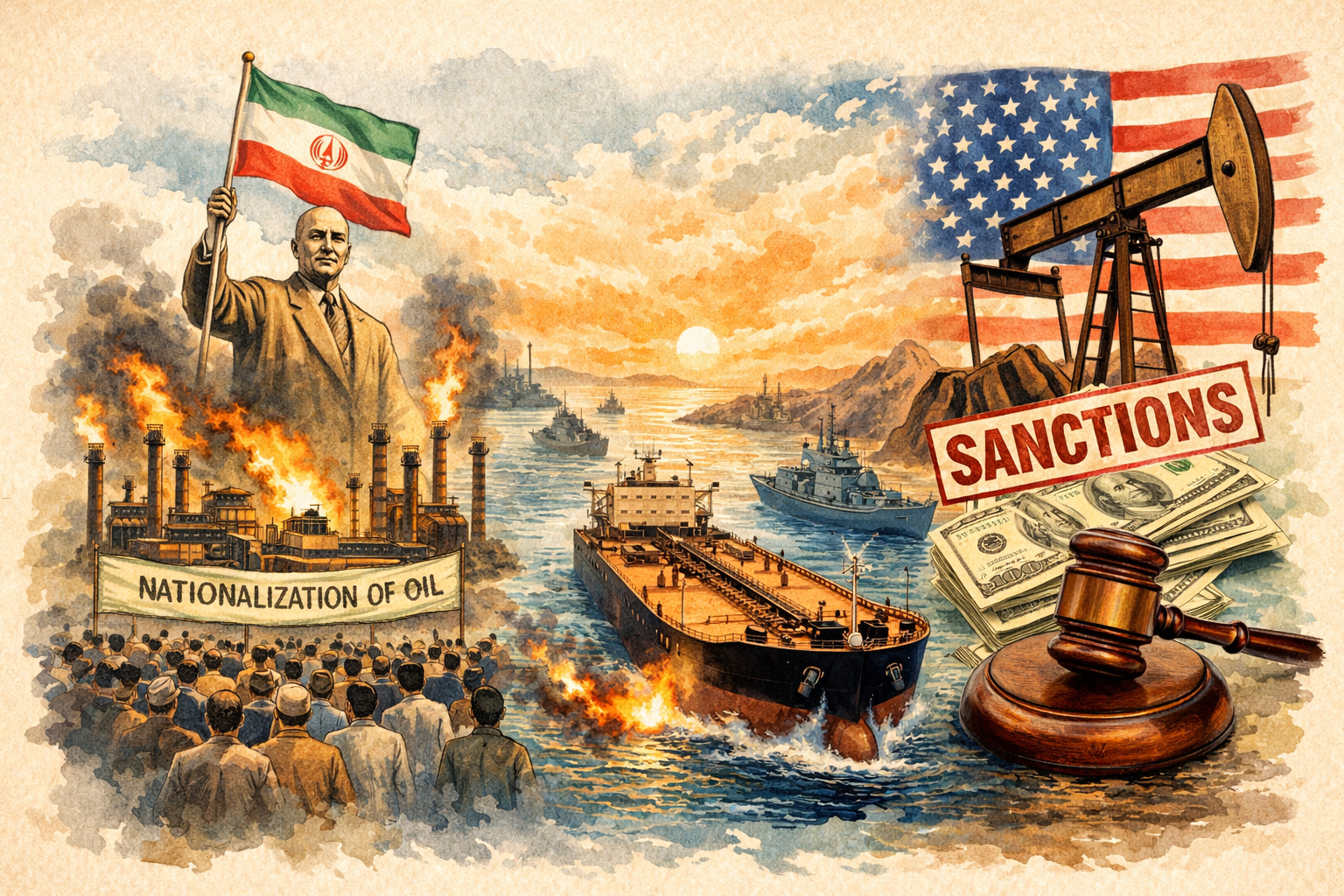
- Iran oil and gas was never just a reserves story. It became a fight over sovereignty, operational control, export access, and who gets to shape the market’s rules.
- From Abadan and Mosaddegh to sanctions and the Strait of Hormuz, this history shows how petroleum repeatedly forced the United States to treat Iran as both an energy issue and a strategic problem.
- For industry insiders, the real through-line is not rhetoric but logistics: refinery capacity, consortium control, OPEC leverage, Kharg Island exports, South Pars gas constraints, and sanctions-evasion shipping.
Iran Oil and Gas and the United States
Any serious history of Iran’s oil and gas as it relates to the United States is less a story about drilling than about control: who holds legal title, who runs operations, who markets barrels, how revenues move through banks and insurers, and who can keep open—or close—the sea lanes. That framing helps explain why oil and politics fuse so easily here, because the industrial system of contracts, operators, tankers, insurance, and payment rails can be as decisive as geology. For broader petroleum market and transport reporting, see our oil and gas industry coverage.
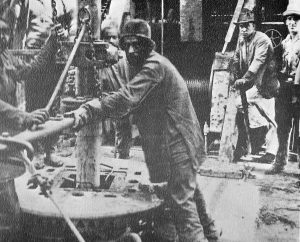
Early drilling works at Masjed Soleyman, where Iran’s first commercial oil discovery took shape. (Source: National Iranian Oil Company, Oil and Economic Development of Iran, p. 18, via Wikimedia Commons)
“Iran’s oil story began in the field, but its global consequences were shaped by who controlled production, refining, and export access.”
Iran oil and gas as a U.S. strategic system
From Washington’s perspective, Iran’s oil and gas sector has repeatedly fallen into three overlapping policy buckets: Cold War and regional security calculations, global energy security and maritime chokepoints, and sanctions enforcement and financial containment. These buckets have shifted in weight over time, but they have rarely disappeared. The historical record makes clear that strategic objectives—especially preventing Iran from falling under communist influence in the early 1950s—were treated as central even when they collided with legal and commercial arguments around oil.

Why does Iran’s oil and gas keep reshaping U.S. policy?
Because Iran’s oil and gas sector sits at the intersection of two hard realities that do not negotiate easily: Iran’s insistence, across governments and eras, on meaningful sovereignty over its most valuable resource base, and the United States’ recurring interest in the stability of the Persian Gulf system that moves energy to world markets. Once oil revenue became tied to state solvency and political stability, U.S. officials often treated the resumption of oil revenue as inseparable from efforts to prevent internal collapse and geopolitical realignment.
Enjoying our insights?
Subscribe to our newsletter to keep up with the latest industry trends and developments.
Stay Informed
How did concessions and nationalization turn Iran’s oil and gas into a sovereignty battle?
The prehistory of Iranian oil and gas in U.S. strategy begins before the United States became the main outside actor. A foundational marker is the 1901 concession granted to William Knox D’Arcy. It gave exclusive rights to prospect, exploit, and sell petroleum and related substances across Persia for sixty years, included the right to build pipelines to the Persian Gulf, and established compensation structures that left Iran with limited leverage over the industry built on its territory.
Those terms mattered later because they created the template Iranian nationalists would attack for decades: foreign operational control paired with a disputed local share of the value. For more on crude hauling, export flows, and upstream market pressure, browse our crude oil coverage.
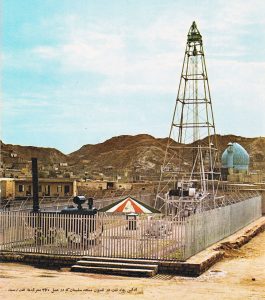
Historic view of the first drilled oil site at Masjed Soleyman, where Iran’s early petroleum era began. (Source: National Iranian Oil Company, Iranian Oil Industry during the Kingdom of the Pahlavi Dynasty, Sept. 1970, p. 9, via Wikimedia Commons)
“The long U.S.-Iran oil story began with a wellhead, but its real stakes grew around control, revenue, and access to world markets.”
In practice, the early industrial buildout centered in the southwest. After oil was discovered in Khuzestan, Abadan was selected as a refinery site. The refinery opened in 1912 and expanded dramatically over the next decades, reaching massive capacity and becoming one of the world’s most important refining centers. That mattered because Iranian oil was not simply extracted and exported raw; it was processed at an industrial scale in a facility that was integral to regional and global supply chains. Any disruption there had consequences well beyond Iran.
A second hinge point came with the 1933 renegotiation of the concession structure. The agreement reduced the concession area, extended the term, and adjusted royalty formulas. Some terms improved from Iran’s perspective, but the central problem remained: operational control and pricing power stayed heavily external even as Iranian political expectations continued to rise.
By the late 1940s and early 1950s, the issue had become existential. Iran’s parliament confirmed a nationalization law declaring the oil industry nationalized throughout the country and placing exploration, extraction, and exploitation in the hands of the government. This is the defining moment when Iran’s oil and gas became a matter of sovereignty rather than merely a commercial dispute.
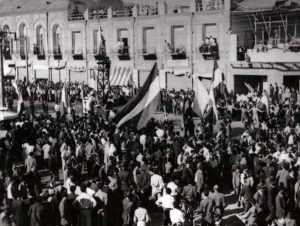
Crowds gather beneath large Iranian flags during a rally in Tehran following the nationalization of the oil industry. (Source: iichs.org, via Wikimedia Commons)
“Before sanctions and shipping advisories, control of Iran’s oil industry was already a mass political issue fought in the streets.”
Mohammad Mosaddegh is central here, not as a symbol alone but as a policymaker confronting a tightly integrated international oil market with weak bargaining leverage. The operational stakes were severe. Refined products from Abadan were difficult to replace quickly. A shutdown risked major dislocation in product markets, while Iran itself faced bankruptcy and instability without oil income. That is the industry reality: upstream production can sometimes be substituted, but refinery output, product slates, tanker availability, storage, and offtake obligations create rigidities that turn political disputes into supply crises. For a more current example of how refining outages can spill into freight and market volatility, read our Ras Tanura refinery strike analysis.
The dispute also became a legal battle. But once jurisdictional limits and legal ambiguities made a clean resolution unlikely, geopolitics took over. U.S. policy documents from the era show that maintaining Iran outside communist influence increasingly outweighed narrower legal considerations in the oil dispute. That is why Iranian oil and gas cannot be written as economic history alone. It was already strategic history.
How did the 1954 consortium reorganize Iranian oil and gas operations?
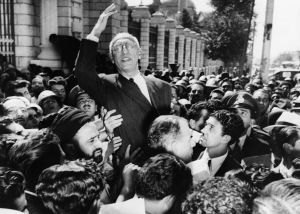
Iranian Prime Minister Mohammad Mossadegh being carried by supporters in Tehran’s Majlis Square during the oil nationalization crisis in 1951. (Source: AP photo file, via Military Times)
“The oil dispute did not stay inside ministries and court filings; it became a public struggle over sovereignty and state power.”
The post-1953 settlement is best understood as an effort to reconcile incompatible demands: Iran’s insistence that nationalization remain real, and the international oil industry’s insistence that operations, marketing, and finance be restored in a form compatible with world markets.
The first fact that must be stated clearly is that declassified U.S. records acknowledge a CIA role in planning and helping implement the coup against Mosaddegh. Interpretations differ over motive and degree, but the existence of official U.S. documentation confirming involvement is a core fact in any impartial history.
The second point is that the 1954 settlement was not simply a case of one foreign company returning. It was a multinational consortium. Five American firms held 8 percent each, for a combined 40 percent. The Anglo-Iranian company held 40 percent. Royal Dutch/Shell held 14 percent. Compagnie Française des Pétroles held 6 percent.
That structure mattered. It spread both commercial responsibility and political ownership across Western allies. It also meant that the United States moved from being a strategic observer and intermittent mediator into a direct participant in the restored operating order.
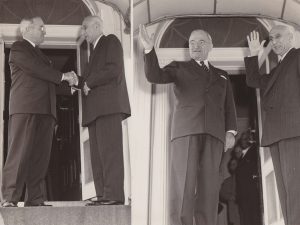
Iranian Prime Minister Mohammad Mossadegh meets U.S. President Harry S. Truman at Blair House in Washington, D.C., on October 23, 1951. (Source: Harris & Ewing press photo, via Wikimedia Commons)
“The U.S.-Iran oil relationship was never just commercial; it moved through presidential meetings, diplomatic bargaining, and strategic calculations.”
The third point is that the settlement was treated not as an ordinary market arrangement but as a matter of national security. U.S. internal legal and policy discussions tied consortium participation directly to broader U.S. security interests. That shows how deeply Iran’s oil and gas were already embedded in Cold War thinking.
Compensation formed part of the deal. Iran agreed to a financial settlement with the Anglo-Iranian Oil Company, payable over time, intended as a final resolution of claims and counterclaims before the new consortium agreement. That compensation structure was crucial because it helped make operational restart financially possible, even if it remained politically contentious.
It remained contentious. The 1954 arrangement restored oil flow to world markets, but it did not erase the political memory of nationalization inside Iran. In effect, nationalization survived formally, but operational control was reassembled in a Western-managed framework that distributed authority through the consortium. That tension would never disappear from Iranian political memory.
What happened at Abadan, and why did Iranian oil and gas matter to global supply?
A common question is: What was the Abadan crisis, and why did it matter outside Iran?
The answer is straightforward. Abadan was not a symbolic asset. It was a giant refinery complex whose disruption affected product availability and shipping patterns across a broad region. Its scale meant the shutdown of Iranian oil operations was not just a national political event. It was a world energy event.
The loss of refined products from Abadan posed a different challenge than the loss of crude alone. Refineries cannot be replaced instantly. Product markets are region-specific. Tankers, storage, and distribution patterns are not infinitely flexible. That is why the Abadan crisis had such outsized effects.

Aerial view of the Abadan Oil Refinery showing major process units, tank farms, and nearby residential blocks. (Source: Fine Art Storehouse, “oil-refinery-tanks-aerial-view-39180311”)
“Abadan mattered because Iran’s oil story was never only upstream; refining capacity and export infrastructure were central to global supply.”
It also revealed a recurring mechanism that would echo in later sanctions eras: cut off the oil revenue stream, and the state comes under fiscal strain. Once export income disappears, unemployment rises, political pressure intensifies, and the government’s room to maneuver narrows sharply. That basic logic shaped both the nationalization crisis and later sanction-based pressure campaigns.
From alliance to sanctions: modern Iran oil and gas constraints
After 1954, the story of Iranian oil and gas did not stabilize so much as industrialize and globalize. A useful way to read the next arc is as a sequence of governance regimes: consortium-era operations and rising state capacity, petro-nationalism through OPEC, and then sanctions-era constraint management.
OPEC marks the clearest beginning of the second phase. Iran became one of the founding members in 1960, alongside Iraq, Kuwait, Saudi Arabia, and Venezuela. The formation of OPEC reflected a producer-state response to the dominance of major international oil companies over posted prices and policy coordination. Producer governments were no longer willing to leave pricing power and production politics entirely to outside firms.
This mattered because Iran’s oil and gas were no longer just a national resource managed through concession structures; they had become part of a producer-state strategy to shape world oil policy. For a current look at how production politics and chokepoint risk can collide, see our Hormuz shock reporting.
The Shah-era boom deserves a brief pause because it explains how deeply oil became tied to both Iranian state capacity and U.S. strategic thinking. By the end of the 1950s, U.S. officials judged petroleum receipts large enough to support rapid development, with plan spending climbing sharply and defense outlays nearly tripling; by the late 1960s, the Shah was pressing for still higher oil income to fund modernization, military procurement, and a more ambitious regional role.
In practical terms, rising oil revenue turned Iran from a politically important producer into a major U.S.-aligned oil state whose budget, development model, and security posture were increasingly built on petroleum, making the 1979 rupture far more consequential than the loss of an ordinary commercial relationship.
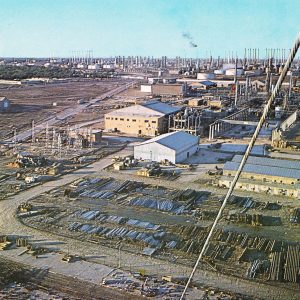
An elevated view of the Abadan Oil Refinery complex in September 1970. (Source: National Iranian Oil Company, Iranian Oil Industry during the Kingdom of the Pahlavi Dynasty, p. 49, via Wikimedia Commons)
“Abadan mattered because it was not just an oil site; it was a refining system whose disruption could ripple through product markets and shipping lanes.”
Oil and gas should be treated as two different strategic stories. Oil is Iran’s export-facing lever: it moves by tanker, it is easier to sanction visibly, and it has the fastest effect on global pricing and freight risk. Gas is more inward-facing.
Iran holds enormous gas reserves and has expanded production substantially, but much of that volume is absorbed by domestic power generation, industry, residential demand, and reinjection into aging oil fields; EIA says Iran reinjected about 0.6 Tcf of natural gas in 2023 and flared roughly 721 Bcf the same year, a reminder that infrastructure, processing limits, and field management matter almost as much as reserves. That is why gas gives Iran depth at home but less export flexibility abroad, especially when South Pars faces pressure-management needs and sanctions complicate access to foreign capital and technology.
That matters today because the modern Iranian oil and gas story is often constrained as much by gas infrastructure and domestic demand as by crude reserves.
The sanctions era began in the aftermath of the 1979 revolution and hostage crisis. Executive Order 12170 blocked Iranian government property and interests in property subject to U.S. jurisdiction. This was not just a diplomatic punishment. It marked a structural shift. Once blocking authority, banking restrictions, and jurisdiction-based enforcement entered the relationship, the energy story ceased to be mainly about oil companies. It became a story about banks, insurers, ship registries, compliance departments, and legal exposure. For additional reporting on rule changes and enforcement issues affecting fleets and bulk carriers, browse our regulations and compliance coverage.
That architecture widened in the 1990s. Executive Order 12957 prohibited U.S. persons from entering into contracts for financing or the overall management or supervision of the development of Iranian petroleum resources. The wording matters. It was not narrowly about ownership. It targeted the management role that major international firms often play, even when they do not formally own the reserves.
Then the sanctions structure broadened further through legislation and regulatory regimes aimed not only at U.S. persons but at foreign firms and institutions that might facilitate Iran-related energy activity. This is where the logic of secondary sanctions became decisive. Once outside banks, traders, insurers, and shipping actors had to price U.S. enforcement risk into any Iran-linked transaction, the commercial environment around Iran’s oil and gas became radically more restrictive.
The Iranian Transactions and Sanctions Regulations further widened the scope of prohibited conduct by covering not only direct transactions but also facilitation, financing, approval, and guarantees. In practical terms, this meant that even indirect participation in the Iranian energy chain could become subject to sanctions or be deemed commercially radioactive.
The nuclear deal cycle demonstrated how directly Iran’s oil and gas had become tied to U.S. nonproliferation policy. On Implementation Day in January 2016, sanctions relief followed the International Atomic Energy Agency’s verification that Iran had taken key nuclear-related steps. That opened limited pathways for renewed energy-related activity.
But the shift reversed in 2018, when the United States ceased participation in the JCPOA and began reimposing sanctions after wind-down periods. Those wind-down clocks mattered enormously to shipping schedules, inventories, financing, and compliance planning. They were not legal technicalities. They were market-moving deadlines.
Beyond oil, natural gas has become even more central to understanding Iranian energy constraints. Iran holds enormous natural gas reserves, including the South Pars field, but that does not automatically translate into unrestricted export power. Gas is consumed heavily at home, infrastructure requires investment, pressure management is costly, and sanctions complicate access to technology and finance.
Iran also uses large volumes of gas for reinjection to support oil recovery, which means gas is not only a commodity but also an operational input into crude production. Add chronic flaring and infrastructure bottlenecks, and the result is a system in which resource abundance does not automatically yield export freedom.

CIA-produced map highlighting Iran’s major petroleum facilities and related energy geography. (Source: United States Central Intelligence Agency Cartography Center / Library of Congress, via Wikimedia Commons)
“The industry story is not just where the reserves sit, but how fields, refineries, terminals, and chokepoints fit into one export system.”
How do sanctions govern Iranian oil and gas trade today?
A common question is: How does Iran still sell oil under sanctions?
The answer is that sanctions enforcement operates as a contest between legal reach and logistical adaptation.
In practice, sanctions enforcement now works less like a ban on one seller and more like scrutiny across an entire voyage chain. OFAC’s 2025 shipping advisory warns that Iranian barrels can move through shadow-fleet vessels, non-Iranian brokers, falsified certificates of origin, repeated ship-to-ship transfers, and manipulated or missing AIS signals, creating risk not just for traders but for charterers, shipowners, managers, insurers, port operators, and banks. For a practical look at documentation risk, hidden petroleum flows, and trade scrutiny, read our analysis of the illegal crude oil smuggling crackdown.
That is why compliance has become behavioral as much as documentary: the key questions are no longer only who owns the cargo, but where the vessel has been, how the cargo was transferred, whether the paperwork is credible, and whether the routing pattern suggests deliberate origin concealment.
Today’s system involves a wide compliance perimeter: shipping companies, vessel owners, vessel managers, insurers, charterers, commodity traders, port operators, and financial institutions all face risk if they facilitate sanctioned trade. That risk environment has pushed trade into more opaque channels. For related reporting on tanker markets, marine transport exposure, and fleet implications, visit our tankers coverage.
Modern sanctions-evasion methods often include ship-to-ship transfers, sometimes repeated several times within the same shipment chain, to obscure cargo origin and vessel history. Another major indicator is missing or manipulated AIS data, especially when paired with unusual routing, nighttime operations, or activity near sanctioned terminals and waters.
For industry insiders, that is the key point: modern sanctions enforcement is not just about checking a name on a list. It is increasingly behavioral. Voyage patterns, documentation inconsistencies, telemetry gaps, ownership opacity, and cargo transfer anomalies all matter.
Iran’s export infrastructure also remains concentrated. Kharg Island is especially important as a crude export node, while facilities such as Bandar Mahshahr and Bandar Abbas remain important to refined product flows. That concentration means disruption risk is focused on a relatively small number of locations.
At the same time, data on exports and revenues come with caveats. Public estimates often rely on tanker tracking, trade intelligence, and partial disclosures because opacity is itself part of the current system. Cargoes may be relabeled, signals may be turned off, and transfer chains may be designed to weaken attribution.
Still, the broad pattern is clear. After exports fell sharply following the return of sanctions, Iranian shipments later rebounded through alternative marketing channels and a compliance-shadowed trade network. Demand has become increasingly concentrated among buyers willing to absorb legal and reputational risk, often through intermediaries.
How does the Strait of Hormuz amplify Iran’s oil and gas risk for the United States?
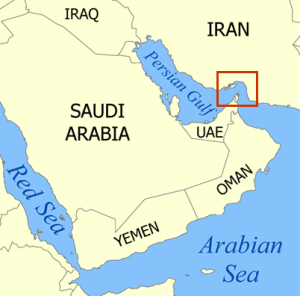
Map showing the Strait of Hormuz in relation to Iran, Oman, and the Arabian Peninsula. (Source: Kleptosquirrel, via Wikimedia Commons)
“Hormuz is where geography turns into leverage: a narrow passage whose disruption can reshape freight costs, insurance exposure, and oil prices.”
No geographic feature shapes the external impact of Iran’s oil and gas more than the Strait of Hormuz.
This chokepoint carries an enormous share of global petroleum liquids and LNG trade. That means any serious disruption in or around the Strait of Hormuz matters even for countries that do not import much Iranian oil directly. The United States may import less crude from the Gulf than in earlier decades. Yet, it remains exposed to price spikes, insurance costs, freight disruptions, and broader macroeconomic consequences if Hormuz traffic is threatened.
That is why the U.S.-Iran energy relationship cannot be measured only by bilateral trade volumes. The relationship also operates through the structure of the world market.
This helps explain repeated U.S. naval involvement in the Gulf. During the later stages of the Iran-Iraq War, attacks on shipping escalated into the Tanker War. The United States reflagged and escorted Kuwaiti tankers under Operation Earnest Will, and later retaliated in Operation Praying Mantis after a U.S. warship struck an Iranian mine.
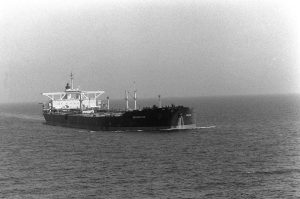
The reflagged Kuwaiti supertanker BRIDGETON is underway in the Persian Gulf on August 22, 1987. (Source: PH3 Henry Cleveland, U.S. Navy, via Wikimedia Commons)
“By the late 1980s, oil security in the Gulf meant more than supply and price; it meant escort missions, mine risk, and naval protection of tanker traffic.”
The importance of that period extends beyond military history. It showed that tanker protection, maritime deterrence, and escalation management had become part of the operating environment of Gulf energy flows. The United States was not merely watching the market. It was actively shaping the conditions under which the market functioned.
A final point is essential if this history is being told specifically as related to the United States. The most consequential U.S. interventions were often less about buying Iranian oil and more about structuring the world around Iranian oil: enabling or denying finance, setting legal conditions for insurers and shipowners, shaping maritime enforcement, and building a sanctions architecture that causes much of the international system to self-police.
In that sense, Iran oil and gas is not just a history of hydrocarbons. It is a long-running case study in how strategic power works through both hard security and the infrastructure of global commerce.
Related Tank Transport coverage
- For additional petroleum market and trade reporting, explore our petroleum news coverage.
- For a current fleet-facing compliance snapshot, read our Tank Fleet Compliance Update.
- For more on fuel-marking and hazmat workflow changes, see our HM-265 fuel compliance guide.
Key Developments: Why Iran Oil and Gas Still Shapes U.S. Strategy
- The 1901 D’Arcy concession established the foreign-control model that later fueled Iranian nationalism and set the stage for every major oil dispute that followed.
- The rise of Abadan refinery made Iranian petroleum a system-level issue for global supply, because this was not only about crude production but also large-scale refining and product flows.
- The 1933 concession revision adjusted the framework, but it did not resolve the deeper Iranian grievance over pricing power, outside management, and the distribution of oil wealth.
- Oil nationalization in 1951 turned the industry into a sovereignty battle and made control of Iranian hydrocarbons a defining political issue at home and abroad.
- The Abadan crisis showed how quickly a refinery shutdown could ripple through international energy markets, underscoring that downstream disruption can matter as much as upstream loss.
- U.S. policymakers increasingly treated the Iranian oil dispute as a strategic Cold War issue, not just a legal or commercial disagreement.
- The 1953 coup remains the pivotal break in the history of Iran’s oil and gas as related to the United States, because it fused oil politics, intelligence activity, and regional power strategy.
- The 1954 consortium restarted exports and stabilized operations, but it also institutionalized the tension between formal Iranian ownership and externally managed control.
- Iran’s role as a founding OPEC member shifted the story from concession politics to producer-state leverage, giving Tehran a larger role in the struggle over pricing and supply power.
- Under the Shah, oil revenue turned Iranian oil and gas into a pillar of state-building, military modernization, and U.S.-aligned regional influence.
- The 1979 revolution and hostage crisis destroyed the earlier energy relationship and replaced it with freezes, sanctions, and long-term strategic rupture.
- U.S. sanctions policy transformed Iran’s oil and gas from a commercial relationship into a compliance-driven battleground shaped by banks, insurers, traders, shipowners, and regulators.
- The Iran Sanctions Act, executive orders, and secondary sanctions widened the pressure campaign beyond U.S. firms, forcing global energy actors to price U.S. enforcement risk into Iran-linked trade.
- The JCPOA period briefly reopened space for Iranian energy exports, but the 2018 U.S. withdrawal restored a much tighter sanctions environment and renewed uncertainty across oil and shipping markets.
- South Pars made natural gas central to Iran’s modern energy balance, yet domestic demand, reinjection needs, infrastructure limits, and sanctions-related technology barriers kept that gas story constrained.
- Modern Iranian exports increasingly depend on ship-to-ship transfers, AIS gaps, layered intermediaries, and opaque trading networks, making enforcement as much about behavior and logistics as formal ownership.
- Kharg Island remains the key crude export hub, meaning Iran’s energy system remains highly concentrated around a small number of strategically sensitive nodes.
- The Strait of Hormuz ensures that Iran remains a U.S. energy concern even without major direct bilateral trade, because any disruption there can move freight risk, insurance costs, and global oil prices almost immediately.
- Taken together, the history of Iranian oil and gas is best understood as a long contest over who controls the barrels, the revenue, the shipping lanes, and the rules of the market.
Key References on Iran Oil, Sanctions, and Gulf Shipping
- Review the original 1901 D’Arcy concession text in the U.S. State Department’s historical records.
- See the U.S. assessment of the effects of shutting down the Iranian oil industry in 1951.
- Read the official Iranian oil nationalization law and related dispute documents.
- Examine the U.S. strategic rationale in the State Department record on overriding legal considerations in the Iran oil dispute.
- Explore the National Security Archive’s documentation on how the CIA confirmed its role in the 1953 Iran coup.
- Understand Washington’s role in the post-coup oil order through the U.S. record on consortium participation and NSC strategy.
- Follow the structure of the restored oil system in the consortium negotiations and ownership breakdown.
- See how the post-crisis settlement was resolved in the claims and compensation agreement tied to the 1954 oil settlement.
- Trace Iran’s producer-state role in the historical record on OPEC’s founding context.
- Learn more about the industrial scale and significance of Abadan in Encyclopaedia Iranica’s history of the modern city and refinery complex.
- Understand the legal and commercial framework behind Iran’s petroleum disputes in Encyclopaedia Iranica’s overview of oil agreements in Iran.
- Read background on foreign control and corporate evolution in Encyclopaedia Iranica’s entry on the Anglo-Persian and Anglo-Iranian Oil Company.
- Explore the longer energy transition from crude to domestic fuel demand in Encyclopaedia Iranica’s entry on Iran’s natural gas industry.
- Read the original sanctions order in Executive Order 12170 blocking Iranian government property.
- See how U.S. restrictions moved directly into the petroleum sector in Executive Order 12957 on Iranian petroleum development.
- Review the operative compliance framework in the Iranian Transactions and Sanctions Regulations.
- Understand the broader statutory pressure campaign through OFAC reference material on the Iran Sanctions Act.
- See how sanctions relief briefly reopened energy access in OFAC’s JCPOA Implementation Day guidance.
- Track the return of tighter restrictions in OFAC’s May 2018 sanctions reimposition guidance for Iran.
- Use the latest government energy overview in the EIA’s Country Analysis Brief on Iran.
- Understand current shipping and trade-risk red flags in OFAC’s maritime advisory on Iranian oil sanctions evasion.
- See the update notice tied to that guidance in OFAC’s publication note for the revised Iranian oil shipping advisory.
- Review recent export-flow estimates in the EIA SHIP Act report on Iranian petroleum exports.
- Understand why maritime disruption matters globally in the EIA’s Strait of Hormuz oil chokepoint analysis.
- For historical naval context, read the U.S. Naval Institute’s account of Operation Praying Mantis and Gulf security escalation.