- Fleetworthy + Haul unifies an AI fleet compliance platform with telematics, tolling, and weigh-station bypass—creating end-to-end oversight for carriers.
- Automated document audits, LLM-parsed roadside inspections, and real-time risk scoring transform FMCSA compliance into proactive safety and performance gains.
- Self‑service compliance for small fleets plus driver scorecards and targeted coaching for enterprise carriers—one stack that scales with your operation.
Fleetworthy’s acquisition of Haul merges an AI fleet compliance platform with telematics, tolling, and weigh-station bypass to centralize safety and regulatory workflows in one stack. By uniting automated document audits, LLM-assisted roadside inspection analysis, real-time risk scoring, and driver scorecards—including self-service tools for smaller carriers—the combined offering reduces administrative burden while strengthening FMCSA readiness.
Below, we outline what’s changing, how the integrations work in practice, and where the roadmap points for U.S. trucking fleets and global road transportation. For more news on how technology is reshaping the trucking industry, visit our TruckingTech news page.
Fleetworthy’s Haul Acquisition Transforms AI Fleet Compliance Platform
Haul by Fleetworthy unifies AI compliance under one brand.
(Official wordmark reflecting the integration of Haul’s platform within Fleetworthy’s broader safety and compliance suite.)
Fleetworthy’s recent acquisition of Haul is a significant development in the trucking and logistics technology space. In mid-2025, Fleetworthy, known for its comprehensive compliance and fleet safety solutions, acquired Haul, a startup offering an advanced AI-powered fleet compliance platform.

This strategic move brings Haul’s cutting-edge automation and artificial intelligence tools under Fleetworthy’s umbrella, expanding the capabilities of fleet safety and compliance management in a single suite. Fleetworthy’s leadership emphasizes that the deal will “transform the way fleets manage compliance and safety”, marking a positive step toward more innovative and more efficient operations.
By uniting with Haul, Fleetworthy aims to provide trucking fleets with an integrated compliance automation solution that is impartial in its analysis yet highly effective, helping carriers meet regulatory requirements while improving overall safety performance. For additional insights into evolving fleet compliance solutions, explore our Compliance news section.
Enjoying our insights?
Subscribe to our newsletter to keep up with the latest industry trends and developments.
Stay Informed
The acquisition also highlights Fleetworthy’s growth strategy in the U.S. trucking industry and beyond. In recent years, Fleetworthy (based in Albany, NY) has broadened its portfolio through partnerships and acquisitions to become a one-stop fleet safety management provider.
Notably, toll management platform Bestpass acquired Fleetworthy Solutions in late 2023, and together they soon acquired Drivewyze, a weigh station bypass and in-cab safety alert provider, in 2024. The combined company rebranded simply as Fleetworthy, reflecting an expanded mission. For more news and updates on acquisitions in the trucking and logistics sector, visit our Acquisitions news page.
By 2025, adding Haul to the mix will further cement Fleetworthy’s position as a leader in trucking compliance technology. Fleetworthy now offers what it calls the only complete technology suite that combines safety, compliance, toll management, and weigh station bypass for commercial fleets.

Automated audits and driver scorecards boost FMCSA readiness.
(Haul by Fleetworthy dashboard showing DQF status, BASIC indicators, and integrations (Motive, Samsara, TA, Geotab) for end‑to‑end compliance management.)
This means that fleets using Fleetworthy’s platform can handle driver and vehicle compliance, safety monitoring, toll payments, and bypass services all through a single provider. According to the company, its solutions are already trusted by 75% of the top fleets in North America, supporting millions of vehicles and drivers. With Haul’s AI capabilities on board, Fleetworthy is “redefining road readiness” by going beyond compliance to proactive risk reduction and efficiency gains.
Fleetworthy’s Strategic Move to Expand AI Fleet Compliance
The decision to acquire Haul was driven by Fleetworthy’s desire to accelerate innovation rather than build new AI tools from scratch. “To build or to partner?” is a classic question in tech, and Fleetworthy chose to acquire Haul’s mature AI platform quickly.
Mike Precia, Fleetworthy’s President and Chief Strategy Officer, noted that the two companies share a common vision and that bringing Haul into the fold fills critical gaps in Fleetworthy’s offerings while extending its market reach. “A large percentage of things that we were planning on doing, we complete by this acquisition,” Precia explained.
In other words, Haul’s existing technology accomplishes many of Fleetworthy’s AI roadmap goals at once. This positive synergy expedites Fleetworthy’s development of an AI-enhanced compliance platform.
Haul was an attractive target due to its focus on automation and its appeal to smaller fleets – a segment that Fleetworthy wanted to serve better. Haul got its start in 2020, founded by Tim Henry and Toan Nguyen Le, who met while working at Uber Freight.
Having witnessed both large and small carriers struggle with compliance, the Haul founders set out to create a user-friendly digital solution that addresses these challenges. They built a platform to support multiple aspects of fleet operations (compliance, maintenance, and safety) with an emphasis on fleets with fewer than 100 trucks.
Despite that focus, Haul also attracted some larger clients, such as J.B. Hunt and Ryder, proving its scalability. The startup spent about 36 months developing its AI-driven compliance platform, and although it saw success, its small team could only onboard a limited number of new customers at a time.
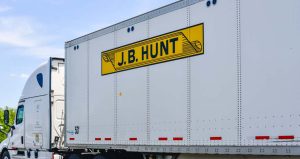
Enterprise carriers validate the scalability of AI compliance tools.
(J.B. Hunt trailer—large‑fleet context for AI document auditing, real‑time risk scoring, and integrated telematics in modern compliance programs.)
By joining Fleetworthy, Haul gains access to resources and a nationwide support network, enabling it to scale its solution to many more fleets. Fleetworthy, in turn, can offer a self-service, cloud-based compliance tool to smaller operators – something it lacked before.
Precia noted that historically Fleetworthy’s core customers were larger carriers, but “now with Haul, they [small fleets] can start with a self-service tool… and as they grow and need support, they won’t have to find another vendor”. This unifies Fleetworthy’s market, enabling it to serve owner-operators and mega-fleets alike with right-sized solutions.
From a leadership perspective, the acquisition appears seamless. Haul’s co-founders, Tim Henry and Toan Nguyen Le, have joined Fleetworthy’s leadership team in key roles focusing on strategy and product innovation.
Their expertise in AI and software development is now being applied within Fleetworthy’s larger organization. Fleetworthy executives Mike Precia and Chief Product Officer Shay Demmons have praised Haul’s team and technology, citing the “powerful automation, actionable insights, and intuitive user experiences” the platform brings.
Shay Demmons highlighted that Haul’s AI capabilities complement Fleetworthy’s own AI initiatives, helping drive better outcomes at lower cost – ultimately “setting a new industry standard” for fleet compliance technology. Such statements are carefully impartial in tone yet clearly optimistic about the combined company’s direction.
Likewise, Tim Henry of Haul remarked that he has always believed in AI’s power to improve fleet operations, and “joining Fleetworthy gives us the scale and reach to achieve that vision”. All indications suggest a smooth integration, with Haul continuing to operate under the brand name “Haul by Fleetworthy” from now on.
Haul’s existing customers will still use the same platform but now benefit from Fleetworthy’s nationwide support infrastructure and broad suite of compliance services. For Fleetworthy’s clients, the acquisition immediately injects new AI tools into the product lineup, advancing the platform toward a more automated and intelligent future.
Haul’s AI Platform Elevates Fleet Compliance Capabilities
Haul’s platform centralizes compliance, maintenance, and safety management for a fleet, serving as a digital hub for all relevant data. It integrates with various systems, including the Federal Motor Carrier Safety Administration (FMCSA) databases, electronic logging devices (ELDs), driver mobile applications, and camera systems.
By consolidating information on drivers, vehicles, and equipment, the platform provides fleet managers with a unified, real-time view of their compliance status and safety performance. To stay informed about FMCSA regulations and updates, visit our FMCSA news page.
In essence, Haul provides a continuously updated compliance snapshot for each driver and asset, accessible through a single dashboard. This comprehensive visibility enables fleets to quickly remedy issues across their operations – whether it’s an expiring commercial driver’s license, a missing maintenance record, or a safety event that requires follow-up.
Automating Compliance & Safety Tasks with AI
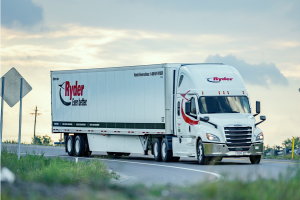
Self‑service compliance that scales from rentals to enterprise carriers.
(Ryder tractor‑trailer on a U.S. highway—representative of nationwide fleets adopting AI‑driven compliance, HOS analytics, and safety workflows.)
A core strength of Haul’s AI fleet compliance platform is its ability to automate time-consuming compliance tasks that were traditionally manual. One prominent feature is automated document handling and auditing.
Fleet operators can upload their compliance paperwork – for example, a driver’s newly renewed medical examiner’s certificate or a vehicle inspection report – into the system. Haul uses computer vision and machine learning to classify each document and extract the key data from it.
In practical terms, this means the AI reads the forms and extracts details such as dates, license numbers, or inspection results that a safety manager would otherwise have to enter manually. The platform then overlays a digital compliance workflow on the extracted data.
If any document is out-of-date, missing information, or indicates a compliance lapse, the system flags it automatically. For instance, if a driver uploads a photo of their medical card, Haul’s AI will recognize the document type, capture the expiration date and other fields, and immediately determine if that information satisfies the regulatory requirements.
The compliance workflow engine then audits the document in real-time, alerting if something is amiss or scheduling the following required action. This type of AI-driven document auditing significantly reduces administrative burdens.
“You do not need to be a compliance expert,” explains Tim Henry – the software effectively embeds a safety and compliance manager within the tool. By modeling the complex FMCSA regulations and applying them to each fleet’s data, Haul’s platform can determine whether a fleet is compliant at any moment and guide managers on precisely what needs to be done to address any gaps.
This level of automation and guidance is akin to having a virtual compliance officer on staff. It is especially beneficial for smaller trucking companies that may not have dedicated compliance personnel.
As Henry noted, small fleets often either hire costly consultants or struggle with DIY methods (like calendars and spreadsheets) to keep up with requirements. Haul aims to deliver a “compliance manager in a box” for these operators, leveling the playing field by giving them an automated system that ensures nothing falls through the cracks.
Intelligent driver onboarding and scorecarding are additional features of the platform. When a new driver joins a fleet, Haul can streamline the onboarding process by automatically verifying the driver’s credentials, past violations, and training status.
It can audit a driver’s qualification file and ensure that all necessary documents (such as a CDL, medical certificate, drug test results, and safety training certificates) are collected and valid. The platform then continues to monitor each driver’s performance and compliance over time, creating a dynamic driver scorecard.
These scorecards aggregate data, including hours-of-service compliance (from ELD logs), inspection history, and any incidents or violations. The AI identifies patterns to flag high-risk behavior or compliance issues, and it updates scores in real-time.
Fleet managers can quickly identify which drivers may require additional coaching or interventions based on these automated scorecards. By quantifying driver compliance and safety metrics, Haul’s tool supports a data-driven approach to driver coaching, enabling continual improvement in fleet safety.
This directly ties into reducing risk: carriers with better compliance records and safer drivers can lower their chances of accidents and avoid costly penalties. In fact, since implementing Haul’s software, some of its customers have improved their FMCSA Compliance, Safety, and Accountability (CSA) scores, enabling them to bid for freight opportunities (such as Amazon contracts or large logistics RFPs) that were previously out of reach due to low scores.
In this way, the AI platform not only helps with legal compliance but also has a positive impact on a carrier’s business opportunities and reputation.

Beyond compliance: turning on‑road data into proactive safety.
(Long‑haul tractor on an open corridor—context for telematics ingestion, HOS monitoring, and targeted driver coaching.)
Regulatory Crosswalk: Where the Platform Aligns (49 CFR)
| Requirement Area | 49 CFR Part(s) | How the AI fleet compliance platform helps | Typical Data Sources |
|---|---|---|---|
| Drug & Alcohol Testing | Part 382 (DOT Part 40 procedures) | Tracks testing pools, results, refusals, and MIS reporting support; alerts for follow‑ups and return‑to‑duty steps. | TPA feeds, lab results, and employer records |
| CDL Standards | Part 383 | Validates CDL class/endorsements and medical status; monitors expirations; documents disqualification events. | State MVRs, uploaded credentials |
| Driver Qualification Files (DQF) | Part 391 (e.g., §391.23, §391.51) | Automates DQF intake/audits; previous employer inquiries tracking; med card & MVR cadence; auto‑reminders for expirations. | DQF docs, MVR pulls, prior employer responses |
| Driving of CMVs | Part 392 | Surfaces unsafe behaviors (e.g., handheld use, speeding) for coaching and policy attestation. | Telematics, dashcams, and coaching records |
| Vehicle Safety/Equipment | Part 393 | Flags equipment‑related defects and trends; ties repair confirmations to inspection findings. | DVIRs, repair orders, inspection reports |
| Hours of Service (HOS) | Part 395 | Real‑time HOS monitoring; alerts on violations; exception auditing; unassigned driving review workflows. | ELD data, dispatch logs |
| Inspection, Repair & Maintenance | Part 396 (e.g., §396.3, §396.11, §396.17) | Schedules PMs; validates annual/periodic inspections; captures roadside reports and corrective actions. | DVIRs, maintenance CMMS, inspection PDFs |
| General FMCSR & Accident Register | Part 390 (e.g., §390.15) | Maintains accident register; correlates incident data with coaching and claims documents; and sends reminders for carrier filings. | Incident logs, claims docs, carrier profiles |
Implementation & Integration: 30–60–90 Day Plan
Days 0–30 — Foundation
- Connect core data sources: ELD, cameras, MVR provider, DQF repository, maintenance/CMMS, and roadside inspection feeds.

Telematics and ELD integrations unify driver, vehicle, and inspection data, providing a comprehensive view of fleet operations.
- Import historical documents (DQF, med cards, inspections); configure retention and role‑based access.
- Stand-up baselines: HOS violation rate, inspection violations per 100 inspections, DQF error/expiration count, and average DQF closure time.
- Enable automated document classification/extraction; create review queues and accuracy thresholds.

Days 31–60 — Pilot & Training
- Run a pilot on 10–20% of drivers/vehicles across mixed duty cycles.
- Activate risk scoring and targeted coaching, linking violations to relevant training modules and acknowledgments.
- Validate roadside inspection parsing to corrective‑action closure within set SLAs.
- Train admins and supervisors; publish standard operating procedures for review/override.
Days 61–90 — Scale & Optimize
- Roll out to remaining terminals/fleets; enforce exception‑based workflows.
- Tune alerting (noise reduction), adjust thresholds by lane/region, and lock reporting definitions.
- Launch executive dashboards; schedule weekly KPI reviews and monthly model‑drift checks.
- Formalize change‑management and continuous‑improvement cadence.
7‑Step Go‑Live Checklist
- Connect ELD & camera feeds → 2) Import DQF & maintenance records → 3) Configure roles/retention → 4) Set KPI baselines → 5) Pilot risk scoring/coaching → 6) Validate inspection-to-corrective closure → 7) Organization‑wide rollout.
KPI Framework: How to Measure Impact
- DQF Closure Time — Average days from document receipt to compliant file. Goal: ↓ 30–50% from baseline.
- Auto‑Pass Rate (Docs) — % of uploads that clear AI audit without manual touch. Goal: ≥ 70–85% after tuning.
- HOS Violation Rate — Violations per 1,000 driver days. Goal: steady ↓ month over month.
- Inspection Violations — Violations per 100 inspections; track OOS rate separately. Goal: ↓ 10–20% over 90 days.
- Coaching Responsiveness — % of flagged drivers coached within 48 hours. Goal: ≥ 90%.
- Repeat‑Event Recurrence — % of drivers repeating the same infraction within 30 days. Goal: ↓ 25%+.
- Corrective‑Action SLA — % of roadside defects closed within 7 days (or policy target). Goal: ≥ 95%.
- Data Quality Score — Missing/invalid fields per 100 records; audit exceptions rate. Goal: ↓ continuously.
Risks, Limits & Mitigations
- Data Quality & Coverage — Incomplete DQFs or ELD gaps can degrade scoring. Mitigation: enforce required fields, automated re‑requests, and nightly integrity checks.
- False Positives/Over‑Alerting — Early AI tuning may create noise. Mitigation: reviewer queues, threshold tuning by lane/vehicle class, feedback loops.
- State & Modal Variance — Intrastate rules or specialty equipment can diverge. Mitigation: policy packs by jurisdiction/equipment; exception logic.
- Leased O/Os & Seasonal Drivers — Fragmented documentation and turnover. Mitigation: self‑service portals, mobile capture, pre‑hire verification templates.
- Change Management — Supervisor adoption and driver trust. Mitigation: short training bursts, transparent scorecards, coaching tied to clear policy.
- Integration Friction — Legacy systems/API limits. Mitigation: phased connectors, flat‑file fallbacks, data‑mapping sign‑offs before go‑live.
How does AI automate fleet compliance documentation?

Compliance workflows align with FMCSA rules to ensure consistent, auditable processes.
Haul’s platform tackles one of the most tedious aspects of compliance: document management and audits. As mentioned, it uses AI-based text recognition and data extraction to turn paper or PDF documents into actionable digital records.
But how exactly does this automation work in practice? When a fleet leader scans or uploads compliance documents into Haul, the system’s AI first categorizes each document by type (e.g., driver qualification, vehicle maintenance, safety incident).
It then extracts critical details – such as names, dates, identification numbers, and defect notations – using natural language processing. Next, Haul’s platform cross-references those details against regulatory requirements and the fleet’s own compliance policies.
For example, if a vehicle inspection form is uploaded, the AI checks what defects or violations (if any) were noted and whether proper corrective actions were documented. If a driver’s license expiration date is approaching, the system automatically sets a reminder or notifies the driver to renew, ensuring that no deadlines slip through.
By modeling the DOT regulations in software, the platform knows what “compliant” looks like for each document and data point. It can therefore audit the incoming information instantly and continually.
Fleet managers receive alerts or dashboard indicators if something needs attention – such as a missing annual inspection or an out-of-compliance log – without having to sift through files manually. This level of automation not only saves time but also improves accuracy, as the AI is less likely to overlook details that a busy human might miss.
The end result is a near-real-time compliance status report for the entire fleet, maintained with minimal manual effort. Haul’s use of AI in documentation has effectively transformed a once-reactive, labor-intensive task into a proactive digital process.
Real-Time Monitoring and Proactive Safety Coaching
Beyond paperwork, the AI platform excels in real-time monitoring of fleet operations to enhance safety. Haul’s system is integrated with leading telematics providers, meaning it can ingest data from in-cab devices, GPS trackers, ELDs, and even innovative camera systems in trucks. For further news about telematics innovations in fleet management, check out our Telematics news page.
This integration enables the platform to analyze driver behavior and vehicle status continuously. For instance, if a telematics system records hard braking events, speeding incidents, or hours-of-service violations, the data automatically flows into Haul’s platform.

Unified suite spans safety, compliance, toll management, and bypass services.
The AI then evaluates these inputs to support proactive safety management. It might increase a driver’s risk score after multiple harsh braking alerts or trigger a coaching recommendation if a pattern of late brake reactions is detected.
In the words of Fleetworthy, Haul’s platform enables fleets to “act on real-time driver behavior data” by providing automated risk scoring and targeted driver coaching prompts. Essentially, the technology turns raw data from the truck into actionable safety intelligence.
Another area where AI and real-time data combine is roadside inspection management. Haul’s platform leverages a large language model to interpret the results of roadside inspection reports – documents that can be complex and filled with shorthand.
The AI can “run roadside inspections through its recommendation engine” to understand what occurred during an inspection and determine appropriate follow-up. For example, if a driver is cited for a logbook violation at a weigh station, the system identifies this. It can automatically assign a training module to that driver via an integrated learning management system.
By handling this analysis promptly, the platform enables fleets to respond to inspection issues before they escalate into more significant problems or penalties. It’s a way of closing the feedback loop. Every inspection and telematics alert becomes a learning opportunity, and the AI ensures that none of these opportunities are missed in the daily operations.
As a result, carriers can address risky behaviors or compliance shortcomings in near-real time, rather than discovering them weeks or months later during audits. This data-driven, real-time coaching keeps drivers safer and fleets more compliant on an ongoing basis. To learn more about real-time monitoring solutions that improve fleet safety, visit our Real-Time Monitoring section.
How does real-time data improve fleet safety?
For example, engine diagnostics can signal maintenance issues; ELD logs show hours-of-service compliance in real time; and dashcam video or accelerometer data can indicate sharp turns, collisions, or distracted driving. By feeding all this information into an AI system, fleets get immediate insights. For a closer look at electronic logging compliance solutions, check out our ELD compliance coverage.
The platform can prioritize which alerts require urgent attention – such as a critical fault code indicating that a truck needs service immediately, or a severe driving event that warrants a safety check-in with the driver. The AI’s risk scoring logic assesses the frequency and severity of events to provide a comprehensive view of each driver and vehicle.
This means fleet managers aren’t just collecting data; they’re getting an actionable assessment of risk at any given moment. For instance, if a particular driver accumulates multiple overspeed alerts and complex braking incidents in a week, the system might flag them for proactive coaching, even if no accident has occurred.

AI fleet compliance platform centralizes safety and regulatory workflows.
Addressing these trends early can prevent crashes. Similarly, real-time tracking of hours-of-service (HOS) logs through ELD integration allows dispatchers to ensure drivers aren’t exceeding legal driving limits – a key safety and compliance factor.
If a potential HOS violation is imminent, the platform can alert managers or the driver, enabling corrective action (such as arranging a rest break) before a breach or fatigue-related incident occurs. For additional information on hours-of-service rules and compliance strategies, visit our HOS news page.
Fleets can respond to issues immediately, tailor training to drivers’ needs, and maintain a high level of compliance without constant manual supervision. This leads to safer roads and more efficient operations, benefiting not just the carriers but everyone sharing the highways. To learn more about the latest fleet safety initiatives and news, explore our Fleet Safety news section.
Telematics integration and proactive coaching
Haul’s incorporation into Fleetworthy also highlights the significance of partnerships and integrations in contemporary fleet management. By design, the platform is agnostic and modular – it can integrate with legacy systems or various third-party devices a carrier may already use.
This flexibility is crucial because trucking fleets often have diverse tech stacks. Fleetworthy’s goal is to be “best in class in technology with an agnostic product that can be bolted on” to existing systems.
Thanks to Haul’s integrations with ELDs, camera systems, and FMCSA portals, fleets don’t have to rip out or replace their current solutions to benefit from AI compliance automation. Instead, Fleetworthy’s suite can sit on top of those data streams and make sense of them.
The telematics integration enables data from providers such as Geotab, Omnitracs, Samsara, or other in-cab hardware to flow into Fleetworthy’s platform. On the back end, Fleetworthy’s recent alignment with Bestpass and Drivewyze means toll data and weigh station events also become part of that data ecosystem.
With all these inputs combined and analyzed, the platform can coach drivers and guide fleet managers with unprecedented precision. It supports targeted interventions – for example, directing a safety message to just the subset of drivers who routinely speed, or automatically enrolling drivers in a specific training after a particular type of violation.

Real-time risk scoring enables targeted driver coaching and faster remediation.
This targeted, proactive coaching is far more efficient than blanket training or waiting until a quarterly safety review. Ultimately, the integration of Haul’s AI capabilities allows Fleetworthy to offer a comprehensive fleet compliance and safety management solution that is greater than the sum of its parts.
As Precia described, Fleetworthy is no longer “held hostage by where the carrier is on the technology spectrum”; by owning more of these advanced tools, they can drive efficiency for all their clients, small or large. Both Haul and Fleetworthy’s original customers stand to gain from this union, which Precia called a “win-win for everyone”.
A New Standard in Fleet Compliance and Future Outlook
With the integration of Haul’s AI platform, Fleetworthy is positioning itself as an industry leader, setting a new benchmark for fleet compliance automation. The company’s market positioning is now that of a comprehensive compliance partner for the transportation industry, offering a range of services from regulatory paperwork management to on-road safety solutions.
This impartial yet comprehensive approach is especially valuable in the context of U.S. trucking fleets, where carriers must navigate a complex web of FMCSA regulations, safety mandates, and cost pressures. Fleetworthy’s expanded suite helps carriers remain “beyond compliant” – not just meeting the minimum legal requirements but actively improving safety and efficiency.
The impact is tangible: fewer roadside violations, improved CSA safety scores, better insurance risk profiles, and more streamlined operations. These advantages also resonate in the broader context of global logistics and road transportation. For broader insights into logistics management trends and international transport, explore our Logistics Management news section.
Around the world, fleet operators are exploring AI-driven compliance and safety tools to address similar challenges, including driver shortages, safety enforcement, and operational efficiency. Fleetworthy’s move reflects a global trend of leveraging technology to make road transport safer and more accountable.

Telematics and ELD integrations unify driver, vehicle, and inspection data, providing a comprehensive view of fleet operations.
It signals that AI and automation are becoming integral to fleet management, from America’s highways to international logistics corridors. For more on how artificial intelligence is transforming fleet operations, check out our AI news page.
Crucially, Fleetworthy’s acquisition of Haul may be just one step in a larger wave of innovation. Precia hinted that with Haul’s AI in hand, Fleetworthy has “a lot of things on the horizon” and is poised to deliver game-changing innovations in the near future.
Integrations with companies like Bestpass and Drivewyze are expected to become smarter as the company learns how to apply machine learning to tolling and weigh station bypass data as well. The vision is to give fleet managers more profound insights into driver behavior, vehicle usage, and cost-saving opportunities by correlating all these data points using AI.
For example, the system might in the future analyze toll patterns alongside driver hours to suggest more efficient routing or identify compliance risks related to route choices. By continuously innovating, Fleetworthy aims to keep fleets not only compliant with today’s rules but prepared for tomorrow’s demands.
In summary, Fleetworthy’s acquisition of Haul in 2025 represents a positive leap forward for AI in fleet compliance. It combines Fleetworthy’s established compliance expertise and customer base with Haul’s innovative AI platform to create a robust, all-in-one solution for fleet safety and regulatory management.
This impartial synthesis of technology and service enables trucking companies of all sizes to more easily comply with regulations, protect their drivers, and operate their businesses efficiently. The AI fleet compliance platform resulting from this merger is poised to become a new industry standard, demonstrating how digital transformation can address longstanding challenges in the transportation sector.
Fleet operators can look forward to continued advancements from the Fleetworthy-Haul team as they drive toward a future of more intelligent, safer, and more compliant road transportation.
Key Developments: Fleetworthy–Haul AI Fleet Compliance Platform
- Fleetworthy acquires Haul (mid‑2025); brand continues as “Haul by Fleetworthy.”
- Haul founders Tim Henry and Toan Nguyen Le join Fleetworthy leadership to drive AI product strategy.
- The platform centers on AI/ML and LLM, focusing on automated document classification/extraction, digital workflows, and continuous audits.
- Intelligent driver onboarding and dynamic driver scorecards; integrations with ELDs, camera systems, FMCSA data, and telematics feeds.
- Real‑time risk scoring and targeted driver coaching based on driver behavior and roadside inspection analysis.
- Self‑service compliance for small fleets with an upgrade path to managed services as operations scale.
- The suite now spans safety, compliance, toll management (Bestpass), and weigh-station bypass (Drivewyze) in one stack.
- Agnostic, modular integrations designed to bolt onto existing fleet tech stacks.
- Reported outcomes include improved CSA scores and faster remediation cycles.
- Nationwide support infrastructure now backs Haul customers.
- The stated market reach includes a significant share of top North American fleets, with expansion aimed at broader U.S. trucking and global road transport.
- Forward roadmap: deeper machine learning across toll and bypass datasets and richer cross‑signal insights for operations (planned).
- Strategic objective: move fleets beyond compliance toward proactive risk reduction and operational efficiency.
External Resources for the Fleetworthy–Haul Acquisition & FMCSA Compliance
- Review the official acquisition announcement at Fleetworthy acquires Haul — press release.
- See the company’s perspective on integration at Fleetworthy’s blog on the Haul acquisition.
- Explore platform capabilities and trial options at Haul Compliance — product overview.
- Track prior portfolio moves that set the context for Bestpass’s acquisition of Fleetworthy Solutions.
- Understand the suite expansion, including bypass services at Bestpass, as Fleetworthy acquires Drivewyze.
- Read the operator-side announcement at the Drivewyze acquisition overview.
- Reference official FMCSA guidance on hours rules at FMCSA — Summary of Hours-of-Service regulations.
- Access the federal ELD program hub at FMCSA — Electronic Logging Devices (ELD) home.
- Consult driver qualification standards at eCFR — 49 CFR Part 391 (Driver Qualifications).
- Review the full HOS regulatory text at eCFR — 49 CFR Part 395 (Hours of Service).
- Verify drug & alcohol testing requirements at eCFR — 49 CFR Part 382 (Controlled Substances & Alcohol).
- See DOT testing procedures and Q&A at DOT ODAPC — 49 CFR Part 40 procedures.