- California crude by truck is reshaping Central Valley logistics as refinery shutdowns and an idle northbound pipeline force barrels onto short-haul tanker routes toward alternate pipeline entry points.
- What looks like a simple 50-mile reroute is creating a new crude-by-truck lane with higher dispatch complexity, tighter hazmat-capable capacity, added spill exposure, and new cost pressure on producers.
- As Benicia refinery idling collides with California’s inventory-and-import supply strategy, tanker fleets, terminals, and West Coast service providers are being pulled into a rare infrastructure-driven market shift.
California crude by truck has become a live operational reality in the San Joaquin Valley after a chain reaction of refinery drawdowns and pipeline economics cut off a once-straightforward route to Northern California buyers. The key dynamic is straightforward: when the pipe that used to pull barrels north goes idle, volumes that still need a refinery home find the “nearest available valve,” and in this case, that valve includes a 50-mile highway move to a different pipeline entry point.
For a broader state-level freight context around this market shift, see our California coverage and related California Freight reporting.
California crude by truck is replacing a northbound pipeline outlet.
The immediate trigger for California crude by truck is the loss of a high-volume northbound outlet: up to 35,000 barrels per day previously moved from the Kern oil field area to Bay Area refineries on the San Pablo Bay Pipeline system operated by Crimson Midstream, but that line has been empty since December after a key buyer prepared to run its “final barrel” and began shutting units during an idling process that started in February.

The demand-side change is closely tied to Valero Energy’s plan to wind down operations at its Benicia Refinery, communicated to state officials and the market. Valero publicly notified the California Energy Commission in April of its intent to “idle, restructure, or cease” refining operations by the end of April 2026, and later confirmed it would idle in phases, starting with processing units in February for mandatory state inspections, while continuing gasoline production until inventories are worked down. Most process units are properly idled by April.
For more reporting on refinery-driven supply shifts and operating pressure points, visit our Refineries coverage.
“idle, restructure, or cease” refining operations by the end of April 2026
Enjoying our insights?
Subscribe to our newsletter to keep up with the latest industry trends and developments.
Stay Informed


Pumpjacks operating on the Lost Hills Oil Field in California at sunset.
That coexistence—crude outlets constrained while consumer fuel supply is managed through inventories and imports—is a defining feature of this story. Gavin Newsom described the state’s supply posture around the Benicia wind-down as leveraging existing inventories and imported product to maintain steady supply and price stability. He emphasized that the updated plan included continued imports into Northern California once the refinery fully idles.
Regulatory posture matters because it shapes how quickly the market can absorb infrastructure disruptions. The California Energy Commission has been implementing statutes that authorize minimum inventory requirements and resupply planning for refinery outages, explicitly intended to reduce the severity of gasoline price spikes. Those measures are designed for refined fuels, not crude—but they influence downstream planning at terminals and racks, and they frame why the state is emphasizing “keep the market supplied” even as upstream barrels are forced into less efficient transportation modes.
The “Why it’s big” point for TankTransport is that this is a rare case where an in-state crude barrel becomes truck-native, not because trucking is cheaper, but because refinery and pipeline options changed abruptly, and the alternative is curtailment. The result is not just more loads—it is a new lane with a new risk and compliance profile.
For broader fleet-facing coverage across the bulk sector, browse our tank transportation coverage.
The infrastructure trigger behind California crude by truck
Valero’s refinery complex in Benicia, California.
The midstream backbone at issue is the SPB-KLM intrastate crude system overseen by the California Public Utilities Commission. In a formal resolution on emergency rate relief, the CPUC described the SPB-KLM system as a 373-mile intrastate crude oil pipeline that transports crude from production areas in the San Joaquin Valley to refineries in the San Francisco Bay Area, and noted significant volume losses that impaired the operator’s ability to maintain sufficient operating cash flow.
For additional reporting on infrastructure bottlenecks and routing changes, explore our Pipelines coverage.
The CPUC’s intervention underscores the pipeline’s financial stress. The Commission approved an emergency interim rate increase of 59.2% on the SPB-KLM system effective August 1, 2025, subject to refund, raising the interim rate from $2.3571 per barrel to $3.7527 per barrel. The same resolution documents that nominations for December 2025 were reported as zero, and the operator warned that continued operation without interim relief would not be financially sustainable. As a condition for implementing the interim rates, the CPUC required the operator to secure a letter of credit oin the amount f at least $5.8 million to protect shipper refunds.
Independently, earlier CPUC-related materials describe the physical system context: the San Pablo Bay segment includes roughly 300 miles of active pipeline connecting production fields in the San Joaquin Valley to Bay Area refineries. In comparison, the KLM segment includes roughly 50 miles of active pipeline that transports crude from production fields—mostly in Kern County—to an interconnection with the SPB pipeline. Those materials also explain that, after integration work was completed in 2020, KLM effectively functions as a gathering system feeding SPB.
The economics behind “pipe goes idle” are embedded in the operator’s own filings and associated presentations: declining throughput magnifies per-barrel fixed-cost recovery, and tariffs near or above commercial tolerance increase the likelihood that shippers will bypass the system for cheaper southbound alternatives. One CPUC-filed presentation explicitly frames the issue as “economic obsolescence” risk when tariffs approach roughly $6 per barrel, given competing southbound pipeline options, and also documents that December nominations were 0 barrels per day.
This is how infrastructure stress becomes a trucking story: when the pipeline is empty, the producers still need an outlet, and the remaining outlets may require a physical bridge by truck—especially when the most direct rail or pipeline connections are constrained by location, contract structure, or refinery appetite for particular crude slates.
Where is California crude by truck going now?

Aerial view of Carquinez Strait with major bridge crossings visible.
The most actionable new detail for an operator or a transportation planner is the physical reroute: much of the displaced crude is being loaded in eastern Kern County and driven about 50 miles to Pentland Station, where it can enter a different pipeline pathway to refineries in and around the Los Angeles Basin.
This matters because Pentland is not just a generic station on the map—it is explicitly referenced as a junction point for pipelines that can move barrels toward Southern California refinery complexes. In a federal order published as a securities exhibit, the U.S. Department of Energy described an interstate pipeline system ending at Pentland Station, “at which point hydrocarbons move through the Plains All American Line 2000 for transport to refineries.”
“at which point hydrocarbons move through the Plains All American Line 2000 for transport to refineries.”
On the receiving side of those southbound pathways, Plains All American Pipeline has described its California crude systems in investor disclosures: Line 2000 is an approximately 130-mile, 20-inch trunk pipeline with throughput capacity of about 130,000 barrels per day that transports crude to refineries and terminal facilities in the Los Angeles Basin; and Line 63 is described as moving crude from the San Joaquin Valley to refineries and terminals in the Los Angeles Basin and in Bakersfield, including a trunk segment with capacity around 60,000 barrels per day, plus gathering and distribution segments.
For more stories tied to receipt points, storage sites, and downstream distribution hubs, explore our Terminals coverage.
Operationally, the trucking leg is being used to “reach the pipe,” not to replace the pipe end-to-end. That is an important distinction for freight markets: truck miles rise, but the long-haul still often shifts back to fixed infrastructure where capacity exists.
The volume scale implied by publicly reported activity is significant. According to reporting under license, nearly 100 trucks per day are making the roughly 100-mile round-trip journey to Pentland, with one producer described as responsible for about a third of the road-moved volumes.
At the same time, not every displaced barrel is being put on a truck. Reporting indicates roughly half of the displaced crude is being sent on an alternate line, with the remainder largely going by truck to Pentland. The specific identity of the “alternate line” is not detailed in that account. Still, CPUC-filed materials describe a San Joaquin Valley system in which only a small number of pipelines move crude out of the region, with the northbound SPB path and the southbound systems tied to the Southern California refinery complex.
What is California crude by truck doing to prices and barrels?
California crude by truck is not just a cost increase—it is a market signal that the region is temporarily oversupplied relative to its constrained set of outlets, and that the incremental barrel now clears at a discount after paying for a more expensive logistics chain. Reporting describes an “artificial oversupply” that pushed Kern crude to roughly a $10 discount to Brent while producers paid up to $10 per barrel for trucking, severely squeezing margins.

Aerial view of the Kern River Oil Field outside Bakersfield, California.
For related reporting on upstream barrel flows and crude market developments, browse our CrudeOil archive.
The midstream operator’s stance, as described, is that the pipeline remains physically available even if volumes are absent—meaning the issue is not “pipe irreparably broken,” but “pipe uneconomic and un-nominated in current market conditions.” In the same reporting, CorEnergy Infrastructure Trust—the parent associated with the pipeline company—was described as spending at least $3 million per month to keep the option to ship crude open, with the CEO indicating the conduit could ship if called upon.
That is consistent with the regulator-facing record: the CPUC resolution documents months with sharply reduced volumes and nominations dropping to zero, and frames interim rate relief as necessary to avoid suspension of operations.
A second constraint is the Bay Area refinery’s desire for in-state crude. The same report notes that the PBF Energy-owned Martinez Refining Company had not purchased crude “in meaningful quantities” from the San Pablo Bay pipeline since May 2025. Additionally, PBF mentioned in January that Martinez was expected to reach its planned operating rates by early March 2026, and Reuters later reported that key units remained on track for an early-March startup. In this context, Martinez still plays a role in the Bay Area’s supply picture, but it is clearer to view its restart as a moving part of the market rather than as definitively constrained later in March.
From a systems perspective, CPUC-filed materials associated with pipeline economics argue that if Benicia closes, Martinez could become the only Bay Area refinery connected to California crude oil via pipeline. At the same time, Southern California retains larger, more diverse pipeline-connected refining capacity. That particular framing comes from an interested party’s materials and should be read as advocacy; however, it is useful in explaining why the market’s “direction of pull” can shift south when the Bay Area buyer set narrows.
The broader policy environment also adds friction. The California Air Resources Board has been advancing proposed amendments to its cap-and-invest program, and the agency itself describes the program as setting a declining limit on major sources of climate pollution and accepting public comments on proposed regulatory changes. Industry-facing concerns about added compliance costs and reliability have been reported by market publications and echoed by major refiners’ public statements.
For TankTransport readers, the practical implication is that California crude by truck can persist longer than a “single outage week” when the underlying driver is structural—refinery contraction, midstream underutilization, and policy-driven investment reluctance—rather than a short-lived mechanical failure.
California crude by truck math: how many tanker loads does this imply?
California crude by truck becomes tangible when you translate barrels into truck moves. Using the reported displacement scale as an example, 35,000 barrels per day equals 1,470,000 gallons of crude per day because each barrel is 42 gallons.
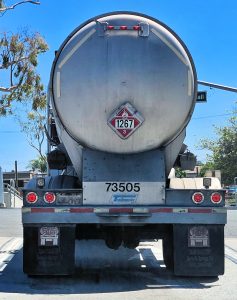
Tanker semi-trailer hauling crude oil.
Cargo tank “typical capacity” depends on configuration, weight limits, product density, and jurisdiction; an industry reference for common non-pressure fuel tankers notes a typical capacity of up to roughly 9,000 gallons, which varies by configuration and jurisdiction.
A simple throughput calculation, using 9,000 gallons as an upper-bound planning proxy, implies:
- 1,470,000 gal/day ÷ 9,000 gal/load ≈ 163 loaded moves per day
If the practical average is lower because of crude density, compartmenting, or site loading limitations—say 7,500 gallons per load—the same volume implies roughly 196 loaded moves per day.
Those are one-way loaded moves. When the route logic is a shuttle to a pipeline receipt point, each load also implies an empty return leg, so dispatchers quickly manage hundreds of tractor movements per day, even if the number of unique tractors is lower because a single unit can handle multiple loads in a shift.
Hours-of-service rules influence how many turns per day are realistic. Under Federal Motor Carrier Safety Administration summaries of U.S. HOS rules, property-carrying drivers operate within an 11-hour driving limit inside a 14-hour on-duty window, with defined off-duty requirements. On a 50-mile shuttle, the driving time is not the binding constraint—terminal queue time, loading/unloading cycle time, and paperwork/inspection time often become the bottleneck. That is why crude-by-truck surges can create “capacity surprises” even on short-haul lanes.
Those cycle times are also shaped by crude quality. The San Pablo Bay tariff document’s “Rule 10” quality options indicate that some crude streams may require elevated temperatures, higher-viscosity handling, and tighter S&W specifications—factors that can extend load/unload times and increase equipment requirements, such as heated lines or more robust pumping capability.
New lane, new risk for California crude by truck hauling
California crude by truck creates a risk stack that differs from pipeline or short marine delivery, even when the truck leg is only 50 miles. The key changes are exposure points: every additional loading/unloading event, every additional freeway merge, and every additional driver shift handoff increases the number of operational “touches” where incidents can occur.
From a compliance standpoint, crude oil is firmly inside the hazardous materials framework. A U.S. Department of Transportation emergency order explicitly describes petroleum crude oil as “UN 1267,” hazard class 3, packing group I, II, or III, subject to the Hazardous Materials Regulations in 49 CFR Parts 171 to 180.
“UN 1267,” hazard class 3, packing group I, II, or III, subject to the Hazardous Materials Regulations in 49 CFR Parts 171 to 180.
That matters to TankTransport managers because it links directly to placarding, shipping papers, employee training, and cargo tank rules.
For more on hazardous materials rules affecting tank carriers, explore our hazardous materials compliance coverage.
California adds its own operational layer. The California Highway Patrol notes that California Vehicle Code requirements trigger a Hazardous Materials Transportation License for carriers transporting hazmat in certain quantities, including shipments requiring placards, and the requirement applies to both intrastate and interstate carriers.
Training is similarly non-optional: federal rules require hazmat employee training, and motor carriers may not transport hazmat by motor vehicle unless hazmat employees involved are trained as required.

Commercial vehicle inspection activity at the Woodburn Port of Entry.
For recent carrier-side rule changes and documentation issues, read our HM-265 fuel compliance analysis and our tank fleet compliance update.
Equipment compliance becomes a throughput limiter when lane demand spikes. Cargo tanks have defined inspection and testing requirements under 49 CFR, and these periodic test/inspection cycles affect fleet availability because units down for testing or repair are not available for dispatch. In a market where California crude by truck suddenly consumes dozens of tankers daily, “spare” compliant capacity can disappear quickly, particularly for fleets that must maintain a specific spec (liner type, vapor recovery compatibility, pumping systems, or heating capability) demanded by a particular crude stream.
Risk measurement is unusually transparent in this space because federal databases exist. The Pipeline and Hazardous Materials Safety Administration publishes hazardous materials incident statistics based on DOT incident reporting, with downloadable data and frequent updates. The point for operators is not “incidents will rise” as a certainty; it is that the shift from pipeline to highway re-weights the modes where reportable events occur, and that shift should change insurance posture, safety brief frequency, route planning, and terminal SOPs.
Insurance and spill exposure also change because the geography of consequence changes. A pipeline leak is a fixed-corridor event; crude-by-truck distributes risk across interstates, surface streets, and the immediate vicinity of tank farms and pump stations. In CPUC-filed materials discussing the consequences of a pipeline ceasing to operate, the operator-side presentation explicitly anticipates increased truck traffic and flags roadway safety hazards and air quality concerns in disadvantaged communities when barrels are forced onto highways.
Finally, California crude by truck is not isolated from broader freight market conditions. The American Trucking Associations has documented tightness and mismatches in driver availability across parts of the broader trucking market, particularly in for-hire truckload segments, and regulatory filters like hazmat endorsements further narrow the usable labor pool for crude lanes. While crude hauling is a specialized niche and should not be conflated with the entire trucking labor market, the practical point is that scaling a hazmat shuttle lane quickly requires both tractors and qualified drivers with the right credentials, and that is not instantly elastic.
Who benefits from California crude by truck, and who absorbs the friction?
California crude by truck reallocates value along the supply chain.
On the “benefits” side, crude haulers and short-haul bulk fleets see direct demand expansion because the truck leg is now a structural bridge to reach southbound pipeline systems. Terminal operators and pump stations that can receive trucked crude—particularly those connected to major southbound lines—gain incremental throughput opportunities.
The midstream and regulatory side experiences a different kind of “benefit”: visibility and leverage. When system viability is in question, a trucking fallback demonstrates to regulators that the market has alternatives, which can affect rate-case narratives around “critical infrastructure” status. The CPUC and related coverage explicitly frame the San Pablo Bay system as a critical piece of crude infrastructure and discuss trucking as an alternative mode if the pipeline were to close.
On the “friction” side, upstream producers absorb the direct cost delta. The reported economics—up to $10 per barrel of trucking cost combined with a deeper local discount—illustrate how quickly profitability compresses when California crude by truck is used as the marginal move.
Local communities also absorb friction in the form of heavy-vehicle traffic. The reported operating pattern—nearly 100 truck trips daily on a short shuttle—concentrates heavy loads on specific corridors, affecting roadway wear, congestion, and exposure to incident risk.
Equipment and handling constraints are an underappreciated source of friction. The San Pablo Bay tariff’s quality rules indicate that some crude streams are handled under elevated-temperature conditions and defined vapor-pressure and contamination limits, which can necessitate special handling and create additional operational checks at loadout and receipt. Even when a producer is not shipping via SPB during the trucking workaround, the same crude qualities exist at the wellhead, and those properties affect pumpability, viscosity, hose selection, and cleanout cycles—features that matter to tank shops and fleet maintenance managers.
A key secondary effect is that California crude-by-truck can indirectly affect refined product trucking and terminal dispatch, even if the barrels being moved are crude, not gasoline. When terminals allocate rack time, yard space, and labor to handle additional crude receipts, the facility’s operational cadence changes. If that facility also supports refined product loading, dispatchers may see new peak windows, longer gate times, or altered appointment systems. This is most likely where crude receipts and refined loadouts share constrained yard infrastructure rather than being fully segregated; the magnitude will vary by site. This is an operational hypothesis grounded in how terminal constraints work, not a formally reported statewide fact.
What changes for fuel haulers and terminals as California crude-by-truck scales?
Two parallel supply chains are operating simultaneously: crude must reach refineries, and refined products must reach retail. As the Benicia facility is idled, the state’s plan—endorsed by the Governor and reported by Reuters—relies on a combination of working down inventories and importing gasoline to meet Northern California obligations.
That shift has practical consequences for fuel haulers:
First, imported gasoline and blending components typically arrive through marine terminals, then feed into racks and downstream distribution. To the extent imports rise while local refining output falls, terminal reliance increases, and that can alter rack volumes and timing for local carriers.
Second, regulatory emphasis on inventory and resupply planning can change how refineries and suppliers schedule maintenance and coordinate deliveries. California’s minimum inventory and resupply authorities are explicitly intended to mitigate supply shortages and price spikes, and that tends to make inventory levels and resupply timetables more central to day-to-day dispatch planning.
Third, capacity competition can become real if the same labor pools, power units, or shop bays serve both hazmat crude moves and the refined product fleet. California crude by truck requires drivers with hazmat credentials and carriers operating under both federal hazmat rules and California licensing requirements; those requirements narrow the feasible capacity that can be shifted in from general freight.
Finally, if crude flows increasingly favor Southern California because more refinery capacity there is pipeline-connected—and CPUC-filed materials explicitly argue that Southern California has substantially more capacity connected to California crude via pipeline—then “where the crude goes” and “where the refined products enter” may diverge geographically. In that world, fuel haulers in Northern California may see a future defined more by imported and transferred product. In contrast, crude haulers in the Central Valley and Southern corridors manage more shuttle-style crude movements into southbound systems. That is a scenario inference based on public filings and reported behavior, not a guaranteed outcome.
Key Developments in California Crude by Truck
- Up to 35,000 barrels per day that once moved north from Kern County on the San Pablo Bay Pipeline lost a key outlet as the line sat empty after December.
- Valero’s Benicia refinery moved into phased idling, with units beginning shutdown activity in February and most refining process units expected to be properly idled by April 2026.
- The SPB-KLM pipeline system received emergency interim rate relief from the CPUC after severe volume losses, including reported zero nominations for December 2025.
- Displaced crude has been rerouted by truck about 50 miles to Pentland Station, where it can access southbound systems tied to Southern California refining markets.
- Public reporting indicates the workaround has meant nearly 100 truck trips per day on the Pentland shuttle, turning a former pipeline flow into a much more truck-intensive lane.
- The economics have worsened for producers, with reported local crude discounts and trucking costs combining to squeeze margins on every diverted barrel.
- For tanker fleets, the shift raises demand for qualified hazmat drivers, compliant cargo tanks, dispatch flexibility, and route-specific risk management, rather than just more tractors.
- California’s response has focused on fuel inventories and imports to stabilize consumer supply, even as upstream crude logistics become more dependent on trucking and alternate pipeline routing.
California Crude by Truck: External Sources and Regulatory References
- Bloomberg — For reported details on the 50-mile Kern County trucking workaround, the idled San Pablo Bay Pipeline, and the shift toward Pentland-linked movements, read Bloomberg’s report on California crude moving by truck after the pipeline idled.
- Valero Energy — For the company’s formal notice on the planned idling, restructuring, or potential cessation of refining operations at Benicia, review Valero’s notice to the California Energy Commission regarding its Benicia refinery.
- Governor of California — For the state’s position on Benicia, fuel supply continuity, inventories, and imports, see Governor Newsom’s statement on Valero’s Benicia refinery update.
- Reuters — For reporting on Valero’s phased Benicia idling and its plan to continue supplying Northern California through imports, read Reuters’ report on gasoline imports after the Benicia refinery closure.
- California Energy Commission — To understand the state’s minimum inventory, refinery resupply, and petroleum market planning framework, visit the CEC’s SB X1-2 and AB X2-1 implementation page.
- California Public Utilities Commission — For the emergency interim rate decision affecting the SPB-KLM pipeline system, review CPUC Resolution O-0098 on Crimson’s request for emergency rate relief.
- CPUC filing background — For additional context on the San Pablo Bay and KLM system configuration, market pressures, and the pipeline’s role in moving San Joaquin Valley crude north, see this CPUC filing on the SPB-KLM crude pipeline system.
- U.S. Securities and Exchange Commission — For the Pentland Station reference tying hydrocarbons into Plains’ Line 2000, review the federal filing describing Pentland Station and downstream transport links.
- Plains All American — For California crude system maps and capacity context for Line 2000 and Line 63, see Plains All American’s California crude transportation presentation.
- PBF Energy — For the latest company-level update on Martinez refinery operations and rebuild timing after the 2025 fire, read PBF Energy’s Martinez refinery operations update.
- Crimson Midstream — For tariff language tied to San Pablo Bay Pipeline service, truck rack unloading charges, and crude handling specifications, review Crimson’s San Pablo Bay Pipeline tariff document.
- California Air Resources Board — For the state’s cap-and-invest program update referenced in the article’s policy discussion, see CARB’s proposed updates to the cap-and-invest program.
- U.S. DOT and eCFR — For the federal hazardous materials framework governing crude oil transportation, review the DOT emergency order on crude oil transportation, 49 CFR Part 171, and 49 CFR Part 177.
- FMCSA and eCFR — For operational rules affecting tanker dispatch, driver time, and cargo tank inspection cycles, review FMCSA’s hours-of-service summary and 49 CFR 180.407 on cargo tank testing and inspection requirements.
- PHMSA — For federal hazardous materials incident data relevant to crude-by-truck spill and highway exposure analysis, visit PHMSA’s incident statistics page.
- California Highway Patrol — For California’s hazardous materials transportation licensing requirements, review the CHP hazmat transportation license form and instructions.
- American Trucking Associations — For a broader context on driver availability and labor tightness that can affect specialized hazmat capacity, read the ATA’s driver shortage report summary.