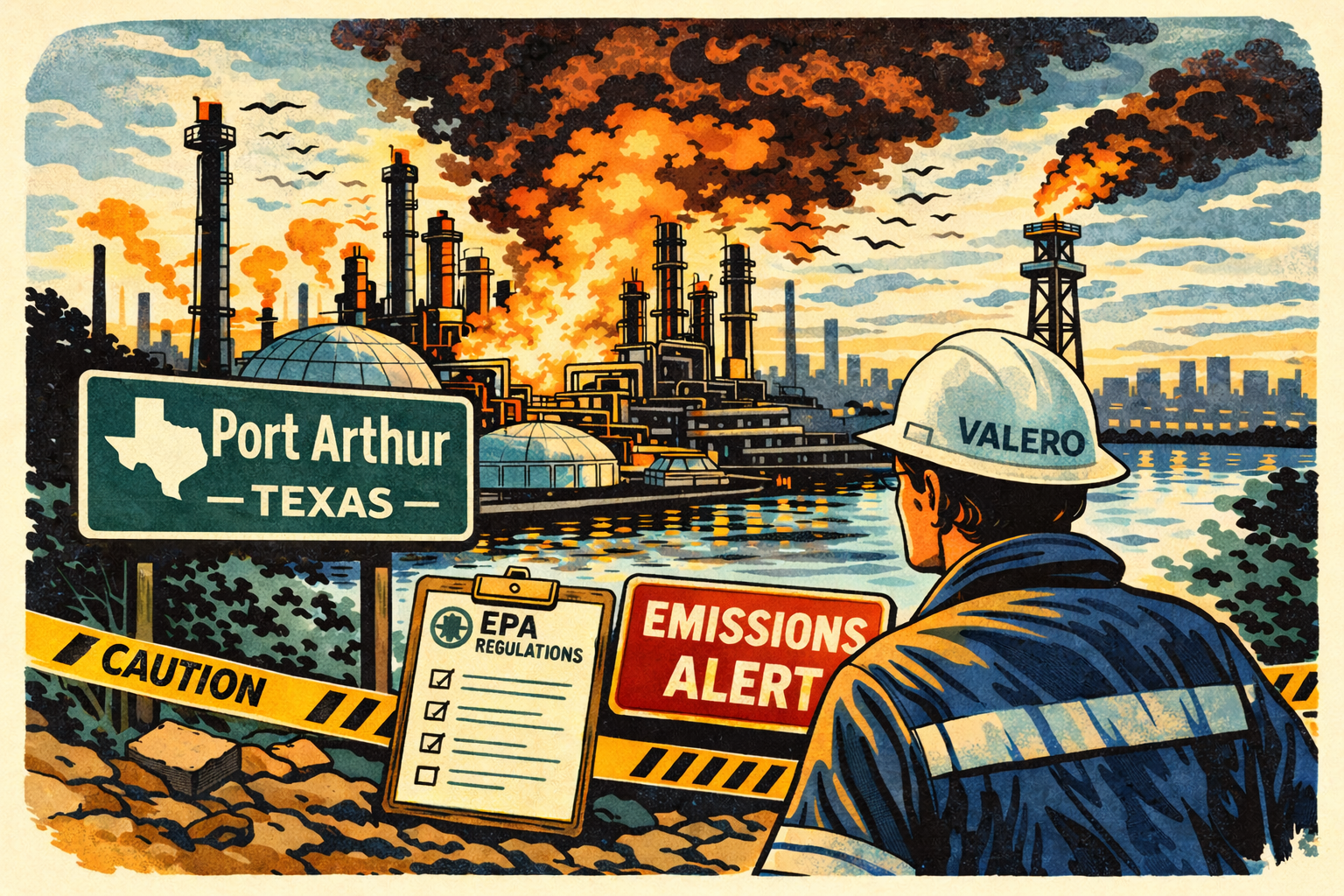
The Valero Port Arthur blast refers to the March 23, 2026, explosion and fire at Valero’s Port Arthur refinery in Port Arthur, Texas. The story is now less about the blast video and more about what still constrains the plant: restart mechanics, lost utilities, emissions accounting, diesel sulfur compliance, litigation exposure, and the broader importance of a site that sits at the intersection of conventional refining and lower-carbon fuel production.

(Exterior view of Valero’s Port Arthur refinery on the Texas Gulf Coast.) “The March 23 blast hit one of Valero’s most important Gulf Coast refining assets, a site that links conventional fuel production, logistics, and lower-carbon fuel investment.”
“The March 23 blast hit one of Valero’s most important Gulf Coast refining assets, a site that links conventional fuel production, logistics, and lower-carbon fuel investment.”
The most useful way to read the incident is to separate the three layers of information. First, there is what has been publicly confirmed about the shutdown, the damaged unit, and the restart sequence. Second, there is what the Texas Commission on Environmental Quality has published in its emissions-event system. Third, there is what remains an allegation, inference, or still-pending investigation. That distinction matters because early industrial-incident coverage often compresses those layers into a single narrative, even though they do not yet deserve equal weight.
For a broader context on petroleum-market disruption and refining risk, explore our oil and gas coverage.

As of April 6, 2026, the most significant official update is that TCEQ’s public incident page for Incident 455167 still lists the event as OPEN, with the report type set to INITIAL. This indicates that the most detailed public regulatory record is already available, but it is not the same as a final root-cause narrative. Meanwhile, Reuters has provided unusually specific reporting on the restart sequence, local and regional outlets have added details about litigation and claims handling, NOAA has documented the Coast Guard’s plume-model request and waterway inspections, and Valero’s own public materials continue to frame Port Arthur as one of the company’s key refining and low-carbon fuel hubs.
Enjoying our insights?
Subscribe to our newsletter to keep up with the latest industry trends and developments.
Stay Informed
Currently, the absence of a newer official cause narrative is not surprising. TCEQ states that a final emissions-event report is due within 14 days of the event’s end time, which was March 25 at 6:25 a.m., making April 8 the next likely public filing deadline unless the record is updated sooner.
What changed after the first wave of coverage
| New detail | What it adds | Why it matters |
|---|---|---|
| TCEQ Incident 455167 still shows OPEN / INITIAL as of April 6 | A current regulator-facing status marker, affected-unit list, duration window, and emissions totals | Shows the official record is detailed but not yet final |
| April 8 is the next obvious TCEQ filing checkpoint | Using TCEQ’s 14-day final-report rule and the event’s posted March 25 end time | Explains why the public record still looks preliminary today and when it may become more complete |
| Public TCEQ line-item emissions totals | Estimated pollutant loads by emission point, including DHT-243 fugitives, flares, and SCOT units | Moves the story from “fire and shutdown” to compliance and accountability |
| Restart sequencing is reported in detail | Feed lines to Unit 243 blocked; natural gas restored; flares and boilers relit; steam rebuilt; other units warmed before feed returns. | Explains why “restart” does not mean immediate rack normality |
| Unit 243 is expected to remain down while the rest of the refinery restarts around it | A partial-outage framework rather than an all-or-nothing restart | Keeps attention on diesel cleanup and spec-management risk |
| NOAA / U.S. Coast Guard response details | Plume-model support and nearby waterway observations after the fire were secured | Adds a federal-response context important to marine logistics and public communications |
| Claims hotline and lawsuit activity | A worker suit, resident litigation, and a company claims channel all surfaced quickly. | Signals that the incident now has a legal and reputational second life |
| EPA RMP rule comment period extended to May 11, 2026 | The event is unfolding against an active chemical-accident rulemaking backdrop | Raises the policy relevance of what emerges from the case |
| April 30, 2026, earnings call is the next likely formal company checkpoint | A scheduled corporate disclosure date remains on the calendar | Offers a practical next checkpoint for readers watching for broader operational commentary |
What caused the blast, and what is actually confirmed right now?
The most direct regulator-facing description remains the operator’s TCEQ filing. In that filing, the initiating event is described as “an unforeseeable release of process fluid in Complex 2” that led to an ignition event and “multiple process unit upsets.” That wording is important. It is the public initial narrative supplied through the emissions-event reporting process, but it is not yet a published final root-cause report. As of April 6, the same TCEQ incident page still shows the event as open and the report type as initial.
The most widely cited operational reporting still points to the same damaged unit: Reuters reported that the explosion and fire were associated with the 47,000-barrel-per-day Unit 243 diesel hydrotreater. Reuters also reported that the full refinery shutdown was deemed necessary during the emergency response, in part because the site lost steam and water while firefighters worked to contain the event. That detail matters because it means the blast did not stay a simple single-unit upset. It quickly became a refinery-wide utilities-and-restart-management problem.
Another point is the capacity discrepancy that continues to appear across reputable sources. Valero’s own Port Arthur refinery page lists the site at 435,000 barrels per day and about 770 employees. Reuters’s coverage of the incident repeatedly cited 380,000 barrels per day. The most reasonable explanation is that different outlets may be using different capacity standards, which is common in refining. What matters commercially is that Port Arthur is clearly one of Valero’s largest and most important sites, regardless of which shorthand figure is used in a headline.
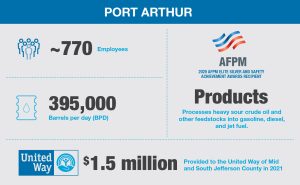
(Valero’s fast-facts graphic for the Port Arthur refinery.) “Even before the incident’s final regulatory record is complete, the site’s size and Gulf Coast role explain why the blast drew immediate attention across fuel markets.”
“Even before the incident’s final regulatory record is complete, the site’s size and Gulf Coast role explain why the blast drew immediate attention across fuel markets.”
For more reporting on capacity shocks and regional outage patterns, see our coverage of refineries.
There is also a confirmed federal-response context. NOAA’s incident log says the U.S. Coast Guard’s Marine Safety Unit in Port Arthur requested a plume model through the Interagency Modeling and Atmospheric Assessment Center. NOAA also reported that on the morning of March 24, after the fire was extinguished and the source secured and compartmentalized, responders checked the waterway and found no petroleum products, chemicals, or fire foam. For readers concerned with marine movements, dock operations, or off-site contamination signals, that is a useful official data point.
For more reporting tied to Texas operations and regional developments, browse our Texas coverage.
What remains unconfirmed in the strict sense is final causation. Lawsuits and local reporting have introduced claims that do not fully align with the earliest operator-and-wire-service framing, including disputes over the exact origin point and differing narratives on injuries. Those differences should not be ignored, but they should be treated as developing claims until the investigation record narrows them.
Operational impact and why restart is not a binary event
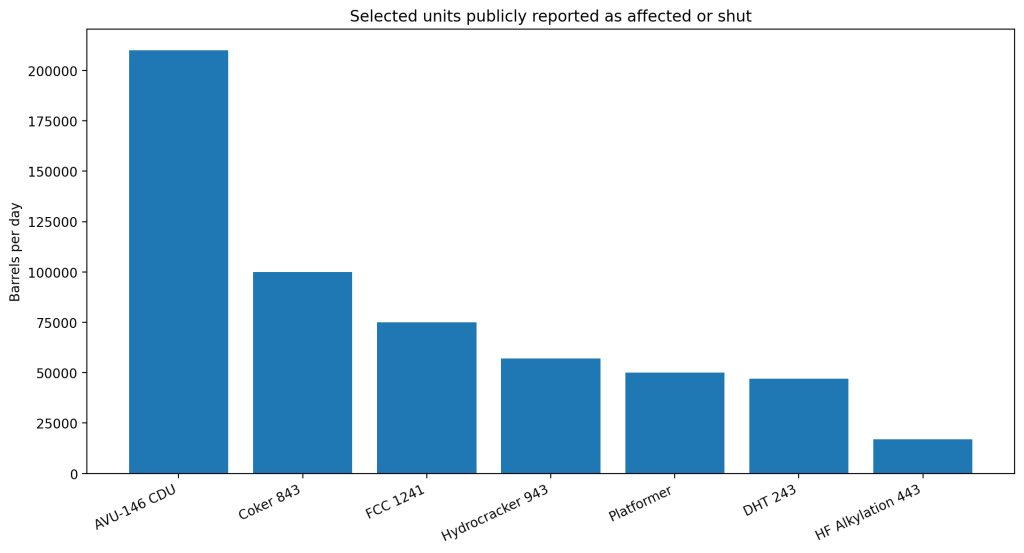
(Selected Port Arthur refinery units publicly reported as affected or shut after the March 2026 incident. Capacities shown are publicly reported unit capacities, not a complete refinery unit inventory.)
The single most useful operational lesson from the Valero Port Arthur blast is that refinery status is not binary. A refinery is not simply “down” one day and “back” the next. The full shutdown, the restart, and the return to specification-quality product are separate stages. Reuters’ public reporting on the Port Arthur restart was unusually specific, which makes it especially useful for trade readers and supply-chain operators.
According to Reuters’ reporting, workers first had to isolate the damaged hydrotreater by blocking the pipelines feeding Unit 243. Once that was done, the refinery could restore natural gas, relight the safety flares and boilers, rebuild steam, return other production units to temperature, and only then begin reintroducing feedstock. Even after feed returns, the plant still has to bring output into specification before those barrels are truly normal commercial barrels. That sequence explains why a headline saying “restart begins” can coexist with days of operational friction at the rack or in wholesale supply.
That framing also clarifies why the refinery’s loss of steam and water was so important. Steam supports a wide range of refinery operations. Water is critical for firefighting, cooling, cooling towers, and, in many cases, for the steam system itself. Once those utilities are disrupted beyond safe limits, the conservative response is a broader shutdown, not a narrow wait-and-see approach.
Reuters’ later reporting considerably broadened the unit picture. Public reporting described not just the 47,000-bpd diesel hydrotreater but also a larger crude distillation unit, the fluid catalytic cracker, the alkylation unit, the platformer, the hydrocracker, the coker, other hydrotreaters, sulfur recovery units, and a saturated gas recovery unit as being part of the outage footprint. That breadth matters because a refinery’s commercial flexibility is not determined by crude input alone. It also depends on its ability to crack, reform, alkylate, hydrocrack, desulfurize, and recover sulfur across multiple intermediate and finished-product pathways.
“The outage footprint reported after the blast extended beyond one unit, underscoring how tightly linked the refinery’s conversion, treating, and sulfur-handling systems are.”
| Unit or system | Publicly described role | Publicly reported status after the incident |
|---|---|---|
| Diesel Hydrotreater 243 | Key diesel desulfurization pathway for ULSD-quality barrels | Damaged unit; expected to remain down while the rest of the refinery restarts around it |
| AVU-146 crude distillation unit | Primary front-end splitter feeding downstream conversion and treating systems | Reported shut during the outage footprint |
| FCC 1241 | Major gasoline blendstock and LPG generator | Reported shut during the outage footprint |
| Hydrocracker 943 | Important distillate and middle-distillate upgrading unit | Reported shut during the outage footprint |
| Coker 843 | Resid conversion into lighter streams and petroleum coke | Reported shut during the outage footprint |
| Hydrofluoric alkylation unit 443 | High-value gasoline blending component production | Reported shut during the outage footprint |
| Platformer | Octane support for gasoline blending | Reported shut during the outage footprint |
| Sulfur recovery units and SCOT units | Sulfur handling and sulfur-emissions management | Multiple units are listed in the public emissions event detail |
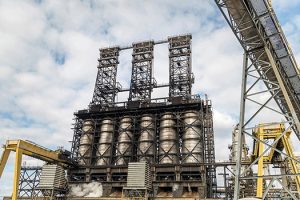
(Valero’s Port Arthur coker unit, as shown in the company’s refinery-projects material.) “The outage footprint reported after the blast extended beyond one unit, underscoring how tightly linked the refinery’s conversion, treating, and sulfur-handling systems are.”
The diesel hydrotreater deserves special attention because it is not just another processing unit. Hydrotreaters use hydrogen to remove sulfur so finished fuels meet environmental requirements. That means the outage risk is not simply fewer diesel barrels. It is also the possibility of a sulfur-compliance bottleneck. In other words, the problem can become a “spec wall” before it becomes a broad and obvious physical shortage.
That distinction matters for buyers, carriers, and terminal operators. A refinery can be partially back, crude can be moving again, and yet diesel quality management can still be tight if the relevant hydrotreating pathway remains offline. That is exactly why the condition of Unit 243 matters so much more than the dramatic images from the night of the fire.
Emissions, monitoring, and the public regulatory record
The emissions record is where the latest public details become especially useful. TCEQ’s incident page for Incident 455167 lists the event as an emissions event, shows the discovery time as March 23 at 6:25 p.m., the end time as March 25 at 6:25 a.m., and the total duration as 36 hours. It also names affected complexes and listed units, including the crude unit, FCC, hydrocracker, multiple hydrotreaters, the hydrofluoric alkylation unit, sulfur recovery units, and the saturated gas recovery unit.
That same incident page goes well beyond naming units. It includes emission-point level totals for specific pollutants. The DHT-243 fugitives line alone lists 15,644.7 pounds of particulate matter, 6,111.38 pounds of carbon monoxide, 914 pounds of unspeciated VOCs, 177.85 pounds of sulfur dioxide, and a small reported amount of hydrogen sulfide. Separate flares and SCOT units add thousands of pounds more sulfur dioxide, plus additional VOC and hydrogen sulfide releases.
For additional detail on emissions-related enforcement, air-quality pressure, and compliance fallout, browse our emissions coverage.
There is a crucial nuance in the TCEQ record that deserves attention. The public incident detail says the basis for the emissions estimates includes CEMS, analyzers, flow meters, and engineering estimates. It also states that while the event was substantially concluded, a small amount of intermittent emissions continued, and the reported totals had been adjusted to reflect estimated future emissions. For industry readers, that line is significant. It tells you the public totals are not a raw snapshot from the first few minutes of the incident. They are already part accounting exercise, part estimate, and part continuing-event projection.
| Emission point | Pollutant | Estimated quantity reported | Why it stands out |
|---|---|---|---|
| DHT-243 fugitives | Particulate matter | 15,644.7 pounds | The largest single headline number in the public record is a useful proxy for combustion intensity |
| DHT-243 fugitives | Carbon monoxide | 6,111.38 pounds | A major combustion byproduct that signals incomplete combustion during the event |
| DHT-243 fugitives | VOC (unspeciated) | 914 pounds | Important to community-health discussion, but not chemically specific in the public line item |
| Flare 23 | Sulfur dioxide | 7,300 pounds | Shows that sulfur emissions were not limited to the initially damaged unit area |
| Flare 26 | Sulfur dioxide | 5,300 pounds | Another large sulfur-emissions point during the upset window |
| Flare 22 | Sulfur dioxide | 3,600 pounds | Reinforces the broad upset footprint across flaring systems |
| Flare 103B | Sulfur dioxide | 3,400 pounds | Further evidence that the event’s emissions profile extended beyond one release point |
| SCOT V | Sulfur dioxide | 979.03 pounds | Shows sulfur-control-related emissions were part of the event record as well |
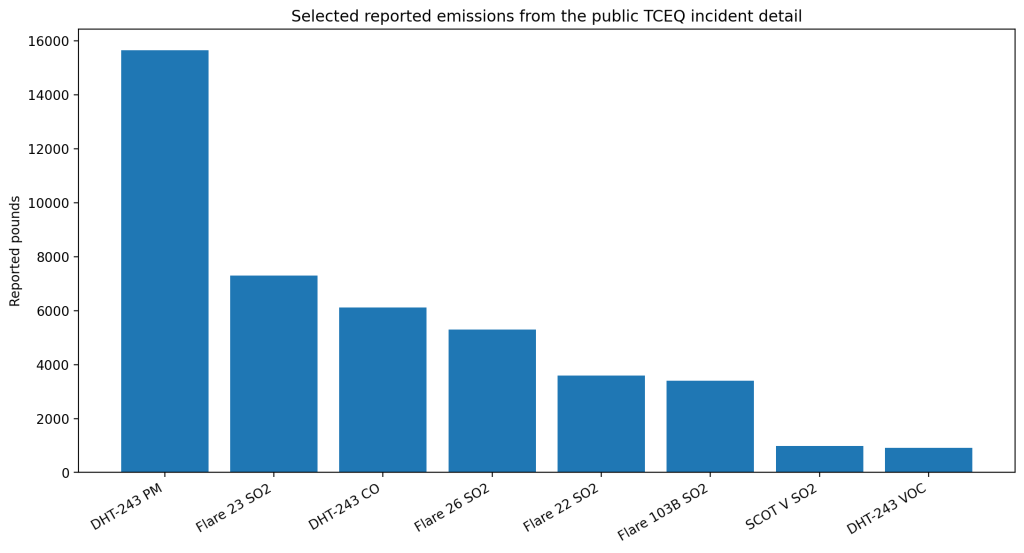
(Selected reported emissions from the public TCEQ incident detail for the Valero Port Arthur event. This chart highlights several of the largest publicly listed quantities rather than the full emissions inventory.)
One of the most important points of communication in this story is the difference between air-monitoring reassurance and emissions-event totals. Local reporting quoted company messaging that air monitoring by Valero, local responders, and TCEQ showed no immediate concerns after the fire was under control. That kind of statement can be true at the same time, the public emissions-event record still shows large unauthorized releases during the broader event window. Those are not necessarily contradictory statements. They address different questions: what nearby monitors showed at a given point in time versus what the operator and regulator later estimated was released over the entire incident period.
That difference matters for community relations, risk communication, and, eventually, litigation. It also matters editorially. Articles that treat “no immediate concerns from monitoring” as if it erases the emissions-event accounting oversimplify the story. Likewise, articles that quote line-item release totals without noting that these are event-report estimates can oversimplify it in the opposite direction.
For more on environmental consequences and related reporting, explore our environmental coverage.
How the blast can affect diesel, gasoline, and jet fuel supply chains
The Port Arthur refinery matters because it is built for both large-scale refining and broad distribution. Valero’s facility description says crude arrives by rail, marine docks, and pipelines, while products move out through pipelines, ships, and barges. That means disruptions can transmit through several distribution channels at once. Lost barrels are one part of the story. The other part is how those barrels would have moved if the plant had been running normally.
Diesel remains the most sensitive product stream in this case because of Unit 243’s role. Ultra-low sulfur diesel compliance is unforgiving. If a major diesel hydrotreater is offline, the refinery may face a hard constraint on the amount of compliant distillate it can produce, reroute, or finish. That can drive reliance on alternate hydrotreating capacity, third-party barrels, swaps, or yield shifts. Even when a broader refinery restart is underway, the distillate side of the commercial equation can remain tight if the relevant cleanup unit remains unavailable.
For related reporting on ULSD pressures, diesel supply, and fuel-market volatility, read our diesel fuel coverage.
Gasoline is absorbed through a different path. Reuters’ reporting indicated the FCC, alkylation unit, and platformer were among the units down in the outage footprint. Those units are deeply important to octane management and gasoline blending economics. A refinery can therefore face gasoline limitations that are less about crude throughput than about the ability to generate and balance the right blend components.
Jet fuel sits somewhere between those two. It is not identical to ULSD from a sulfur-regulation perspective, but it is still influenced by hydroprocessing capacity, hydrogen balance, and middle-distillate optimization. The presence of the kerosene hydrotreater in the TCEQ incident details is relevant here because it indicates that kerosene-range treatment capacity was part of the broader upset landscape.
For rack buyers, dispatchers, and carriers, the practical implication is straightforward: the first commercial sign of a refinery incident often appears as friction rather than as an outright public shortage headline. That can mean longer wait times, changes in terminal behavior, less predictable availability windows, heavier use of alternate terminals, more deadhead miles, more partial-load optimization, and greater sensitivity to specification issues.
As of April 6, the public record does not add a newer unit-by-unit restart status beyond the late-March Reuters reporting. For trade readers, that means the same working assumption still holds: most of the plant may be returning, but Unit 243 remains the unit to watch if the question is diesel cleanup and rack normality rather than headline “restart” optics.
What rack buyers, carriers, and counterparties should watch next
- Watch the “in-spec” timeline, not just the restart headline. The commercial question is when a stable, specification-quality product is available, not merely when furnaces are lit again.
- Separate “barrels available” from “barrels deliverable.” Tank quality, interface management, pipeline nomination timing, dock constraints, and third-party terminal limits can all distort what the public considers “back online.”
- Expect diesel sensitivity to outlast the first restart headlines. A hydrotreater remaining down can keep distillate markets tight even if other units are back.
- Use TCEQ and NOAA records as operational breadcrumbs. The public emissions detail and federal incident log can help readers infer how broad the upset footprint was and where attention may remain focused.
- Treat lawsuit-origin claims carefully. Competing descriptions of the origin point or related damage can affect downtime expectations if they later prove material, but they are not yet a final process-history record.

(A refinery firefighter and fire truck featured in Valero’s site-safety imagery.) “The public story has moved beyond the initial fire to questions of plant safety, emissions accounting, restart discipline, and what later investigations may reveal.”
“The public story has moved beyond the initial fire to questions of plant safety, emissions accounting, restart discipline, and what later investigations may reveal.”
Litigation, claims, and the public’s second life of the incident
The legal side of the story accelerated quickly. Reuters reported that refinery worker Jonathan Jaimes filed suit seeking more than $1 million, alleging injury and inadequate maintenance and safety measures. Regional reporting also described at least two lawsuits, including a potential resident class action tied to property damage and emotional distress. The same reporting said Valero set up a claims hotline, which is a useful practical detail for affected residents, insurers, and counterparties tracking response logistics.
For more on legal fallout and industry disputes, see our lawsuits coverage.
Local reporting from Beaumont added another layer: early evidence-preservation activity and competing legal strategies. One firm sought a temporary restraining order to preserve evidence related to the incident, while another pursued a mass-tort approach. Community meetings were also quickly organized, with residents seeking information on health concerns, property damage, documentation, and legal options. That is often the moment when a refinery incident shifts from being a fence-line event to being a longer-running public dispute over process safety, disclosure, health effects, and accountability.
The tension between early company messaging and later legal claims is worth stating plainly but carefully. Initial public statements emphasized that all personnel were accounted for and that there were no recordable injuries. Later lawsuits alleged significant physical and psychological injuries. Both statements can exist in the record at different times without the contradiction being fully resolved yet. For a journalist or industry analyst, the right approach is not to flatten that tension. It is important to note it clearly and let the record evolve.
For operational readers, the litigation matters for another reason. Discovery can surface maintenance history, inspection records, control-room evidence, alarm history, reliability concerns, and prior warnings that are not visible in first-day emergency statements. In many industrial incidents, the real second phase of public understanding begins not with the fire itself but with the records that later emerge in lawsuits and investigations.
Why Port Arthur matters inside Valero’s wider system
Port Arthur matters not only because it is large, but because it sits inside a broader company strategy that combines conventional fuels, heavy-sour refining capability, renewable diesel, and sustainable aviation fuel. Valero’s investor materials state that the company owns 15 petroleum refineries with a combined throughput capacity of roughly 3.2 million barrels per day. The same materials say Valero participates in Diamond Green Diesel, which has about 1.2 billion gallons per year of low-carbon fuel capacity in the Gulf Coast region, alongside a large U.S. ethanol platform.

(Hero image from Darling Ingredients’ SAF announcement tied to Diamond Green Diesel and Port Arthur supply.) “Port Arthur is not just a refining site; it also sits inside Valero’s wider renewable diesel and SAF buildout, which raises the broader strategic stakes of any disruption there.”
“Port Arthur is not just a refining site; it also sits inside Valero’s wider renewable diesel and SAF buildout, which raises the broader strategic stakes of any disruption there.”
For a broader context on market ripple effects across the petroleum and refined products sectors, visit our fuel industry coverage.
That context makes Port Arthur more than just another refinery in the system. Valero’s Port Arthur facility page says the site is adjacent to one of the company’s two renewable diesel plants. Valero also says the SAF project at the Port Arthur renewable diesel plant was completed in the fourth quarter of 2024. In other words, Port Arthur is a conventional refining asset, a logistics asset, and a low-carbon fuels asset at the same time.
Valero’s 2024 full-year results stated that the DGD Port Arthur SAF project was completed and fully operational, giving the plant the option to upgrade approximately 50 percent of its current 470 million-gallon annual renewable diesel production capacity for blending into SAF. Darling Ingredients, Valero’s 50/50 joint-venture partner in DGD, later said the Port Arthur facility completed its first marine shipment of neat SAF in November 2024 and that the first delivery followed in December 2024. That wider industrial context helps explain why Port Arthur attracts attention beyond refining circles alone.
It also means the reputational stakes are higher. A serious refinery incident at a site that also symbolizes future-facing fuel projects can reverberate across several narratives at once: conventional reliability, community trust, environmental stewardship, and energy-transition credibility. None of that changes the immediate operational facts of the explosion. But it does change the size of the audience watching what happens next.
The next likely formal checkpoint for company-level commentary is April 30, 2026, when Valero is scheduled to report first-quarter results and host its earnings call. Whether the company chooses to give a broader repair or operational context at that point remains to be seen, but it is the clearest scheduled date on the calendar for readers who want more than emergency-response statements and anonymous-sources reporting.
Timeline of key public developments
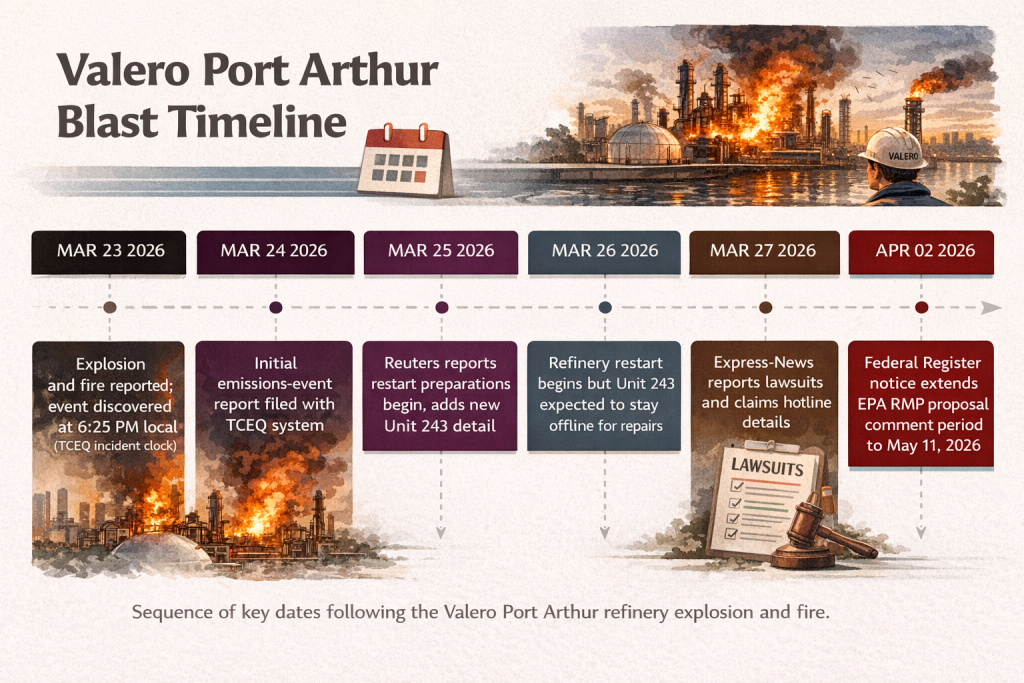
(Timeline of major events following the Valero Port Arthur refinery blast, from the initial explosion and emissions reporting to restart activity, litigation, and regulatory developments.) “The Port Arthur blast quickly moved from an emergency response event into a multi-phase story shaped by restart constraints, emissions reporting, and legal and regulatory fallout.”
“The Port Arthur blast quickly moved from an emergency response event into a multi-phase story shaped by restart constraints, emissions reporting, and legal and regulatory fallout.”
| Date | Public development | Why it matters |
|---|---|---|
| March 23, 2026 | Explosion and fire at Valero’s Port Arthur refinery; temporary shelter-in-place issued | Marks the start of the incident and off-site public-safety response |
| March 24, 2026 | TCEQ incident filed; fire reported extinguished; shelter order lifted; NOAA logs Coast Guard plume-model request and waterway checks | Moves the event from immediate emergency response into the public regulatory record |
| March 25, 2026 | Reuters reports a detailed restart sequence and Unit 243 isolation work | Clarifies why the restart is staged and why product quality can lag the headline |
| March 26, 2026 | Worker lawsuit reported; Reuters says the refinery is restarting around Unit 243 | Begins the legal phase and confirms a partial-outage operating framework |
| March 27–29, 2026 | Regional reporting details claims handling, resident suits, evidence-preservation efforts, and community meetings. | Shows the incident has become a community, legal, and reputational story |
| April 2, 2026 | Federal Register extends EPA RMP proposal comment period to May 11, 2026 | Places the incident within an active chemical-accident rulemaking backdrop |
| April 6, 2026 | TCEQ public incident page still shows OPEN / INITIAL | Confirms that the public emissions-event record remains active and not yet final |
| April 8, 2026 | Next obvious TCEQ final-report checkpoint, based on the posted event end time and the agency’s 14-day rule | Likely next date for the public regulatory record to become more complete, unless updated sooner |
| April 30, 2026 | Valero is scheduled to report first-quarter 2026 results | Potential next checkpoint for broader company commentary |
Bottom line
The most disciplined way to summarize the Valero Port Arthur blast is this: it was serious enough to shut one of Valero’s most important refining sites, broad enough to take down or disrupt major conversion and treating units, and detailed enough in the public record to move well beyond a simple “refinery fire” headline. The story now sits at the intersection of operations, emissions, logistics, litigation, and corporate strategy.
At the same time, the current public record still has limits. The TCEQ page is detailed but still open and still marked initial. Lawsuits have added competing narratives and sharper allegations, but those remain allegations until the investigative record or discovery process clarifies them. Air-monitoring assurances and large event-emissions totals can both exist in the same record without canceling each other out. And a restart underway is not the same thing as a refinery being fully back to normal commercial performance.
For a rack, terminal, dispatch, or refining reader, the practical focus should remain on three questions. How stable is the restart around Unit 243? How much does the hydrotreater outage continue to constrain diesel cleanup and finished-product flexibility? And what do later regulatory filings, litigation records, or company disclosures reveal about maintenance, causation, and recovery time? Those questions will determine whether this event is ultimately remembered as a serious but contained upset or as a case study in wider refinery-risk management.
Official Records, Company Sources, and Referenced Reporting
- Texas Commission on Environmental Quality incident detail for Incident 455167 — Review the regulator-facing incident record, including event timing, listed units, status, and reported emissions totals tied to the Port Arthur refinery blast.
- TCEQ Air Emissions and Maintenance Events program page — Understand how Texas handles emissions-event reporting, including filing requirements, update timing, and final-report expectations.
- NOAA IncidentNews entry for the Port Arthur refinery explosion — See the federal response summary, including the Coast Guard plume-model request and reported post-fire waterway observations.
- Valero Port Arthur Refinery facility profile — Explore Valero’s official overview of the Port Arthur site, including capacity, logistics, core products, and adjacent Diamond Green Diesel and SAF operations.
- Valero renewable diesel and SAF overview — Learn more about Valero’s low-carbon fuels platform, including Port Arthur’s renewable diesel and SAF positioning.
- Valero company history and operations overview — Find broader context on Valero’s refining footprint, low-carbon fuels investment, and overall petroleum and renewables strategy.
- Valero investor notice for first-quarter 2026 earnings — Track the next scheduled corporate update that could provide broader commentary on operations, repairs, or commercial impacts.
- Federal Register notice on EPA’s Risk Management Program comment-period extension — Review the latest federal rulemaking notice extending comments on EPA’s proposed chemical accident prevention revisions.
- U.S. Chemical Safety Board’s current investigations page — Check whether the Port Arthur incident appears on the CSB’s active investigation list as the case develops.
- Reuters report on the initial refinery shutdown — Read the first detailed account of the blast, the diesel hydrotreater involvement, the shelter-in-place, and the full-site shutdown.
- Reuters report on the Port Arthur restart sequence — Follow the reported restart mechanics, including Unit 243 isolation work, utility restoration, and the staged return toward in-spec production.
- Reuters report on the worker lawsuit — See the early legal framing around alleged injuries, maintenance questions, and negligence claims tied to the incident.
- San Antonio Express-News coverage of resident and worker litigation — Review regional reporting on lawsuits, claims handling, and the expanding legal fallout after the blast.
- Beaumont Enterprise reporting on community response and legal organizing — Follow local reporting on evidence-preservation efforts, resident meetings, and the broader community response in Port Arthur.
- Valero 2024 fourth-quarter and full-year results — Use this company filing for official details on Port Arthur’s SAF project status and Valero’s broader operational backdrop before the incident.
- Darling Ingredients update on the first marine shipment of neat SAF from Port Arthur — See partner-company confirmation of SAF shipment milestones tied to the Diamond Green Diesel Port Arthur complex.
- Darling Ingredients update on the first SAF delivery from DGD Port Arthur — Review the next milestone in the Port Arthur SAF rollout for context on why the site matters beyond conventional refining.