- California Clean Truck Check is now a split-enforcement story: EPA finalized a partial disapproval for out-of-state and out-of-country trucks, but CARB’s March 10, 2026 update still says subject vehicles registered outside California must report, pay annual fees, and submit passing emissions tests when operating in the state.
- For interstate tanker fleets, the real issue is no longer just emissions testing. It is the widening gap between federal enforceability for California-registered trucks and California’s continued state-level compliance position at customer sites, terminals, and gate checks.
- EPA says California lacked the required Clean Air Act assurances to extend the rule to pass-through trucks, while CARB’s enforcement materials still reference roadside monitoring, CHP inspections, and possible port or railyard access restrictions for non-compliant vehicles.

EPA changed the federal footing of Clean Truck Check, but the program still sits squarely in the workflow of fleets that operate in California.

Clean Truck Check disapproval and the interstate tanker compliance fallout
Clean Truck Check disapproval: what happened and why fleets care
The Clean Truck Check disapproval is a federal Clean Air Act planning action that changed the federal status of California’s heavy-duty emissions inspection and maintenance program, but did not end the program itself. The final action—issued by the U.S. Environmental Protection Agency—partially approved and partially disapproved California’s State Implementation Plan (SIP) submission for the Heavy-Duty Inspection and Maintenance (HD I/M) regulation (often branded by California as “Clean Truck Check”).
The dispute also fits into the broader debate over California truck emissions standards and how far one state’s truck rules can shape national fleet operations.
For tanker fleets, the Clean Truck Check disapproval matters because the controversy hits the precise operational reality of interstate trucking: equipment that runs into, through, or briefly touches California can still face gate checks, roadside encounters, customer “proof” demands, and contract language that assumes Clean Truck Check is a universally applicable rule. Meanwhile, the federal action creates a new, highly usable (but easy-to-misstate) message for compliance teams: EPA made the rule federally enforceable for California-registered vehicles, and rejected SIP approval for out-of-state/out-of-country vehicles.

The most important detail for day-to-day planning is this: the federal action is about SIP approval and federal enforceability. California’s own regulator maintains that the program’s requirements remain in effect under state law for vehicles operating in California, including vehicles registered outside California—while emphasizing that EPA’s SIP decision affects California’s ability to claim emissions-reduction “credit” from out-of-state vehicles for federal air-quality planning.
That broader rulemaking context continues to evolve in Tank Transport’s Regulations & Compliance News.
Clean Truck Check disapproval: the final EPA action, dates, and codification
The Clean Truck Check disapproval is documented as a final rule in the Federal Register titled “Air Plan Revisions; California; Heavy-Duty Vehicle Inspection and Maintenance Program.” The final rule was signed January 27, 2026 by Michael Martucci and published February 6, 2026, with an effective date of March 9, 2026.
In the Federal Register summary, EPA states it is “taking final action to partially approve and partially disapprove” California’s SIP revision “relating to the control of emissions from non-gasoline combustion vehicles over 14,000 pounds.”
EPA’s partial approval makes the HD I/M regulation “federally enforceable as part of the California SIP with respect to vehicles registered within the State.” EPA’s partial disapproval applies “to the extent that the HD I/M Regulation purports to apply to out-of-state vehicles,” because California did not provide adequate “necessary assurances” under Clean Air Act section 110(a)(2)(E)(i) that SIP implementation is not prohibited by federal law. EPA also states the partial disapproval does not trigger Clean Air Act section 179 sanctions because the submission is not a required SIP submission under section 110(a)(2).
That limitation is now codified in the CFR. The eCFR entry at 40 CFR 52.249 states that EPA’s approval of California’s Heavy-Duty Vehicle Inspection and Maintenance Program “is limited to vehicles registered in the State of California.”
In addition, EPA notes that petitions for judicial review of this action must be filed by April 7, 2026 in the appropriate U.S. Court of Appeals, and the action generally cannot be challenged later in enforcement proceedings.
What exactly did the Clean Truck Check disapproval approve and disapprove?
EPA’s final rule describes the California submission as a SIP revision filed on December 14, 2022, by the California Air Resources Board. EPA lists the submitted regulatory sections: amended 13 CCR 2193 and numerous newly added sections in the 13 CCR 2195–2199.1 range, plus incorporation by reference of California standards for heavy-duty remote on-board diagnostic devices (OBD Standards).
What EPA approved (federally enforceable SIP scope): EPA states that approval is limited to “vehicles registered within the State,” and the regulatory addendum implements that limitation by amending 40 CFR part 52 and adding the new CFR section that expressly limits SIP approval to California-registered vehicles.
What EPA disapproved (SIP scope): EPA disapproved the SIP submission “to the extent that the HD I/M Regulation purports to apply to out-of-state vehicles,” and EPA’s framing repeatedly includes both out-of-state and out-of-country registration (a key point for Mexico/Canada-linked freight patterns and foreign-registered equipment that might traverse California).
EPA’s legal rationale (high-level): EPA argues California did not provide “necessary assurances” that implementing the SIP-based rule on out-of-state/out-of-country vehicles would not be prohibited by federal law, pointing specifically to Commerce Clause concerns and also raising foreign-affairs power concerns over rules applied to vehicles from other countries.
EPA’s operational framing is unusually direct for a SIP action: it describes the out-of-state reach as effectively forcing interstate shippers to treat California’s regime as a national standard, because “proactive compliance” may be the only practical way to avoid noncompliance and penalties in the state. EPA even illustrates the scenario with examples like trucks shipping apples from Washington to Arizona, or export goods from Texas to Pacific ports, becoming obligated merely by passing through California.
EPA’s cost/burden narrative: EPA points to CARB’s staff analysis that the HD I/M regulation will cost $4.12 billion between 2023 and 2050, with a maximum annual cost of $350 million in 2024, and argues that California’s SIP approach improperly weighs localized in-state benefits against costs imposed nationwide through the out-of-state reach.
Fleets comparing this dispute with other looming diesel-policy milestones may also want to monitor the EPA 2027 NOx rule, which remains a separate but closely watched compliance track.
EPA also highlights comments from industry groups—including National Tank Truck Carriers—about feasibility and uncertainty, and clarifies (in response to NTTC) that the HD I/M rule does not and cannot expand the scope of other California truck rules, even though those other rules were discussed in comments.
Does the Clean Truck Check disapproval stop California enforcement in practice?
The short operational answer is that California’s regulator says no—and this is one of the most actionable “new details” you can use to correct confusion in customer conversations.
CARB publicly states that EPA’s partial SIP disapproval “only means that the state cannot credit the portion of emissions reductions from out-of-state vehicles as part of meeting federal air quality standards,” and that EPA’s decision “does not extend to determining, or enforcing, any part of Clean Truck Check” for vehicles operating in California, including those registered outside California.
CARB reinforced this position again in March 2026 postings: it states that Clean Truck Check requirements are in effect for “subject vehicles,” including vehicles registered outside California when operating in the state, to report, pay the annual compliance fee, and submit passing emissions tests.
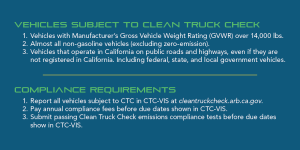
For interstate tankers, the real question is whether each VIN can still be shown as compliant when a customer, terminal, or broker asks for proof.
This “federal vs. state” split explains why many industry writeups say the rule remains effectively “in force” for out-of-state trucks in California while noting EPA’s federal limitation.
From a tanker-fleet risk lens, the Clean Truck Check disapproval therefore does not remove the day-to-day probability of California enforcement interactions if the fleet’s tractors or straight trucks operate in California. What it changes is (a) the federal enforceability status and (b) the way California can claim SIP credit for out-of-state vehicles, which can feed second-order regulatory pressure (e.g., California needing other measures to make up a shortfall in creditable reductions).
Related day-to-day developments across inspections, documentation, and state-federal compliance friction are also tracked in our Compliance coverage.
Clean Truck Check disapproval and federal enforceability: where EPA can enforce
The Clean Truck Check disapproval creates a clean operational line that compliance teams should understand precisely:
For California-registered vehicles: EPA’s partial SIP approval makes the HD I/M regulation federally enforceable “as part of the California SIP” for vehicles registered within California. In practice, federally enforceable SIP provisions can be enforced by EPA and may also be subject to Clean Air Act citizen-suit enforcement mechanisms (a risk category fleets often overlook when they assume all enforcement is “just CARB”).
For out-of-state and out-of-country vehicles: EPA did not approve SIP coverage “to the extent” the regulation purports to apply to vehicles registered outside California, citing the lack of “necessary assurances” tied to federal-law constraints (explicitly including Commerce Clause issues) and also referencing foreign-affairs authority concerns regarding vehicles from other countries.
This distinction is embedded in the CFR itself: 40 CFR 52.249 declares the SIP approval is limited to vehicles registered in California.
What fleets should take from this: the Clean Truck Check disapproval does not mean “out-of-state trucks are automatically free and clear in California.” It means that the federal SIP approval and federal enforceability line stops at California registration, while California’s regulator continues asserting state-law applicability for all vehicles operating in California.
That split is the nucleus of today’s compliance messaging problem: customers, terminals, and even internal teams can easily mash these concepts together. If you say “EPA blocked it,” customers may interpret that as “no Clean Truck Check needed.” If you say “it’s federally enforceable,” customers may interpret that as “everyone must comply because EPA will enforce it everywhere.” The truth is narrower and more technical than either soundbite.
Clean Truck Check disapproval for interstate tankers: compliance posture and customer messaging
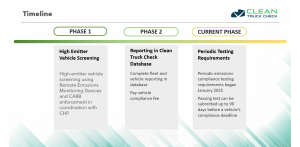
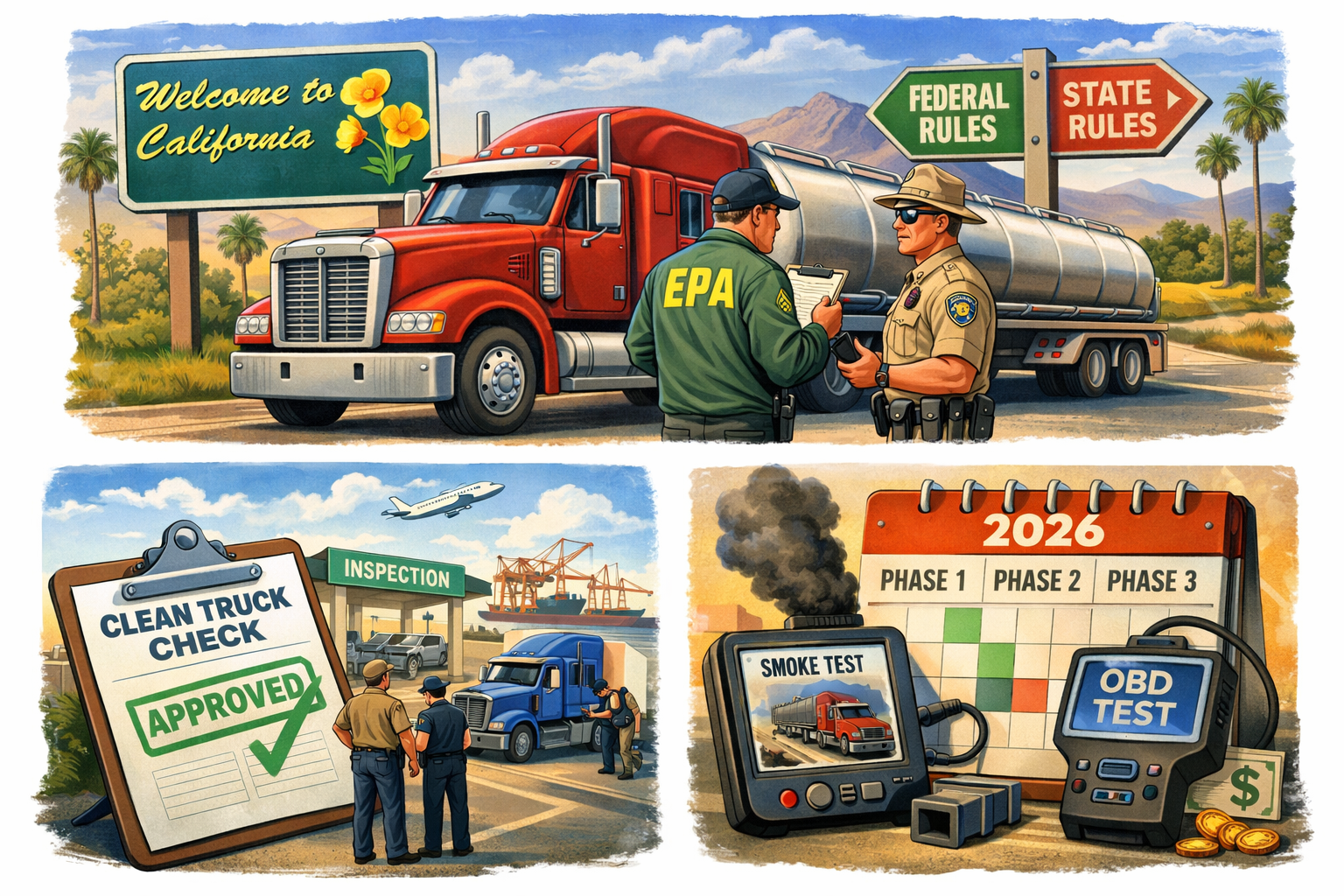
This graphic is useful because it shows how Clean Truck Check moved from roadside screening into a recurring compliance regime that fleets now have to manage.
For a tanker fleet with interstate lanes, the Clean Truck Check disapproval should shape a practical, conservative operating posture centered on uninterrupted access (terminals, gates, scales, inspections) and clean documentation (VIN-based proof that survives scrutiny).
The core compliance reality in California is still VIN-centric. In CARB’s own guidance for freight contractors and brokers, CARB emphasizes that Clean Truck Check compliance is based on the VIN, not the entity name, license plate, or other auxiliary information that can change. CARB also states that freight contractors and brokers must accept either an individual vehicle compliance certificate or an “affirmation of fleetwide compliance” as evidence, and that records must be retained for at least five years and produced within 72 hours upon request by CARB staff, inspectors, or peace officers.
For facility operations (relevant to seaports and intermodal rail yards, and directionally informative for any gate environment that adopts similar flows), CARB states that “applicable freight facilities” must either verify that only compliant vehicles enter and operate—by checking a compliance certificate or confirming through data provided by CARB—or maintain records of noncompliant vehicles that entered. CARB also notes that compliant VINs are provided daily to seaport and intermodal railyard representatives to support verification.
For fleets with recurring West Coast lanes, Tank Transport’s California freight coverage follows many of the same access, terminal, and operating issues now colliding with Clean Truck Check proof demands.
For tanker fleets, the functional consequence is that “proof” requests are not just bureaucratic—they’re a predictable adaptation of California’s broader compliance architecture (dispatch-side verification, shipper-side clauses, terminal-side gating). The Clean Truck Check disapproval is therefore less about whether proof requests disappear (they likely won’t, given CARB’s stance) and more about how you explain the current legal landscape to customers without misrepresenting either federal or state posture.
Operational compliance essentials that are easy to miss, but matter for tankers:
Clean Truck Check began in January 2023 using roadside emissions monitoring devices (REMD) to screen for potential high emitters; vehicles flagged can receive a Notice to Submit to Testing (NST) and must submit a passing test within 30 calendar days, with the practical warning that noncompliant vehicles or vehicles under enforcement action may face additional testing and penalties.
Emissions compliance testing requirements became effective October 1, 2024, and all compliance deadlines on or after January 1, 2025 require a passing test submission as part of the compliance demonstration; tests can be submitted up to 90 days before the deadline.
Test type is fundamentally driven by engine/OBD status: OBD-equipped vehicles (2013+ diesel engines and 2018+ alternative fuel engines) require an OBD scan using a CARB-certified device; non-OBD diesel (2012 and older diesel engines) require smoke opacity testing plus a visual inspection of emissions control equipment; non-OBD alternative fuel (2017 and older alternative fuel engines) require the visual inspection (not smoke opacity). CARB also flags that some heavy-duty vehicles operating on roads may have off-road engines and are still subject to requirements, with opacity/visual pathways used because there are no OBD requirements for off-road engines.
Starting October 2027, OBD-equipped vehicles will be required to test four times per year, while certain categories (e.g., agricultural vehicles and certain motorhomes) remain on annual schedules.
The annual fee is real, moves with CPI, and is operationally tied to compliance deadlines. CARB states the compliance fee was adjusted to $32.13 effective for 2026 annual fees paid to satisfy vehicle compliance deadlines on and after January 1, 2026.
Broader testing changes and diesel-rule developments continue to surface in our Emissions reporting archive.
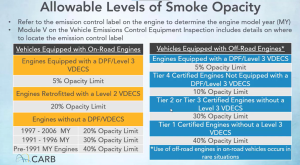
Once the story shifts from rulemaking to testing, this is the kind of threshold fleets and testers have to manage in practice
Compliance deadlines differ based on registration status: for California-registered vehicles, deadlines are based on DMV registration expiration and every six months thereafter; for non-California registered and DMV-exempt plated vehicles, deadlines are based on the last digit of the VIN with recurring six-month deadlines, and CARB’s guidance tables show which months the testing and annual fee deadlines land.
For California-registered units in a tanker fleet, noncompliance can translate to DMV registration holds. CARB states DMV holds are automatically placed on noncompliant vehicles, and provides expected processing timelines for hold removal after requirements are met.
A five-day pass exists, but it is narrowly useful and easy to misunderstand. CARB states a vehicle owner may apply once per calendar year per vehicle, only if there are no outstanding enforcement actions; the 5-day pass does not make the vehicle “compliant,” does not allow California DMV registration during the pass, and the driver must keep the pass available in the vehicle during operation in California.
These program mechanics are part of why EPA framed the out-of-state SIP reach as functionally pressuring interstate fleets to “overcomply,” and why the Clean Truck Check disapproval became nationally controversial.
Clean Truck Check disapproval: What should interstate tanker fleets tell customers asking for proof?
A tanker fleet’s customer-facing message after the Clean Truck Check disapproval should be precise enough to survive legal/compliance review, but simple enough for procurement and terminal ops to understand.
A defensible, technically accurate narrative (structured the way sophisticated shippers tend to accept):
State the federal fact: EPA partially approved and partially disapproved California’s SIP submission for HD I/M; SIP approval is limited to California-registered vehicles, and EPA disapproved SIP coverage for out-of-state/out-of-country vehicles.
State the operational reality: California’s regulator continues to state that Clean Truck Check requirements remain in effect for subject vehicles operating in California, including vehicles registered outside California, and that EPA’s action primarily affects SIP crediting of out-of-state emissions reductions rather than California’s own program enforcement.
State your fleet posture: We maintain Clean Truck Check compliance documentation where required for uninterrupted operations, including VIN-based certificates and test confirmations consistent with CARB guidance. CARB explicitly emphasizes VIN-based compliance and recognizes individual vehicle certificates or fleetwide affirmations as compliance evidence in freight contracting contexts.
Then define “proof” in plain language: proof is (a) the vehicle compliance certificate by VIN and/or (b) an affirmation of fleetwide compliance, depending on what the customer’s internal controls accept; and the fleet can provide certificates that align to CARB’s VIN-first approach.
Fleets building consistent customer language across business units can also compare that posture with our tank fleet compliance update.
If a customer insists that “EPA blocked it so out-of-state doesn’t need it,” the Clean Truck Check disapproval gives you a factual, non-argumentative correction: EPA’s SIP decision limits federal enforceability in the SIP, while CARB continues to represent that the program requirements apply under state law to vehicles operating in California, including out-of-state.
If a customer wants to rewrite contract language, a practical approach is to propose neutral phrasing that avoids conflating federal SIP enforceability with state program obligations, for example: “Carrier will provide current Clean Truck Check compliance documentation for any power unit operating in California, as applicable, and will ensure VIN-level compliance status can be verified through CARB’s systems.” This tracks CARB’s emphasis on VIN verification and certificate evidence without making claims about what EPA will enforce for out-of-state vehicles.
Clean Truck Check disapproval: What should dispatch and drivers carry day-to-day?
Because California’s compliance apparatus is designed to be checked at the VIN level—and because the Clean Truck Check disapproval increases confusion risk—documentation discipline becomes part of operational resilience.
A tanker fleet’s “Clean Truck Check packet” should be built around CARB’s own mechanics:
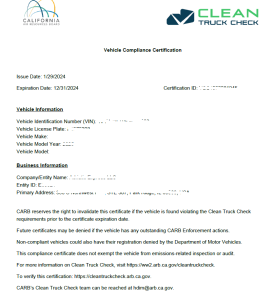
For fleets facing proof requests, the certificate is often the clearest compliance artifact to keep ready by VIN.
VIN-level compliance certificate access: CARB guidance indicates compliance certificates can be requested by applicable parties and that compliance is confirmed by VIN; CARB’s CTC-VIS guidance describes downloading certificates from the account and notes payment processing times and DMV verification flows that depend on VIN accuracy.
Fleetwide attestation artifact (when appropriate): CARB states that vehicle owners must attest under penalty of perjury to having entered the complete list of subject vehicles, must update accounts within 30 days of fleet changes, and can receive an “Affirmation of Fleet Wide Compliance” once all vehicles comply—often within 72 hours after demonstration of full compliance.
Proof of passing test pathway: CARB emphasizes that passing tests may be submitted up to 90 days before deadlines and that deadlines and results are visible in CTC-VIS; test method is OBD scan vs opacity/visual depending on engine model year/OBD status.
Enforcement-trigger artifacts: CARB describes NST issuance for vehicles flagged by roadside emissions monitoring devices and a 30-day window to submit a passing test; a fleet should treat NSTs as high-priority documents that dispatch/compliance track centrally because they can shape roadside outcomes.
5-day pass printouts (only where used): CARB’s 5-day pass guidance is explicit that the pass must be kept in the vehicle and shown upon request; it does not confer “compliance,” and public lookup may still show noncompliant status depending on reporting status.
Facility-facing readiness: CARB’s freight facility guidance indicates that vehicles may be denied access due to noncompliance, and that facilities can verify at entry by certificate or CARB data; CARB also notes eligibility for a 5-day pass to allow temporary access while reporting/payment is being processed (with stated payment processing time ranges).
Comparable documentation and enforcement-readiness issues also appear in our HM-265 fuel compliance coverage.
Finally, because the Clean Truck Check disapproval sits in an active judicial-review window (deadline April 7, 2026), a fleet should assume the narrative may shift again quickly—either through litigation, further federal guidance, or California program messaging updates—even if the practical day-to-day burden stays the same.
What California Clean Truck Check Means Now
Key Developments
- EPA announced its final action on January 27, 2026, partially approving and partially disapproving California’s HD I/M SIP submission. (US EPA)
- The Federal Register action limits federal enforceability to non-gasoline combustion vehicles over 14,000 pounds that are registered in California. (US EPA)
- EPA said California did not provide the “necessary assurances” required under Clean Air Act Section 110(a)(2)(E)(i) and raised Commerce Clause and foreign-affairs concerns about applying the program to out-of-state and out-of-country trucks. (US EPA)
- EPA also said the partial disapproval does not trigger Clean Air Act sanctions or a federal implementation plan because the SIP submission was discretionary, not mandatory.
- CARB’s Clean Truck Check program pages, updated March 10, 2026, continue to state that subject out-of-state vehicles operating in California must report in CTC-VIS, pay the annual compliance fee, and submit required passing emissions tests. (California Air Resources Board)
- CARB’s current enforcement guidance still describes REMD and ALPR roadside screening, CHP field inspections, and the possibility that non-compliant vehicles may be denied entry into ports and railyards. (California Air Resources Board)
Official Clean Truck Check and Interstate Tanker Compliance Resources
Federal action and legal text
- Learn how EPA framed the final partial disapproval for out-of-state and out-of-country vehicles in the EPA final action press release. (US EPA)
- Review the full rulemaking text, publication date, and effective date in the Federal Register final rule on California’s Heavy-Duty Vehicle Inspection and Maintenance Program. (Federal Register)
- See the codified federal limitation in 40 CFR 52.249, California Heavy-Duty inspection and maintenance program. (eCFR)
CARB program and compliance resources
- Get CARB’s current overview of who must comply, including vehicles registered outside California when operating in the state, at the Clean Truck Check main page. (California Air Resources Board)
- Use CARB’s operational guidance on roadside monitoring, DMV holds, access restrictions, and test pathways in the TruckStop Clean Truck Check regulation page. (California Air Resources Board)
- Review the baseline scope and compliance requirements in the Clean Truck Check overview fact sheet. (California Air Resources Board)
- Check applicability details and exemptions in the Clean Truck Check FAQ. (California Air Resources Board)
- Confirm testing schedules, OBD vs. non-OBD pathways, and future quarterly testing for certain vehicles in the emissions compliance testing requirements guide. (California Air Resources Board)
- See how brokers and freight contractors can request VIN-level proof and acceptable certificates in CARB’s freight contractor and broker requirements guide. (California Air Resources Board)
- Review gate-access and recordkeeping expectations for terminals in CARB’s requirements for operations in seaports and railyards. (California Air Resources Board)
- Use the official CTC-VIS portal to manage accounts, look up compliance status, and access certificates. (Clean Truck Check)
- Check reporting fields, VIN data requirements, and fleetwide attestation details in the database reporting requirements guide. (California Air Resources Board)
- Verify the current annual fee in CARB’s Clean Truck Check compliance fee update effective 1/1/2026. (California Air Resources Board)
- Review eligibility and limits for temporary California operation in the Five-Day Pass Request fact sheet. (California Air Resources Board)
Further Sources
- See EPA’s earlier rationale in the proposed-action press release. (US EPA)
- Trace the proposal stage in the Federal Register proposed rule. (Federal Register)