- ARKO Petroleum has agreed to acquire a U.S. Petroleum Partners business that distributes approximately 280 million gallons annually to more than 400 wholesale locations.
- The disclosed assets include two Buckeye-connected fuel terminals, 32 tractors and 26 titled trailers, but the filing does not identify how many trailers are cargo tanks.
- The $235 million base transaction remains pending and is subject to federal antitrust review, other closing conditions and performance-based purchase-price adjustments.
ARKO Petroleum Corp.’s proposed ARKO USPP acquisition is less a simple purchase of fuel volume than a bid to control a larger portion of the Great Lakes distribution chain—from pipeline-connected terminals and loading racks to transport equipment and final-mile customer deliveries.
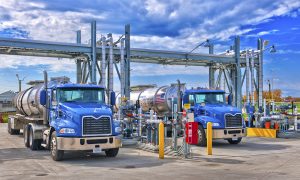
U.S. Petroleum Partners tankers stand beneath a terminal loading rack. ARKO’s proposed acquisition would combine USPP’s terminal infrastructure, wholesale contracts and transportation operation if the transaction closes. (Photo courtesy of U.S. Petroleum Partners)
ARKO signed the asset purchase agreement on Aug. 4 and announced the proposed transaction Aug. 6. The company says U.S. Petroleum Partners, or USPP, distributes approximately 280 million gallons of fuel annually to more than 400 wholesale locations. If completed, the deal would increase ARKO’s annual fuel volume by about 14% and expand its wholesale network to more than 2,500 locations.
For tank fleets, the consequential assets are not the location count alone. The proposed purchase includes terminals in Novi, Michigan, and Toledo, Ohio, along with the fleet that ARKO says moves more than 80% of USPP’s distributed gallons. That combination could give ARKO more direct control over rack access, dispatch, delivery execution and transportation earnings. It does not, by itself, prove that the region will gain more trucks, more storage capacity or lower delivered-fuel costs.


ARKO Is Buying a Connected Fuel-Logistics Chain
USPP describes itself as a vertically integrated distributor assembled through acquisitions. Its history begins with Delta Fuels and Knight Enterprises in 2018, followed by Tri Lakes Petroleum, Oakland Fuels’ wholesale and transportation division, Barrick Enterprises’ wholesale and transportation operation, and the Toledo terminal. The pending ARKO transaction would transfer substantially all assets used in that combined business, subject to the agreement’s exclusions.
ARKO’s Form 8-K and the underlying asset purchase agreement provide a more precise operating picture than the announcement alone.
| Disclosed element | Public figure or asset | Tank/bulk consequence | Still undisclosed |
|---|---|---|---|
| Annual volume | Approximately 280 million gallons | Material Great Lakes gasoline and diesel delivery demand | Product split, seasonality and route-level gallons |
| Customer network | More than 400 wholesale locations | Recurring dealer, commercial and farm delivery obligations | Contract duration, concentration and minimum volumes |
| Terminal network | Novi, Michigan, and Toledo, Ohio | Pipeline, storage, blending, rack and rail access near delivery markets | Current storage capacity, throughput and spare rack capacity |
| Transport equipment | 32 tractors, 26 titled trailers, six small untitled trailers and 11 other vehicles | An operating private-fleet platform rather than outsourced delivery alone | Cargo-tank count, age, specifications, ownership status and utilization |
| Fleet-carried share | More than 80% of USPP volume | The acquired fleet performs most of the company’s physical delivery work | Loads, miles, driver count, outside-carrier spend and cost per gallon |
| Base consideration | $205 million cash plus $30 million in stock, before inventory | Values the combined contracts, terminals, property and transport platform | Closing-date inventory value and final performance adjustments |
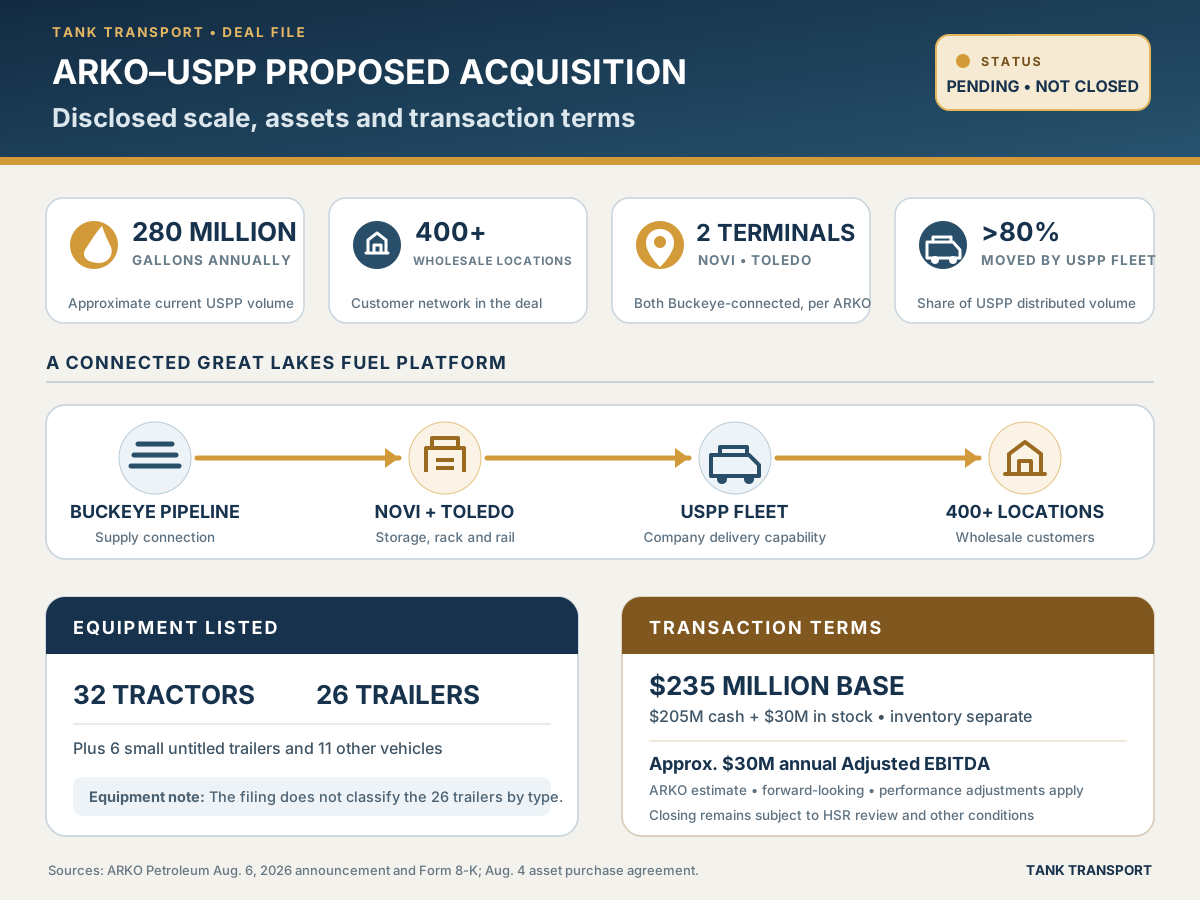
ARKO’s proposed USPP acquisition includes approximately 280 million annual gallons, more than 400 wholesale locations, two fuel terminals and a fleet carrying more than 80% of USPP’s distributed volume. The transaction remains pending. (Graphic: Tank Transport; sources: ARKO Petroleum and SEC filings)
Applying the company’s “more than 80%” statement to 280 million annual gallons means the acquired fleet currently transports more than 224 million gallons a year. That is arithmetic based on ARKO’s figures—not a disclosed load count. Without the product mix, average payload, split-delivery frequency or backhaul pattern, converting those gallons into an annual trip estimate would create false precision.
The deal’s operating significance is the chain ARKO would control: terminal access, wholesale contracts and the fleet performing most of USPP’s deliveries.The Trucking Consequence Starts at the Terminal Rack
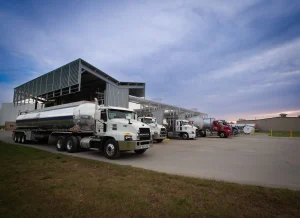
U.S. Petroleum Partners tankers stand beneath a terminal loading rack. ARKO’s proposed acquisition would combine USPP’s terminal infrastructure, wholesale contracts and transportation operation if the transaction closes. (Photo courtesy of U.S. Petroleum Partners)
The two terminals make this transaction more consequential than a conventional purchase of dealer contracts. In its operating description, USPP says the 13-acre Novi facility has seven storage tanks, a four-bay electronic loading rack and an eight-inch connection to Buckeye’s Wayne receiving station. Listed products include gasoline, clear and dyed diesel, recreational fuel and JP-8.
USPP says its Toledo terminal operates around the clock, handles gasoline and diesel, and can load or unload by a rail spur connected to CSX’s Toledo line. The acquisition documents identify both terminals as connected to the Buckeye Pipeline system, but they do not disclose storage capacity, annual terminal throughput, rack wait times or available expansion capacity.
That distinction matters. Terminal ownership can provide more control over product sourcing, scheduling and loading, while private-fleet ownership can provide more control over dispatch and customer delivery. It can also place terminal operations, equipment maintenance, driver availability and regulatory compliance inside the same organization. Those are potential operating advantages, not guaranteed outcomes. Real performance will depend on throughput, asset condition, customer density, staffing and how ARKO integrates USPP’s systems.
The customer base also extends beyond retail stations. The purchase agreement refers to commercial and farm tank-wagon customers, while USPP’s service profile lists branded and unbranded gasoline, clear diesel and red-dyed diesel. Its transportation division also advertises minor repairs, tire work and regulatory vapor testing from a Taylor, Michigan, facility. The agreement lists one owned truck yard, although the public filings do not map every service asset or employee to ARKO’s final post-closing plan.
Tank Transport has previously examined how rack access, terminal queues and alternate-source credentials can turn a market disruption into a physical delivery problem. A terminal-and-fleet platform can improve an operator’s options during those disruptions, but the USPP disclosures do not establish additional contingency supply or promise uninterrupted deliveries.
The $235 Million Price Is Tied to Performance.
The agreement sets base consideration at $235 million: approximately $205 million in cash and $30 million in ARKO Class A shares. Inventory is valued separately at closing. ARKO expects to fund the cash portion through existing credit lines, and the transaction is not subject to a financing condition.
ARKO projects approximately $30 million in annual Adjusted EBITDA from the acquired business. Dividing the $235 million base consideration by that forecast produces a simple ratio of about 7.8 times projected Adjusted EBITDA, before inventory. That is not a clean final acquisition multiple: the earnings figure is forward-looking and non-GAAP, the inventory payment remains unknown, and part of the consideration is conditional.
The $30 million stock component will be held in escrow. The SEC filing says the true-up tests include $31.7 million in EBITDA and $2.2 million generated by specified fuel-related components during the applicable post-closing measurement period. Underperformance can reduce the equity payment and, in some circumstances, allow recoupment of as much as $5 million in cash. Outperformance can increase the seller’s payment.
Those gates put measurable weight on retaining gallons, preserving terminal and transportation earnings, and integrating the operation without losing customers or service quality. Yet the public package gives tank-fleet readers no baseline for driver retention, tractor or trailer age, maintenance expense, loaded miles, outside-carrier dependence, terminal utilization or cost per delivered gallon.

A U.S. Petroleum Partners tanker departs a company fuel-terminal site. The transportation operation is among the assets ARKO Petroleum proposes to acquire in its pending USPP transaction. (Photo courtesy of U.S. Petroleum Partners)
Tank Transport has tracked other Great Lakes fuel-distribution expansion, including Offen Petroleum’s purchase of Gas Depot’s wholesale division. The proposed ARKO–USPP combination is distinct because its public documents pair a substantial wholesale book with two terminals and an operating delivery fleet.
Closing Is the First Gate; Integration Is the Real Test
The agreement has not closed. ARKO says the parties have made the required Hart-Cottrell-Rodino filing, and completion is subject to expiration or termination of the federal waiting period, absence of legal restraints, and satisfaction of other contractual conditions. Under the FTC’s standard merger-review process, most reportable transactions observe an initial 30-day waiting period unless early termination is granted or an agency issues a request for additional information.
The purchase agreement contains an outside-closing mechanism tied to several milestones, including antitrust clearance and completion of schedules and exhibits. It does not support treating a specific public closing date as certain. As of Aug. 10, ARKO had not announced completion or federal clearance.
This is also not ARKO’s first attempt to add a fuel-distribution platform. Tank Transport’s coverage of the unsuccessful Mountain Express bid illustrates the difference between a proposed transfer and a completed acquisition. A definitive asset purchase agreement supports the USPP transaction, but ownership and operational control remain with the seller until closing.
Until closing, ARKO owns none of the announced USPP terminal or fleet capacity; after closing, integration results—not the announcement—will determine the operating value.The first post-closing disclosures should be judged against the missing operating baselines. The most useful evidence would include the number and type of cargo tanks transferred, driver and technician retention, terminal throughput, fleet utilization, outsourced-load share, safety performance, maintenance cost, and any change in gallons delivered per asset. Announced synergies should not substitute for those measures.
ARKO–USPP Acquisition Key Developments
- Agreement: ARKO Petroleum and the USPP seller entities signed a definitive asset purchase agreement Aug. 4, 2026; ARKO announced it Aug. 6.
- Operating scale: The proposed assets serve more than 400 wholesale locations and distribute approximately 280 million gallons annually through two terminals and a fleet carrying more than 80% of that volume.
- Equipment disclosure: The agreement lists 32 tractors, 26 titled trailers, six small untitled trailers, and 11 other vehicles, without identifying the cargo-tank count or fleet utilization.
- Transaction status: The $235 million base deal, plus inventory and possible adjustments, remains subject to antitrust review and other closing conditions.
- Next proof point: Closing is necessary, but terminal throughput, customer retention, transport economics and verified fleet composition will determine whether the promised vertical integration produces durable operating value.