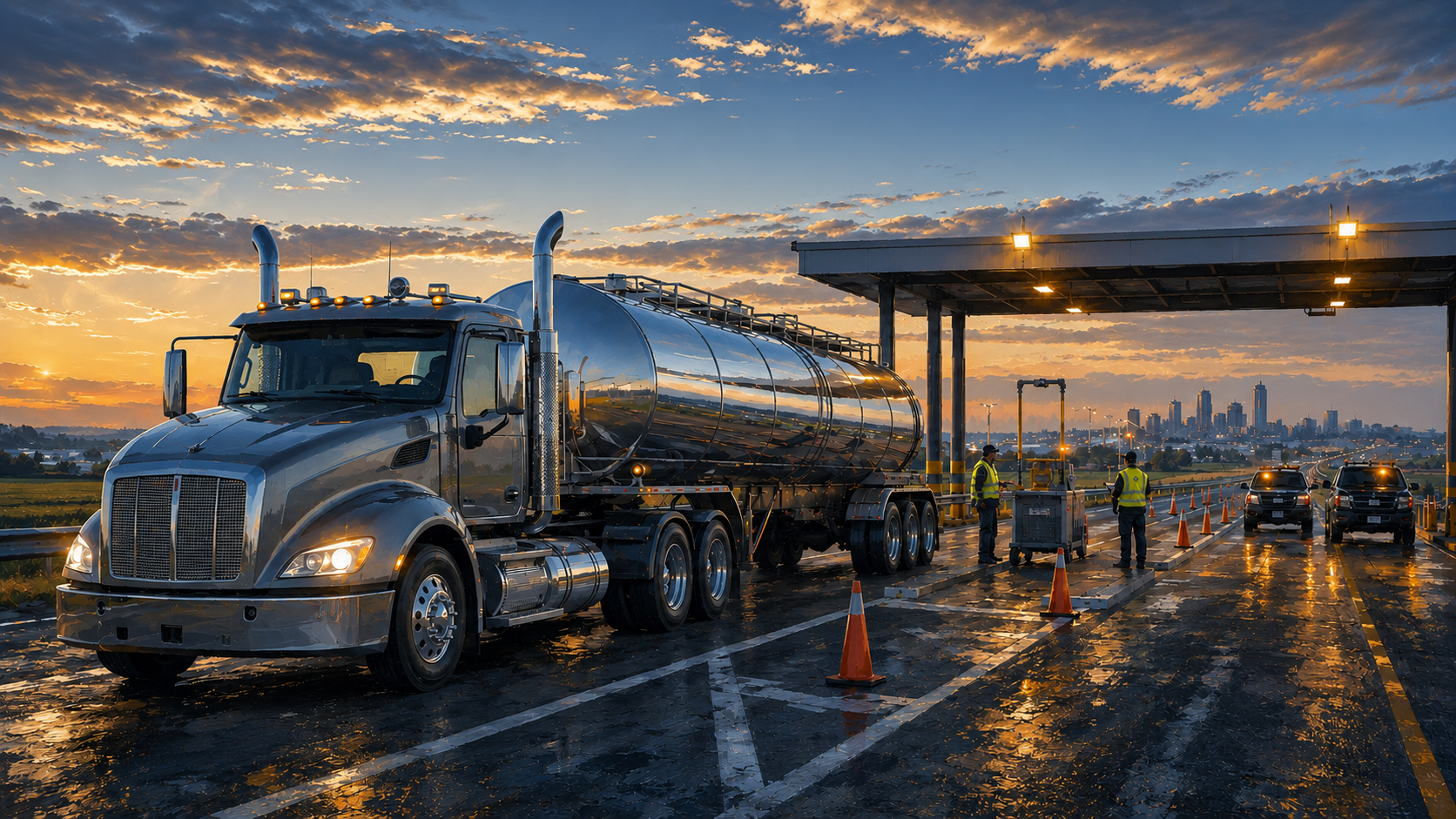
- Operation Highway Shield placed a combined 766 drivers and commercial vehicles out of service during a July 28–30 sweep across Illinois, Indiana, Iowa and Ohio.
- Federal officials also reported 51 immigration detentions, 36 English-language-proficiency violations, 86 operator arrests and nearly $1 million in recovered stolen cargo.
- The results are preliminary: USDOT did not publish a driver-versus-vehicle split, a state breakdown or enough data to calculate an official out-of-service rate.
Operation Highway Shield placed 766 drivers and commercial vehicles out of service during a three-day enforcement sweep across four Midwestern states, according to preliminary results released by the U.S. Department of Transportation.
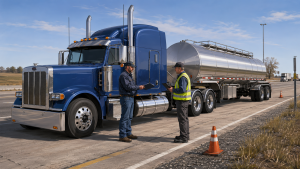
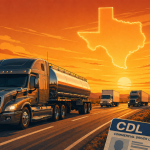
A tanker driver and commercial-vehicle inspector review documents during a roadside inspection. (Original Tank Transport illustration)
The July 28–30 operation brought federal inspectors, immigration agents and state highway patrols together along freight corridors in Illinois, Indiana, Iowa and Ohio. For tank and bulk fleets moving through the region, the practical warning is broader than any single violation: driver qualification, roadside communication, vehicle condition and cargo security can now be examined in the same coordinated stop.
An out-of-service order involving a loaded tank combination can disrupt a terminal appointment, delay a time-sensitive delivery and leave a carrier arranging a qualified replacement driver or necessary repair. However, USDOT did not identify the cargo types inspected or say that any tank vehicles were among the units placed out of service.


Operation Highway Shield Combines Multiple Enforcement Missions
USDOT and the Department of Homeland Security described the campaign as the second wave of Operation Highway Shield. The agencies said Federal Motor Carrier Safety Administration inspectors worked with Immigration and Customs Enforcement, Homeland Security Investigations and state highway patrols.
The government reported 51 immigration detentions, including 21 drivers holding non-domiciled commercial driver licenses issued by California or New York. It also reported 36 English-language-proficiency violations, 86 operator arrests for conduct the release described as including road rage and domestic violence, and the recovery of nearly $1 million in stolen cargo.

Preliminary Operation Highway Shield results from a July 28–30 enforcement sweep across Iowa, Illinois, Indiana and Ohio. The 766 out-of-service figure combines drivers and vehicles; USDOT did not release a split or inspection denominator. (Graphic: Tank Transport; source: U.S. Department of Transportation)
Those categories should not be collapsed into a single safety statistic. An immigration detention is not the same action as a vehicle out-of-service order, and an arrest is not a conviction. A non-domiciled CDL is also a recognized license type; the public release did not individually establish that every credential held by the 21 detained drivers was invalid. Tank Transport has separately covered the changing federal framework for non-domiciled CDL eligibility and state licensing controls.
The operation follows a March enforcement wave in Florida. USDOT said that earlier effort involved more than 3,300 inspections, placed 176 drivers out of service and produced 54 English-proficiency violations, 35 criminal-related arrests and 42 immigration-related detentions. The four-state expansion shows that Highway Shield is becoming a repeatable multi-agency enforcement model rather than a one-state event.
What the 766 Out-of-Service Figure Does Not Reveal
The headline number requires careful handling. USDOT described 766 “drivers and vehicles” placed out of service, but it did not disclose how many were drivers, how many were vehicles, or how much overlap existed between the two groups.
The public release also omitted a second-wave inspection total and state-by-state results. That means the official material does not support an out-of-service percentage or a comparison of Illinois, Indiana, Iowa and Ohio. It also does not identify the leading mechanical, hours-of-service, licensing or documentation violations behind the combined total.
For fleets, an out-of-service result is an immediate operating restriction, but it does not by itself prove a crash occurred or that a carrier is broadly unsafe. The specific violation, corrective action, and inspection record determine the longer-term compliance consequence. Tank Transport’s Roadcheck ELD enforcement guide explains how one common driver-compliance problem can move from a citation to an out-of-service event.
English Proficiency Returns as a Roadside Risk
The 36 English-language-proficiency violations fit a larger enforcement shift. Under 49 CFR 391.11(b)(2), covered commercial drivers must be able to communicate with the public, understand English-language highway signs and signals, respond to official inquiries, and make required entries on reports and records.
FMCSA’s April 2026 roadside policy directs enforcement personnel evaluating that standard and addresses when a violation results in a driver being placed out of service. The agency’s carrier qualification guidance also recommends assessing whether drivers can communicate with law enforcement during an inspection, explain shipping-paper information and understand highway signs they may encounter.
That is especially important in tank and hazmat service. A driver may need to identify the product, locate shipping papers, discuss placards or emergency-response information, and follow directions at a terminal, scale house, or incident scene. The issue is functional compliance during the encounter, not accent or conversational style. Tank Transport’s CDL English-enforcement analysis provides a practical review for carriers.
How Tank Fleets Can Prepare for the Next Sweep

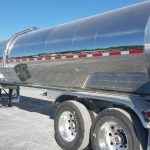
Inspectors conduct a roadside walkaround of a tank trailer, checking its tires, running gear, and visible safety equipment. (Original Tank Transport illustration)
Carriers do not need to know the next checkpoint location to reduce exposure. Safety managers can verify license and qualification records before dispatch, rehearse ordinary inspection questions with drivers, and confirm that each tractor and trailer is ready for a complete roadside examination.
For placarded loads, the review should include shipping papers, emergency-response information, endorsements, registration, and any route- or permit-specific documents. Hours-of-service records and ELD status should also be checked before the vehicle enters a high-enforcement corridor. These are routine controls, but coordinated operations raise the cost of assuming another department already handled them.
The cargo-theft recovery adds a separate security signal. USDOT did not disclose the commodities, number of loads or investigative circumstances, so fleets should not infer a particular theft pattern. It does reinforce the value of dispatch verification, route monitoring and escalation procedures when a driver, tractor, trailer or pickup instruction does not match the load plan.
Highway Shield arrives shortly after Operation Safe Driver Week intensified July roadside scrutiny. Together, the campaigns show that enforcement attention can move quickly among driving behavior, credentials, communication, equipment, logs and criminal activity. The most reliable fleet response is a dispatch-ready compliance file backed by a road-ready truck and a driver prepared to handle the inspection directly.
Operation Highway Shield: Key Developments
- The second wave ran July 28–30 across Illinois, Indiana, Iowa and Ohio.
- USDOT reported a combined 766 drivers and vehicles placed out of service, but did not publish the split or an official out-of-service rate.
- Federal officials reported 51 immigration detentions, 36 English-proficiency violations, 86 operator arrests and nearly $1 million in recovered stolen cargo.
- The official release did not identify cargo types, tank vehicles, state-level totals or the leading driver and vehicle violations.
- Tank fleets should treat the operation as a prompt to verify driver qualifications, roadside communication, vehicle readiness, hazmat documentation, logs and cargo-security procedures before dispatch.