- The global refinery crunch is shifting fuel-market pressure from crude supply to refined products, putting the availability of diesel, jet fuel, gasoline, LPG, and fuel oil under sharper scrutiny.
- Russian refinery attacks and disruptions in the Middle East are exposing the limits of global crude processing capacity, raising questions about rack availability, export pull, and terminal sourcing.
- For fuel haulers and distributors, refinery outages are no longer distant geopolitical events — they can translate into longer supply lanes, tighter product balances, and more volatile customer pricing.
Why the Global Refinery Crunch Is Now a Refined-Products Story
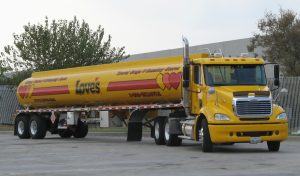
“A refinery crunch becomes a transportation issue when finished fuel has to move through trucks, terminals, racks, and regional supply lanes.”
Love’s Freightliner tanker truck in southern Oklahoma (Greg Goebel, Wikimedia Commons, CC BY-SA 2.0).
The central fact pattern is stark. The global refinery crunch is no longer just a crude-oil supply story. It has become a refined-products story because the market pressure is moving downstream into diesel, jet fuel, gasoline, fuel oil, LPG, and other petroleum products that actually move freight, aviation, construction, agriculture, emergency response, and industrial activity.
In its May 2026 Oil Market Report, the International Energy Agency said global oil supply fell sharply in April and that refinery crude throughputs were expected to plunge in the second quarter. The agency also pointed to historically high refining margins, with middle-distillate crack spreads especially strong.
That matters because high refining margins are not simply a sign of profitability. They are also a sign of stress. When margins rise sharply, it usually means the market is paying refiners more to turn crude into usable fuels because finished-product supply is tight relative to demand.


Those numbers do not mean every refinery affected earlier in the year remains fully offline today. They do mean the broader framing remains valid: a meaningful share of global refining and processing capability has been functionally impaired through direct damage, precautionary shutdowns, lower crude runs, storage bottlenecks, disrupted logistics, and extended turnaround schedules.
Reuters reported that war-linked disruptions tied to the Iran conflict and Russia-Ukraine war had affected nearly 9 percent of global refining capacity when outages and processing cuts across multiple regions were counted together. The same report pointed to additional throughput reductions in Asia and Europe due to disruptions in crude feedstock and logistics.
That is why the refined-products lens is more useful than the crude-oil lens. Crude can still exist in the ground, in storage, or on rerouted vessels. But if the refining system is damaged, starved of feedstock, or forced to operate below normal rates, the impact shows up at terminals, racks, airports, distributors, and downstream supply chains.
For related coverage of how maritime energy disruptions can spill over into fuel logistics, see our analysis of the Hormuz supply risk and downstream fuel pressure.
”The world does not only need crude oil; it needs refineries capable of turning crude into diesel, jet fuel, gasoline, fuel oil, LPG, and other usable products.”
For a transporter, the issue is especially direct. A refinery outage becomes a transportation story when it changes what is available at the rack, how far product must be hauled, which terminals are favored, whether emergency supply moves are needed, and how customers respond to timing and price volatility.
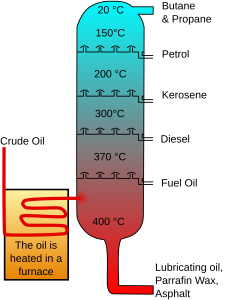
“The market does not run on crude alone; it runs on the refinery capacity that turns crude into usable fuels.”
Diagram of the crude oil distillation process showing how crude is separated into usable petroleum products (Psarianos, Theresa Knott, Rogilbert, and Utain, Wikimedia Commons, CC BY-SA 3.0/GFDL).
The industry also entered 2026 with less spare refining flexibility than many casual observers assume. Pandemic-era closures, weak economic conditions, operational problems, and shifting long-term demand expectations had already removed capacity from the global system. Even where capacity has recovered, the margin for error remains thinner than it looked before the current shock.
How the Global Refinery Crunch Spread Beyond Russia and Iran
There is a connection to Russian refinery attacks and Middle East disruptions, but the updated picture is broader. The global refinery crunch has expanded into a multi-region product-supply problem involving Russia, the Middle East, Europe, Asia, and export-oriented refiners elsewhere.
China’s state refiners have reportedly cut runs sharply since the Iran conflict began. Reuters reported that state-controlled throughput declined from pre-conflict levels as crude supply disruption and weak margins forced companies, including Sinopec and PetroChina, to reduce processing. That matters because China is both the world’s largest crude importer and a major swing player in global refined-product balances.
Europe is also exposed, although the near-term picture has become more nuanced. Reuters reported that Middle East jet fuel arrivals in Europe fell sharply earlier this spring. Replacement cargoes from the United States and Nigeria helped offset some of the loss, but the recovery was partial rather than complete.
Near-term continuity has improved, but structural vulnerability remains obvious. European airlines, airports, and tourism operators have expressed confidence that summer flying can continue, but the broader jet fuel supply chain is still operating amid disrupted Middle East product flows.

“When refinery operations slow, the effects can move quickly from processing units to storage tanks, terminals, and product supply lanes.”
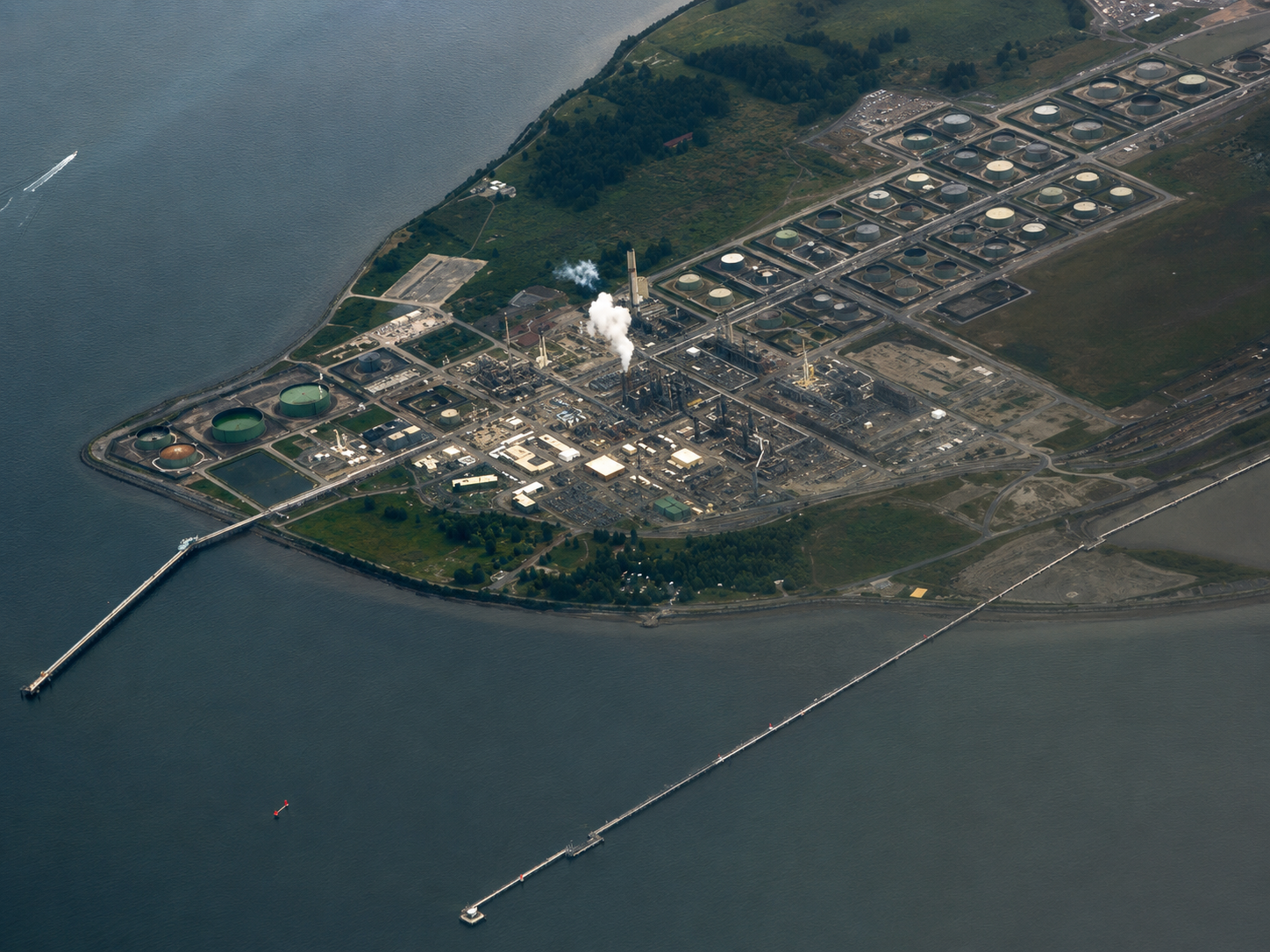
The Andeavor Anacortes Refinery near Anacortes, Washington, viewed from the air (Colin Stepney, Wikimedia Commons, CC BY-SA 4.0).
The U.S. Energy Information Administration has also reinforced the refined-products framing. It reported that gasoline, distillate, and jet fuel prices all rose sharply in the first quarter following disruptions to crude and product supplies in the Middle East. Distillate and jet fuel rose more than gasoline, partly because both products come from similar middle-distillate fractions, and refining flexibility is limited.
In practical terms, refiners can adjust yields, but they cannot instantly create unlimited diesel or jet fuel from a constrained system. If middle distillates are the products under the most pressure, trucking, aviation, agriculture, rail, marine, construction, and emergency services all become more exposed.
For a closer look at how diesel markets are affecting fleets, rates, and carrier operations, read our coverage of diesel trucking costs and freight-market pressure.
Which Russian Attacks Are Driving the Global Refinery Crunch Right Now?
The Russian side of the global refinery crunch has intensified materially. Reuters reported that virtually all major oil refineries in central Russia had either halted or scaled back fuel output after recent Ukrainian drone attacks. The combined capacity of affected sites exceeded 83 million metric tons per year, and those plants collectively account for a large share of Russia’s gasoline and diesel production.
The named facilities are strategically important rather than marginal. Reuters identified Kirishi, Moscow, NORSI in Nizhny Novgorod, Ryazan, and Yaroslavl among the major sites under pressure. Kirishi is one of Russia’s largest refineries. NORSI is one of Russia’s largest gasoline producers. Ryazan accounts for a meaningful share of Russia’s total refining volume.
These are not symbolic losses. They strike at the heart of fuel conversion in European Russia.
The Syzran refinery update also sharpens the story. Reuters reported that the Rosneft-owned Syzran refinery in the Samara region was struck again and had already suspended oil refining after an earlier attack damaged processing equipment. The plant can process roughly 170,000 barrels per day and produces gasoline, diesel, and fuel oil.

“When product balances tighten, the pressure often reaches the highway through longer hauls, alternate sourcing, and more complicated terminal decisions.”
Freightliner double tanker rig in Moses Lake, Washington (Greg Goebel, Wikimedia Commons, CC BY-SA 2.0).
That product slate is important. Syzran is not just an upstream or crude-handling asset. It is part of the refined-products chain that supplies usable fuels.
Ryazan is also highly consequential from a product slate perspective. Reuters reported that the refinery halted output after a May attack. In 2024, the site processed more than 13 million metric tons of crude and produced large volumes of gasoline, diesel, and fuel oil.
When a plant of that size is down or constrained, the impact is difficult to treat as purely local. For more refinery-focused reporting, explore our Refineries coverage and RefineryCapacity archive.
What Has Changed for Rosneft in the Global Refinery Crunch?
Rosneft’s own disclosures explain why the company matters to this story. Rosneft says it is Russia’s refining leader, with 13 large refineries and 3 mini-refineries. The company also says it holds roughly 30 percent of Russia’s refining market.
That footprint makes Rosneft systemically important. It is not merely the owner of isolated refineries that happen to have been attacked. Its refining network underpins a large share of domestic Russian motor-fuel stability.
Rosneft’s official materials also show the scale of product supply involved. The company has reported tens of millions of tons of annual refining volume and large domestic deliveries of gasoline, diesel, and other petroleum products.
The official Rosneft pages for Syzran and Ryazan confirm the type of product mix at stake. Syzran produces motor fuels, jet fuel, and bitumen. Ryazan is described as one of Rosneft’s leading refining assets, with gasoline, diesel, and other petroleum products in its slate.
Those facts do not automatically prove a lasting domestic shortage. Russia has export controls, inventories, internal balancing tools, and state mechanisms to redirect supply. But they do explain why repeated refinery attacks matter well beyond the immediate damage at a single site.

“Finished fuels do not reach customers by market theory alone; they move through trucks, terminals, docks, racks, and local delivery networks.”
Cape Cod Oil Company delivery truck parked at a dock in Cape Cod, Massachusetts (Connor Williams, Wikimedia Commons, CC BY 2.0).
What the Global Refinery Crunch Means for Russian Fuel Balances
The Kremlin’s official position remains that there is no current risk to the Russian domestic fuel supply. Kremlin spokesman Dmitry Peskov has attributed some reduced output to seasonal maintenance and said Russia has mechanisms to compensate for regional shortfalls.
That point belongs because it is the central balancing fact. Moscow is not publicly acknowledging a domestic fuel crisis.
Even so, the underlying market data suggests a more conditional reality. If refineries that account for major shares of gasoline and diesel production are halted or scaled back, Russia can soften the blow through export bans, stock draws, product redirection, and administrative controls. But those tools do not make lost conversion work disappear.
In logistics markets, “no shortage” can still coexist with higher internal transport costs, forced rerouting, reduced export availability, uneven regional supply, and greater government intervention. A domestic market kept nominally supplied is not the same as an efficient market.
The physical impact of refinery disruption often shows up first in rail flows, terminal sourcing, product nominations, rack behavior, and export restrictions long before it becomes visible to the average fuel consumer.
How Middle East Outages Are Deepening the Global Refinery Crunch
The Middle East side of the story also needs precision. Reuters reported earlier this spring that nearly 1.9 million barrels per day of Gulf refining capacity had already been shut because of the Iran conflict, with outages or rate cuts affecting Bahrain, Iraq, Kuwait, Qatar, Saudi Arabia, and the United Arab Emirates.
By May, Reuters reported that the Iran conflict had affected up to 3.52 million barrels per day of refining capacity. That progression shows the crisis widening rather than remaining fixed at a single point of disruption.
Saudi Arabia is the clearest example, with Ras Tanura, which was part of the outage story. Reuters reported that Aramco shut the 550,000-barrel-per-day refinery after a March drone strike and later restarted it. Aramco’s leadership later said the refinery had been restored, though some units were still undergoing turnaround.
So the updated version should not say Ras Tanura remains fully offline. It should say the refinery was hit, restarted, and remained part of the broader story because not every unit was immediately back to completely normal operation.

“Refined-product disruption is not limited to diesel and gasoline; LPG, propane, and other fuel streams can also feel the strain.”
Propane tank truck at a Chevron gas station near I-65 in Greenville, Alabama (Infrogmation, Wikimedia Commons, CC BY-SA 4.0).
Kuwait remains a heavier unresolved issue. Reuters reported drone strikes and damage at operating units, including Mina Al-Ahmadi and Mina Abdullah. Industry analysis cited by Reuters also indicated that Kuwait’s three refineries — Al-Zour, Mina Al-Ahmadi, and Mina Abdullah — had reduced processing rates as storage tanks filled.
The official IEA framing is broader still. The agency has said diesel, jet fuel, and LPG are among the products most immediately affected by the disruption because the Middle East is not only a crude exporter, but also a major supplier of finished fuels.
That point is essential. If the story is framed only as a crude-oil story, it misses the downstream reality. Middle East product flows help balance global markets for jet fuel, diesel, LPG, and other refined products.
For additional reporting on regional energy disruptions and fuel-market exposure, follow our Middle East updates. When those flows are disrupted, the pressure lands directly on buyers and carriers.
What Saudi Aramco, KNPC, KIPIC, and TotalEnergies Reveal About the Global Refinery Crunch
Saudi Aramco’s own documents show why disruption in its refining system matters globally. Aramco operates one of the world’s largest refining businesses, with a network spanning Saudi Arabia, the United States, South Korea, China, Poland, Japan, and Malaysia.
Its refined-products slate includes LPG, naphtha, gasoline, jet fuel (kerosene), diesel, heavy fuel oil, and asphalt. That product range is exactly why damage or temporary disruption at a major Aramco refining asset matters beyond crude markets.
Aramco’s financial results also show that physical disruption and stronger downstream economics can coexist. In its Q1 2026 materials, the company reported stronger downstream performance, reflecting higher refining margins and trading conditions. That is an important nuance: integrated refiners can be operationally constrained in one part of the system while benefiting commercially from stronger margins elsewhere.
Kuwait’s official operators tell another important part of the story. KNPC says Mina Al-Ahmadi has a capacity of 346,000 barrels per day and Mina Abdullah has a capacity of 454,000 barrels per day, for a combined capacity of 800,000 barrels per day. KIPIC says Al-Zour is a 615,000-barrel-per-day refinery and the world’s largest grass-roots refinery.
Those numbers matter because Kuwait’s refining system is not a secondary market detail. Al-Zour, Mina Al-Ahmadi, and Mina Abdullah collectively represent a major share of finished-fuel capacity. KNPC has said Al-Zour increased Kuwait’s combined refining capacity to 1.415 million barrels per day.
The product details are equally important. Al-Zour has exported kerosene, premium jet fuel, low-sulfur fuel oil, low-sulfur diesel, and naphtha. That makes it directly relevant to the middle-distillate story.

“Jet fuel pressure is one of the clearest signs that the refinery crunch has moved downstream into finished-product logistics.”
Flightline tanker trucks at Centennial Airport in Denver, Colorado (Greg Goebel, Wikimedia Commons, CC BY-SA 2.0).
TotalEnergies rounds out the company checks from a different angle. Its Q1 2026 results showed stronger Refining & Chemicals earnings, driven by strong refinery operations, high refining margins, and favorable crude and product trading conditions.
That makes TotalEnergies a useful corporate signal. Companies with flexible downstream assets and trading books can benefit from the same dislocation that makes the physical market more fragile. Higher refining margins can improve earnings for some operators while raising costs and uncertainty for fuel buyers.
Can the Global Refinery Crunch Ease Soon for Diesel and Jet Fuel Buyers?
The short answer is that the global refinery crunch can ease at the margin, but it is unlikely to clear quickly.
Europe has already shown that alternative sourcing can work to a degree. Airlines and fuel buyers have secured replacement jet fuel from suppliers in the United States and Nigeria. Airport operators have also increased jet fuel reserves, helping to reduce immediate concerns about summer flying.
But the structural warning has not gone away. Replacement cargoes do not fully erase the vulnerability created by disrupted flows in the Middle East, constrained refining capacity, and strong seasonal demand.
IEA leadership has warned that the market could enter a more dangerous zone by July or August due to peak summer demand, declining inventories, and the slow pace of recovery from disrupted supply. Strategic stock releases can cushion the market, but they cannot indefinitely replace normal commercial flows.

“Aviation fuel is part of the same refined-products chain, and refinery constraints can ripple into airports as quickly as they reach fuel terminals.”
U.S. Air Force R-11 refueler truck used for aircraft fueling (U.S. Air Force, public domain). An Oshkosh R-11 refueling truck from the WI Air National Guard’s 115th Fighter Wing in Madison, WI, was shot on June 28, 2009.
Policymakers are also making adjustments that underscore how serious the product issue has become. The United Kingdom deferred a planned ban on imports of diesel and jet fuel refined from Russian crude in third countries due to supply concerns linked to the conflict in Iran. That kind of policy adjustment is a strong signal that governments are closely monitoring refined-product availability.
The United States can cushion part of the shock, but it cannot solve the entire problem. U.S. refiners are major exporters of transportation fuels, especially distillate fuel oil. U.S. Gulf Coast refiners can help fill some gaps when global diesel or jet fuel markets tighten.
Even so, U.S. refining capacity remains below its 2020 peak, and U.S. refiners have already been running hard when distillate cracks are strong. That suggests a stronger U.S. export pull is possible, but it is an offset rather than a cure.
For fuel logistics, that is the real bottom line. If the global refinery crunch persists through the summer, the most visible effects are likely to show up through diesel premiums, jet-fuel procurement behavior, terminal sourcing changes, longer hauls from alternate supply points, and greater leverage for refiners and traders with intact conversion capacity.
For a regional example of how supply pressure can affect terminals, diesel availability, and fuel logistics, read our coverage of the Midwest fuel supply squeeze.
The world does not only need crude oil. It needs refineries capable of turning crude into diesel, jet fuel, gasoline, fuel oil, LPG, and other usable products. When that conversion system is damaged or constrained, the pressure is transmitted directly to the transportation and storage networks that keep fuel moving.
Key Developments in the Global Refinery Crunch
- The global refinery crunch has become a refined-products issue, not simply a crude-oil supply story, because damaged or constrained refineries reduce the availability of usable fuels.
- Diesel and jet fuel remain among the most exposed products, especially because both depend heavily on middle-distillate refining capacity.
- Ukraine’s refinery strike campaign has added pressure to Russian fuel production, with several major refineries reportedly halted, damaged, or operating below normal levels.
- Russia says domestic fuel supply remains under control, but continued refinery disruptions may still affect exports, regional balancing, logistics costs, and product flows.
- Middle East refinery and product-flow disruptions have heightened concerns, particularly for jet fuel, LPG, diesel, and other refined products tied to Gulf refining and shipping networks.
- Replacement cargoes have helped ease near-term jet fuel concerns in Europe, but the broader supply chain remains vulnerable if outages persist or summer demand rises.
- Companies with intact refining and trading capacity may benefit from stronger margins, while fuel buyers, fleets, terminals, and distributors face more uncertainty.
- For tank transport operations, the key risk is downstream disruption — tighter rack availability, longer hauls from alternate terminals, stronger export pull, and more pricing friction with customers.
Internal Resources on Fuel Markets and Supply Chain Pressure
- For broader reporting on oil-market shifts affecting tank fleets and fuel logistics, explore our Oil&Gas coverage.
- For more updates on refined products, fuel pricing, and downstream market pressure, visit our FuelIndustry archive.
- For continued coverage of refinery outages, restart timelines, and crude-processing constraints, browse our Refineries reporting.
- For additional background on refining capacity and product-market exposure, follow our RefineryCapacity updates.
- For diesel-market coverage tied to freight costs, rack pressure, and fleet operations, see our DieselFuel coverage.
- For reporting on fuel availability, emergency supply moves, and downstream disruption, review our FuelShortage reporting.
- For regional energy-security coverage tied to Gulf supply, jet fuel, LPG, and crude flows, follow our Middle East updates.
- For Russia-related fuel-market and energy-infrastructure developments, browse our Russia coverage.
- For updates tied to Ukraine-related disruptions and energy-infrastructure attacks, visit our UkraineConflict archive.
- For ripple effects across fuel movement, terminals, freight, and downstream logistics, explore our SupplyChain reporting.
External Resources on the Global Refinery Crunch and Refined-Products Supply Pressure
- Review Reuters’ reporting on how the Iran and Ukraine conflicts have disrupted refining output and tightened diesel and jet fuel markets at Reuters’ global refining capacity disruption report.
- Track the Russian energy sites affected by Ukraine’s expanded strike campaign through Reuters’ overview of Ukraine attacks on Russian energy infrastructure.
- Read more on the reported Syzran refinery strike and its role in Russia’s refined-products supply chain at Reuters’ Syzran refinery strike coverage.
- Find additional details on Ryazan refinery output disruptions and Russian fuel production pressure at Reuters’ Ryazan refinery shutdown report.
- Understand the scale of refinery disruption in central Russia through Reuters’ report on oil refining at a standstill after Ukrainian drone strikes.
- Learn how Strait of Hormuz disruption could delay oil-market recovery and alter refined-product flows at Reuters’ coverage of Aramco’s Hormuz market outlook.
- Review the reported restart status of Saudi Arabia’s Ras Tanura refinery at Reuters’ Ras Tanura refinery restart report.
- Explore how Europe has been working to replace lost Middle East jet fuel supply through Reuters’ report on Europe’s Middle East jet fuel import gap.
- Read more on European airline expectations and summer jet fuel availability at Reuters’ coverage of European airlines and jet fuel supply concerns.
- Follow the IEA warning on peak-season oil-market pressure and inventory risks at Reuters’ report on the IEA’s July-August oil-market warning.
- Review the U.K. policy adjustment allowing continued diesel and jet fuel imports derived from Russian crude at Reuters’ report on the U.K. diesel and jet fuel sanctions carve-out.
- Access the International Energy Agency’s latest oil supply, refinery throughput, and demand outlook at the IEA Oil Market Report for May 2026.
- Review the IEA’s broader analysis of oil-supply shocks, emergency stocks, and energy-security planning at the IEA’s Sheltering From Oil Shocks introduction and context.
- Understand the role of aviation fuel in oil-supply disruptions through the IEA’s air transport fuels analysis.
- Check U.S. refinery capacity trends and refining-sector context at the U.S. Energy Information Administration’s refinery capacity update.
- Review U.S. transportation fuel export trends and their role in global product markets at EIA’s transportation fuel exports analysis.
- Learn how crude oil and petroleum product prices moved after Middle East disruptions at EIA’s refined-product price analysis.
- Read Rosneft’s official overview of its downstream refining operations at Rosneft’s petroleum refining page.
- Find Rosneft’s official background on the Syzran refinery and its product slate at Rosneft’s Syzran Refinery profile.
- Review Saudi Aramco’s official description of its refined hydrocarbon products and downstream product mix at Saudi Aramco’s refined products overview.
- Explore Saudi Aramco’s refining capacity, downstream business, and annual operating context in the Saudi Aramco 2024 annual results report.
- Review Saudi Aramco’s latest downstream and financial performance update at Saudi Aramco’s first-quarter 2026 results.
- Learn more about Kuwait National Petroleum Company’s refining role and operating structure at KNPC’s company overview.
- Review KNPC’s official background on Al-Zour and its role in Kuwait’s refining system at the KNPC’s Al-Zour refinery overview.
- Find official details on Al-Zour refinery operations, scale, and integrated petroleum infrastructure at KIPIC’s Al-Zour Refinery page.
- Review KIPIC’s operational and product-export details in the KIPIC 2024-2025 annual report.
- Explore TotalEnergies’ refining, chemicals, and trading performance in the TotalEnergies first-quarter 2026 results report.