- EPA renewable fuel standards are now final for 2026–2027, with record-high obligations that push renewable fuel compliance out of theory and into real terminal, blending, and bulk-fuel logistics decisions.
- A 70% reallocation of small-refinery exemptions raises the true compliance burden and sharpens focus on the carryover RIN bank, creating fresh pressure points for obligated parties, traders, and distributors.
- New rules on renewable diesel, SAF, eRIN removal, and future import treatment could reshape product flows, rack economics, and the competitive balance between domestic and imported supply.
CHICAGO / WASHINGTON — The EPA renewable fuel standards for the 2026–2027 compliance years are now final—and the operational headline is not simply “bigger mandates,” but how EPA intends to force the market to reconcile those mandates: a seventy-percent reallocation of waived small-refinery obligations into future years, a deliberate drawdown of the RIN bank, delayed but meaningful cuts to default RIN generation for hydrotreated fuels beginning in 2027, and a definitive end to renewable-electricity RIN eligibility.
For more Tank Transport reporting on federal agency actions affecting fuel transport, see our EPA coverage.
How the EPA renewable fuel standards reshape compliance and supply
What the EPA’s renewable fuel standards finalize in the Set Two rule
The EPA renewable fuel standards Set Two final rule is formally titled “Renewable Fuel Standard (RFS) Program: Standards for 2026 and 2027, Partial Waiver of 2025 Cellulosic Biofuel Volume Requirement, and Other Changes,” published in the Federal Register on April 1, 2026. The Federal Register header identifies the action as a final rule under 40 CFR parts 63, 80, and 1090; docket EPA–HQ–OAR–2024–0505; FRL–11947–02–OAR; and RIN 2060–AW23.

EPA sets out three binding pillars in the rule summary: (a) applicable volumes and percentage standards for 2026 and 2027 across cellulosic, biomass-based diesel, advanced biofuel, and total renewable fuel; (b) a partial waiver of the 2025 cellulosic volume requirement driven by a documented shortfall; and (c) additional regulatory changes, including removal of renewable electricity as a qualifying renewable fuel (eRINs) and revisions touching biogas provisions and RIN integrity mechanics.
For broader reporting on renewable fuel policy and market developments, explore our biofuels coverage.
The effective dates are not a footnote. The rule is effective June 15, 2026, except for one amendatory instruction effective April 28, 2026, and another effective January 1, 2027. EPA ties the January 1, 2027, timing primarily to its revised equivalence values for renewable diesel, renewable jet fuel, and renewable naphtha, arguing that immediate implementation would be disruptive and would foreclose time for petitions to establish higher equivalence values where justified.
Enjoying our insights?
Subscribe to our newsletter to keep up with the latest industry trends and developments.
Stay Informed
To follow the latest compliance-driven changes affecting the tank transport sector, visit our regulations coverage.
EPA also acknowledges it missed the statutory deadlines to establish the 2026 and 2027 applicable volume requirements, October 31, 2024, and October 31, 2025, but emphasizes it is issuing the standards early in the 2026 compliance year and ahead of the 2027 compliance year.
For industry operators, the Set Two rule makes explicit that the universe of potentially affected entities includes “petroleum bulk stations and terminals” and related wholesaling categories—an unusually direct acknowledgment that compliance choices, and not just refinery blend decisions, cascade into terminals, rack pricing, and product-transfer documentation systems.
One additional framing detail matters for the risk and litigation posture: EPA includes severability language indicating that each year’s standards can stand independently, and SRE reallocation volumes can be severed from base volume requirements if successfully challenged.
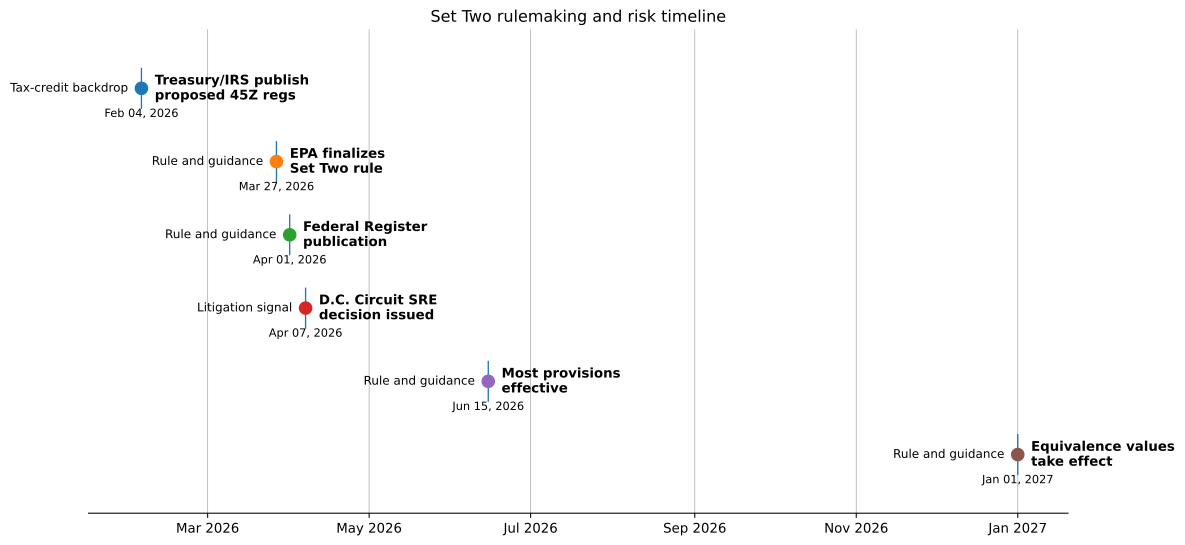
Key regulatory and litigation dates shaping EPA’s Set Two renewable fuel standards rule, including publication, effective dates, the D.C. Circuit SRE ruling, and the 45Z tax-credit backdrop.
The dates above are sourced from EPA’s Set Two final rule announcement/page, the Federal Register PDF publication, and the D.C. Circuit decision date line.
Rule text, Federal Register publication, and effective dates for EPA renewable fuel standards
The Set Two final rule is officially published in the 91 Federal Register at 16388 (April 1, 2026), as document number 2026-06275. The PDF itself contains the definitive docket and effective-date language, including the June 15 effective date and the January 1, 2027, delayed effective date for equivalence values.
For stories tied to published federal actions and official rule text, review our Federal Register-related coverage.
EPA’s public-facing Set Two page functions as an authoritative companion index. It publishes the final base volumes, SRE reallocation volumes, and total applicable volumes in a single table. It links directly to the final rule PDF, the final fact sheets, the Regulatory Impact Analysis (RIA), the Response to Comments document, and the 2025 CWC price calculation memo.
Within EPA’s own communications, there is a split in tone that industry readers should recognize. The one-page EPA fact sheet positions Set Two as “Action Taken by Trump EPA” and claims it sets the highest renewable fuel volumes in program history, produces large job totals, and reduces foreign oil dependence. The RIA, by contrast, explicitly treats many distributional effects as transfers and limits its core monetized societal accounting to fuel costs and energy security benefits. This divergence matters when quoting “benefits” in investor communications versus when modeling the pass-through of compliance costs.
Even the pre-final media narrative showed reallocation as the make-or-break variable. Reuters reported in late February that the administration had settled on a plan to require large refiners to compensate for at least half of waived obligations tied to SREs, with a final decision expected by late March. Set Two ultimately lands at seventy percent, as confirmed in EPA’s rule summary.
For additional reporting on federal agency proposals, revisions, and final actions, browse our rulemaking coverage.
What are the EPA renewable fuel standards volumes and percentage standards?
EPA expresses the Set Two volumes in billion RINs (ethanol-equivalent gallons). The single most important structural nuance—highlighted in your attached outline—is that EPA publishes (1) base volume requirements and (2) SRE reallocation volumes, which together yield the (3) “total applicable volumes” that drive the compliance percentage standards.
The official volume table, base vs reallocation, is summarized below from EPA’s final Set Two rule page.
| RFS category (billion RINs) | Base volume requirement 2026 | SRE reallocation 2026 | Total applicable 2026 | Base volume requirement 2027 | SRE reallocation 2027 | Total applicable 2027 |
|---|---|---|---|---|---|---|
| Cellulosic biofuel | 1.36 | 0.00 | 1.36 | 1.43 | 0.00 | 1.43 |
| Biomass-based diesel | 8.86 | 0.21 | 9.07 | 8.95 | 0.25 | 9.20 |
| Advanced biofuel | 10.82 | 0.28 | 11.10 | 10.98 | 0.34 | 11.32 |
| Total renewable fuel | 25.82 | 0.99 | 26.81 | 25.98 | 1.04 | 27.02 |
EPA explicitly defines one RIN as one ethanol-equivalent gallon of renewable fuel in its published rule summary.
EPA also anchors one of the most “insider-useful” clarifications in the Federal Register preamble: because biomass-based diesel is now framed in RINs rather than physical gallons, the 9.07 and 9.20 billion-RIN BBD applicable volumes are not directly comparable to prior gallon-based requirements; nevertheless, EPA states the finalized BBD volumes guarantee at least 5.33 and 5.75 billion gallons of BBD to be used in 2026 and 2027, respectively.
For related reporting on biomass-based diesel markets, imports, and policy, visit our biodiesel news archive.
For conventional ethanol demand, EPA reaffirms the implied conventional renewable fuel target of 15 billion gallons for 2026 and 2027 within the preamble’s volume-discussion section.
To follow developments tied to ethanol volumes and downstream market implications, explore our ethanol coverage.
On percentage standards, the RIA provides a compact table pairing EPA’s “average RIN price” inputs with the computed percentage standards for 2026 and 2027. EPA stresses that it cannot forecast future RIN prices, but it uses average RIN prices from January through December 2025 as an input estimate in its analysis.
The RIA table reports:
Cellulosic (D3) 0.79% in 2026 and 0.84% in 2027; Biomass-based diesel (D4) 5.24% and 5.37%; “Other advanced” (D5) 0.39% and 0.40%; and “Conventional renewable fuel” (D6) 9.07% and 9.17%.
From the same table, EPA’s RIN price inputs for that analysis are D3 at $2.40, D4 at $0.95, D5 at $0.99, and D6 at $0.91, average prices from Jan–Dec 2025.
Those percentages are operationally decisive because they are what obligated parties apply to their gasoline and diesel production or imports to compute annual Renewable Volume Obligations, and they embed the SRE reallocation in the numerator, raising the compliance bar relative to base-only obligations.
For more on how federal blending targets are reshaping the market, review our biofuel mandate reporting.
How do carryover RINs and SRE reallocation interact under EPA renewable fuel standards?
EPA’s Set Two design is unusually explicit: the SRE reallocation volumes are intended to “make up” a portion of exempted obligations by forcing retirement of carryover RINs that exist because of prior exemptions—thereby preventing SREs from permanently lowering the program’s effective renewable fuel use.
The RIA quantifies this “bank drawdown” concept. EPA estimates projected effective carryover RINs for 2026 and 2027, derived from carryover availability after 2024 compliance and adjusted by deficits, including 2,513,591,893 RINs in the non-cellulosic advanced pool (D4 + D5), 1,067,360,767 in conventional (D6), 17,318,049 in cellulosic (D3 + D7), and 3,601,783,344 total across all D codes.
Set Two’s SRE reallocation adders are large relative to that projected bank. The total renewable fuel SRE reallocation volumes are 0.99 (2026) and 1.04 (2027) billion RINs, totaling 2.03 billion across the two years, while advanced biofuel reallocation totals 0.62 billion (0.28 + 0.34).
The implication—strictly mechanical and consistent with EPA’s RIA framing—is that a large fraction of available carryover would be absorbed simply by satisfying reallocation volumes, even before any incremental physical blending response is considered.
The visualization below uses the EPA RIA’s projected effective carryover totals and EPA’s published reallocation adders to show the “bank versus reallocation” tension at the center of the Set Two narrative.
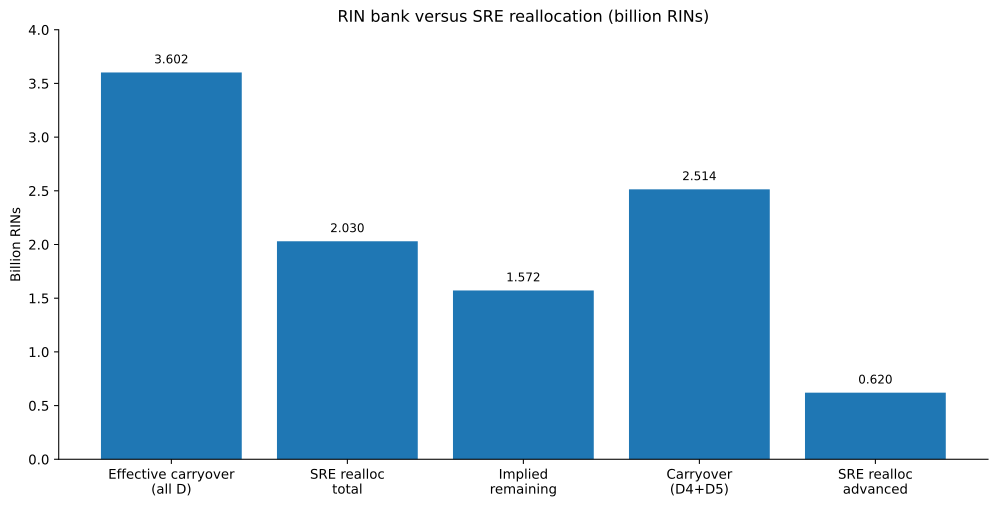
EPA’s Set Two framework is designed to absorb a large share of the carryover RIN bank through SRE reallocation volumes in 2026 and 2027.
EPA also frames carryover RINs as a shock absorber for market volatility and enforcement uncertainty: the RIA notes effective carryover can change due to truing-up of RVOs and enforcement actions, which is why EPA is cautious about setting base volumes that would further drain the bank beyond what SRE reallocation already does.
Litigation now overlays that bank logic. On April 7, the D.C. Circuit vacated EPA’s denials of 2024 SRE petitions for Alon Refining Krotz Springs and HF Sinclair Parco, holding EPA’s interpretation of its own eligibility rule conflicted with the regulation’s plain text and remanding to EPA. The court also highlights timing stakes in RIN validity, noting that if returned after a successful challenge, 2024 RINs could “expire” after the 2025 compliance deadline, which the opinion identifies as likely September 1, 2026, under the existing compliance timeline framework.
That does not change the Set Two volume tables directly; it does, however, raise the probability that SRE-related administrative reconsiderations could ripple into future waiver counts and the political durability of reallocation mechanics, particularly as EPA has built severability into the Set Two preamble and as judicial review windows run.
Program changes inside the EPA renewable fuel standards
If the Set Two volume tables are the headline, the program changes are the “basis risk.” Three changes in particular are likely to matter to compliance desks and operators beyond 2026–2027: removal of renewable electricity from the RFS program (eRINs), deferral, not adoption, of import RIN reduction (IRR), and revised equivalence values for hydrotreated fuels, delayed into 2027.
EPA’s own messaging about these changes is spread across the Federal Register preamble, the Response to Comments, and the fact sheets.
On eRINs, EPA conclusively reverses the earlier interpretation that renewable electricity can generate RINs, stating the statute does not permit electricity to generate RINs and finalizing the removal of renewable electricity as a qualifying renewable fuel under the program. EPA also notes a critical practical reality: EPA has not registered any parties to generate RINs for renewable electricity, and no renewable-electricity RINs have ever been generated. This removes a compliance “option” that existed more on paper than in the EMTS market.
On imports, EPA confirms what many insiders suspected before final publication. Despite an aggressive proposal, EPA is not finalizing IRR in Set Two, stating it requires more time and that EPA intends to establish IRR provisions beginning in the 2028 compliance year or shortly thereafter. EPA’s rationale is partly operational and partly contextual: EPA cites the changing Federal tax credit landscape as altering import incentives and reducing imports in 2025, complicating analysis.
On equivalence values, EPA finalizes lower defaults for renewable diesel and renewable jet fuel and retains the proposed default for renewable naphtha, but delays use of those defaults until January 1, 2027. EPA emphasizes that producers may petition for alternative equivalence values, and it gives a roadmap for renewable diesel producers to support petitions based on energy content and renewable content.
The Set Two rule also lands in a tax-credit transition defined by Section 45Z, and EPA explicitly weaves 45Z into its analysis of imports and blending economics.

“Mandate increases matter most when they intersect with facilities already positioned to supply large volumes.” (Aerial view of storage and processing infrastructure at Diamond Green Diesel’s renewable diesel refinery in Norco.)
Operationally, this is where the EPA renewable fuel standards become a terminal-and-logistics story, consistent with your attached outline: the compliance regime increasingly expresses itself through rack economics, product segregation, tank turns, blending schedules, and credit transfer documentation rather than only through refinery-level decisions.
EPA’s Response to Comments includes a useful framing for operators: it describes RINs as functioning like a cross-subsidy, raising the cost of petroleum fuels while reducing the cost of renewable fuels blended into the vast majority of transportation fuels. That framing is one reason EPA argues simple “RIN price equals pump price” narratives are incomplete, even while acknowledging that the final volumes are likely to increase consumer fuel costs overall when renewable fuel production costs are included.
EPA also provides a “small but non-trivial” estimate specific to the SRE reallocation itself: EPA projects SRE reallocation volumes add about 0.5 cents per gallon in 2026 and 0.6 cents per gallon in 2027, costing about $2 billion across the two years. This is separate from EPA’s broader estimated fuel price impacts from the complete rule package, which EPA describes in the Response to Comments as on the order of five cents per gallon for gasoline and twenty cents per gallon for diesel over the period, inclusive of renewable fuel production costs.
Against that, EPA’s RIA monetized societal ledger reports fuel costs of roughly $18.24 billion in 2026 and $21.24 billion in 2027, with energy security benefits of roughly $360 million and $440 million, producing negative net benefits within that monetized accounting frame. EPA explicitly cautions that many other effects discussed elsewhere in the RIA are transfers, are difficult to monetize, or are treated outside that narrow societal accounting table.
What do equivalence values and CWCs mean under EPA renewable fuel standards?
For hydrotreated fuels, the equivalence value is the “hidden multiplier” that tells you how many RINs are generated per physical gallon. In Set Two, EPA finalizes new default equivalence values of 1.5 for renewable diesel, 1.5 for renewable jet fuel, and 1.4 for renewable naphtha, and delays these defaults to January 1, 2027, to give producers time to submit petitions and EPA time to process them.
EPA also provides context explaining why industry should expect a transition period: historically, renewable jet fuel equivalence values were approved on a facility-by-facility basis and often ranged from 1.6 to 1.7, while naphtha often ranged from 1.4 to 1.5, and renewed defaults are meant to reduce over-crediting associated with non-renewable hydrogen inputs in hydrotreating.
Two operational implications follow, both consistent with your draft’s “terminal activity story” thesis:
First, if the default equivalence value for renewable diesel drops from 1.7 to 1.5, then all else equal, more physical renewable diesel must be produced and blended to generate the same number of D4 RINs, or more RINs must be purchased in the market. EPA’s delay into 2027 is therefore a meaningful temporal boundary for supply planning and contracting cycles.
Second, EPA anticipates that renewable jet fuel volumes will often be produced at the same facilities and from the same feedstocks as renewable diesel, so increased renewable jet fuel output may correspond to decreased renewable diesel output in the near term, depending on facility constraints and incentive structures. That is a direct feedstock-and-throughput story for terminals and marketers because it affects which “drop-in” molecules arrive at which racks and what RIN category they carry.
On CWCs, Set Two is more immediate. EPA partially waives the 2025 cellulosic biofuel volume requirement due to a 0.17 billion-RIN shortfall, reducing the 2025 cellulosic volume from 1.38 to 1.21 billion RINs and revising the associated percentage standard.
When EPA exercises that cellulosic waiver authority, it is required to make cellulosic waiver credits available, and EPA explains that CWCs are priced by a statutory formula: the higher of $0.25 per gallon or $3.00 minus the average wholesale gasoline price, adjusted for inflation.
EPA’s 2025 calculation memo shows how the agency derives the wholesale gasoline price and inflation factor and concludes that the 2025 CWC price is $1.91.

“Federal policy becomes tangible when it connects to the plants, tanks, and rail-linked assets that move fuel into the market.” (Montana Renewables’ Great Falls site, where the company produces renewable fuels including SAF, renewable diesel, and renewable naphtha.)
That CWC price matters because it sets a known-cost compliance tool for meeting the waived portion of the 2025 cellulosic requirement, subject to the RFS’s rules governing how CWCs interact with D3 obligations, and it also functions as a ceiling-like reference point for some compliance strategies, especially where D3 RIN availability tightens.
A subtle but critical clarification for 2026–2027 planning: EPA states it is establishing the 2026 and 2027 cellulosic biofuel volume requirements without using the cellulosic waiver authority, and therefore CWCs would not be available for those years absent a future action to exercise waiver authority.
Is import RIN reduction coming, and what about eRINs under EPA renewable fuel standards?
EPA’s Set Two preamble provides one of the clearest status statements in years on import RIN reduction: EPA is not finalizing IRR for the 2026 and 2027 volume requirements, but intends to establish IRR provisions beginning in the 2028 compliance year or shortly thereafter.
EPA’s description of the originally proposed IRR concept is blunt: under the proposal, import-based renewable fuels would have generated half as many RINs as under current regulations. EPA explicitly cites stakeholder concerns about market disruption without sufficient lead time, as well as definitional and implementation gaps.
At the same time, EPA still strengthens importer accountability in Set Two by adding provisions that treat importers as jointly and severally liable for violations, including those associated with future import RIN reduction provisions. This is a compliance-and-counterparty risk item for market participants that source renewable fuels or renewable feedstocks through complex ownership chains.
On renewable electricity, eRINs, EPA goes further than mere delay: it reverses the eligibility determination, finalizing removal of renewable electricity as a qualifying renewable fuel and removing multiple associated provisions, including definitions, pathways, equivalence value, RIN generation and separation requirements, and registration, reporting, and recordkeeping rules.
EPA asserts two core rationales. First, renewable electricity is not “fuel” within the best reading of the statute’s definitions of renewable fuel and transportation fuel. Second, even if interpreted as eligible, the existing regulations were inadequate to prevent double-counting and thus unworkable for RIN integrity.
EPA underscores the practical reality that no parties have been registered to generate renewable-electricity RINs and none have ever been generated, meaning the removal should not unwind an existing EMTS credit market. Still, it shuts the door on any near-term eRIN-based compliance strategy that some stakeholders modeled.
Company and product signals meeting the EPA renewable fuel standards
Even though Set Two is written as compliance mathematics, the market answer is physical capacity, and the last year of public disclosures shows why EPA and the market keep returning to renewable diesel and SAF as the marginal “compliance molecules.”
For more Tank Transport coverage on the shift toward lower-carbon fuel supply, see our renewables reporting.

“The rule’s impact will ultimately be judged by how much renewable fuel capacity is running, not just by the size of the mandate.” (Phillips 66’s Rodeo Renewable Energy Complex during renewable feedstock processing operations.)
In California, Phillips 66’s Rodeo Renewable Energy Complex describes renewable feedstock processing of about 50,000 barrels per day, roughly 800 million gallons per year, and an initial neat SAF capability of about 150 million gallons per year, emphasizing geographic and logistics advantages in Rodeo, California. EIA’s capacity reporting similarly notes that the Rodeo conversion increased capacity dramatically and highlights the broader industry shift toward SAF flexibility at renewable diesel plants.
For more reporting on renewable jet fuel supply, project buildouts, and distribution strategy, read our SAF reporting.
In the Gulf Coast, Diamond Green Diesel publicly positions itself as operating 1.2 billion gallons per year of renewable diesel plants, emphasizing an integrated supply chain combining feedstock sourcing, refining, and marketing logistics. In parallel, EIA’s capacity analysis identifies Diamond Green Diesel’s Norco plant as the largest renewable diesel plant in the United States and notes that Diamond Green Diesel can shift about 235 million gallons per year of capacity to SAF, reinforcing the “SAF as a swing product” thesis.
Valero and Darling’s previously announced SAF project at Port Arthur is a case study in how those swing capabilities become concrete. Valero’s investor release states the Port Arthur plant would be able to upgrade about 50 percent of its 470 million-gallon annual production capacity to SAF, with the project expected in 2025 and the capability positioning DGD among the world’s largest SAF manufacturers.
In Montana, Montana Renewables is the other production node central to the Set Two “capacity reality” story. DOE’s announcement of a $1.67 billion loan guarantee describes current production of about 140 million gallons per year of biofuels, mostly renewable diesel, and an expansion to about 315 million gallons per year, most of which would be SAF, with DOE projecting Montana Renewables could represent about half of all North American SAF and about 12 percent of global SAF through 2030 once fully ramped.

“The compliance story grows more consequential when policy support and production capacity begin moving in the same direction.” (Department of Energy project graphic illustrating the Montana Renewables expansion tied to future SAF production.)
On February 19, a Calumet and Montana Renewables release adds the commercial contracting layer: Montana Renewables and World Energy announced a three-year SAF agreement expected to deliver more than seventy million gallons to the market and reduce up to 600,000 metric tons of CO2 emissions, positioning the deal as evidence of scaling in domestic SAF offtake contracts.
Internationally, Neste’s 2025 annual report provides one of the clearest capacity metrics from a leading renewable fuels supplier: global SAF production capability of 1.5 million tons per year in 2025, expected to grow to 2.2 million tons per year in 2027, with the report also describing the Rotterdam SAF production start and associated capacity uplift.
These corporate disclosures do not “prove” EPA’s volume assumptions. Still, they do support the core operational premise behind Set Two: compliance will be met through a combination of physical production and use and the credit mechanisms, including carryover RIN retirement, with renewable diesel and SAF projects acting as both compliance suppliers and strategic hedges against future regulatory direction, including the deferred but still-signaled IRR future.
Market impacts and operational implications of EPA renewable fuel standards
The EPA renewable fuel standards Set Two rule arrives alongside a tax-credit redesign that EPA explicitly treats as part of its market context. The Federal Register preamble states that the Section 45Z Clean Fuel Production Credit does not provide credit for imported biofuels and, after amendment by the One Big Beautiful Bill Act, requires biofuels to be produced from North American feedstocks to qualify, which changes EPA ties to a sharp drop in imported renewable fuel volumes in 2025.
Separately, the Treasury and IRS proposed a regulation package for Section 45Z, published in the Federal Register on February 4, that states it provides rules on credit eligibility, emissions rates, and certification and registration requirements. The operational upshot is that producers and blenders are optimizing across overlapping incentive systems, RIN credits, potential State programs, and 45Z economics, which EPA explicitly says it considered when assessing blending costs and retail price impacts.
EPA’s Response to Comments includes one of the most practical explanations for terminal and wholesale-market participants: EPA estimates the cost of RINs to obligated parties for compliance with the 2026 and 2027 standards at about $0.16 per gallon of petroleum fuel based on 2025 RIN prices, but notes that this is not the same as the impact of RINs on fuel prices because RIN value also acts as a subsidy to blended renewables.
For terminals and logistics operators, the Set Two rule suggests several forecastable friction points, presented here as analytical inferences grounded in the rule’s mechanics, not as guaranteed outcomes:
Rack economics are likely to remain credit-sensitive because Set Two is intentionally sized to draw down carryover RINs while simultaneously raising percentage standards through reallocation. That combination encourages greater attention to the timing of blending and RIN separation and to the value of banked RINs before they age out.

“Mandate increases matter most when they intersect with facilities already positioned to supply large volumes.” (Aerial view of Diamond Green Diesel’s renewable diesel refinery in Norco, Louisiana.)
Tankage and segregation constraints become more valuable when equivalence values change in 2027. A lower default equivalence value reduces RIN generation per gallon, increasing the “physical gallons per RIN” requirement for some strategies and shifting the premium and discount behavior for blendstocks and finished products at specific terminals.
SAF’s growth as a swing product, as documented by EIA reporting and reflected in company disclosures, creates competition for hydrotreating units and lipid feedstocks that historically produced renewable diesel, thereby shifting regional flows of renewable diesel and renewable naphtha and reshaping diesel pool blending strategies, especially during seasonal specification changes.
Finally, litigation risk on SREs now has a new near-term reference point. The D.C. Circuit’s April 7 decision is narrowly about EPA’s regulatory interpretation for eligibility under a specific rule provision. Still, it signals that SRE administration remains a live and contested feature of program implementation, one that can influence future reallocation politics and the compliance calendar pressure on RIN banks.
A final note on stakeholder positions: trade groups predictably split. EPA’s narrative emphasizes rural economic stability and “highest volumes,” while trade groups that refine argue that reallocation distorts markets and inflates compliance costs. The Response to Comments repeatedly reflects this divide and documents EPA’s rebuttal to large pump-price impact claims by narrowing assumptions, notably distinguishing SRE reallocation impacts from broader rule impacts and emphasizing the role of carryover RIN retirement.
Key Developments in the EPA Renewable Fuel Standards Set Two Rule
- EPA finalized the Set Two rule for 2026 and 2027, locking in the highest renewable fuel requirements in the program’s history.
- Total applicable volumes rise to 26.81 billion RINs in 2026 and 27.02 billion RINs in 2027, with biomass-based diesel set at 9.07 billion and 9.20 billion RINs.
- EPA finalized a 70% reallocation of recent small-refinery exemptions, increasing the mandate’s effective size and drawing renewed attention to the carryover RIN bank.
- The agency also partially waived the 2025 cellulosic biofuel requirement and set the 2025 cellulosic waiver credit price at $1.91.
- Renewable electricity was removed from the RFS program, eliminating eRIN eligibility and narrowing the compliance focus back toward liquid renewable fuels.
- Revised default equivalence values for renewable diesel, renewable jet fuel, and renewable naphtha take effect in 2027, changing how many RINs those fuels generate per physical gallon.
- EPA did not finalize import RIN reduction for 2026–2027, but it signaled that imported fuels and feedstocks are likely to receive reduced compliance value beginning in 2028.
- A fresh D.C. Circuit ruling on 2024 small refinery exemptions adds another layer of uncertainty to the waiver and reallocation landscape moving forward.
Official Rule, Compliance, and Industry Resources for EPA’s Set Two Renewable Fuel Standards
- Review EPA’s overview of the final rule, including official 2026–2027 volume tables and supporting materials, at EPA’s Final Renewable Fuel Standards for 2026 and 2027 page.
- Read the full published rule text and effective-date language in the official government PDF at GovInfo’s Federal Register publication of the Set Two final rule.
- Examine EPA’s technical modeling, cost assumptions, and market analysis in the Regulatory Impact Analysis for the Set Two rule.
- See how EPA addressed stakeholder arguments and implementation issues in the Response to Comments for the Set Two final rule.
- Get EPA’s high-level summary of the final action in the Final “Set 2” Rule fact sheet.
- Compare proposed and finalized volumes, including SRE reallocations, in EPA’s detailed Set Two fact sheet.
- Understand how EPA calculated the 2025 cellulosic waiver credit price in the Cellulosic Waiver Credit Price Calculation for 2025.
- Read the April 2026 court opinion affecting the small refinery exemption landscape in the D.C. Circuit decision in Alon Refining Krotz Springs, Inc. v. EPA.
- For directly referenced reporting on the pre-final waiver reallocation debate, see Reuters’ report on expected SRE reallocation for large refiners.
- Learn more about one of the renewable fuels facilities discussed in the article at Phillips 66’s Rodeo Renewable Energy Complex page.
- Review the federal context on SAF expansion financing at DOE’s Montana Renewables expansion announcement.
- Read the company announcement on SAF delivery scaling at Montana Renewables and World Energy’s SAF delivery agreement release.
- See EIA’s market context on renewable fuels capacity trends in EIA’s report on U.S. biofuels production capacity growth.
- Explore Diamond Green Diesel’s company overview and product focus at Diamond Green Diesel’s corporate site.
- Read about the Port Arthur SAF project in Valero’s investor release on the DGD SAF project.
- Review broader SAF capacity disclosures in Neste’s 2025 annual report.
- For the tax-credit backdrop discussed in the article, read the official notice at the Federal Register’s Section 45Z Clean Fuel Production Credit page.