Updated August 20, 2026: This article has been substantially revised to include the second 90-day waiver extension, the narrower August product list, the new voyage-by-voyage vessel-availability process, completed-movement reporting, and EIA evidence of record for April coastal petroleum flows.
- The Jones Act waiver extension began August 17 and can cover approved foreign-flag voyages whose eligible cargo is loaded before 11:59 p.m. Eastern Time on November 15, 2026.
- The latest phase adds voyage-specific approval: each proposed foreign-flag movement must clear a MARAD vessel-availability survey and receive an individual Department of War determination.
- April and May data show that domestic coastal petroleum movements did rise after a weak March start, but the records do not prove lower rack prices, consumer savings, or additional tank-truck loads.
The Jones Act waiver extension has transformed a broad emergency exception into a narrower, voyage-specific operating process. The second 90-day extension began at 12:00 a.m. Eastern Time on August 17, 2026. For an approved movement to qualify, covered cargo must be loaded aboard the relevant vessel before 11:59 p.m. Eastern Time on November 15.
The deadline is important, but the procedural change is more consequential. A commodity’s appearance on the federal product list does not authorize a foreign-flag voyage. Before initiating a movement under the new phase, a trade participant must request a vessel-availability review; the Maritime Administration surveys the coastwise-qualified market; and the Department of War decides whether the requested foreign-flag movement qualifies under the waiver.


The evidence has changed as well. When Tank Transport first published this article on April 8, domestic coastwise liquid movements had remained broadly flat in March while record clean-product exports pulled barrels toward overseas markets. That was a defensible early reading. The U.S. Energy Information Administration now reports that Gulf Coast petroleum movements to the West Coast rose sharply in April and remained elevated in May, while Gulf Coast-to-East Coast shipments reached a record in April.
Those later movements materially revise the early picture without settling the larger argument. The waiver has enabled the reporting of domestic marine cargo movements by foreign-flagged vessels. Still, waterborne volume alone does not establish that the policy lowered rack prices, reduced retail prices, or increased demand for tank trucks. It shows that cargo moved. The economic and downstream consequences must still be demonstrated on a market-by-market basis.
Central distinction: the waiver expands the vessels that may perform an approved domestic marine movement; it does not dictate the cargo’s economics, receiving terminal, rack price, carrier or final delivery market.
How the waiver reached a stricter third phase
The Jones Act is the common name used for the coastwise merchandise rule in 46 U.S.C. § 55102. With limited exceptions, merchandise moving by water between U.S. points must travel on a U.S.-owned vessel that holds a coastwise endorsement; the coastwise qualification also incorporates U.S.-build requirements through the vessel-documentation framework.
On March 17, the Department of Homeland Security issued a limited waiver under 46 U.S.C. § 501(a) at the request of the Department of War. The original phase lasted 60 days. A first 90-day extension began May 18, and CBP’s August 13 guidance announced a second 90-day period beginning August 17.
| Waiver phase | Operating period | Loading deadline | Principal operating change |
|---|---|---|---|
| Original waiver | March 17–May 17 | 11:59 p.m. EDT, May 17 | 60-day limited waiver with CBP notice, vessel-entry, and post-voyage reporting requirements |
| First extension | May 18–August 16 | 11:59 p.m. EDT, August 16 | Added 90 days and required a PDF copy of CBP Form 1302 in the initial notice |
| Second extension | August 17–November 15 | 11:59 p.m. ET, November 15 | Adds a pre-voyage request, MARAD market survey, and individual Department of War determination |
The legal basis did not change when the survey was added.
The distinction between subsections 501(a) and 501(b) matters. Under § 501(a), a defense-requested waiver rests on a determination that relief is necessary in the interest of national defense to address an immediate adverse effect on military operations. The original March process did not include the ordinary coastwise-vessel nonavailability review associated with § 501(b), a point emphasized by domestic maritime interests opposing the broad waiver.
The current statute uses the title “Secretary of Defense,” whereas CBP’s 2026 notices identify the requesting organization as the Department of War. The source language should not be collapsed into one title. The 10-day waiver limit and 45-day aggregate limit found in § 501(b) do not govern this § 501(a) action.
The August guidance adds a coastwise-qualified vessel survey to each proposed foreign-flag movement. That is a major implementation change, but it does not convert the underlying waiver into a different statutory action. The national-defense basis remains. What changes is the operational gate: domestic vessel operators now have the opportunity to report their availability for the proposed cargo and time window before the Department of War decides whether the requested foreign-flag voyage is covered.
Legal takeaway: the August market survey changes how the § 501(a) waiver is administered; it does not erase the waiver or make every listed commodity automatically eligible for foreign-flag carriage.
What a requester must submit before a foreign-flag voyage
The written request must use the subject line “VESSEL AVAILABILITY REQUEST” and go to the Department of War and MARAD, with CBP copied for situational awareness. CBP Guidance #4 requires a detailed operating picture:
- vessel name, IMO number, flag, owner, operator, country and carrier;
- voyage dates, ports of call and the places, ports and dates of loading and unloading;
- commodity description, relevant HTS code, applicable hazmat code and quantity per shipment;
- expected shipment frequency and the national-defense justification; and
- other information MARAD requests, including special shipping or stowage needs and charter-party timing.
MARAD then surveys coastwise-qualified vessel operators. It sends the survey result to the Department of War, which informs the requester, MARAD, and CBP whether a foreign-flag vessel is authorized under the waiver or whether the survey identified coastwise-qualified capacity. The requesting trade participant then contacts the appropriate carrier to arrange transportation.
A 24-hour vessel response is not a 24-hour approval.
Unless MARAD specifies otherwise, coastwise-qualified vessel operators have 24 hours to respond to a market survey and state whether they can pick up the cargo within the defined window. The guidance does not promise a final government determination within 24 hours. It also does not guarantee that a domestic vessel identified in the survey will ultimately be chartered. Commercial terms, suitability, and scheduling still must be resolved by the parties.
That difference has practical consequences. Chartering, berth windows, tank availability, cargo sequencing, and downstream nominations should not be treated as final merely because a product appears on the federal list or because the survey response period has closed.
CBP and MARAD filings remain after authorization
An authorized foreign-flag carrier must still notify CBP with vessel, commodity, HTS, carrier, port, and date information and provide a PDF copy of CBP Form 1302. The vessel-entry and clearance rules continue to apply. No later than 10 days after the voyage concludes, the owner or operator and the waiver requester must submit the required voyage report to MARAD under § 501(c).
Eight hard truths about the Jones Act waiver extension
The new deadline, product list, and coastal-flow data can be reduced to eight defensible conclusions. Each one limits a common overstatement about what the waiver does.
- The November 15 deadline controls loading, not voyage completion. An approved covered product must be loaded before 11:59 p.m. Eastern Time that day. CBP does not require the vessel to arrive at its destination before the deadline.
- The August product workbook contains about 65% fewer listed rows than the April file. Tank Transport counted 237 nonblank product rows in August versus 671 in April. That is a narrower administrative list—not evidence of a 65% reduction in cargo volume, economic value, or usable routes.
- “Potentially covered” does not mean authorized. The exact HTS entry is only the first screen. The proposed foreign-flag voyage must still pass through the new request, survey, and determination process.
- Each foreign-flag request now faces a domestic-vessel availability check. The new survey provides coastwise-qualified operators with a clear opportunity to report capacity for the specified cargo and schedule.
- The 24-hour clock belongs to vessel operators, not to the final decision. It is a market-survey response window, not a published approval service level.
- Authorization does not end the compliance work. CBP notice and Form 1302 requirements remain in effect, and completed-voyage reporting is due to MARAD within 10 days.
- April and May flows materially change the weak March picture. EIA recorded sharply higher Gulf Coast-to-West Coast petroleum movements and a Gulf Coast-to-East Coast record in April.
- More waterborne cargo is not proof of cheaper fuel or more truckloads. Rack prices and highway activity depend on product specifications, delivered cost, storage, blending, allocation, terminal capacity, and local demand.
Evidence boundary: the strongest new proof is that reported domestic marine movements increased. The available public data do not isolate the waiver’s effect on retail prices, terminal turns or tank-fleet utilization.
The August product list is narrower—but still reaches tank and bulk cargo
The product workbook is one of the most consequential changes for shippers because broad commodity labels are not enough. The controlling field is the exact HTS number in the current attachment. A product that appeared in April may have disappeared by August, while a product that remains listed is still only potentially covered.
| Tank Transport workbook count | April 24 file | August 17 file | Change |
|---|---|---|---|
| Nonblank listed product rows | 671 | 237 | 434 fewer; 64.7% |
| Distinct full HTS numbers | 631 | 228 | 403 fewer; 63.9% |
Methodology: Tank Transport counted rows with a populated HTS number or product description, excluded the header and blank formatted rows, and then counted unique full HTS values separately. Duplicate HTS rows with different or repeated descriptions explain why row totals exceed distinct-code totals. The comparison measures the administrative attachments; it does not measure cargo volume.
Every distinct HTS number in the August file also appeared in the April attachment. The narrower list therefore removes entries rather than adding a new product family, although descriptions and duplicate rows still require line-by-line review.
What disappeared and what remained
The August file contains no coal entries, while the April file included 23 coal-related rows. Chapter 29 organic chemicals and Chapter 34 soap, lubricant and preparation entries also disappear as complete chapter groups. Chapter 38 is reduced from 46 rows to two. The largest remaining group is Chapter 27 mineral fuels and oils, with 189 of the August file’s 237 rows.
| Product family | August status | Tank and bulk relevance |
|---|---|---|
| Petroleum fuels and feedstocks | Extensively retained | Crude oil, gasoline components, finished gasoline, jet fuel, diesel, fuel oils, naphtha and related streams remain central to marine terminals and petroleum tank fleets. |
| Natural gas and LPG | Selected entries retained | LNG, gaseous natural gas, propane and other selected gas classifications remain listed; equipment and terminal requirements differ sharply by product. |
| Fertilizer and ammonia | Thirty Chapter 31 rows plus selected Chapter 28 entries | Urea, ammonium products, anhydrous ammonia, and other fertilizers retain relevance for dry-bulk, liquid-bulk, storage, and seasonal distribution. |
| Ethanol, biodiesel, and DEF | Selected entries retained | Fuel ethanol, a biodiesel classification, and a urea entry specifically identifying ISO 22241 diesel exhaust fluid remain on the list. |
| Sulfur and soybean oil | Selected entries retained | These products extend the potential operating relevance beyond finished motor fuels to industrial, agricultural, and food/feed supply chains. |
| Coal and many organic chemicals | Removed from the August attachment | Earlier inclusion should not be treated as current eligibility; the latest HTS workbook must be checked before planning a request. |
The product list therefore remains relevant to both liquid and dry bulk transportation, but not uniformly. LNG, anhydrous ammonia, gasoline, sulfur and soybean oil require different vessels, terminals, storage systems, quality controls and highway equipment. A common place on the waiver attachment does not make the products operationally interchangeable.
What the MARAD and EIA records actually establish
March was a valid baseline, not the final result
The original article found that the waiver had not produced a visible domestic response in March. Reuters reported coastwise shipments of crude oil, refined products, biofuels and liquid chemicals at about 1.37 million barrels per day, broadly unchanged from February. Gulf Coast liquid movements to other U.S. coastal markets fell from 826,000 barrels per day in February to 770,000 in March. At the same time, clean-product exports rose from about 2.5 million barrels per day to a record 3.11 million.
That evidence supported the original conclusion that legal vessel flexibility had not yet overcome stronger export economics. It should remain as historical context—not as a description of the entire waiver period. EIA’s later data show that domestic movements changed in April and May.
| Measure | Reported level | Comparison | What the evidence establishes |
|---|---|---|---|
| All cited U.S. coastwise liquids, March | About 1.37 million b/d | Broadly flat from February | No immediate aggregate March surge in the Reuters/Kpler measure |
| Gulf Coast to West Coast, April | 190,000 b/d | Less than 30,000 b/d in January and February | A material increase in waterborne route volume and product diversity |
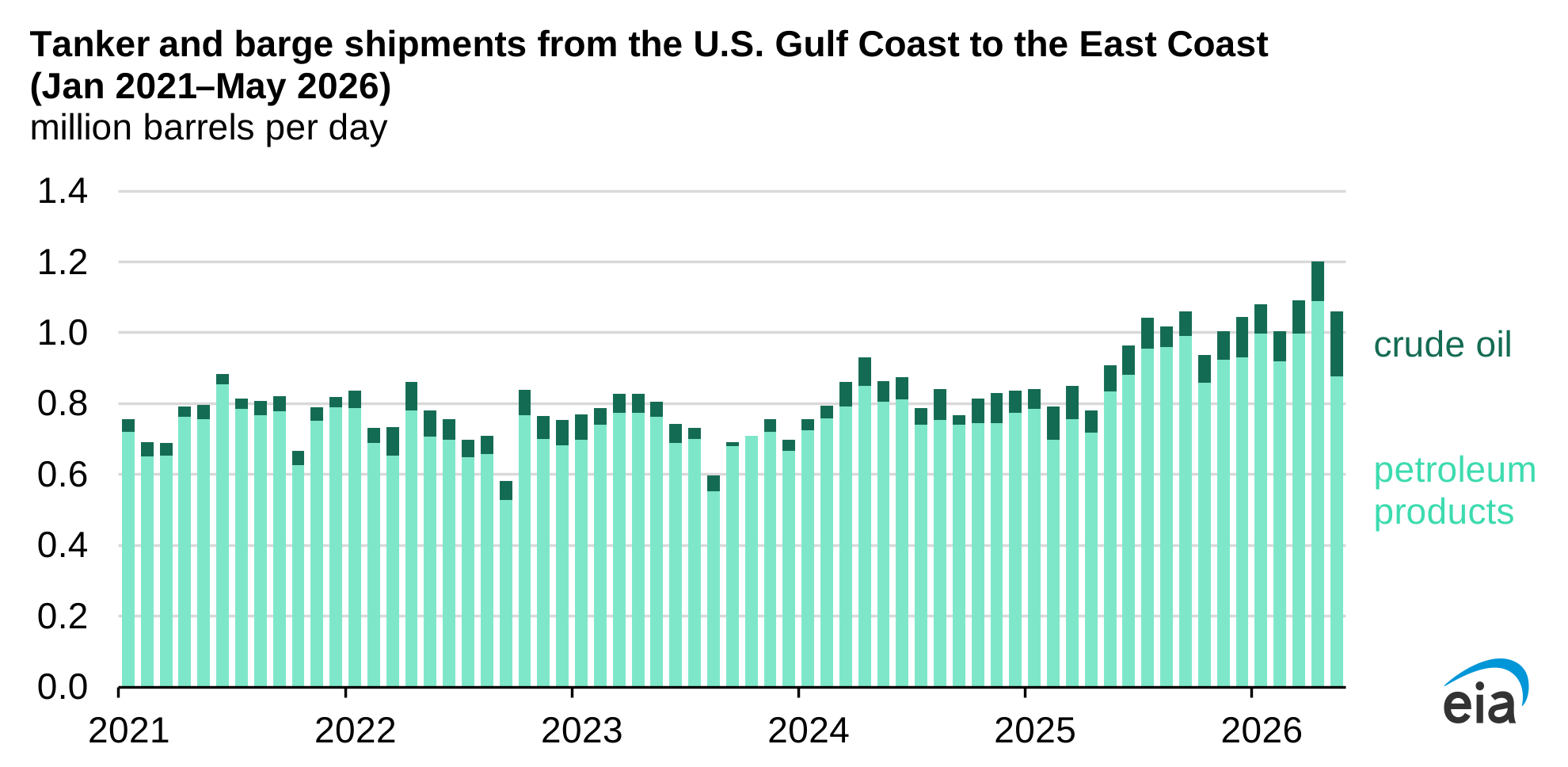
| Gulf Coast to East Coast, April | 1.2 million b/d | 11% above the pre-waiver record | A new monthly waterborne route record |
| Gasoline blending components, April | 620,000 b/d | Record high | Record Gulf Coast-to-East Coast receipts for that class |
| Distillate, April | 220,000 b/d | Record high | Record Gulf Coast-to-East Coast receipts for that class |
| Gulf Coast-to-East Coast crude, May | 180,000 b/d | Record high | Crude set a separate record as total route movements fell 12% |
The West Coast gained product diversity as well as volume
From 2021 through February 2026, renewable diesel accounted for 96% of the waterborne petroleum shipments from the Gulf Coast to the West Coast. April looked different. Gasoline blending components, finished gasoline, jet fuel, and crude oil were added to the route, raising total shipments to 190,000 barrels per day. EIA says the April total was more than double the previous record, and movements remained elevated in May.
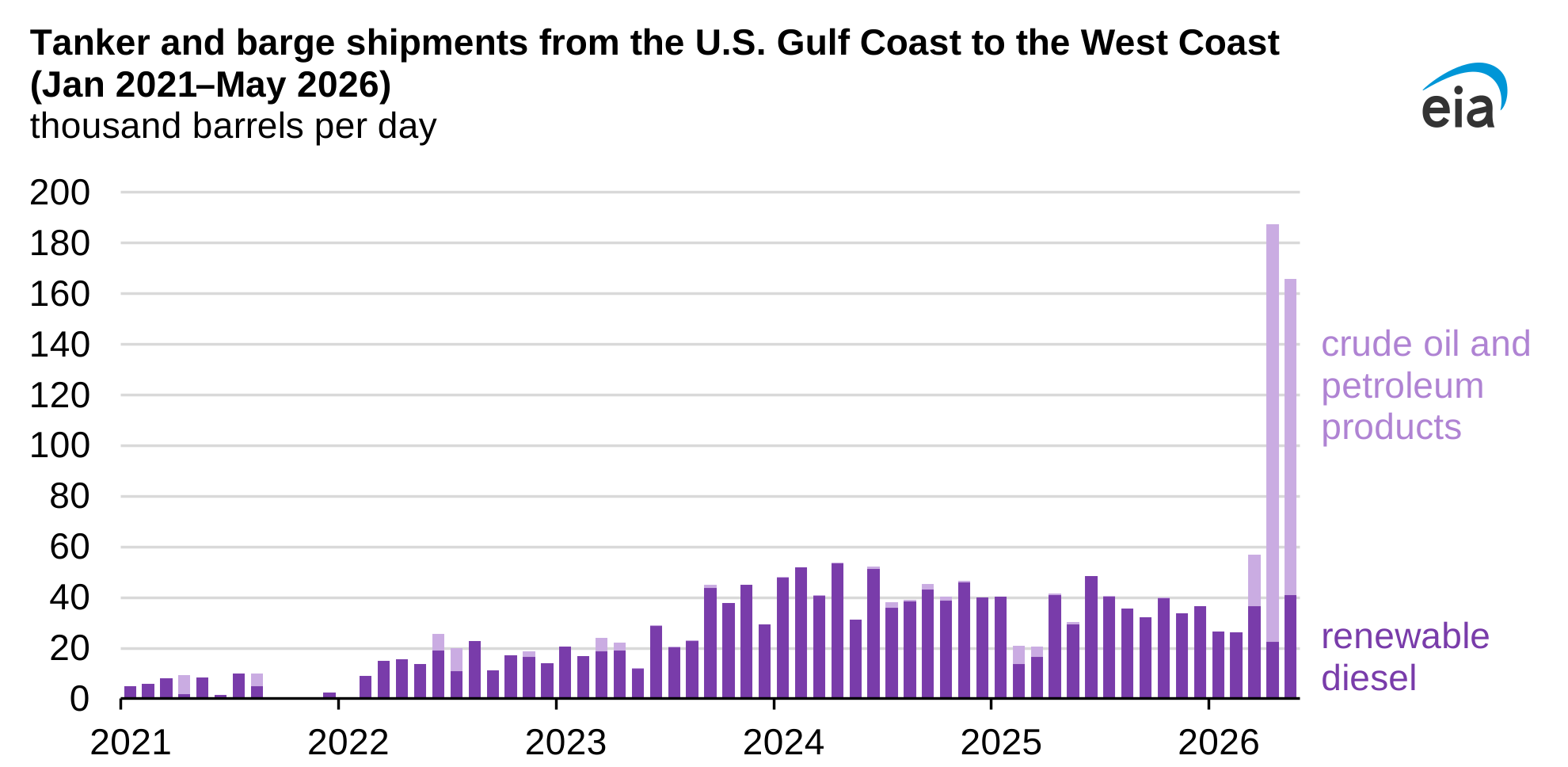
That matters for marine-dependent western markets because route volume alone can hide product limitations. Renewable diesel does not automatically substitute for every gasoline, jet fuel, or crude requirement. April’s broader product mix is therefore more operationally informative than the headline volume alone.
The East Coast record was larger, but May showed volatility.
Gulf Coast-to-East Coast movements reached 1.2 million barrels per day in April, 11% above the prior record. Gasoline blending components reached 620,000 barrels per day, and distillate reached 220,000 barrels per day, both records. EIA also notes that Florida depends heavily on waterborne receipts from Gulf Coast refining centers, which helps explain why PADD 3-to-PADD 1 is the dominant U.S. inter-PADD waterborne route.
Total movements on the route then fell 12% in May, even as crude oil reached a separate record of 180,000 barrels per day. The month-to-month change is a warning against treating one record as a permanent new baseline.
MARAD’s report proves useful, but it is not a price study
The cumulative MARAD workbook posted August 17 contains 224 populated vessel-name rows, and Tank Transport counted 174 distinct vessel-name strings. Neither count establishes a unique-vessel total or an analytically independent-voyage total. Vessels can recur, and exact name strings are not normalized identifiers. The report is structured as participant-submitted movement data rather than a normalized research dataset.
The rows document cargo descriptions, loading and discharge facilities and ports, dates, quantities, flags, and participant explanations. Reported cargoes include gasoline, ultra-low-sulfur diesel, crude oil, renewable diesel, jet fuel, ethanol, naphtha, vacuum gas oil, fuel oil, anhydrous ammonia, and fertilizer products. They establish that the waiver was used across multiple cargo types and routes.
They do not establish the counterfactual. The workbook does not show which cargoes would have moved on coastwise-qualified vessels absent the waiver, which movements would not have occurred, how freight compared, or what happened to rack prices because of an individual voyage. Quantities also appear in different industry units, so adding all rows to a single total would produce a misleading number without substantial normalization.
Data takeaway: MARAD reports who moved what and where after a completed voyage; EIA measures route-level petroleum flows. Neither dataset, by itself, proves consumer savings or additional highway demand.
From vessel approval to the terminal rack
The waiver directly changes vessel eligibility. Tank trucks feel only the downstream consequences, and those consequences arrive through a chain of operational decisions.
- Voyage authorization and chartering: the proposed foreign-flag movement must clear the federal process before the parties can rely on it.
- Berth and arrival timing: a different vessel, a delayed determination, or a revised voyage window can change terminal scheduling.
- Tank assignment and segregation: the receiving terminal must have compatible storage, sufficient working capacity, and an acceptable cargo sequence.
- Quality, blending and release: imported or coastwise cargo must meet the destination market’s specifications and complete any required testing, blending or documentation before rack release.
- Rack nomination and allocation: available inventory must be translated into customer nominations, loading windows or allocation changes.
- Dispatch and final delivery: only then can petroleum tank fleets adjust loads, routes, shifts, equipment and customer schedules.
A cargo can therefore improve physical inventory without immediately increasing truck activity. It may replace another supply source, refill low storage, arrive at a terminal without a highway rack, remain restricted to a specific customer, or require blending before release. Conversely, a strategically placed cargo can prevent a rack interruption or reduce unusually long repositioning moves without increasing total gallons consumed.
For a broader view of inventories, refining constraints and replacement economics, Tank Transport’s fuel supply crunch analysis and 2026 U.S. fuel supply outlook provide the market context. The original emergency backdrop remains documented in the publication’s Hormuz shock coverage.
Highway rules remain fully separate.
The waiver does not alter the Hazardous Materials Regulations, cargo-tank specifications, driver qualification, hours-of-service rules, security requirements, or state and local product standards. A foreign-flag vessel authorization is not a PHMSA or FMCSA waiver. Tank fleets must still use the correct equipment, documentation, placards, loading procedures, and qualified personnel for highway movement.
That separation is especially important for anhydrous ammonia, LPG, ethanol, and other regulated cargoes on the list. The marine policy may affect the origin or timing of supply, but it does not reduce the hazard controls associated with storage, transfer, or road transportation. Tank Transport’s PHMSA hazmat rules reference covers the separate federal highway framework.
Broader bulk cargoes create different downstream patterns.
Fertilizer, sulfur, soybean oil, ethanol, biodiesel, and DEF illustrate why the waiver cannot be analyzed solely through the lens of gasoline racks. Dry fertilizer may be discharged into warehouse or transload systems before being moved by pneumatic or hopper equipment. Anhydrous ammonia requires pressure-capable storage and transport. Ethanol and biodiesel can enter blending networks. DEF may move through dedicated storage and packaging channels rather than petroleum racks.
The August list gives those commodities a possible marine pathway, subject to exact HTS matching and voyage approval. It does not disclose that any particular inland market will receive more product, that a named carrier will gain volume, or that seasonally constrained logistics will be resolved.
Operational takeaway: the waiver can change the timing and origin of terminal receipts, but the downstream result depends on the facility, product, customer and release path—not simply on the vessel’s arrival.
The policy argument the records do not settle
The March waiver divided industries that define national resilience differently. American Fuel & Petrochemical Manufacturers welcomed the flexibility for crude oil, refined products and petrochemicals. The American Farm Bureau Federation supported additional shipping access for fuel and fertilizer during a period of acute farm-input pressure.
Domestic maritime and labor organizations opposed the broad action. The American Waterways Operators argued that the waiver could displace U.S.-flag capacity, expose domestic commerce to international volatility, and weaken the maritime base. The AFL-CIO framed the issue in terms of U.S. maritime jobs, military readiness, and the limited share of gasoline costs attributable to domestic shipping.
The public movement data do not resolve those competing claims. EIA data show that coastwise petroleum flows increased, weakening any blanket assertion that the waiver never changed domestic movement. But the data do not isolate retail savings, compare every foreign-flag movement with an available domestic alternative, or measure long-term investment effects on the U.S.-flag fleet.
The August process appears designed to give coastwise-qualified operators a clearer role by means of a voyage-specific market survey. That may address part of the capacity concern, but CBP does not state that advocacy pressure caused the change. Nor does the survey settle the broader question of whether emergency flexibility strengthens energy security more than repeated waivers weaken maritime capacity.
The impartial conclusion is that both sides now have evidence, but neither has complete proof. Supporters can point to actual coastal movements and record route volumes. Opponents can point to the absence of demonstrated consumer savings and to the statutory preference for U.S. maritime capability. A serious evaluation requires both the short-term movement record and the longer-term industrial consequences.
What to watch through November 15
The second extension creates a defined research window. Five indicators will determine whether it becomes a more selective operating tool or another broad phase of foreign-flag coastwise movement:
- Request outcomes: the number of foreign-flag requests authorized, matched with coastwise-qualified capacity, withdrawn or declined.
- Decision time: the elapsed time from request to final determination, not merely the 24-hour vessel-response window.
- Later EIA route data: whether April’s records persisted, normalized, or shifted among products through the summer and fall.
- MARAD reporting: changes in cargoes, ports, quantities, and repeated vessel use after the new process began.
- Downstream evidence: terminal inventory, allocation, rack availability, price basis, and truck dispatch changes tied to identifiable receipts.
California, Hawaii, Puerto Rico, Florida and other marine-dependent markets remain particularly important because pipeline access, refinery configuration and geography can make waterborne supply unusually consequential. Even there, the proper question is not whether a waiver cargo arrived, but what shortage, substitution or cost it changed.
EIA’s latest route analysis ends in May, and MARAD’s August 17 workbook largely reflects movements completed under the earlier operating process. Neither source can yet measure how the voyage-by-voyage survey changed authorizations beginning August 17.
CBP’s implementation notice verifies the operating dates and procedure. As of August 20, Tank Transport could not locate publicly posted copies of the signed second-extension instrument, the Department of War request, or the § 501(a) explanation submitted to Congress. The complete national-defense rationale and evidentiary basis for extending the umbrella waiver therefore remain less transparent than the compliance mechanics.
Unless the government announces another change, November 15 remains the controlling loading deadline. Approved covered cargo must be aboard by 11:59 p.m. Eastern Time. Post-voyage reporting is due within 10 days of the voyage’s conclusion.
Jones Act waiver extension: Key Developments
- The second extension runs from August 17 through November 15, 2026.
- The deadline applies to loading approved covered cargo aboard the vessel, not to completing the voyage.
- The current attachment contains 237 nonblank product rows and 228 distinct full HTS numbers.
- The August list has about 65% fewer rows than the April 24 attachment, but row reduction does not measure cargo volume.
- Every proposed foreign-flag voyage seeking coverage under this phase must begin with a vessel-availability request.
- MARAD normally gives coastwise-qualified vessel operators 24 hours to respond to the survey; that is not a guaranteed approval deadline.
- CBP filing and MARAD post-voyage reporting requirements remain in force.
- EIA recorded a sharp April increase to the West Coast and a record April Gulf Coast-to-East Coast route total.
- MARAD’s cumulative report documents broad use across petroleum, biofuel, chemical and fertilizer cargoes but is not a price or counterfactual study.
- The waiver changes marine eligibility, not highway hazmat, cargo-tank, driver or state fuel-compliance requirements.
- No public evidence yet isolates the waiver’s effect on rack prices, retail prices, tank-truck loads or U.S.-flag investment.
- Later route data and the results of the new voyage-specific review will determine the extension’s durable significance.
Official sources and further reading
- CBP Updated Guidance #4, issued August 13, 2026, provides the second-extension dates, the November 15 loading deadline, the required vessel-availability request, the MARAD survey process, and continuing filing duties.
- CBP Updated Guidance #3, issued April 24, 2026, documents the first extension and the earlier operating process.
- CBP’s original March 19 implementation guidance describes the initial 60-day waiver and reporting requirements.
- CBP’s August 17 potentially covered-products workbook provides the current HTS entries used in Tank Transport’s row-and-code analysis.
- CBP’s April 24 potentially covered-products workbook supplies the comparison baseline.
- 46 U.S.C. § 501 states the national-defense waiver authority and reporting framework.
- 46 U.S.C. § 55102 establishes the coastwise merchandise rule, commonly known as the Jones Act.
- MARAD’s domestic shipping and waiver reporting page explains the legal framework and indexes completed movement reports.
- MARAD’s cumulative August 17 waiver report provides the movement-level vessel, route, cargo, quantity, and participant-reported national-defense fields analyzed here.
- EIA’s August 17 analysis of Gulf Coast waterborne shipments provides the April and May East Coast and West Coast route figures and charts.
- Reuters’ April 1 report on record March clean-product exports supplies the historical export baseline.
- Reuters’ April 6 analysis of March domestic flows supplies the original coastwise movement figures preserved for historical comparison.
- American Fuel & Petrochemical Manufacturers’ March 18 statement documents the refining and petrochemical industries’ support for additional supply flexibility.
- The American Farm Bureau Federation’s waiver statement records the agricultural argument concerning fuel and fertilizer availability.
- The American Waterways Operators’ March 18 statement records the domestic maritime industry’s objections concerning capacity, jobs, and national security.
- The AFL-CIO’s March 24 statement sets out organized labor’s position on maritime employment, readiness, and consumer price claims.