- Midwest fuel supply squeeze is no longer just a Chicago jet-fuel story. It is becoming a broader warning sign for diesel racks, terminal pressure, and bulk-fuel logistics across the region.
- Chicago jet fuel surged above $5 a gallon as Illinois refinery maintenance collided with a global distillate shock, pushing the Midwest into one of its tightest refined-products stretches this spring.
- With distillate inventories falling, exports rising, and Gulf Coast refiners running above 95% utilization, the real question is no longer what sparked the spike, but how long Midwest supply tightness lasts.
Chicago’s jet-fuel spike is the headline. Still, the larger story is a Midwest fuel-supply squeeze that is now affecting nearly every part of the refined-products chain, from airport storage and diesel racks to Gulf Coast exports and bulk-fuel logistics. Reuters reported on April 7 that Chicago wholesale jet fuel rose above $5 a gallon, up from roughly $2.47 before the Iran war, after scheduled Illinois refinery maintenance collided with a global supply shock.

“Midwest supply pressure became more serious as major Illinois refining assets moved through planned maintenance while global distillate markets tightened.” (Stainless and insulated process piping at the Wood River refinery)
What makes this Midwest fuel supply squeeze worth more than a one-day pricing story is the way local refinery turnarounds, falling distillate inventories, strong export pull, and broader inflation data are reinforcing one another. The original Reuters story pointed to Chicago first because the city became the most expensive US jet-fuel market. But the follow-on reporting and official data suggest the price spike is better understood as a stress signal from a broader Midcontinent refined-products market that is short on flexibility just as global barrels are being rerouted and repriced.
“The Midwest fuel supply squeeze is not only about an airport paying more for aviation turbine fuel. It is about a distillate-heavy market running into refinery turnaround season while export economics remain strong and geopolitical risk continues to distort crude and product flows.”
Midwest Fuel Supply Squeeze hits Chicago first.
The immediate reason Chicago moved to the front of the market is simple: a large aviation and trucking hub ran into a supply tightening event at exactly the wrong moment. Reuters reported that Chicago jet fuel topped $5 a gallon on April 7, while New York Harbor and Gulf Coast jet fuel were closer to the high-$4.80s. In the same report, Reuters said Midwest refinery outages reached 398,000 barrels per day in the week ended April 3, the highest among US refining regions, with Chicago diesel cash differentials also jumping 25 cents a gallon.


That matters because Chicago is not merely a price marker. It is a demand center tied to one of the country’s biggest airport systems, a heavy trucking corridor, and a large network of terminals, pipelines, and industrial users across Illinois, Indiana, Wisconsin, Iowa, and Missouri. When Chicago’s jet market blows out, the signal is not just that airlines are paying more. It is that the local refined-products system has lost spare capacity and that the distillate side of the barrel, which includes both diesel and jet fuel, is becoming harder to replace quickly inside the region. That is the essence of the Midwest fuel supply squeeze now taking shape.
The latest geopolitical turn has made that squeeze harder to dismiss as temporary noise. Reuters reported on April 13 that the US blockade would halt shipping to and from Iranian ports, potentially removing about 2 million barrels per day of Iranian oil from global trade, while traffic through Hormuz remained limited even after earlier ceasefire hopes. Reuters also reported the same day that physical crude for immediate delivery into Europe was nearing $150 a barrel and that refined fuels in global markets, including jet fuel and diesel, had surged again. In other words, the external pressure that helped spark Chicago’s move has not reset. It has intensified.
To dive deeper into the broader energy-market disruption behind this refined-fuel squeeze, explore our Oil & Gas Industry coverage.
For more on how Hormuz disruptions are pressuring tanker fleets, diesel prices, and domestic fuel logistics, read Hormuz Shock: 12 Critical Insights for Oil Transportation Fleets and Supply Chains.
Midwest Fuel Supply Squeeze is more than an airport story.
This is why the Chicago story should not be framed as aviation-only. Reuters reported on April 8, citing EIA data for the week ended April 3, that US distillate inventories fell by 3.1 million barrels while distillate exports rose to 1.58 million barrels per day. In the same market window, Gulf Coast refiners were running above 95% utilization, and refined-product exports hit record levels in March, Reuters reported on April 9. Those two data points together tell the more important story: the US is producing hard, but barrels are still leaving the country in large volumes, even though domestic distillate balances are already tight.
The latest EIA data kept that trend in place. In the week ended April 10 and released April 15, US distillate fuel oil inventories fell again to 111.559 million barrels from 114.681 million barrels, while kerosene-type jet fuel inventories slipped to 42.514 million barrels from 43.343 million barrels.
The downstream impact is already visible in public pricing data. The EIA’s national on-highway diesel series showed the US average at $5.643 a gallon for the week of April 6, with the Midwest at $5.304 a gallon, both sharply higher week over week. By the week of April 13, the US average eased slightly to $5.608, but the Midwest climbed further to $5.382 a gallon.
That is a retail number, not a terminal wholesale number, but it confirms that distillate tightness is moving through the chain rather than staying isolated in prompt spot markets. When retail diesel moves that quickly, fleets, shippers, and fuel buyers do not need a market note to tell them something has changed. They see it in surcharge conversations and rack replacement costs.
For additional insights into diesel price volatility and its effect on fleet costs, browse our FuelPrices coverage.
To better understand how diesel volatility can flow through operating expenses and dispatch planning, read our Diesel Fuel Cost Management analysis.
The inflation data reinforce the same point from a different angle. The Bureau of Labor Statistics said the energy index rose 10.9% in March and that the gasoline index jumped 21.2% month over month, the largest monthly gasoline increase since the series began in 1967. That does not measure Chicago jet fuel directly, but it shows fuel-market stress has already escaped the wholesale trading screen and entered headline economic data.
For industry readers, that is the real read-through from Chicago. The Midwest fuel supply squeeze is not only about an airport paying more for aviation turbine fuel. It is about a distillate-heavy market running into refinery turnaround season while export economics remain high and geopolitical risk continues to distort crude and product flows. That combination usually shows up next in rack pricing, allocation risk, terminal wait times, and lane adjustments, especially for carriers that move diesel, aviation fuel, and other transportation fuels across the Midcontinent.
Why the Midwest Fuel Supply Squeeze deepened at two Illinois refineries
The local mechanics of the squeeze start with Illinois. Reuters reported that Phillips 66 took a crude unit and other equipment offline at its Wood River refinery at the end of February for a turnaround expected to last about 45 days. Reuters also reported that Marathon Petroleum began maintenance at its Robinson refinery in mid-March, with units expected to remain offline until mid-May. That left two major Midwest refineries partially constrained at the same time the global market was paying up for distillates.

“Location matters in a story like this: refinery outages in Illinois ripple through Midwestern fuel distribution, terminals, and rack pricing.” (Illinois map graphic showing where the Robinson refinery is located)
For more news and updates on refinery outages affecting Midwest fuel availability, see our Refineries coverage.
For added context on how refinery maintenance can squeeze Gulf Coast and Midwest fuel logistics, see Q4 2025 Refinery Outages: 12 Critical Impacts & Logistics Pressures That Squeeze Gulf Coast & Midwest Fuel Logistics.
Wood River matters because it is not a marginal plant. Phillips 66 says the Wood River refinery in Roxana, Illinois, has crude throughput capacity of 346,000 barrels per day and distillates production capacity of 140,000 barrels per day. The company says the site produces gasoline, diesel, and aviation fuel, along with petrochemical feedstocks, asphalt, and coke, and that products move out by pipeline, barge, tank truck, and rail. That transport mix is exactly why a Wood River turnaround matters to the broader Midcontinent market: the refinery is tied into multiple distribution modes and feeds more than one customer base.
There is also a meaningful corporate update behind Wood River that was not in the original draft. Phillips 66 said in February that it had acquired the remaining 50% interest in WRB Refining, gaining full ownership of both Wood River and Borger. That does not change the short-term effect of a turnaround, but it does change the ownership structure behind one of the region’s most important refining assets. For industry observers, that matters because full ownership can simplify portfolio decisions and commercial coordination once maintenance is complete, even if it does not eliminate outage-driven tightness in the moment.
Robinson is smaller than Wood River but hardly minor. Marathon says its Robinson refinery in southeastern Illinois has crude oil refining capacity of 253,000 barrels per calendar day and processes sweet and sour crude into gasoline, distillates, natural gas liquids, petrochemicals, propane, and heavy fuel oil, with products distributed by pipeline, transport truck, and rail. In practical terms, that means Robinson also sits squarely at the intersection of the diesel and logistics story, not just the gasoline market. When Robinson is in planned maintenance, the effect is felt across trucked supply and replacement-barrel planning, especially in a market that is already watching every distillate molecule.
Marathon’s own capital plan makes that even clearer. In its February earnings release, the company said an ongoing Robinson product flexibility project is intended to increase the refinery’s ability to maximize production of higher-value jet fuel to meet growing demand, with completion expected in the third quarter of 2026. That is a notable signal from Marathon itself: the company sees enough value in jet-fuel yield flexibility at Robinson to dedicate capital to it. The longer-term implication is constructive for regional supply diversity. The short-term implication is that the market is tightening before that flexibility arrives.
Neither company provided detailed public operating commentary in the Reuters maintenance reports. But the broad picture is clear enough without it. The Midwest fuel supply squeeze intensified because two large Illinois refining systems that feed transportation fuels were constrained during a period when global distillate demand was already elevated, and alternative barrels were commanding stronger economics elsewhere. In a looser market, a planned turnaround is manageable. In this market, it becomes price-setting.
How the Midwest Fuel Supply Squeeze is feeding diesel and export competition
The next layer of the story is the Gulf Coast. Reuters reported on April 9 that the Iran war had lifted demand for US fuel exports, pushing Gulf Coast refining margins to their strongest levels in years and driving utilization above 95%. Reuters also said refined-product exports hit record levels in March. Those figures explain why Midwest tightness cannot be analyzed only as a local outage problem. Even with Gulf Coast refiners running hard, the global market is paying enough for diesel and jet fuel to keep export barrels competitive.
Reuters added on April 15 that Europe is drawing record jet-fuel inflows from the United States and Nigeria, with US supply to Europe seen at between 149,000 and 200,000 barrels per day so far in April and total US jet-fuel exports reaching an estimated 442,000 barrels per day in the week ended April 3.

“Wood River’s ability to produce more middle distillates matters more when diesel and jet fuel are already under pressure.” (Newly installed hydrocracker equipment at the Wood River refinery following an upgrade project)
That matters because distillate is the product family where the Midwest looks most exposed. The EIA said in its April outlook that diesel prices are expected to peak above $5.80 a gallon in April and average $4.80 in 2026, while warning that higher refining margins are contributing materially to diesel pricing. The agency also said tight global supplies and US inventories below the 2021-2025 five-year average are part of the reason diesel is behaving differently from gasoline. A Midwest refinery turnaround during that backdrop does not merely raise local prices. It lands on top of a global distillate structure that is already stretched.
Chicago’s 25-cent jump in diesel cash differentials is therefore better read as a regional expression of a much larger market. Product exports remain attractive. Gulf Coast refiners are highly utilized. US distillate inventories are drawing. And the global crude system is still absorbing the effects of a conflict that has disrupted one of the world’s most important energy corridors. That is why local buyers can feel squeezed even when headline US refining utilization looks healthy. The barrels are being made. The question is where they are most valuable.
There is another reason this matters for Chicago and the Midwest specifically: replacement logistics are not frictionless. Wood River and Robinson sit inside a Midcontinent distribution network that depends on pipelines, truck transport, rail, and barge movements. Wood River alone is connected to all four, according to Phillips 66. That gives the region optionality in normal times. But in a tight market, optionality is not the same thing as abundance. It can still mean longer hauls, different terminal economics, tighter delivery windows, and more competition for alternate supply points. That is where the Midwest fuel supply squeeze stops being abstract and becomes an operations problem.
Why is the Midwest Fuel Supply Squeeze still getting worse?
Because the global side of the market has not normalized, on April 13, Reuters reported that the US blockade on Iran would block all shipping to and from Iranian ports, removing about 2 million barrels per day of Iranian oil from trade, even as neutral transit rules still allowed some non-Iran-linked movement. Reuters also reported that tanker traffic through Hormuz remained limited and uncertain. For refiners and product traders, that means the market is still dealing with both actual supply disruption and a heavy geopolitical risk premium.
The physical market tells the same story in louder numbers. Reuters reported on April 13 that physical oil for immediate delivery to Europe approached $150 a barrel and that refined fuels such as jet fuel and diesel had surged sharply, with Europe facing growing concern over jet-fuel availability if Hormuz remains constrained. Those are not Midwest prices, but they matter to Midwest buyers because US markets do not clear in isolation. When global buyers are scrambling for prompt distillate and non-Middle Eastern barrels, US refiners and traders recalibrate around those margins.
For more on crude-market pressures that can feed into refined-product pricing and supply risk, visit our Crude Oil coverage.
For related reporting on Gulf refinery risk and the wider market fallout, explore Ras Tanura refinery strike coverage.
Even a successful reopening would not necessarily bring instant relief. Reuters reported on April 7 that the EIA expected fuel prices to remain elevated for months after Hormuz reopens because restarting disrupted flows would take time. Uncertainty would continue to support a risk premium. The EIA’s own April outlook said much the same thing, projecting higher diesel and gasoline prices through the near term and emphasizing how contingent the forecast remains on the duration of the disruption and the pace of supply restoration.

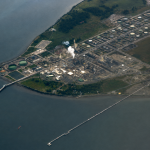
“Robinson is one of the Illinois assets at the center of the region’s refined-fuel squeeze, especially for diesel and other distillates.” (The Robinson refinery complex is seen from above in southeastern Illinois)
Reuters reported on April 16 that the European Union is now drafting emergency measures to maximize refinery output and address jet-fuel supply, with proposals due April 22, after airlines warned shortages could hit within weeks if replacement barrels fail to arrive fast enough. In other words, the Midwest fuel supply squeeze can remain a live story even if the military headlines soften before refinery maintenance fully clears.
“Chicago jet fuel above $5 a gallon is the visible symptom, not the whole disease. The deeper issue is a Midwest fuel supply squeeze created by refinery maintenance in Illinois landing on top of a global distillate shock, falling U.S. distillate inventories, export-heavy Gulf Coast economics, and a geopolitical disruption that has not yet resolved.”
What does the Midwest Fuel Supply Squeeze mean for carriers and terminal operators?
For tank carriers, terminal managers, airport suppliers, and large fleet buyers, the market implication is not mysterious. When a local refining center loses capacity at the same time distillate inventories fall, and export demand stays strong, buyers usually face more volatile rack pricing, more sensitivity to terminal outages, tighter nomination discipline, and a higher probability of shifting lanes to secondary or tertiary supply points.
For broader reporting across tank fleets, petroleum hauling, and bulk-fuel transportation, explore our Tank Transport coverage.
For more news tied to tanker movements, petroleum logistics, and related supply-chain pressures, browse our Tankers coverage.
For diesel haulers, the distinction between wholesale and retail pricing matters, but not enough to change the operating reality. The EIA’s April 6 data showed Midwest retail diesel at $5.304 a gallon and the US average at $5.643. By April 13, Midwest retail diesel had climbed again to $5.382 a gallon, even as the US average edged down to $5.608. That tells operators the pressure has already propagated beyond spot markets into public pump-price benchmarks and is still hitting the Midwest harder than the broader US market.
In practice, that can sharpen shipper demands around surcharge timing, force more frequent price resets, and increase the value of supply diversification between terminals. In a region as interconnected as the Midwest, a few cents at the rack can alter an entire lane plan.
Airport fuel suppliers and large commercial users face a similar challenge from a different angle. Chicago’s move above $5 a gallon matters because jet fuel is not easy to substitute when a hub is busy, and storage is finite. Reuters said airlines were already raising fares and cutting capacity as jet fuel shortages spread through the market. For cargo operators, fixed-base operators, and airport fueling contractors, the message is that aviation fuel is now moving with the same distillate stress that diesel buyers are already seeing, and that the Midwest fuel supply squeeze has become a common problem across both transport sectors.
Can Phillips 66 and Marathon ease the Midwest Fuel Supply Squeeze quickly?
Not quickly enough to erase the current pressure on their own. Phillips 66 now fully owns Wood River, giving it more direct control over a strategically important refinery that the company says has substantial transportation-fuel capabilities, including diesel and aviation fuel. Marathon, for its part, is investing in Robinson to expand its ability to maximize production of higher-value jet fuel. Those are meaningful company-level developments, and they support the case that both assets remain central to regional product supply. But neither full ownership nor a future product-flexibility project changes the basic math of a turnaround underway during a global distillate squeeze.

“Images like this help show why refinery turnarounds and upgrade work can have real supply consequences when markets are already tight.” (A large refinery reactor is being lifted into place during a Robinson refinery upgrade project)
The more realistic answer is that relief depends on two separate timelines converging. One is local and operational: Wood River is finishing its turnaround, and Robinson is progressing toward the end of maintenance that Reuters said could extend into mid-May. The other is global and geopolitical: whether product and crude flows around Hormuz stabilize enough to reduce the premium now embedded in distillate markets. Until both improve, the Midwest fuel supply squeeze is likely to remain a pricing and logistics story, not just a headline from Chicago.
What should the Midwest Fuel Supply Squeeze market watch next?
The first watchpoint is operational: whether Wood River and Robinson return to the timelines the market has been using. The second is statistical: whether EIA data continue to show distillate draws and elevated exports. The third is commercial: whether Gulf Coast refiners keep running above 95% utilization with export economics still attractive. The fourth is whether Europe’s record pull on US jet fuel continues through April. And the fifth is geopolitical: whether the April 13 blockade hardens into a longer disruption that keeps prompt crude and product prices elevated well into the second quarter. Those are the variables most likely to determine whether Chicago’s jet spike proves to be the peak or merely the first unmistakable warning.
The cleanest way to read the market now is this: Chicago jet fuel above $5 a gallon is the visible symptom, not the whole disease. The deeper issue is a Midwest fuel supply squeeze created by refinery maintenance in Illinois, which landed on top of a global distillate shock, falling US distillate inventories, export-heavy Gulf Coast economics, and a geopolitical disruption that has not yet been resolved. For airlines, truck fleets, terminal operators, and refined-products traders, that makes this a diesel-and-logistics story as much as an aviation one, and perhaps more so. The market is not simply paying up for jet fuel. It is providing flexibility in repricing across the entire Midwestern distillate chain.
Key Developments Driving the Midwest Fuel Supply Squeeze
- Chicago became the most expensive US jet-fuel market, with wholesale prices topping $5 per gallon, up sharply from pre-war levels near $2.47 per gallon.
- Midwest refinery outages reached 398,000 barrels per day in the week ended April 3, the highest among US refining regions, while Chicago diesel cash differentials jumped 25 cents per gallon.
- Phillips 66’s Wood River refinery and Marathon Petroleum’s Robinson refinery were both in planned maintenance, tightening regional supply during an already stressed market window.
- US distillate inventories fell by 3.1 million barrels in the April 3 reporting week, and the latest EIA data for the week ended April 10 showed distillate stocks down again to 111.559 million barrels while jet-fuel stocks slipped to 42.514 million barrels.
- Gulf Coast refiners were running above 95% utilization as export demand for US fuel strengthened, limiting how much spare supply could quickly move inland to ease Midwest tightness.
- Europe is drawing record jet-fuel inflows from the United States, with US supply to Europe seen at between 149,000 and 200,000 barrels per day so far in April and total US jet-fuel exports reaching an estimated 442,000 barrels per day in the week ended April 3.
- Midwest retail diesel climbed again to $5.382 a gallon for the week of April 13, even as the US average edged down to $5.608, underscoring how regional tightness is still biting harder than the national average.
- Phillips 66 has moved to full ownership of WRB Refining, including Wood River, while Marathon is advancing a Robinson project to improve jet-fuel production flexibility over time.
- The bigger takeaway for fuel haulers and terminal operators is that this is not just an aviation headline. It is a broader Midwest distillate and logistics story with implications for racks, timing, allocations, and lane planning. That framing aligns with the attached draft’s industry angle.
External Sources and Market References on the Midwest Fuel Supply Squeeze
Primary news reporting
- For a direct look at Chicago’s wholesale jet-fuel spike and the refinery maintenance tightening Midwest supply, read Chicago jet fuel tops $5 a gallon, as refiner maintenance adds to war-related price surge.
- For more details on distillate inventory draws and export movements shaping the market, see US crude stocks rise to near 3-year high, fuel inventories drop, EIA says.
- To understand how export demand is lifting Gulf Coast refinery margins and keeping barrels competitive, review how the Iran war raises demand for US fuel, boosting Gulf Coast refining margins.
- For a broader context on how the April blockade affects crude flows and trade routes, explore What does a US naval blockade of Iran mean for oil flows?.
- To follow the latest physical-market pressure tied to Hormuz disruption and refined-fuel tightness, visit Physical oil hits fresh record high near $150 a barrel as Hormuz crisis worsens.
- For added context on how export competition is pulling more US jet fuel toward Europe, read Europe facing jet fuel crunch sees record inflows from US, Nigeria.
- To understand how the supply crunch is prompting a policy response in Europe, review the EU’s work on a jet fuel plan amid the Iran crisis, which threatens air travel.
Government and market data
- For official weekly refinery, production, and inventory data supporting the supply-side analysis, use the EIA’s Weekly Petroleum Status Report.
- For public diesel and gasoline retail pricing benchmarks referenced in the article’s Midwest pricing discussion, check the EIA’s Gasoline and Diesel Fuel Update.
- To review the federal inflation release tracking the jump in energy and gasoline prices, read the BLS Consumer Price Index Summary for March 2026.
Company and asset checks
- For Phillips 66’s own overview of capacity, products, and distribution at the Illinois asset central to the story, visit Wood River Refinery: Advanced Fuel Production.
- To review Phillips 66’s portfolio update and its full ownership of WRB Refining, see Phillips 66 Delivers Strong 4Q Operating Results While Enhancing Portfolio.
- For Marathon Petroleum’s official description of the Robinson asset, its capacity, and product slate, read Robinson Refinery.
- To check Marathon Petroleum’s corporate filing on its refinery portfolio and Robinson-related project timing, review Marathon Petroleum Corp. Reports Fourth-Quarter and Full-Year 2025 Results.