- A new 25% Section 301 duty applies to covered Brazilian ethanol entered for U.S. consumption beginning July 22, 2026; ethanol is not on the final exemption list.
- Brazil sent about 253 million liters—roughly 67 million gallons—of ethanol to the United States in 2025. Still, U.S. trade data indicate that industrial alcohol, not fuel ethanol, made up most of that lane.
- A narrow in-transit exception runs through July 29, while a separate proposed 12.5% tariff remains unresolved and should not yet be treated as part of the final rate.
The Brazil ethanol tariff took effect at 12:01 a.m. Eastern on July 22, creating an immediate landed-cost event, but its tank-transport consequences are more specialized than the first headlines suggest. The Office of the U.S. Trade Representative has imposed an additional 25% duty on covered goods from Brazil, and ethanol is not among the exemptions in the final Federal Register notice.
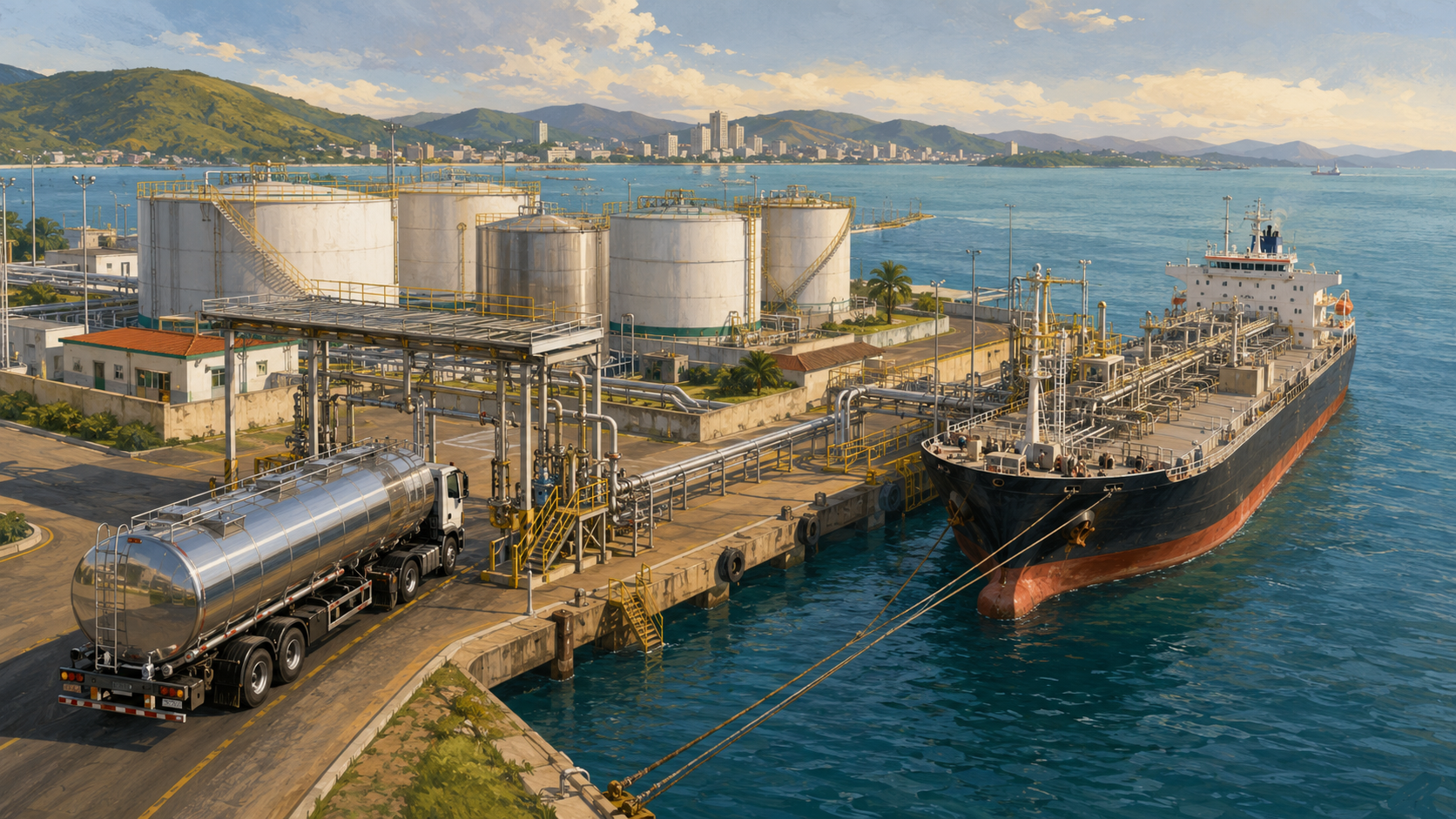
Brazilian ethanol and industrial alcohol move through an interconnected network of marine berths, storage tanks, loading racks and regional tank-truck routes.
For liquid-bulk carriers, terminals and importers, the important question is not simply whether Brazilian ethanol becomes more expensive. It is which ethanol is moving, where it enters, how it is classified, and whether importers replace it with U.S. or third-country product. Those distinctions determine which shore tanks, quality-control systems, rail lanes, and tank-truck routes gain or lose throughput.
The central finding is easy to miss: Brazil exported approximately 253 million liters of ethanol worth $163 million to the United States in 2025, according to Brazilian industry data reported by Reuters. That equals about 66.8 million gallons. Yet U.S. trade statistics show that almost all of the volume was industrial alcohol rather than gasoline-blending ethanol.


What takes effect on July 22—and what does not
The additional duty applies to covered Brazilian goods entered for consumption, or withdrawn from warehouse for consumption, at or after 12:01 a.m. Eastern time on July 22. The operative HTSUS heading is 9903.05.01, which adds 25% to the otherwise applicable duty. The notice also says covered products remain subject to their normal tariff classification and, where applicable, other Chapter 99 duties.
That means “25%” is the new Section 301 increment, not necessarily the complete customs calculation for every ethanol entry. Importers need the correct product code, origin, entry date, and any concurrent tariff treatment before assigning a final landed rate. The frequently repeated 37.5% figure is not the rate finalized in this action. USTR recorded testimony that other proposed actions could eventually lift the combined burden that high, but the separate forced-labor action was still a 12.5% proposal as of July 21.
There is also a short in-transit exception. A covered Brazilian product avoids the new 25% duty only if it was loaded onto a vessel at the port of loading and was in transit on the final mode of transit before 12:01 a.m. Eastern time on July 22, and then entered for consumption or withdrawn from warehouse for consumption before 12:01 a.m. Eastern time on July 29. Cargo admitted into a U.S. foreign-trade zone after the effective date generally must enter in privileged foreign status, preventing the zone from becoming a simple route around the duty.

U.S. fuel-ethanol imports totaled about 4 million gallons in 2025, while industrial-alcohol imports reached 96 million gallons. Brazil supplied more than 90% of the fuel volume and 64 million gallons of the industrial volume—source: U.S. Census Bureau and Department of Commerce data compiled by the Renewable Fuels Association.
USTR says the action responds, in part, to Brazil’s ethanol market barriers and its departure from earlier bilateral cooperation. U.S. ethanol groups cite Brazil’s 18% tariff and technical barriers that hinder participation in RenovaBio. Brazilian producers counter that their tariff is consistent with World Trade Organization rules, applies without discrimination to countries lacking preferential treatment, and that domestic corn-ethanol growth has reduced Brazil’s need for imported U.S. product. Those positions explain the dispute; neither changes the immediate entry rules facing importers on July 22.
The 67-million-gallon lane is mostly industrial alcohol.
The most useful comparison comes from the Renewable Fuels Association’s 2025 ethanol trade statistical summary, which is based on data from the U.S. Census Bureau and the Department of Commerce. It puts total U.S. fuel-ethanol imports at only about 4 million gallons in 2025, the lowest level in at least 30 years. More than 90% of that small volume of fuel came from Brazil.
Industrial alcohol was the larger lane. The same report identifies 96 million gallons of U.S. industrial-alcohol imports in 2025, including 64 million gallons from Brazil. Add Brazil’s fuel share and the result closely matches the roughly 67 million gallons reported from the Brazilian export side.
This distinction changes the logistics analysis. Fuel ethanol moves into gasoline blending and rack-distribution systems governed by renewable-fuel economics, blend specifications, and regional fuel programs. Industrial alcohol can serve the chemical, pharmaceutical, personal care, food, beverage, and other manufacturing markets. Its equipment, segregation, documentation, denaturing status, and quality requirements depend on the specific product and customer specifications.
High-proof ethanol also demands flammable-liquid controls, but carriers should not assume that every shipment uses the same proper shipping description or operational procedure. Concentration, denaturant, intended use, and blend composition matter. Tank Transport’s HM-265 fuel-compliance analysis illustrates why ethanol content and actual product identity must remain aligned with markings and shipping papers in fuel operations.
The split also explains why the tariff can be material to a group of importers without becoming a nationwide gasoline-supply shock. U.S. operable fuel-ethanol production capacity stood at approximately 18.36 billion gallons annually in April 2026, according to Energy Information Administration data. Four million gallons of imports are negligible compared to that capacity. Industrial users, however, cannot assume that every gallon of domestic fuel ethanol is a drop-in replacement for the grade, purity, certification, or contract terms they buy from Brazil.
Where carriers and terminals may see the shift

An aerial view of Rotterdam’s Seventh Petroleum Port illustrates how tanker berths connect with large liquid-bulk storage terminals. The facility is shown as general logistics context and is not identified as handling the Brazilian ethanol discussed here. (Photo: Rik Schuiling / TropCrop-TCS, CC BY-SA 4.0, via Wikimedia Commons)
At the 2025 reported trade value, a simple 25% calculation equals about $40.8 million, or approximately 61 cents per gallon across the 66.8-million-gallon lane. That is an illustration, not a forecast of the tax bill: actual duties depend on customs value, product classification, timing, exemptions, and how volumes respond. Still, it shows why buyers may reprice contracts, defer cargoes, or quickly test alternative origins.
For industrial alcohol, the first logistics effects may appear as fewer Brazilian vessel parcels, lower turns in specific import tanks, different port calls, or new domestic and Canadian supply arrangements. A change in origin can shift work among marine terminals, railroads, transload sites, and regional tank carriers without changing end-user consumption by the same amount. Some truck miles may disappear near an import port while new transfer or delivery miles emerge closer to a replacement source.
The fuel lane is smaller but still worth watching. The RFA report says 84% of 2025 U.S. fuel-ethanol imports entered through the Savannah Customs district, with Detroit and Buffalo accounting for most of the remainder. That is a sharp change from the older pattern documented by USDA’s ethanol trade analysis: from 2018 through 2021, all reported fuel-ethanol imports entered through the West Coast, where Brazilian sugarcane ethanol benefited from California’s Low Carbon Fuel Standard.
For terminal and carrier planners, classification is now as important as volume: industrial alcohol and fuel ethanol may share a chemical name without sharing the same customers, specifications or logistics network.That geographic shift is a warning against using an old California-centered map to predict the 2026 effect. Current contract data, customs districts and product codes matter more than historical assumptions. The broader fuel market also remains shaped by federal blending obligations, as analyzed in Tank Transport’s 2026–2027 Renewable Fuel Standards coverage, while rack prices remain exposed to refinery, credit, and freight pressures examined in the recent fuel-supply analysis.
Tank carriers should therefore resist two opposite conclusions. The tariff does not mean that 67 million gallons of fuel will suddenly shift from Brazilian imports to domestic tank trucks. It also does not mean the action is irrelevant, even if national fuel imports are small. A concentrated industrial lane can be important to the terminals, customers and specialized carriers serving it, even when it barely registers against U.S. gasoline or ethanol production.
Brazil Ethanol Tariff Watch: Key Developments
- Effective entry date: The additional 25% duty applies to covered Brazilian ethanol entered for consumption, or withdrawn from warehouse for consumption, beginning at 12:01 a.m. Eastern time on July 22, 2026.
- Transit cutoff: The exception requires loading before the effective time and entry or warehouse withdrawal before 12:01 a.m. Eastern time on July 29.
- Product split: Brazil’s roughly 67-million-gallon 2025 lane was dominated by industrial alcohol; total U.S. fuel-ethanol imports were only about 4 million gallons.
- Tariff-stack risk: A separate 12.5% forced-labor tariff was proposed, not final, as of July 21. Customs teams should monitor USTR action rather than treating 37.5% as settled.
- Next market signal: Watch post-July customs volumes, Savannah fuel entries, industrial alcohol port calls, contract repricing, and any U.S.–Brazil modifications or retaliation before projecting carrier gains or losses.