- Canada’s September 8 measures raise scheduled surtaxes to 50% on specified U.S.-origin steel tanks and compressed- or liquefied-gas containers.
- Existing tariff relief can eliminate the surtax for qualifying imports under both principal tank classifications.
- Existing orders, future supply contracts and planned storage investment could respond differently, depending on continued relief and available alternatives.

Propane-storage vessels at an Indiana facility in September 2016. Photo: Carl Young / Wikimedia Commons, CC BY-SA 4.0.
Canada tank tariffs rose September 8, 2026, when Ottawa increased the scheduled surtax on specified U.S.-origin iron or steel tanks and gas containers from 25% to 50%. An existing remission order can eliminate that surtax for qualifying imports under both classifications.
For manufacturers and buyers already involved in U.S.–Canada equipment trade, the commercial question extends beyond the next shipment. It concerns the economics of existing orders, responsibility for tariff costs in future contracts and budgets for planned storage capacity. Continued remission could preserve the economics of qualifying purchases while leaving longer-term sourcing decisions open.
Finance Canada’s September 8 product schedule identifies the affected tariff items. The measures apply to U.S.-origin goods imported into Canada, adding an equipment-purchasing issue to broader tariff coverage affecting bulk transportation.

Which tanks and gas containers carry the 50% rate?
Two tariff items are particularly relevant. The applicable classification depends on the container’s material, capacity, and intended contents.
| Tariff item | Product scope | Scheduled surtax | Remission listing |
|---|---|---|---|
| 7311.00.00 | Iron or steel containers designed for compressed or liquefied gas. | 50% | Schedule 2, item 44.02 |
| 7309.00.00 | Iron or steel reservoirs, tanks, vats and comparable containers over 300 liters, for contents other than compressed or liquefied gas; no mechanical or thermal equipment fitted. | 50% | Schedule 2, item 43.3 |
The 300-liter threshold applies to item 7309.00.00. Gas containers under 7311.00.00 have no corresponding minimum capacity in that tariff description. Item 7309 includes lined or insulated containers, but excludes vessels fitted with mechanical or thermal equipment.
Complete tanker trailers are classified separately under item 8716.31.00 in Chapter 87. The 50% rates on the two container categories therefore do not automatically apply to a finished tanker trailer.
Existing remission changes the equipment-cost calculation
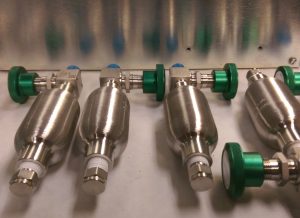
Cylinders containing natural-gas reference-standard samples. Photo: Geoff Ellis / U.S. Geological Survey. Public domain.
The United States Surtax Remission Order (2025) lists both classifications in Schedule 2. Qualifying imports can receive remission, allowing covered surtaxes to be waived or refunded under the order’s conditions.
The September 4 order implementing the new measures retains coverage of the steel-and-aluminum surtax order in the revised remission provision. This preserves relief for qualifying products even as the scheduled rate rises.
These Schedule 2 provisions currently have no import-date cutoff. Claims must be made within two years of importation, the goods must match the listed classification and description, and the importer cannot receive duplicate relief for the same surtax.
For example, equipment with a customs value of C$100,000 would carry a C$50,000 surtax at the new rate, compared with C$25,000 at the earlier rate. Full remission could eliminate that surtax. Freight, other taxes and additional delivery costs would still affect the final bill.
For a qualifying purchase receiving full relief, the higher scheduled rate would add no surtax cost. An existing equipment budget could therefore remain intact despite the headline increase. Manufacturing costs, delivery commitments and service support would continue to influence the choice of supplier.
For shipments already moving when the change took effect, CBSA’s Customs Notice 25-11 retains the previous 25% rate for qualifying steel goods in transit on or before September 8, before any remission. That distinction separates equipment already in transit from equipment ordered earlier but still awaiting shipment.
Tank Transport’s coverage of the Brazil ethanol tariff provides a separate liquid-bulk example of how product scope and shipment timing can change import costs.
How Canada tank tariffs could influence purchasing plans
For businesses with established cross-border supply arrangements, the first adjustments could appear in quotations, contract renewals and the next capital budget. With full remission preserved, changes made through those planning cycles appear more plausible than an immediate, widespread switch away from U.S. equipment.
A buyer could retain its established U.S. supplier while evaluating alternatives for a future order. That would preserve options if relief changed, without immediately giving up familiar engineering, service support, or an agreed delivery date. Competing manufacturers could receive more requests for quotations before seeing a meaningful transfer of business.
Contract renewals and new project bids would offer opportunities to revisit pricing and responsibility for any unrecovered surtax. Where relief remains available, the scheduled increase may have little effect on the equipment price. Where a purchase carries an actual additional cost, the parties could negotiate margins, change sourcing, or adjust the order.
Canadian manufacturers could gain opportunities by offering comparable equipment. The Canadian pressure-vessel operations acquired by TerraVest illustrate the specialized manufacturing capabilities already present in that market. Turning additional inquiries into orders would depend on product fit, available factory capacity, and delivery schedules.
Other overseas manufacturers could enter future bid comparisons, with freight, delivery times and applicable tariffs included in the price. Any sourcing change would also have to satisfy Canada’s origin rules; routing U.S.-origin equipment through another country does not by itself change its origin.
For terminals, chemical distributors, and other bulk-storage operators, exposure could differ between committed construction, necessary equipment replacement, and capacity planned for a later budget cycle. An optional expansion offers more room to reconsider supplier, size, or timing than equipment needed to maintain existing operations.
Continued remission could support the original purchase plan. A sustained unrecovered cost could change the economics of the next project. The effect on bulk transportation would follow any resulting change in storage capacity, terminal activity or delivery locations.
These are potential responses; the available evidence does not yet establish a shift in tank-equipment orders. Changes in the suppliers invited to bid or selected for renewed agreements could reveal a shift before it appears in delivered-equipment volumes. Project commitments and factory lead times would show whether that interest is becoming new business.
Canada Tank Tariffs: Key Developments
- Scheduled rate: The specified U.S.-origin tank and gas-container items moved to 50% on September 8.
- Existing relief: Both principal classifications remain eligible for product-specific remission when the goods and claims meet the order’s conditions.
- Transit treatment: Qualifying shipments already moving to Canada retain the earlier 25% rate before applicable relief.
- Equipment scope: Complete tanker trailers have a separate classification from the two container categories.
- Market outlook: Any sourcing shift could first appear in new bids, renewed supply agreements, and future capital budgets before showing up in equipment deliveries.