- EPA would retain the core model-year 2027 NOx limits while rolling back the extended emissions warranty and delaying longer useful-life requirements.
- Mandatory DEF-related speed and power derates would give way to visible and audible warnings for newly manufactured engines no later than model year 2029—not immediately for every truck already operating.
- EPA projects as much as $12 billion in net present-value savings. Still, its own analysis also shifts substantial repair expense from manufacturer warranties to vehicle owners and projects higher NOx emissions than the current rule.
The EPA 2027 diesel rewrite is not a repeal of the federal low-NOx standard, nor is it an immediate nationwide software fix for every truck experiencing diesel exhaust fluid problems. It is a proposed restructuring of the rules governing model-year 2027 heavy-duty engines: emissions warranties, regulatory useful life, limited-transition engines, nonconformance penalties, selective catalytic reduction diagnostics, and inducements that can reduce engine power or vehicle speed when a DEF-related condition is detected.
The U.S. Environmental Protection Agency announced the proposal on July 9, 2026, and published it in the Federal Register on July 14. Written comments are due August 29 under docket EPA-HQ-OAR-2026-0728. EPA scheduled virtual public hearings for July 29 and July 30, with a possible additional day if participation warrants it.
For tank-truck carriers, the proposal reaches well beyond an emissions-policy headline. It could affect the acquisition price of 2027 equipment, the amount of emissions-system risk included in the factory warranty, the availability of particular engine families, the treatment of a DEF fault during a loaded trip, maintenance reserves after warranty expiration, and the resale assumptions attached to late-model power units.

Tank Transport’s environmental coverage tracks EPA actions and related compliance changes affecting tank fleets.
Tank Transport’s previous EPA27 fleet analysis identified the 450,000-mile emissions warranty and 650,000-mile useful life for heavy-duty engines as two of the largest unresolved cost variables. EPA has now put a specific alternative on the table. The numerical NOx standard remains; much of the compliance structure around it would change.
The 2027 NOx target survives. The proposed relief is concentrated in who carries long-term repair risk, how manufacturers bridge into compliance, and what happens when a DEF system reports a fault.
EPA 2027 Diesel Rewrite: What the Proposal Actually Changes

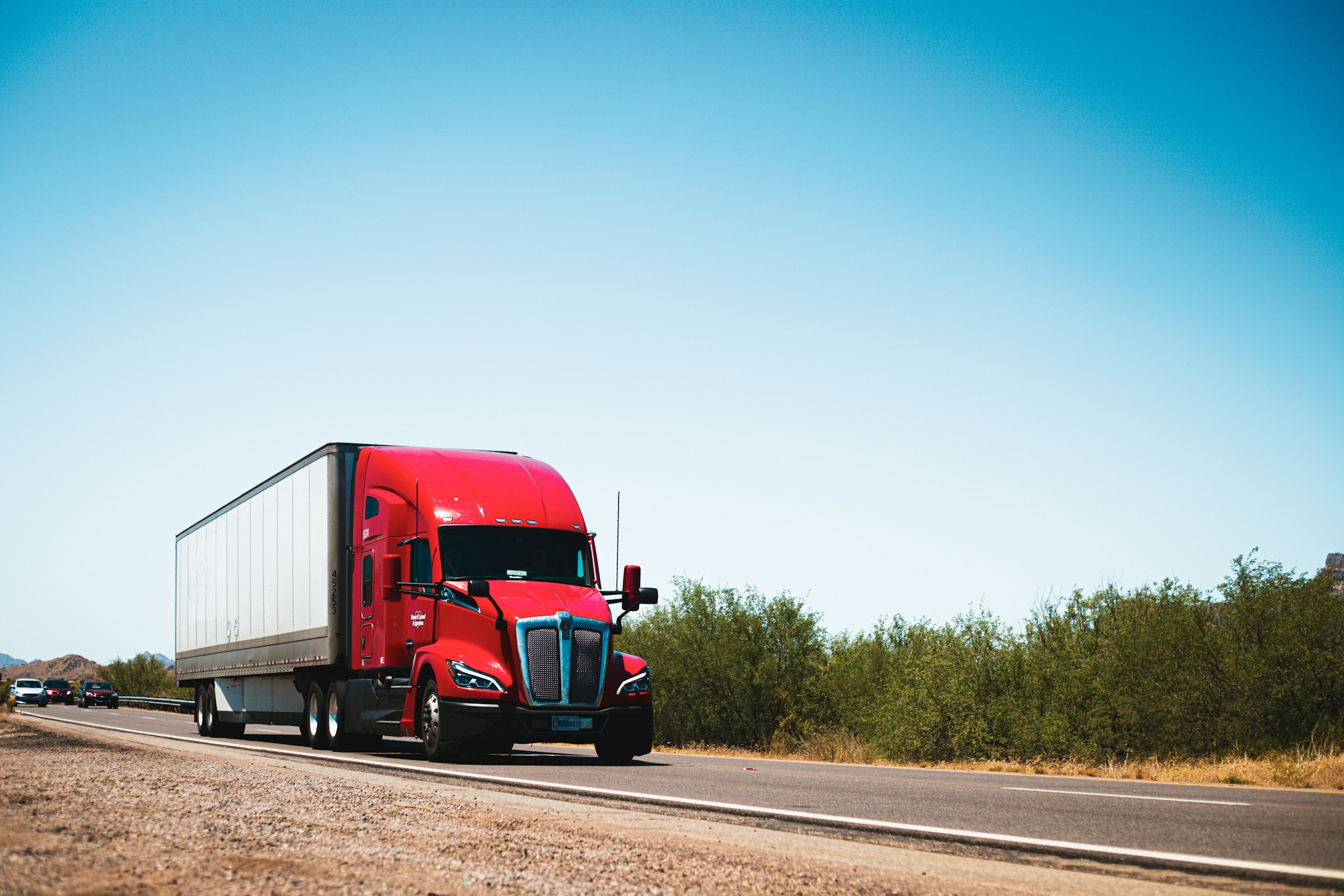
Shorter mandatory emissions warranties could lower acquisition cost while shifting more repair exposure to owners. (Photo: Bogdan Krupin/Pexels)
The proposal’s most important feature is its split personality. It offers meaningful operational and purchase-cost relief, especially through shorter mandatory warranties and the planned removal of DEF-related performance derates. At the same time, it would reduce the durability assurances built into the 2023 rule and, without flexibility, permit several transition pathways for engines that do not initially meet the new standard.
EPA says most manufacturers remain on track for model year 2027. The agency therefore states that it is not reopening the 2027-and-later NOx, particulate matter, hydrocarbon, or carbon monoxide standards. For medium- and heavy-duty engines, the principal NOx limit remains 35 milligrams per brake horsepower-hour (0.035 grams per brake horsepower-hour) for the applicable federal test cycles.
That distinction matters under the EPA 2027 diesel rewrite. Describing the action as the cancellation of EPA27 would be inaccurate. Describing it as a minor technical correction would also understate the proposal, because warranty, useful life, inducements, production flexibility, and penalty pathways determine how the standard is experienced in the real market.
12 High-Stakes Changes for Tank Fleets and Engine Buyers
1. The central NOx standard and 2027 start remain in place. EPA is proposing targeted amendments rather than withdrawing the 2023 heavy-duty criteria-pollutant rule. The 35 mg/hp-hr NOx standard for medium and heavy-duty engines remains the compliance centerline. More representative low-load and off-cycle requirements also remain part of the program, except for specified technical amendments.
Under the EPA 2027 diesel rewrite, fleets should not assume that model-year 2027 equipment will use model-year 2026 emissions architecture. Manufacturers still need certified products that meet the tighter limit unless they use one of the expressly proposed transition mechanisms.
2. The extended federal emissions warranty would be rolled back. The 2023 rule lengthened mandatory emissions warranties beginning with model year 2027. EPA now proposes to retain the shorter periods that apply to model year 2026 and earlier engines.
| Engine service class | Current pre-2027 warranty | 2023 rule for MY 2027+ | July 2026 proposal |
|---|---|---|---|
| Light HDE | 50,000 miles / 5 years | 210,000 miles / 10 years / 10,000 hours | Return to 50,000 miles / 5 years |
| Medium HDE | 100,000 miles / 5 years | 280,000 miles / 10 years / 14,000 hours | Return to 100,000 miles / 5 years |
| Heavy HDE | 100,000 miles / 5 years | 450,000 miles / 10 years / 22,000 hours | Return to 100,000 miles / 5 years |
The warranty rollback in the EPA 2027 diesel rewrite lowers the manufacturer’s federally required exposure to emissions-related repairs. EPA expects those savings to reduce vehicle prices, but the repair risk does not disappear. After the mandatory warranty ends, it moves to the owner, an optional extended-warranty provider, or a negotiated lease-and-maintenance program.
A shorter federal warranty can reduce the amount embedded in the purchase price while increasing the importance of extended-warranty terms, exclusions, deductibles, and post-warranty maintenance reserves.
3. The longer regulatory useful life would be delayed until model year 2030. Useful life is the period over which a manufacturer must demonstrate that an engine’s emissions controls continue to meet the applicable standards. It is not the same as the expected mechanical life of a truck, nor is it a warranty.
For heavy HDE, the 2023 rule increased useful life from 435,000 miles, 10 years, or 22,000 hours to 650,000 miles, 11 years, or 32,000 hours. EPA proposes to keep the shorter period for model years 2027 through 2029 and begin the longer requirement in model year 2030. Medium HDE would similarly remain at 185,000 miles or 10 years through model year 2029, then move to 350,000 miles, 12 years, or 17,000 hours.
Under the EPA 2027 diesel rewrite, the delay would allow manufacturers to gather three years of real-world data on new low-NOx systems before those engines are judged over the extended period. The agency does not expect manufacturers with finished 2027 designs to remove technology due to the temporary delay, and it assigns no direct manufacturing cost savings to this provision in its main cost estimate. That is an agency assumption, not a guarantee of identical hardware across every product.
4. A five-percent Heavy HDE transition allowance would no longer require NOx credits. The existing 2023 rule allows a manufacturer to certify a limited volume of heavy HDE—no more than five percent of a defined U.S.-directed production average—to pre-2027 requirements during model years 2027 through 2029. Still, it requires NOx credits to offset those engines.
The EPA 2027 diesel rewrite would remove the credit requirement while retaining the five-percent cap, the Heavy HDE limitation, the carryover-family condition, reporting obligations, and certification to model-year 2026 requirements. EPA describes the flexibility as a bridge for low-volume or specialized applications that may need additional integration time.
For tanker fleets, the EPA 2027 diesel rewrite does not promise that a particular vocational or tractor configuration will qualify. It does mean that the 2027 market could contain a small population of legally certified carryover engines alongside fully compliant EPA27 engine families. Buyers will need precise model year, engine family, and certification information rather than relying on a generic “2027 truck” label.
5. Nonconformance penalties would create a second transition path. The EPA 2027 diesel rewrite would make NCPs available for diesel-fueled Medium HDE and Heavy HDE beginning in model year 2027. An NCP allows an engine family that exceeds the 35 mg/hp-hr standard to be sold after the manufacturer pays a per-engine penalty based on the certified compliance level.
The proposed upper limit is 200 mg/hp-hr—the previous standard. EPA’s examples put the model-year 2027 penalty for a Heavy HDE family at $904 per engine at 45 mg/hp-hr and $5,875 at 100 mg/hp-hr. For Medium HDE, the corresponding examples are $851 and $3,799. Penalties are intended to rise with the degree of nonconformance and remove any cost advantage over manufacturers selling compliant engines.
An NCP is not a waiver from certification and not a fleet-paid roadside fine. It is a manufacturer compliance mechanism tied to a specific engine family and emissions level.
The EPA 2027 diesel rewrite characterizes NCP use as temporary and short-lived, but the agency cannot predict how many manufacturers will use the mechanism. That uncertainty matters for truck supply, specification comparisons, engine pricing, and the emissions profile of equipment offered during the transition.
6. Some broader NOx credit changes are being considered, but they are not yet proposed outcomes. As part of the EPA 2027 diesel rewrite, EPA requests comment on whether to raise the family emission limit cap above 65 mg/hp-hr, potentially as high as the prior 200 mg/hp-hr standard; whether pre-model-year 2022 NOx credits should become usable after 2026; and whether credits should move across engine service-class averaging sets.
The EPA 2027 diesel rewrite has not resolved those credit questions. They could materially affect manufacturers’ flexibility and competition if adopted, but they should not be reported as provisions that the EPA has already selected. The final rule could retain the existing restrictions, adopt a single option, combine multiple options, or adopt a different response based on the record.
7. Mandatory DEF-related performance derates would be replaced for new engines. The EPA 2027 diesel rewrite proposes to replace required engine-power and vehicle-speed inducements with visible and audible notifications for newly manufactured heavy-duty engines, diesel light- and medium-duty vehicles, and covered nonroad diesel equipment.
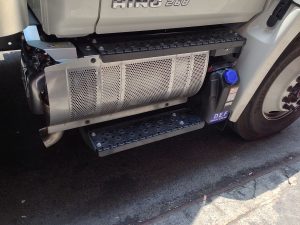
Hino truck and its selective catalytic reduction (SCR) system next to the Diesel particulate filter (DPF), with regeneration via late fuel injection to control exhaust temperature and burn off soot.
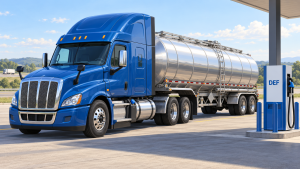
Tank Transport’s DEF coverage follows diesel exhaust fluid quality, handling, supply, and aftertreatment reliability for heavy-duty fleets.
Under the EPA 2027 diesel rewrite, the heavy-duty engine change would be mandatory no later than model year 2029, with manufacturers allowed to adopt it sooner. The proposal generally retains the 2023 inducement requirements for model years 2027 and 2028, while EPA asks whether an accelerated pathway is feasible.
For DEF inducements, model year and manufacturer implementation will matter. The proposal does not establish one overnight transition date for every new truck.
8. Alerts would become persistent, scheduled operating signals. The EPA 2027 diesel rewrite would remove the mandatory emissions derate without removing DEF monitoring. EPA proposes 90-second audible alerts combined with visible notifications.
For DEF level, the proposed audible sequence begins three hours before the tank is expected to become empty, then sounds when empty, and again every 30, 60, and every hour thereafter until corrected. For DEF quality or detected tampering, it would sound at detection, 30 minutes later, 90 minutes later, and then every three hours.
The EPA 2027 diesel rewrite also seeks comment on whether the alerts are sufficient, whether they should be more or less frequent, whether visible indicators should flash, and whether a limited derate should remain. The warning schedule is therefore proposed text, not a final cab-interface specification.
9. Manufacturers could still use protective derates. The EPA 2027 diesel rewrite distinguishes an emissions inducement from a derate needed to prevent catastrophic engine or aftertreatment damage. The proposal would allow manufacturers to retain protective power reductions—for example, where operating without DEF could overheat and damage a DEF injector.
That qualification prevents an overbroad promise that model-year 2029 trucks can never derate. The proposed rule removes the federal requirement to use performance loss as the compliance inducement for DEF supply, quality, or tampering conditions. It does not prohibit every electronically commanded reduction in engine output.
Tank Transport’s emissions coverage follows SCR, DPF, NOx, and aftertreatment developments affecting compliance and uptime.
10. Existing trucks would not receive automatic regulatory relief. The certification amendments in the EPA 2027 diesel rewrite apply to newly manufactured engines and vehicles. EPA is considering separate guidance that could allow manufacturers to seek approval for corresponding modifications to in-use engines without violating Clean Air Act prohibitions against tampering or defeat devices.
EPA has already issued voluntary guidance encouraging less severe inducement schedules and permitting the use of approved NOx-sensor-based strategies on some existing engines. Availability still depends on manufacturer engineering, EPA approval where required, the engine family, software validation, and distribution through authorized service channels.
The proposal does not itself reflash the installed fleet. Existing-equipment relief remains a manufacturer- and engine-specific implementation question.
11. DEF quality detection would focus on more serious deviations. Commercial DEF is nominally a 32.5-percent urea solution. Under the EPA 2027 diesel rewrite, systems would have to detect when the urea concentration falls below 20 percent by weight, while manufacturers could use a urea-quality sensor, NOx sensors, or another approved surrogate measurement.
Manufacturers would also have to describe compensation algorithms that adjust dosing for variations in DEF quality. EPA proposes allowing quality checks to focus on refill events, when a meaningful change is most likely to occur, rather than continuously demanding unnecessarily precise measurements that can lead to false fault decisions.
This is both a reliability and an anti-tampering measure. It would reduce sensitivity to modest concentration variations while preserving a threshold meant to detect water dilution, incorrect fluid, or a condition in which adequate NOx conversion can no longer be assured.
12. Cold-weather protection and OBD reliability would be rewritten together. The EPA 2027 diesel rewrite proposes to codify freeze-protection features and a certification procedure focused on restoring SCR function after a cold soak. It would allow audible DEF notifications to be temporarily disabled below 12 degrees Fahrenheit, DEF’s freezing point, and would establish conditions for restarting notifications as temperatures recover.
The proposal also includes on-board diagnostic amendments intended to reduce false passes and false failures in increasingly complex multi-catalyst, multi-sensor systems. Those provisions matter because a false diagnostic decision can create downtime even if mandatory emissions derates disappear; it can also conceal a real failure if the monitor is too permissive.
Tank fleets that operate in extreme cold, use long duty cycles, idle during waiting periods, or power auxiliary equipment from the truck engine have a direct interest in how the EPA finalizes temperature thresholds, monitor frequency, alert logic, and protective derate authority.
What EPA’s $12 Billion Cost Estimate Means for Fleets

EPA projects $37 billion in warranty savings and $25 billion in added owner operating costs, leaving $12 billion in net present-value savings at a three-percent discount rate. (Source: U.S. EPA, July 2026)
The $12 billion headline attached to the EPA 2027 diesel rewrite requires two qualifiers. First, it is neither an annual saving nor a forecast of immediate cash returned to fleets. It is the present value of projected net savings from 2027 through 2055 using a three-percent discount rate. At a seven-percent rate, the estimate is $9.4 billion.
Second, the estimate is not simply a $12 billion reduction in manufacturing cost. EPA calculates approximately $37 billion in present-value emissions-warranty savings at a three-percent rate, offset by approximately $25 billion in additional operating costs. The resulting difference is $12 billion.
| EPA cost component, 2027–2055 | 3% discount rate | 7% discount rate |
|---|---|---|
| Emissions-warranty savings | $37.0 billion | $24.0 billion |
| Additional owner operating costs | -$25.0 billion | -$15.0 billion |
| Net projected savings | $12.0 billion | $9.4 billion |
EPA’s model-year 2027 estimate for the reduced warranty alone is $5,358 per diesel Heavy HDE, $4,130 per diesel Medium HDE, and $6,152 per diesel Light HDE, stated in 2024 dollars. Those amounts exclude the additional repair costs that owners are expected to incur after the shorter warranty expires.
Warranty Savings Are Not the Same as Net Fleet Savings
The practical economics of the EPA 2027 diesel rewrite will vary by operation. A high-mileage line-haul tractor may quickly exceed a 100,000-mile emissions warranty, whereas a low-mileage vocational unit may reach the five-year limit first. EPA reports that manufacturers said the extended Heavy HDE warranty could add more than $15,000 to the cost for certain low-mileage vocational applications covered for the full 10 years. The agency’s average per-engine figures are lower because they span a broader range of regulatory classes and operating assumptions.
A tanker carrier comparing bids will need to separate four numbers: the base truck price, the price of optional emissions coverage, expected deductibles and exclusions, and the operation’s own aftertreatment repair history. A lower sticker price can be a genuine advantage without being a universal reduction in total cost of ownership.
Maintenance Risk Moves Beyond the Federal Warranty
The shorter warranty could make maintenance records, fault-code history, sensor replacement patterns, DEF storage practices, connector corrosion, and technician diagnostic capability more important to residual value. It may also create wider differences among OEM extended-warranty products.
For fleets that replace tractors early, purchasing less federally mandated coverage may align better with the ownership cycle. For fleets that run power units deep into their economic life, the proposal can reduce acquisition cost while leaving a larger portion of the SCR, DPF, sensor, wiring, and control-system exposure on the fleet’s balance sheet.
Tank Transport’s heavy-duty truck maintenance coverage follows diagnostic, repair, uptime, and lifecycle-cost issues for fleet operators.
Truck Prices May Fall Less Than the Headline Suggests
EPA assumes manufacturers will pass warranty savings to purchasers. Actual transaction prices will also reflect demand, production capacity, product content, financing, dealer inventory, optional coverage, and the value manufacturers place on different engine packages. The proposal does not regulate the amount of savings that must appear on an invoice.
It also does not erase the underlying cost of meeting the 35 mg/hp-hr NOx standard. Advanced aftertreatment, thermal management, calibration, sensors, diagnostics, and certification remain. Compared with the earlier expectations outlined in Tank Transport’s EPA truck-emissions outlook, the likely capital premium may narrow, but it does not logically fall to zero.
Procurement, Resale, and Compliance Consequences
The EPA 2027 diesel rewrite weakens the case for a blanket 2026 pre-buy based solely on the former 450,000-mile mandatory warranty cost. It does not eliminate procurement uncertainty. A final rule is still pending, engine-family availability may differ, and NCP or five-percent carryover engines could add variation to the 2027 marketplace.
Fleet specifications should therefore identify the certified engine family, emissions level, warranty package, inducement strategy, available software update path, cold-weather logic, and the treatment of engine-protection derates. Lease documents should state who pays for emissions system repairs after the federal warranty period and how downtime is handled.
The proposal also interacts with fleet-age decisions. As Tank Transport noted in its coverage of the proposed repeal of the heavy-duty truck excise tax, acquisition cost is only one factor in replacement timing. Keeping older equipment longer can avoid a new-truck premium while increasing maintenance exposure and delaying the safety, fuel-efficiency, and emissions performance of newer units.
The better fleet comparison is not 2026 truck versus 2027 truck in the abstract. It is one certified engine, warranty, duty cycle, service network, and ownership horizon against another.The emissions tradeoff within the EPA 2027 diesel rewrite is equally important. Compared with leaving the 2023 rule unchanged, EPA projects that the proposal would increase national heavy-duty NOx emissions by 30,626 tons in 2030 and 36,673 tons in 2055. That is a 4.2-percent increase in the modeled heavy-duty NOx inventory in 2030 and an 11.6-percent increase in 2055 compared with the no-action case.
Relative to a different baseline—having no 2023 rule at all—EPA says the amended program would still reduce the 2055 heavy-duty NOx inventory by more than 260,000 tons, or about 42 percent, retaining nearly 90 percent of the reductions attributed to the original program.
Both emissions statements can be true: the proposal preserves most of EPA27’s modeled NOx reduction while producing more NOx than the 2023 rule would produce if left intact.
EPA did not conduct new full-scale air-quality modeling for the proposal and did not monetize the associated health and welfare effects. It also did not quantify a separate emissions effect from removing performance inducements, because real-world operator response, DEF use, maintenance, and tampering behavior are uncertain. The agency’s monetized “net benefits” therefore represent projected cost savings, not a complete dollar balance of economic savings against health effects.
That omission is central to the public debate. The American Trucking Associations has endorsed the proposed cost and reliability relief. CALSTART, a clean-transportation nonprofit whose membership includes industry and public-sector organizations, argues that shortening durability and warranty provisions could increase long-term emissions and market uncertainty. The public docket will determine which technical evidence EPA must address before finalizing the rule.
EPA27 Rewrite: Key Developments and Deadlines
- Status: Proposed rule; no provision is final as of July 15, 2026.
- Core standard: EPA is not reopening the model-year 2027 NOx, PM, HC, and CO standards.
- Federal warranty: EPA proposes retaining the model-year 2026 emissions warranty periods for model-year 2027 and later engines.
- Useful life: Longer periods would begin in model year 2030 rather than 2027.
- Limited production: Up to 5% of qualifying Heavy HDE production may use pre-2027 requirements in model years 2027–2029 without surrendering NOx credits.
- NCP pathway: Medium and Heavy HDE manufacturers could pay per-engine penalties for certified NOx levels above 35 mg/hp-hr and no higher than the proposed 200 mg/hp-hr ceiling.
- DEF derates: Mandatory performance inducements would be replaced by visible and audible notifications for new engines, no later than model year 2029; earlier adoption is possible.
- Protective derates: Manufacturers could still reduce power to prevent catastrophic engine or aftertreatment damage.
- Existing fleet: No automatic retrofit has been created; the EPA is considering additional in-use guidance.
- Cost estimate: EPA projects $12 billion in net present-value savings at a three-percent discount rate after subtracting added owner operating costs.
- Emissions estimate: The amended rule would retain most of the 2023 program’s modeled reductions while increasing NOx relative to leaving the rule unchanged.
- Hearings: Virtual sessions are scheduled for July 29 and July 30, 2026.
- Comment deadline: August 29, 2026, under docket EPA-HQ-OAR-2026-0728.
Authoritative EPA27 Proposal Resources
- EPA’s official rule page provides the current docket, hearing information, summary, and supporting documents.
- The official Federal Register PDF of the proposed rule and preamble contains the warranty tables, useful-life changes, NCP formulas, DEF provisions, emissions inventory, and requests for comment.
- EPA’s July 2026 fact sheet summarizes the agency’s positions on cost, emissions, warranty, useful life, and DEF inducement.
- The public rulemaking docket is the official repository for comments and supporting materials associated with EPA-HQ-OAR-2026-0728.
- EPA’s diesel exhaust fluid resource page collects current inducement guidance and background on SCR, DEF monitoring, and in-use modifications.
- EPA’s 2023 heavy-duty engine standards page supplies the baseline rule and supporting materials that the July 2026 proposal would amend.