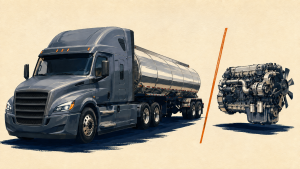
- The heavy-duty truck excise tax repeal could reshape how tank fleets plan tractor, trailer, and semitrailer chassis purchases.
- Ending the 12% FET may lower upfront equipment costs, but it also raises a major question for the Highway Trust Fund: who pays for road repairs afterward?
- For tank carriers, the debate goes beyond taxes—it touches fleet modernization, safety technology, emissions upgrades, and long-term capital planning.
Heavy-Duty Truck Excise Tax Repeal: What Ending the 12% FET Could Mean for Tank Fleets

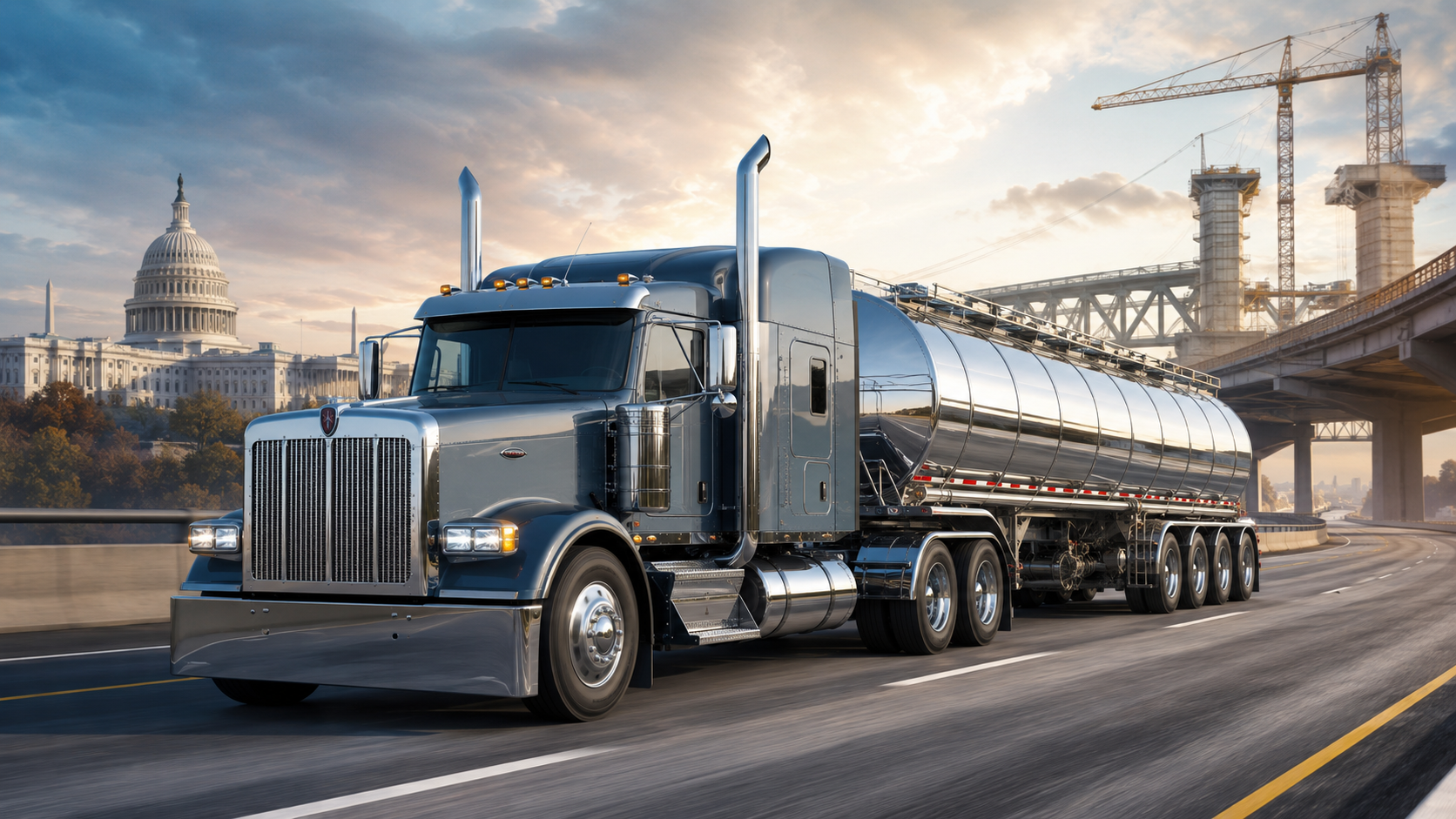
“For tank fleets, the 12% FET is not just a tax line—it can affect when tractors and trailers are replaced.” (Image: Groendyke Transport – Tanker on CPCH Bridge)
The heavy-duty truck excise tax is back in the center of Washington’s trucking-policy debate, and this time the issue is not just about tractors. It is about the cost of replacing the equipment that keeps tank fleets moving: highway tractors, specialized tank trailers, semitrailer chassis, cargo tank bodies, safety technology, emissions systems, pumping equipment, vapor-recovery hardware, and the capital budgets that must absorb it all.
A bipartisan Senate proposal introduced on June 2, 2026, by Republican Sen. Todd Young and Democratic Sen. Angela Alsobrooks would eliminate the 12% federal excise tax on heavy-duty trucks, trailers, semitrailer chassis, and tractors. Supporters argue that the tax has become a barrier to fleet modernization because it can add tens of thousands of dollars to the price of new equipment. Critics and transportation-funding advocates counter that the same tax produces billions of dollars annually for road construction and repairs. For more coverage of federal excise tax issues affecting commercial equipment purchases, see our FET reporting.
For tank carriers, the debate is especially practical.

Tank fleets rarely buy simple, off-the-shelf equipment. A new tractor purchase may be paired with a decision on a specialized trailer. A chemical fleet may need corrosion-resistant components. A fuel hauler may need vapor-recovery systems. A food-grade carrier may need sanitary equipment. An LPG or pressure-vessel operator may face added compliance, inspection, and specification costs. When the base cost of equipment is high, a 12% tax becomes more than a line item. It becomes a replacement-cycle decision. For ongoing news across the tank transportation sector, visit our TankTransport coverage.
”For tank carriers, the heavy-duty truck excise tax debate is not only about tax relief. It is about whether lower equipment costs can accelerate safer, cleaner, and more predictable fleet replacement.”
The proposal arrives at a moment when fleet managers are already facing expensive trucks, high insurance costs, technician constraints, diesel price volatility, emissions uncertainty, and a federal highway-funding system that has struggled for years to match revenue with infrastructure needs.
That is why the heavy-duty truck excise tax repeal debate is bigger than a tax bill. For tank transportation, the question is whether federal policy should lower the upfront cost of new equipment to encourage the replacement of older units, or preserve a dedicated revenue stream for the roads those same fleets rely on every day.
Heavy-Duty Truck Excise Tax Repeal Puts Fleet Modernization and Road Funding on the Same Collision Course
The federal excise tax on heavy trucks is imposed on the first retail sale of several categories of equipment. Under the current statute, the 12% tax applies to automobile truck chassis, truck bodies, truck trailers, semitrailer chassis, tank truck trailers, semitrailer bodies, and tractors chiefly used for highway transportation in combination with a trailer or semitrailer.
That scope matters.
This is not only a Class 8 tractor tax. It can reach the trailer and semitrailer equipment that tank carriers depend on. For a tank fleet, that makes the heavy-duty truck excise tax a purchasing issue across the entire power-and-trailer package, not just the vehicle sitting under the driver. To track developments in heavy-duty tractors and commercial truck equipment, see our heavy-duty truck updates.

“The heavy-duty truck excise tax affects the equipment that keeps specialized bulk fleets moving.” (Image: A fleet of specialized bulk semitrailers.)
The statute includes exclusions for lighter vehicles and equipment. Truck chassis and bodies suitable for vehicles with a gross vehicle weight of 33,000 pounds or less are generally outside the tax. Trailers and semitrailers suitable for a gross vehicle weight of 26,000 pounds or less are also excluded. Certain lighter tractors fall outside the tax when they remain under specific tractor and combined-weight thresholds.
Those exclusions leave the practical burden on the heavy-duty commercial equipment market, which is exactly where tank transportation lives.
A new tractor already represents a major capital purchase. A specialized tank trailer can be equally strategic because the trailer often determines the freight a carrier can haul, the customers it can serve, and the compliance regime it must manage. Add pumps, valves, hoses, pressure ratings, compartment designs, vapor systems, washout requirements, telematics, brake systems, underride guards, and corrosion-resistant materials, and the all-in cost of modernization becomes substantial. For more updates on tank trailer equipment, specifications, and market developments, explore our tank trailer reporting.
The central argument for repeal is simple: if policymakers want fleets to adopt newer, safer, cleaner, and more fuel-efficient equipment, they should not make the initial purchase of that equipment more expensive.
Supporters of repeal say the 12% FET discourages new truck and trailer purchases by raising the price at the exact moment when fleets must commit capital. Reuters reported that lawmakers said the tax can add $15,000 to $30,000 to the cost of a new heavy truck, trailer, semitrailer chassis, or tractor. In a market where replacement planning is already tight, that amount can decide whether a carrier orders equipment now, delays another year, or keeps an older unit in service through another maintenance cycle. To follow broader tax developments affecting trucking and transportation costs, browse our taxes coverage.
The age of part of the national heavy-truck fleet strengthens the policy case. Lawmakers backing the proposal noted that roughly one-fifth of the largest trucks on the road still use engines produced before 2010. That matters because 2010 is a key dividing line in modern diesel emissions technology. Fleets operating older equipment may face different emissions profiles, higher maintenance exposure, and reduced access to newer safety systems.
But repeal is not a cost-free decision.
The same tax raises more than $6 billion annually for road construction and repair. Removing it without replacement revenue would create a funding gap in a system already under stress. Congress has repeatedly struggled to fund the Highway Trust Fund as fuel-tax revenue has failed to keep pace with infrastructure spending, inflation, improved vehicle efficiency, and the growth of vehicles that use little or no gasoline or diesel. To follow infrastructure funding debates affecting carriers and commercial vehicle operators, read more in our highway funding coverage.
”The policy tradeoff is direct: repeal could make new heavy-duty equipment more attainable, but it would also remove a major source of highway revenue unless Congress identifies a replacement.”
That is the core tradeoff.
For fleets, repeal could reduce the cost of new equipment. For infrastructure planners, repeal could reduce a dedicated source of road money. For Congress, the issue is whether the economic and safety benefits of faster fleet replacement justify finding another way to fund highways.
Why Is the Heavy-Duty Truck Excise Tax So Important to Tank Carriers?
For tank carriers, the heavy-duty truck excise tax lands in a part of the business where timing matters.
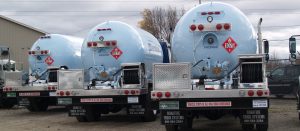
“When equipment prices rise, a 12% tax becomes a replacement-cycle decision for fleets.” (Image: TerraVest Industries Tankers)
Fleet replacement is not only about buying new iron. It is about uptime, safety performance, driver retention, customer expectations, insurance posture, fuel economy, environmental compliance, and maintenance predictability. Equipment decisions shape the cost structure of a tank fleet for years. For more insight into fleet operations, replacement cycles, and equipment strategy, follow our fleet coverage.
A dry van fleet may evaluate equipment largely through tractor utilization, trailer availability, and freight density. Tank fleets must go further. They must consider product compatibility, cargo tank testing, cleaning requirements, hazardous materials rules, pressure ratings, loading infrastructure, unloading speed, customer specifications, and the risk of contamination or product loss.
That makes the replacement cycle more complicated.
When a fuel fleet replaces a tractor, it may also consider whether its tank trailers remain aligned with customer demand and terminal requirements. When a chemical carrier evaluates a new trailer, it may require specialized linings, stainless-steel construction, specific fittings, or wash-system compatibility. When a food-grade carrier modernizes its equipment, it may focus on sanitary design, residue control, and faster turnaround. When an LPG carrier makes a capital decision, pressure-vessel standards and specialized safety equipment are central.
In that environment, a 12% tax can affect more than the purchase price. It can influence whether a carrier modernizes one unit or multiple units, whether it accepts a longer financing term, whether it shifts capital toward repairs, or whether it delays entry into a new customer segment.
That is why the question of repealing the heavy-duty truck excise tax should be framed around replacement behavior, not just tax policy.
If repeal lowers the upfront cost of new equipment, some fleets may accelerate purchases. Others may use the savings to specify better safety technology, improve driver comfort, adopt newer telematics, or invest in trailer upgrades. Larger fleets may adjust procurement schedules. Smaller carriers may find that the difference between “buy” and “wait” becomes less painful.
Still, repeal would not automatically produce a buying boom.
Truck and trailer availability, interest rates, freight demand, insurance costs, diesel prices, maintenance capacity, and customer contract stability all affect equipment decisions. A carrier facing weak freight rates or uncertain volumes may not buy new equipment simply because the tax disappears. A fleet with strong demand but tight capital may respond more quickly.
For tank fleets, the likely impact would be uneven but meaningful.
The fleets most likely to benefit are those already planning replacement purchases, those running older equipment with rising maintenance costs, and those seeking to modernize specialized trailers with high taxable prices. The fleets least likely to respond immediately are those constrained by freight-market uncertainty, financing conditions, or broader business risk.
Heavy-Duty Truck Excise Tax Costs Can Change the Real Price of Specialized Equipment
The heavy-duty truck excise tax is especially noticeable because it is calculated as a percentage of the sale price.

“Tank fleets do not buy generic equipment; product-specific trailers and components can raise the real cost of modernization.” (Image: PT Coupling Hose Drainer)
That structure matters for specialized equipment. The more expensive the tractor, trailer, body, chassis, parts, or taxable accessories sold in connection with the vehicle, the more painful the 12% tax can become.
A basic purchase decision becomes more complicated when fleets begin adding equipment required for tank operations. Pumps, hoses, metering equipment, vapor-recovery systems, stainless steel, insulation, multiple compartments, specialized valves, electronic stability systems, collision mitigation, camera systems, telematics, and onboard diagnostics can all push the final price higher. For more on equipment trends shaping fleet purchasing and maintenance decisions, review our heavy-duty equipment coverage.
For buyers, the tax can feel like a penalty for better specifications.
A carrier that orders a more capable trailer may face a higher taxable amount. A fleet that chooses newer technology may face higher upfront costs. A business that wants to replace older equipment with safer, more fuel-efficient units may have to absorb the tax before realizing long-term operating benefits.
That is the strongest industry argument for repeal.
Supporters are not saying that all equipment costs vanish. They are saying the federal government should not impose a double-digit tax on the very assets that policymakers often want fleets to modernize. In the tank sector, where equipment must meet demanding operational and regulatory requirements, the argument has practical weight.
But the other side is also practical.
Heavy trucks create real road wear. Tank fleets depend on reliable highways, bridges, ramps, terminals, ports, refineries, chemical plants, food-processing facilities, and industrial corridors. Road funding is not theoretical. Poor pavement, bridge restrictions, detours, congestion, and construction delays all raise operating costs.
If Congress eliminates a tax that generates more than $6 billion annually, the missing revenue does not disappear as a public-policy problem. It must be replaced, absorbed through reduced spending, shifted to general funds, or covered by another user-fee model.
That is why a serious article on the heavy-duty truck excise tax cannot stop at “repeal would lower truck prices.” It must also ask who pays for roads afterward.
Heavy-Duty Truck Excise Tax Repeal Would Land During a Larger Policy Reset
The repeal push also comes during a broader period of uncertainty in transportation policy.
Federal fuel-economy and emissions policy has been in flux. Reuters reported earlier in 2026 that the U.S. Transportation Department planned to revisit Biden-era heavy-duty pickup and van fuel-economy standards. That rulemaking does not map perfectly onto tank tractors and cargo tank trailers, but it signals a broader regulatory reset around commercial vehicles, vehicle costs, fuel use, and technology mandates. For more reporting on transportation policy, federal rulemaking, and legislative issues, explore our politics, laws, and policies coverage.
At the same time, the Environmental Protection Agency’s heavy-duty vehicle emissions standards finalized in 2024 remain part of the broader industry backdrop. Those rules cover model years 2027 through 2032 and were designed to cut greenhouse gas emissions from heavy-duty trucks, buses, and other large vehicles. Industry groups have argued that timelines and infrastructure requirements can be challenging, while environmental and public-health advocates argue that stronger standards are necessary to reduce pollution along freight corridors.
The repeal proposal therefore enters a marketplace where fleets are not evaluating tax policy in isolation. They are watching emissions rules, fuel-economy requirements, diesel prices, zero-emission truck feasibility, charging and fueling infrastructure, equipment availability, and customer sustainability goals.
For tank carriers, that broader uncertainty can slow capital decisions.
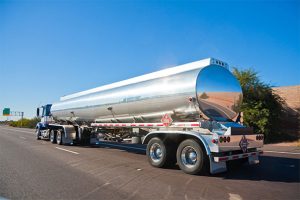
“Fuel-economy and emissions policy can shape the timing, cost, and technology choices behind every major fleet replacement decision.” (Image: SuperTanker by Dixon Bayco + Betts)
A fleet may want to modernize, but hesitate if it is unclear which powertrains, emissions systems, or regulatory requirements will dominate the next equipment cycle. A carrier may want newer tractors, but worry about residual values. A fleet may want to pilot alternative fuels but lack terminal infrastructure or route predictability. A small carrier may decide that the safest move is to keep older equipment running.
In that context, repealing the heavy-duty truck excise tax could remove one obstacle, but not every obstacle.
The tax is an important cost factor. It is not the only factor. The carriers that gain the most from repeal would likely be those with stable freight, available financing, clear customer demand, and a replacement plan already underway.
How Would Heavy-Duty Truck Excise Tax Repeal Affect Small and Mid-Sized Fleets?
For small and mid-sized tank carriers, the heavy-duty truck excise tax can have an outsized effect because capital is usually more constrained.
A large fleet may be able to spread equipment costs over a broader purchasing schedule, negotiate more favorable financing terms, and absorb timing changes more easily. A smaller carrier may be choosing between replacing one tractor, rebuilding another, buying a used trailer, or postponing growth.
That is where a $15,000-$30,000 tax impact can be decisive.
A small petroleum hauler considering a tractor replacement may see repeal as an opportunity to adopt newer safety technology sooner. A regional chemical carrier may be able to justify a specialized trailer order that previously looked too expensive. A food-grade operator may put more emphasis on sanitary trailer upgrades. A dry bulk tank fleet may use the savings to improve reliability or reduce maintenance exposure.
The effect could also show up in financing.
Lower taxable purchase cost can reduce the amount financed, improve down-payment flexibility, or make monthly obligations more manageable. That matters in a period when interest expense can be a meaningful part of the economics of equipment.
But repeal would not automatically solve small-carrier pressure.
Insurance premiums, driver availability, maintenance costs, customer concentration, and freight-rate volatility would still shape decisions. A fleet with weak margins might use tax savings to stabilize cash flow rather than expand. A fleet operating in a soft freight market might still delay purchases. A carrier facing uncertain customer contracts may avoid taking on new debt.
The most realistic view is that repeal would improve the economics of replacement for fleets already close to buying. It would not override every market constraint.
That makes the proposal potentially helpful, but not magical.
For tank fleets, the strongest case is that removing the tax could shorten the time from recognizing the need for a replacement to acting on it. That can matter in an industry where equipment age affects uptime, maintenance planning, roadside risk, and customer confidence.
What Does Heavy-Duty Truck Excise Tax Repeal Mean for Safety, Emissions, and Equipment Strategy?
The safety and emissions argument behind repeal is straightforward: newer equipment usually gives fleets access to newer technology.
Modern tractors may offer collision mitigation, lane-departure warning, adaptive cruise control, electronic stability control, improved braking systems, better visibility, advanced diagnostics, and more driver-assistance features. Newer engines may offer improved fuel efficiency and emissions performance compared with much older units. Newer trailers may bring better braking components, lighting, telematics, tire-pressure monitoring, and structural improvements.
For tank fleets, equipment condition is more than a cost issue. It is central to risk management.
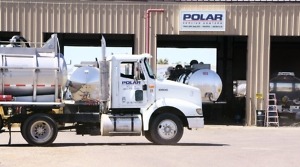
“Older equipment can remain productive, but rising maintenance costs often shape the replacement decision.” (Image: Polar Service Center – Tanker Service)
A cargo tank incident can create consequences far beyond a late delivery. Depending on the product, an incident can involve environmental exposure, hazardous materials response, customer loss, regulatory scrutiny, insurance claims, and reputational damage. Even for nonhazardous products, contamination, leakage, rollover risk, or unloading problems can quickly become expensive.
That is why modernization has a safety value.
”Lowering the upfront cost of replacement does not guarantee safer fleets, but it can make newer safety technology easier to justify when the operational case already supports modernization.”
If repeal encourages fleets to replace older tractors and trailers sooner, supporters argue that the public benefit could include safer equipment and cleaner technology on the road. The fact that a notable share of the largest trucks reportedly still use pre-2010 engines adds weight to that claim.
Still, the public-policy case needs discipline.
Not every older vehicle is unsafe. Not every new vehicle is automatically suitable for every operation. Maintenance quality, driver training, route selection, loading procedures, inspection culture, and management systems all matter. A well-maintained older unit may perform reliably, while a poorly managed newer unit can still create risk.
The best argument is not that repeal guarantees an improvement in safety. It is that lowering the upfront cost of replacement can make it easier for fleets to choose newer equipment when the operational case already supports it.
The same logic applies to emissions.
A newer diesel tractor may emit less than a much older unit. Still, the size of that improvement depends on the equipment being replaced, duty cycle, maintenance condition, fuel use, and regulatory category. Alternative-power units may offer benefits on certain routes, but tank operations often involve weight, range, payload, fueling, and infrastructure constraints that must be carefully evaluated.
For many tank carriers, the near-term modernization pathway may be cleaner, safer diesel equipment rather than a rapid switch to zero-emission tractors. For others, especially those in regional or terminal-based duty cycles, alternative fuels or battery-electric pilots may become more realistic over time.
Either way, the heavy-duty truck excise tax is part of the purchase-cost equation.
Removing it could make new technology easier to justify. Keeping it preserves road-funding revenue. Both outcomes carry consequences.
What Should Tank Fleets Watch Next on Heavy-Duty Truck Excise Tax Repeal?
Tank carriers should watch five developments closely.
First, the bill’s legislative path matters. Introduction is only the beginning. The proposal would need committee attention, broader Senate support, House consideration, and a path through a Congress already facing major transportation-funding questions.
Second, fleets should watch whether repeal is paired with replacement revenue. That may be the single most important political issue. If lawmakers identify another funding stream, repeal becomes easier to defend. If they do not, opposition from road builders, infrastructure advocates, budget hawks, or state transportation interests could intensify.
Third, the proposal may become part of a larger highway reauthorization debate. The current surface transportation law is approaching a major deadline, and Congress is already discussing how to fund roads as vehicles become more efficient and electric vehicles avoid federal gasoline taxes. Proposals for annual EV and plug-in hybrid fees indicate that lawmakers are actively seeking new user-fee models.
Fourth, industry groups will matter. Truck dealers, manufacturers, carriers, trailer builders, and specialized equipment suppliers may support repeal because it could improve the affordability of new equipment. Road-funding stakeholders may resist repeal unless there is a credible replacement. Environmental groups may be split depending on whether they view repeal as a modernization tool or a revenue loss that weakens infrastructure funding. For additional updates on tax policy changes tied to transportation and fleet investment, visit our tax reform coverage.
Fifth, fleets should watch equipment-order behavior. If repeal gains momentum, some buyers may delay purchases in hopes of avoiding the tax. If repeal stalls, fleets may return to normal replacement planning. That uncertainty alone can affect the timing of the order.
For tank fleets, the practical takeaway is to model both scenarios.
One scenario assumes the tax remains in place. Another assumes repeal or partial repeal. A third assumes repeal paired with another user fee, such as a registration charge, weight-based fee, mileage-based fee, or another Highway Trust Fund mechanism.
The best-prepared carriers will not wait for Congress to decide before understanding the numbers.
They will calculate how repeal would affect tractor replacement, trailer replacement, financing, maintenance tradeoffs, residual values, and customer contract pricing. They will also evaluate whether any tax savings would be used to buy sooner, specify better equipment, reduce debt, improve margins, or upgrade safety systems.
Bottom Line on Heavy-Duty Truck Excise Tax Repeal for Tank Transport
The heavy-duty truck excise tax repeal proposal gives tank fleets a clear potential benefit: lower upfront cost for new heavy-duty tractors, trailers, semitrailer chassis, and related equipment. In a sector where specialized equipment is expensive and replacement cycles are critical, that matters.

“The policy challenge is balancing fleet modernization with the infrastructure investment that keeps commercial trucks moving.” Workers digging by an intersection in the United States. (Matthew Henry / Unsplash / Wikimedia Commons, CC0)
The proposal also creates a clear public-policy problem: the tax currently contributes more than $6 billion annually to road construction and repair. Repealing it without replacement revenue would widen the Highway Trust Fund challenge at a time when Congress is already debating how electric vehicles, hybrids, fuel-efficient vehicles, heavy trucks, and other road users should pay for infrastructure.
For tank transportation, the issue should not be reduced to a slogan.
Repeal could help modernize fleets. It could make newer safety technology more affordable. It could improve the economics of replacing older tractors and trailers. It could help small and mid-sized carriers make purchases that are currently just out of reach.
At the same time, tank carriers need roads, bridges, industrial corridors, ports, terminals, and reliable infrastructure. A weaker road-funding system would eventually show up in operating costs, routing constraints, congestion, maintenance, and delivery reliability.
The most balanced view is this: ending the 12% FET could be a meaningful tool for fleet modernization, but only if Congress addresses the road-funding gap honestly.
For tank fleets, the question is not whether lower equipment costs are attractive. They are.
The real question is whether lawmakers can design a policy that makes newer equipment easier to buy without undermining the infrastructure that keeps that equipment productive.
That is why the heavy-duty truck excise tax debate deserves close attention from every tank carrier planning its next equipment cycle. It is not just a Washington tax fight. It is a fleet-planning issue, a safety issue, an emissions issue, a capital-spending issue, and a road-funding issue all moving through the same lane.
What Tank Fleets Should Watch as the Heavy-Duty Truck Excise Tax Debate Moves Forward
Key Developments
- A bipartisan Senate proposal would repeal the 12% federal excise tax on heavy-duty trucks, trailers, semitrailer chassis, and tractors.
- The heavy-duty truck excise tax can add $15,000 to $30,000 to the cost of new heavy-duty equipment, according to lawmakers cited in the original report.
- Tank carriers could be affected more directly than some general freight operators because specialized tank trailers, cargo tank bodies, pumps, valves, vapor-recovery systems, and compliance-related equipment can significantly raise purchase costs.
- Supporters argue that repeal could help fleets replace older equipment faster and accelerate adoption of newer safety technology, emissions systems, telematics, and fuel-efficient tractors.
- Lawmakers backing repeal have pointed to the continued use of pre-2010 engines among a share of the largest trucks on the road as evidence that equipment replacement remains a challenge to modernization.
- The main policy concern is road funding: the tax currently generates more than $6 billion annually for highway construction and repairs.
- Any repeal effort will likely face pressure to identify replacement revenue for the Highway Trust Fund, especially as Congress also debates EV fees, fuel-tax gaps, and long-term infrastructure funding.
- For tank fleets, the practical issue is not only whether repeal passes, but whether it changes equipment-order timing, financing decisions, replacement cycles, and future trailer specifications.
- Fleet managers should model both outcomes: one in which the heavy-duty truck excise tax remains in place, and another in which repeal lowers upfront costs but a different road-user fee may replace it.
- The debate is likely to remain relevant as Congress weighs highway reauthorization, fleet modernization, emissions policy, diesel costs, and commercial vehicle affordability.
Related Tank Transport Coverage
- For more coverage of federal excise tax issues affecting commercial equipment purchases, see our FET reporting.
- To follow broader tax developments affecting trucking and transportation costs, browse our taxes coverage.
- For additional updates on tax policy changes tied to transportation and fleet investment, visit our tax reform coverage.
- For more reporting on transportation policy, federal rulemaking, and legislative issues, explore our politics, laws, and policies coverage.
- To track developments in heavy-duty tractors and commercial truck equipment, see our heavy-duty truck updates.
- For more on equipment trends shaping fleet purchasing and maintenance decisions, review our heavy-duty equipment coverage.
- For more insight into fleet operations, replacement cycles, and equipment strategy, follow our fleet coverage.
- For ongoing news across the tank transportation sector, visit our TankTransport coverage.
- For more updates on tank trailer equipment, specifications, and market developments, explore our tank trailer reporting.
- To follow infrastructure funding debates affecting carriers and commercial vehicle operators, read more in our highway funding coverage.
External Resources on Heavy-Duty Truck Excise Tax Repeal, Fleet Modernization, and Highway Funding
- Read the original report on the bipartisan proposal to repeal the 12% federal excise tax on heavy-duty trucks at Reuters heavy-duty truck excise tax coverage.
- Review the statutory language governing the 12% federal excise tax on heavy trucks, trailers, semitrailer chassis, bodies, and tractors at 26 U.S. Code § 4051.
- Track federal Highway Trust Fund balances and infrastructure funding data through the Federal Highway Administration’s Highway Trust Fund status page.
- Find IRS guidance on heavy highway vehicle tax filing requirements at the IRS Form 2290 resources.
- Explore the EPA’s heavy-duty vehicle emissions framework through its Phase 3 greenhouse gas standards for heavy-duty vehicles.
- Read background on federal heavy-truck fuel-economy policy changes at Reuters coverage of heavy-truck fuel-economy rule revisions.
- Review reporting on highway funding alternatives, including EV and plug-in hybrid fees, at Reuters coverage of proposed road-repair fees.
- Follow the latest vehicle emissions policy debate through Reuters reporting on EPA pollution-rule revisions.
- Read background on EPA heavy-duty truck and bus emissions standards at Associated Press coverage of heavy-duty emissions rules.