- Omni is seeking a U.S. special permit for carbon-fiber-reinforced T7, T9, and T10 UN portable tanks for use in highway, rail, and vessel transportation.
- TriArc wants to manufacture MC 331-equivalent cargo tanks under ASME Section XII with a “T” stamp rather than the Section VIII “U” stamp, as named in current regulations.
- Both applications remain pending: the public-comment deadline is August 13, 2026, and neither Federal Register notice authorizes manufacture or transportation.
Two tank special permits now before the Pipeline and Hazardous Materials Safety Administration could expand how specialized chemical and compressed-gas tanks are built for the U.S. market. One asks federal regulators to accept a carbon-fiber-reinforced portable tank, even though current rules assume a metallic shell. The other asks to build an MC 331-equivalent pressure cargo tank to a transport-specific ASME code that PHMSA has considered—and selectively authorized—for more than a decade.
PHMSA published notice of the applications on July 14, 2026. The two PHMSA special permit applications address different equipment and regulatory departures. These tank special permits would cover separate equipment classes. Omni Composite Tank Limited’s application 22309-N covers non-specification T7, T9, and T10 UN portable tanks constructed of carbon-fiber-reinforced plastic, or CFRP, for movement by motor vehicle, rail freight, and cargo vessel. TriArc Tank LLC’s application 22333-N covers non-DOT specification cargo tanks that would otherwise conform to the MC 331 requirements, except that they would be constructed to ASME Boiler and Pressure Vessel Code Section XII and carry a “T” stamp instead of the traditional Section VIII “U” stamp.
With tank special permits, the distinction between an application and an authorization is decisive. The Federal Register notice confirms only that PHMSA received the requests and opened them to public comment through August 13. Under the federal process, the agency must evaluate whether each proposed alternative would provide a level of safety at least equal to the regulation from which relief is requested. PHMSA may grant, deny, partially grant, or attach additional operating conditions to either request.

These tank special permits are not blanket approvals for composite tanks or Section XII MC 331 trailers. They are company-specific requests for alternative compliance pathways that PHMSA has not yet accepted.
The pairing of tank special permits is nevertheless significant for tank fleets and equipment manufacturers. Omni’s request spans materials, corrosion resistance, payload, multimodal handling, and the inspection of a composite pressure-retaining structure. TriArc’s request extends to pressure-vessel certification, design margins, authorized inspection, repair capability, and the continued-service system for LPG and other compressed-gas cargo tanks.
It also arrives after Tank Transport’s earlier coverage of the Omni composite chemical tank trailer and its recent analysis of MC 331 inspection and documentation requirements. The new filings do not simply repeat those stories. They expose the federal approvals that must be in place for unconventional tank trailers and portable tanks before claimed material or operational advantages can become a broadly usable U.S. fleet option.
PHMSA tank special permits test two different equipment pathways
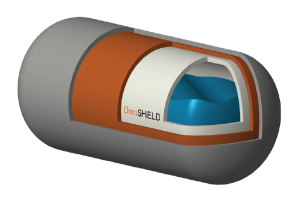
Cutaway illustration of Omni Tanker’s OmniSHIELD seamless thermoplastic interior within the company’s layered OmniTANK composite system. This is a technology illustration, not a drawing of the equipment submitted under PHMSA application 22309-N. (Courtesy of Omni Tanker.)
Tank special permits are variances from specific provisions of the Hazardous Materials Regulations, not exemptions from hazardous-materials safety as a whole. Under 49 CFR Part 107, Subpart B, an applicant must identify the relief requested, describe the proposed packaging or operation, document quality controls and service-life limits where applicable, estimate expected manufacturing or shipping activity, and support the alternative with analyses, test results, or other evidence.
PHMSA evaluates tank special permits against the governing standard of an equivalent level of safety. The agency may also consider whether an applicant is fit to conduct the activity, request additional information, inspect a facility, or impose controls beyond those proposed. A complete nonemergency application is docketed, published in the Federal Register, and open to public comment before final action.
That framework explains why the short docket descriptions for tank special permits cannot answer every engineering question. The public notice names the regulations affected and the broad form of relief, but it does not publish the applicants’ full drawings, failure-mode analyses, impact tests, fire-performance evidence, inspection methods, repair procedures, or chemical-compatibility matrices. PHMSA states that copies are available through its Records Center. Until the technical files or an issued permit are public, firm claims about service life, damage tolerance, repair economics, or authorized cargoes would outrun the available record.
The commercial promise may be weight, payload and corrosion resistance. The regulatory question is whether those benefits can be delivered with an equivalent safety case over the tank’s entire transportation life.
The two proposed tank special permits also differ in their distance from existing federal practice. Omni’s request for composite portable tanks would substitute a CFRP pressure-retaining structure for rules that expressly call for metallic shells. TriArc’s Section XII request has close precedent: PHMSA has previously issued manufacturing permits for MC 331-equivalent tanks built to Section XII and marked with a T stamp. That does not predetermine TriArc’s outcome, but it changes the nature of the review.
What exactly is PHMSA considering?
The requested tank special permits can be reduced to a practical comparison without treating unlike tank types as interchangeable.
| Application | Equipment | Requested pathway | Modes | Central regulatory issue |
|---|---|---|---|---|
| 22309-N Omni Composite Tank Limited | T7, T9 and T10 UN portable tanks | Non-specification portable tanks using a CFRP shell while otherwise conforming to UN portable-tank requirements. | Highway, rail, and vessel | Current 49 CFR 178.274 language requires metallic shells and expresses several design and thickness rules in metallic-material terms |
| 22333-N TriArc Tank LLC | MC 331-equivalent cargo tank motor vehicles | Construction to ASME Section XII with a T stamp instead of Section VIII with a U stamp | Highway | Current MC 331 rules incorporate Section VIII construction and U-stamp certification, while Section XII is written specifically for transport tanks. |
Neither “T” means the same thing. In Omni’s application, T7, T9, and T10 are UN portable-tank instructions that define combinations of test pressure, shell-thickness treatment, pressure-relief requirements, and bottom-opening controls. In TriArc’s filing, the T stamp is the ASME certification mark associated with Section XII transport tanks. Confusing those terms would collapse two separate regulatory systems into one.
Omni’s composite portable tank request goes beyond a road trailer
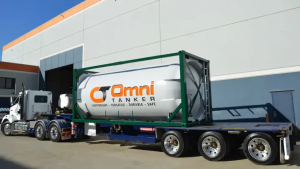
An Omni Tanker composite tank container mounted on a road chassis, illustrating the equipment’s intermodal form. The pictured unit is not represented as authorized under pending PHMSA application 22309-N. (Courtesy of Omni Tanker.)
Omni’s July filing is one part of a broader U.S. approvals push. In a separate June 12 Federal Register notice, PHMSA published application 22307-N from the same company for non-DOT-specification CFRP cargo tanks to be assembled into vehicles that otherwise conform to DOT 407/412 requirements—the comment period for that road-cargo-tank request closed July 13.
Application 22309-N addresses a different product class. A UN portable tank can transfer between a chassis, rail movement, and vessel service without becoming a conventional, permanently attached highway cargo tank. Omni seeks authority for UN T7, T9, and T10 tanks across all three surface modes, giving the portable-tank filing a genuinely intermodal scope.
The current HMR creates an obvious point of departure. Section 178.274 says portable-tank shells must be designed and constructed to Section VIII of the ASME Code unless an approved alternative design code is used for liquid or solid hazardous materials. It then states that shells must be made of metallic materials suitable for forming. The same section specifies minimum shell thickness by reference to steel or an equivalent thickness in another metal. It uses concepts of yield, proof strength, elongation, and weldability throughout the design criteria.
A carbon-fiber-reinforced shell does not fit neatly inside that language. Its structural behavior is direction-dependent; its laminate architecture, resin system, interfaces, and manufacturing controls matter in ways that cannot be translated by simply substituting a metal thickness. A credible approval, therefore, has to address the composite as a designed system, not merely as a lighter material.
Omni describes its commercial OmniTAINER as an armored thermoplastic composite tank container. The OmniTAINER carbon fiber tank platform pairs a CFRP structural shell with a seamless polyethylene interior. The company’s published 20-foot T7 and T8/T9/T10 variants have a nominal capacity of 22,500 liters, or 5,943 U.S. gallons; a nominal tare weight of 2,850 kilograms, or 6,283 pounds; a 36,000-kilogram maximum gross weight; a 4-bar design pressure; and a 2.7-bar maximum allowable working pressure. The company lists a design temperature range of minus 40 degrees Celsius to 50 degrees Celsius and identifies Class 5 and Class 8 products.
Those are manufacturer specifications, not PHMSA findings. They show the type of commercial case behind the requested tank special permits. Still, they do not establish that every listed cargo, configuration, or approval would carry into a U.S. authorization. An issued permit would control, including its authorized materials, testing, marking, repair, and operational provisions.
Omni’s filing is potentially consequential because it asks PHMSA to evaluate a composite portable tank as a complete pressure-retaining and multimodal system—not simply as a lighter substitute for steel.
The T codes also matter. Under 49 CFR 172.102, T7, T9, and T10 each carry a minimum test pressure of 4 bar, but their other conditions differ. T7 uses the shell-thickness method in 178.274(d)(2), normal pressure relief, and a bottom opening with three effective means of closure. T9 calls for 6 millimeters of reference-steel thickness, normal pressure relief, and the prohibition of bottom openings for liquids. T10 also calls for a 6-millimeter reference-steel thickness, requires the pressure-relief arrangement in 178.275(g)(3), and prohibits bottom openings.
Because the regulatory table is written around reference steel, a composite authorization must establish how its design and validation deliver equivalent performance without pretending that a CFRP laminate has a one-to-one metallic thickness. The resulting hazardous materials tank design case would reasonably be expected to address internal pressure, fatigue, impact, lifting and tie-down loads, stacking, thermal exposure, permeation, liner integrity, electrostatic grounding where applicable, and damage detection after abnormal events. Whether the pending application addresses each point, and what limits PHMSA might impose on the resulting tank special permits, remain undisclosed in the public notice.
TriArc’s MC 331 T-stamp request follows a real federal precedent
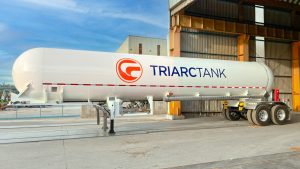
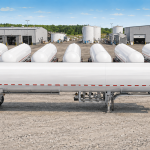
TriArc Tank’s MC 331 semi-trailer for LPG transportation. TriArc is seeking PHMSA authorization for a Section XII/T-stamp construction pathway; the pictured trailer is not represented as having been manufactured under the pending special permit. (Courtesy of TriArc Tank.)
TriArc’s proposal is narrower. The company wants to manufacture, mark, sell, and use cargo tanks conforming to the MC 331 rules except for the governing ASME construction section and certification stamp. Instead of Section VIII and a U stamp, the tanks would use an ASME Section XII T stamp.
Section VIII is the long-established pressure-vessel construction code incorporated into the MC 331 specification. Section XII was developed specifically for transport tanks and extends beyond new construction to include continued-service concepts, covering inspection, testing, repair, alteration, and recertification. PHMSA described the T stamp in its 2010 advance rulemaking as essentially equivalent in certification role to the U stamp, while emphasizing that the underlying Section XII system is tailored to transportation.
Section XII tank special permits are not new to PHMSA. The agency issued DOT-SP 16516 to Exosent Engineering in 2016 for MC 331-equivalent tanks constructed in accordance with the 2013 edition of Section XII. In July 2024, PHMSA issued DOT-SP 21745 to Exosent for a comparable pathway using the 2023 edition. That later permit required the tanks to meet the MC 331 requirements except where specifically replaced by Section XII provisions covering such areas as material, structural integrity, joints, manholes, pressure-relief-device certification, marking, and the manufacturer’s data report.
The 2024 permit also required Section XII inspection and recordkeeping, DOT-registered inspectors, conspicuous special-permit markings, and repair or alteration by a facility holding an appropriate National Board TR or R authorization with a Section XII endorsement for Category 331 cargo tanks. A current permit copy had to be carried aboard the vehicle, and hazmat employees performing covered functions required training on the permit’s conditions.
That public permit listed an expiration date of June 30, 2026. Federal rules allow a permit to remain in effect beyond its printed expiration when a complete renewal application is filed at least 60 days in advance, and PHMSA has not yet taken final administrative action. The public record reviewed for this article does not establish whether Exosent made such a timely filing, so the present legal status of DOT-SP 21745 should not be inferred from the face date alone.
TriArc’s application, therefore, should not be described as the first federal test of a Section XII MC 331. Its importance lies elsewhere: another manufacturer is seeking its own production authority for the pathway, and manufacturing permits are not open to ordinary party-status additions under 49 CFR 107.107. A company that wants to manufacture under alternative requirements cannot simply attach itself to another manufacturer’s permit.
TriArc is not asking PHMSA to invent the Section XII MC 331 concept. It is asking the agency to approve TriArc as a manufacturer under a pathway with close prior precedent and company-specific controls.
TriArc markets the TriArc MC 331 trailer for propane and LPG service and emphasizes tare weight and payload optimization. Those claims provide a commercial context but are not part of the relief described in application 22333-N. The Federal Register notice does not publish the proposed capacity, tare weight, steel grade, code edition, design calculations, authorized commodities, or inspection network. Until the application or permit terms are available, the defensible story is about the certification pathway—not a guaranteed payload gain.
What could the applications mean for fleets, shippers, and tank shops?
If PHMSA grants the applications, the immediate authorization would belong to the specific permit holder and the equipment built under the permit’s terms. It would not rewrite 49 CFR for every manufacturer. Even so, issued tank special permits can influence equipment purchasing, shipper acceptance, repair planning, and eventual rulemaking by establishing a controlled body of operating experience.
For chemical transportation, Omni’s portable-tank pathway could be most relevant where corrosion resistance and tare weight constrain equipment choice. A lower tare can create room for additional lading before gross-weight limits are reached. Still, the realized payload depends on cargo density, chassis configuration, axle limits, route restrictions, and the permitted maximum gross mass. For lower-density products, tank volume may become the limiting factor before weight. No universal payload increase can be calculated from tare weight alone.
The seamless thermoplastic interior could also affect compatibility and cleaning decisions for corrosive Class 5 and Class 8 products. Yet compatibility must be established for the actual lading, concentration, temperature, cleaning chemistry, gaskets, valves, and service equipment. A broad claim that composite construction eliminates corrosion or cross-contamination risk would be too strong. The liner, structural shell, and interfaces remain an engineered system requiring defined inspection and damage criteria.
Multimodal use adds another layer. An intermodal portable tank encounters lifting, stacking, chassis, rail, and marine environments that differ from the duty cycle of a road-only trailer. Fleets and lessors would need to understand which approvals apply in each jurisdiction and mode, how the design certificate is recognized, what markings and documents must accompany the tank, and whether terminals, steamship lines, rail operators, and shippers accept the specific special-permit equipment.
For TriArc’s MC 331 pathway, the purchasing question is less about a new tank material than the service ecosystem surrounding a Section XII vessel. An owner would need access to the required manufacturer’s data report, the issued permit, and qualified inspectors and repair organizations. The special permit number, code stamp, specification plate, and maintenance records would become part of the asset’s compliance identity.
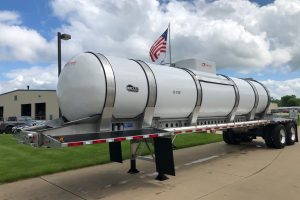
Omni Composite Tank’s carbon-fiber road cargo-tank trailer. PHMSA is reviewing a separate application for T7, T9, and T10 portable tanks; the pictured trailer is not the portable-tank configuration covered by application 22309-N. (Courtesy of Omni Composite Tank Ltd.)
That matters because the current MC 331 compliance practice already turns on inspection access, correct test classification, and complete records. A Section XII-built tank would not erase those obligations. Depending on the final permit language, it could include permit-specific training, markings, repair qualifications, and document control requirements.
A lighter or differently certified tank is not operationally interchangeable merely because it can carry the same commodity. Its permit, records, inspection method and repair network travel with the asset.
Resale and leasing also deserve attention. A purchaser evaluating equipment built under tank special permits must confirm that the permit remains effective, that the tank was manufactured and maintained under its terms, and that the buyer can lawfully use or reoffer it. PHMSA permits commonly allow a person receiving an authorized packaging to use or reoffer it without becoming the manufacturing permit holder, but only in exact conformance with the permit and HMR. Final language for the pending applications could differ.
Insurance, shipper qualification, and terminal acceptance may move more slowly than federal authorization. Large chemical and gas shippers often maintain equipment standards beyond the regulatory minimum. A PHMSA permit can make transportation lawful; it does not compel every shipper, carrier, terminal, or vessel operator to accept the equipment.
What evidence and decisions should the industry watch next?
For these tank special permits, the first milestone is the August 13 public-comment deadline for applications 22309-N and 22333-N. Comments should identify the application number and address the safety or operating issues PHMSA must evaluate. The agency then reviews the record and may seek additional information before issuing a grant, partial grant, or denial.
For Omni, the most important technical questions concern the composite shell’s validated life cycle. Industry participants will want to know the governing design standard, laminate and liner qualification, impact and abrasion resistance, fire performance, permeation limits, fatigue basis, inspection techniques, repairability, rejection criteria, service-life limit, and the method for assessing damage that may not be obvious through ordinary visual inspection. Authorized commodities and concentration limits will be equally important.
The eventual permit, if granted, should also clarify how the metallic-shell and reference-steel provisions are replaced, how design approval and production surveillance work, which approval agencies and inspectors are involved, and whether exceptional inspections are triggered after drops, impacts, overheating, or other events.
For TriArc, the key document will be the permit’s deviations from the ordinary MC 331 text. The Exosent precedent is a useful guide but not a substitute. The code edition, design-stress criteria, required material rules, data-report format, marking, authorized repair stamps, continued-qualification requirements, and permit-copy obligations must be read from TriArc’s final authorization.
PHMSA’s broader policy choice also bears watching. Section 107.113 allows the agency to initiate rulemaking when an application involves a matter of general applicability and future effect. PHMSA considered broad incorporation of Section XII as early as 2010, yet the MC 331 pathway continues to appear through company-specific permits. Repeated tank special permits can strengthen the case for a uniform rule, but they do not guarantee that PHMSA will choose rulemaking over individual authorizations.
Omni’s two pending U.S. requests raise a similar question for composites. If the agency authorizes both a road cargo tank and an intermodal portable tank, it could begin generating operating data across two distinct tank categories. If the applications are denied, limited, or withdrawn, the agency’s reasoning may be just as instructive for future composite designs.
The next decisive documents are not product announcements. They are PHMSA’s final actions and the operating, inspection and repair conditions written into any permits that emerge.
Tank Special Permits: Key Developments
- PHMSA published applications 22309-N and 22333-N on July 14, 2026; comments close August 13, 2026.
- Omni application 22309-N seeks authority for CFRP T7, T9, and T10 UN portable tanks transported by highway, rail, and vessel.
- Omni also has a separate pending road-cargo-tank application, 22307-N, for CFRP tanks used in DOT 407/412-equivalent cargo tank motor vehicles.
- The current UN portable-tank rule requires metallic shells, making Omni’s requested alternative a direct materials and design-validation issue.
- TriArc application 22333-N seeks MC 331-equivalent construction under ASME Section XII with a T stamp in place of Section VIII and a U stamp.
- PHMSA previously issued closely related Section XII MC 331 manufacturing permits to Exosent Engineering, so the concept has federal precedent, even though TriArc must qualify independently.
- Manufacturing special permits are company-specific and cannot be joined through ordinary party status.
- Neither pending application establishes promised payload, maintenance, or safety results; those claims depend on technical evidence and final permit conditions.
- Fleets would need to evaluate permit validity, authorized cargoes, documentation, inspection methods, repair access, shipper acceptance, and resale implications before deployment.
- PHMSA may grant, partially grant, deny, or impose additional conditions after reviewing the applications and public comments.
Official Tank Design and Special Permit Resources
- The July 14 PHMSA applications notice identifies Omni application 22309-N, TriArc application 22333-N, and the August 13 comment deadline.
- The June 12 PHMSA applications notice describes Omni’s separate 22307-N request for CFRP DOT 407/412-equivalent road cargo tanks.
- 49 CFR Part 107, Subpart B explains the application, equivalent safety, public comment, evaluation, and renewal procedures governing hazmat special permits.
- 49 CFR 172.102 defines the T7, T9, and T10 portable-tank instructions and their pressure, thickness, relief-device, and bottom-opening requirements.
- 49 CFR 178.274 contains the current metallic-shell, design-load, service-equipment, and structural requirements for UN portable tanks.
- 49 CFR 180.605 provides the federal 2.5-year, five-year, and exceptional inspection framework for UN portable tanks.
- DOT-SP 21745 shows PHMSA’s 2024 conditions for an Exosent Section XII MC 331 manufacturing authorization.
- PHMSA’s 2010 Section XII advance rulemaking explains the transport-tank code, T stamp, and continued-service framework.
- Omni’s OmniTAINER product specifications describe the company’s commercial T7 and T8/T9/T10 composite tank-container configurations; these manufacturer claims do not substitute for a PHMSA permit.