- Iraq has assembled a truck-to-terminal fuel-oil route through Syria that the Syrian Petroleum Company says is handling around 900 tanker trucks per day.
- Three Aframax vessels loaded approximately 1.42 million barrels at Baniyas; the first vessel reached Houston in late July, while the other two remained scheduled for August U.S. Gulf Coast arrivals.
- The route is operating, but it remains costly, road-intensive and exposed to border congestion, accidents, protests and unresolved cargo details.
The Iraq-Syria fuel corridor has moved beyond a contingency plan. A continuous road-tanker operation is carrying Iraqi fuel oil across Syria to the Mediterranean port of Baniyas, where the product is transferred through shore storage into marine tankers. The first of three U.S.-bound vessels reached Houston in late July, creating a direct operational link between hundreds of daily tanker-truck movements in the Middle East and Gulf Coast petroleum markets.
The development is more specific than a broader story about the disruption of the Strait of Hormuz. It shows how a land bridge can be assembled when a maritime chokepoint becomes unreliable: road tankers replace the missing first leg, a coastal terminal consolidates thousands of truckloads, and Aframax vessels carry the resulting parcels into international trade.
It also requires restraint. Current vessel data identify the U.S.-bound product as fuel oil—not crude oil or naphtha—and the cargoes’ precise grade, buyers, U.S. receiving terminals, and downstream movements have not been disclosed. The route is commercially real, but its limits are as important as its scale.



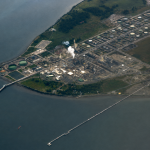
Baniyas harbor on Syria’s Mediterranean coast, photographed in 2010. The port now serves as the terminal point for Iraqi fuel oil transported by road tanker across Syria. (Photo: varunshiv, CC BY 2.0)
How 900 Tanker Trucks Feed the Baniyas Oil Terminal
Iraq began expanding the overland route after disruption to Gulf shipping restricted exports through its customary southern outlets. State oil marketer SOMO awarded contracts for about 650,000 metric tons of fuel oil per month from April through June to move through Syria, according to Reuters’ April reporting.
The operation initially depended heavily on the al-Waleed crossing in western Iraq. On April 20, Iraq reopened the Rabia border crossing in Nineveh province after more than a decade, giving convoys a second outlet and easing pressure on tanker queues at al-Waleed. Syria’s state news agency later reported that a first 70-truck convoy crossed the Rabia–al-Yarubiyah route on May 1.
Inside Syria, the tanker truck corridor ends at the Baniyas oil terminal on the Mediterranean coast. The Syrian Petroleum Company told Reuters that Baniyas was unloading around 900 tanker trucks per day and loading one marine tanker every seven to 10 days. Reuters reporters observed tanker lines extending more than 30 kilometers, or about 19 miles, near the port.
The transfer process is important. Iraqi fuel oil is not being processed at the Baniyas refinery, according to a terminal source cited by Reuters. Trucks unload at a marine platform connected to storage tanks north of the refinery. From those tanks, the product is pumped to export vessels. That makes Baniyas a consolidation and re-export hub rather than the origin for cargo processing.
The route works because a marine cargo can be assembled from hundreds or thousands of individual road-tanker deliveries. Still, every transfer adds scheduling, storage, and quality-control demands.The reported 900-truck figure should not be casually converted to barrels per day. Public sources do not provide a uniform truck capacity, average payload, fuel-oil density or confirmation that every available unloading position operates at full utilization every day. It is best treated as an operator-reported measure of the route’s physical intensity, not a fully audited throughput figure.
Three Aframax Cargoes Point Toward the U.S. Gulf Coast

The corridor consolidates around 900 daily tanker-truck deliveries at Baniyas before loading Iraqi fuel oil onto marine vessels bound for the Bahamas and U.S. Gulf Coast. (Graphic: Tank Transport)
The clearest proof of commercial scale is at sea. Kpler vessel data reported by Reuters show three Aframax tankers loading Iraqi-origin fuel oil at Baniyas between June and July for delivery toward the United States.
The On Passion departed June 17 with approximately 716,600 barrels. About 487,600 barrels were discharged in the Bahamas in mid-July, leaving roughly 229,000 barrels that Kpler expected to unload in Texas later in July. Port Houston records listed the vessel at Bayport on July 21, while public AIS data later recorded a Houston departure and return to anchorage on July 24. Together, those records show that the vessel reached Houston in late July, but they do not establish the receiving terminal, buyer, or whether the reported balance was fully discharged.
The Nissos Christiana loaded about 288,500 barrels and departed by July 8 for an expected early-August Gulf Coast discharge. The Green Warrior loaded about 414,400 barrels in mid-to-late July and was scheduled to reach the United States during the third week of August.
Together, the vessels loaded approximately 1.42 million barrels at Baniyas. After the reported Bahamas discharge, about 932,000 barrels were routed toward the U.S. Gulf Coast, including the On Passion balance that reached Houston. The itineraries establish the new North American trade route, but they still do not publicly identify a receiving refinery, terminal, final buyer, or inland destination.
That distinction matters for the domestic tank sector. A ship arriving on the Gulf Coast does not automatically create a new tank-truck lane. The product could move into refinery feed systems, terminal tanks, blending operations, pipelines, barges, or other marine transport. Until a discharge facility and buyer are identified, any claim about local fuel-hauling demand would be speculative.
Fuel oil is also not interchangeable with gasoline, diesel, or crude. The U.S. Energy Information Administration’s Iraq-specific series records limited but recurring U.S. residual fuel-oil imports from Iraq, including small volumes in early 2026. The new fact is the route: Iraqi fuel oil exports reached the Mediterranean by road and then turned west toward the U.S. market.
Why Fuel Oil Is Not Yet a Crude-Oil Breakthrough
Public descriptions of the cargo have not always matched. The Syrian Arab News Agency’s May 1 report described the 70-truck Rabia convoy as crude oil. More recent terminal reporting and vessel data, however, identify current Baniyas re-exports as Iraqi fuel oil. Reuters reported on July 23 that facilities were being prepared to process crude and naphtha, but commercial exports of those products had not begun.
The defensible conclusion is therefore narrow: fuel oil is moving at scale; crude and naphtha remain proposed expansions. Without product specifications, the cargo should not be labeled as bunker fuel, high-sulfur fuel oil, straight-run feedstock, or any narrower grade.
That product distinction connects the route to Tank Transport’s broader global refinery crunch analysis. Refined products and intermediate feedstocks can tighten even when crude oil is available. A fuel-oil route may serve a specific refinery or blending need without materially replacing the much larger crude volumes Iraq normally exports through southern terminals.
Before the war-related disruption, Iraq exported about 3.6 million barrels of oil per day, with roughly 3.4 million barrels per day flowing through Basra-area terminals, according to Iraqi officials cited by Reuters. Against that system, a road-based Strait of Hormuz bypass is strategic but limited in scope. It preserves an outlet, clears storage pressure and establishes optionality; it does not replicate the scale or efficiency of pipelines and deepwater export facilities.
Nine hundred tanker trucks a day demonstrate the value of road transport in an emergency—and the infrastructure limits that make a permanent pipeline more attractive.The Operational Risks Behind the New Export Route
The route’s main strength is flexibility. Trucks can begin moving before a damaged pipeline is reconstructed, can be split between border crossings and can feed terminal storage incrementally. Its main weakness is that the same flexibility multiplies exposure across drivers, tractors, tanks, roads, border inspections, unloading positions and intermediate storage.
Road conditions are already testing the operation. Reuters reported damaged highways, long queues, a June collision involving two Iraqi tankers near Homs, a fuel spill, and protests that temporarily blocked convoys in northeast Syria. A separate tanker overturned and burned near the Homs–al-Tanf highway in early July. These events do not prove the corridor is unworkable. Still, they show why high-volume petroleum transport requires traffic control, driver-rest planning, vehicle inspection, emergency response, spill capacity, and secure staging areas.
Commercial compliance has changed as well. The U.S. Treasury revoked the broad Syria sanctions program effective July 1, 2025, while retaining targeted sanctions under a new accountability framework. That reduces a major barrier to legitimate Syrian trade, but it does not eliminate the need to screen vessels, terminal interests, intermediaries, banks and counterparties against remaining restrictions.
The pipeline project advanced again July 25, when Iraq’s Council of Ministers authorized the director general of Basra Oil Company to sign a memorandum of understanding with Syria’s Ministry of Energy for a route linking Iraqi production to Mediterranean export markets. The cabinet action followed a preliminary July 4 agreement between Basra Oil Company and a consortium including Chevron, TI Capital and Qatar’s UCC to study alternative export routes, as well as the July 17 U.S.–Iraq business summit where Chevron said it would invest in a pipeline that could reach Syria’s Mediterranean coast. It is still not a construction contract: no capacity, financing plan, or completion schedule has been disclosed. The latest authorization moves the project forward, but leaves its commercial execution unresolved.
A functioning pipeline would not make the truck operation irrelevant. Tankers could continue serving origins beyond the pipeline, balancing terminal inventory, handling products unsuitable for the line or providing contingency capacity. But the economics would change: road transport would likely shift from primary bridge to supplemental lane.
For the U.S. market, the immediate effect remains a cargo-sourcing story rather than proof of rack-level relief. Tank Transport’s fuel supply crunch reporting has shown that product availability depends on refinery conversion, specifications, inventories and terminal flows—not simply the arrival of another vessel. The next decisive facts will be where these cargoes are unloaded, how they are classified, and what Gulf Coast facilities do with them.
Iraq-Syria Fuel Corridor: Key Developments
- Syria reports that the Baniyas operation can unload around 900 tanker trucks per day and assemble one marine cargo every seven to 10 days.
- Three Aframax vessels loaded approximately 1.42 million barrels of Iraqi-origin fuel oil at Baniyas; the On Passion reached Houston in late July, while two cargoes remained scheduled for August arrivals.
- Current commercial shipments are fuel oil. Crude and naphtha exports through Baniyas remain planned but were not operating as of July 23.
- The route faces material road, border, safety and security constraints, including long queues, damaged highways, collisions, spills and protest blockades.
- Iraq’s cabinet authorized Basra Oil Company on July 25 to sign a pipeline memorandum with Syria’s Ministry of Energy, advancing the project while leaving its capacity, financing and construction schedule unresolved.
Sources and Further Reading
- Reuters — First U.S.-bound fuel-oil cargoes shipped through Syria (July 23, 2026): Vessel identities, cargo volumes, destinations and the current fuel-oil-only status of Baniyas exports.
- Reuters — Iraq’s road-tanker route and Baniyas terminal operation (June 19, 2026): SOMO contracts, terminal configuration, reported truck volumes, road conditions, accidents and proposed crude and naphtha expansion.
- Reuters — Iraq reopens the Rabia border crossing (April 20, 2026): Reopening of the second tanker-truck crossing and the development of Iraq’s overland export route.
- Syrian Arab News Agency — First 70-truck convoy through Rabia (May 1, 2026): Syrian government account of the initial convoy and the source of the unresolved crude-versus-fuel-oil description.
- Port Houston — Bayport vessel movement report and VesselFinder — On Passion vessel record: Records supporting the vessel’s late-July Houston arrival without establishing its buyer, complete discharge or final receiving facility.
- U.S. Energy Information Administration — U.S. residual fuel-oil imports from Iraq: Historical federal data showing that Iraqi residual fuel oil had reached the United States before the new route through Syria opened.
- U.S. Treasury Department — Revocation of the Syria sanctions program (June 30, 2025): Official notice ending the broad sanctions program while retaining targeted restrictions and compliance requirements.
- Reuters — Preliminary study of alternative Iraqi export routes (July 5, 2026), Reuters — Chevron’s Iraq pipeline commitment (July 17, 2026), and The National — Iraq–Syria pipeline authorization (July 26, 2026): The sequence of study agreements, commercial discussions, and cabinet authorization behind the proposed Mediterranean pipeline.