- Federal investigators traced the 2024 Bio-Lab Conyers disaster to water leaking from a corroded sprinkler component onto water-reactive pool-treatment chemicals.
- The warehouse held nearly 14 million pounds of oxidizers—more than twice the 6.2 million pounds anticipated when its design was submitted to local officials.
- The findings expose a supply-chain blind spot: transport compliance can end at a receiving site whose inventory, fire protection and emergency controls no longer match the material risk.
The Bio-Lab fire report turns a spectacular toxic plume over metro Atlanta into a more consequential industry lesson: hazardous-material risk does not end when freight reaches a warehouse.
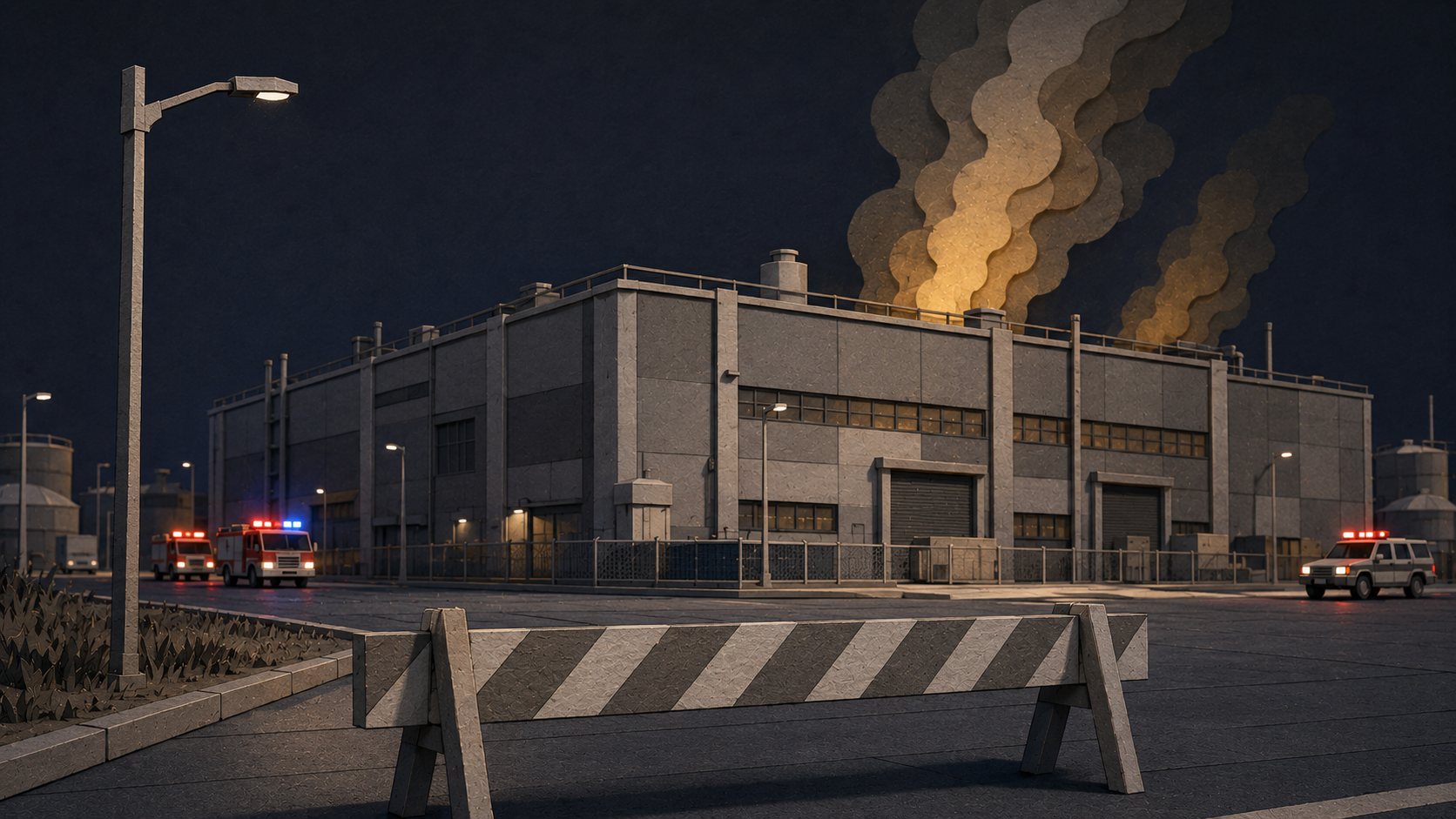
A stylized paper-craft interpretation of the emergency response, road closures and chemical plume that followed the 2024 Bio-Lab fire in Conyers, Georgia. (Original Tank Transport illustration)
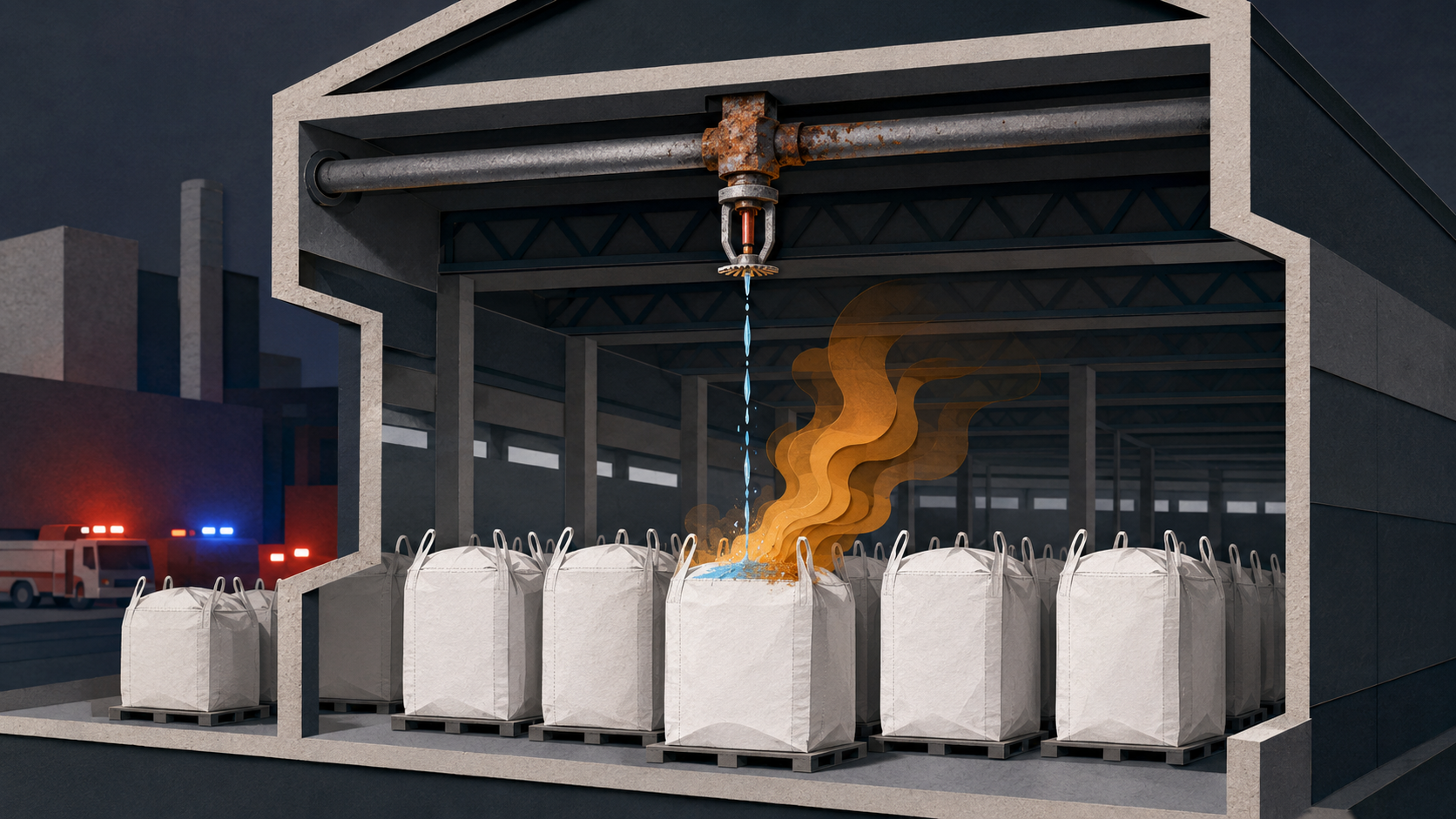
According to the U.S. Chemical Safety and Hazard Investigation Board’s final findings released July 21, the September 29, 2024, fires at KIK Consumer Products’ Bio-Lab facility in Conyers, Georgia, began after water from a corroded sprinkler-system component contacted reactive chemicals. Water contacted chlorinated isocyanurates, initiating decomposition reactions that generated heat, triggered additional sprinkler activation, and caused fires and toxic smoke containing chlorine, hydrogen chloride, bromine, and other substances.
The chemicals at issue were predominantly solid oxidizers stored in flexible intermediate bulk containers, commonly called super sacks—not liquid cargo in tank trailers. That distinction matters. The transport lesson lies at the handoff among shipper, carrier, consignee, and warehouse, where a properly documented load can enter a stationary facility with a very different and potentially deteriorating risk profile.

The Board organized its findings around five safety issues: operating equipment to failure, inadequate identification of storage hazards, weak risk management and oversight, incomplete industry guidance for pool-treatment chemicals, and insufficient regulatory coverage of reactive hazards.
A fire-protection system became the initiating hazard
Plant 12’s sprinkler system was supposed to limit a fire. Instead, the CSB concluded that a failed, corrosion-damaged component supplied the water that initiated the reaction.
Closed super sacks of chlorinated isocyanurates can naturally release chlorine fumes. In the warm, humid, and insufficiently ventilated warehouse, those fumes combined with moisture and condensed as corrosive hydrochloric acid droplets on metal surfaces. Construction personnel observed corroded sprinkler heads and prematurely rusted piping bolts within two months of TCCA storage beginning in November 2019, according to the 148-page CSB investigation report.
The warning pattern persisted. Inspections in 2021 and 2022 documented hundreds of corroded heads in the warehouse’s protected “bunker.” Bio-Lab replaced those heads with wax-coated, corrosion-resistant models but continued to use brass-finish heads elsewhere. After the company expanded oxidizer storage outside the bunker, a December 2023 inspection found 1,124 corroded sprinkler heads in those other areas.
The fire-protection system registered an abnormal condition on at least 60 of the 637 days from January 1, 2023, through the incident date. The CSB also identified 13 periods between March and September 2024 when the system was impaired for more than four hours; the longest lasted 44 hours. Investigators said the facility could not produce the notifications required by KIK’s corporate procedure for those impairments.
The Bio-Lab fire report rejected Hurricane Helene roof leakage as the likely initiating source. Documented roof leaks were in another part of the building near inert materials, rainfall had ended more than 36 hours before the reaction, and employees at the scene identified a sprinkler failure as the water source.
A protective system cannot remain a safeguard when its repeated failures become accepted as routine operating conditions.Inventory growth outran the warehouse’s original hazard profile.
Quantity was not a background detail. Documentation submitted during the 2019 permitting process anticipated average raw-material inventory of approximately 6.2 million pounds, including oxidizers. By September 2024, Plant 12 held nearly 14 million pounds of TCCA, NaDCC, NaDCC dihydrate and BCDMH—approximately 12.8 million pounds of Class 1 oxidizers and 1.2 million pounds of Class 2 oxidizers.
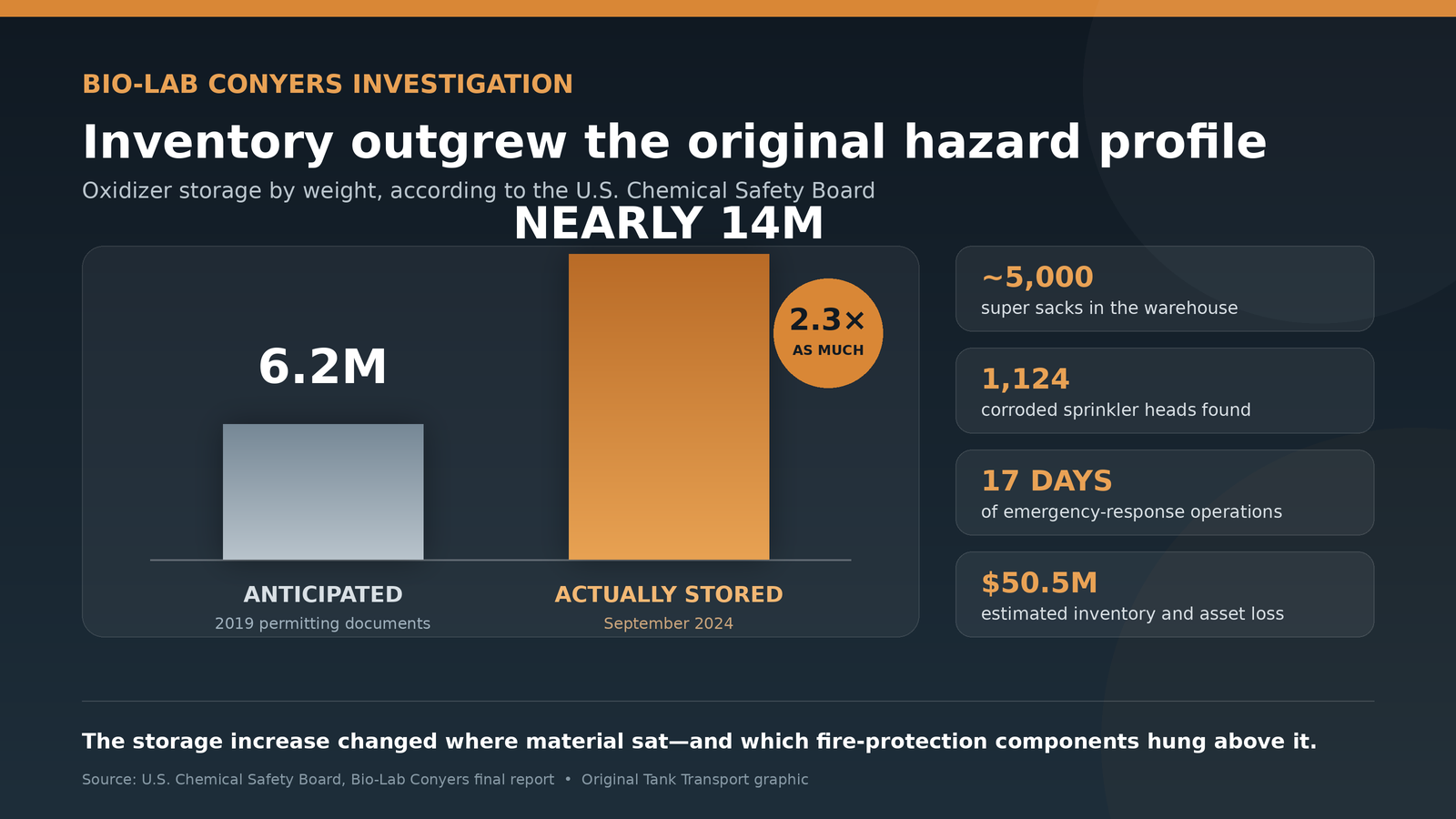
Plant 12 held nearly 14 million pounds of oxidizers by September 2024, compared with approximately 6.2 million pounds anticipated in 2019 permitting documents. (Source: U.S. Chemical Safety Board)
About 5,000 super sacks of chlorinated isocyanurates, each weighing between 2,205 and 2,805 pounds, were in the warehouse. Roughly 11 million pounds of oxidizers remained inside the bunker, while nearly 3 million pounds had spread into areas outside it. Bio-Lab management told the CSB that storage rose with seasonal demand and logistics and supply factors in the pool-products business.
That growth changed where product sat, what sprinkler components hung above it, and whether responders could reach a reacting sack. The CSB found that some storage configurations and pile arrangements obstructed access to the initial reaction. As heat activated more sprinklers, additional chemicals became wet, accelerating decomposition and eventually helping to overwhelm the building.
The Bio-Lab fire report’s central management lesson is therefore not simply “avoid excess inventory.” It is that every sustained increase in hazardous-material quantity, location or configuration should trigger a fresh review of building classification, fire protection, ventilation, segregation, aisle access, emergency planning and maximum allowable quantities.
Inventory growth can quietly turn a warehouse designed for one hazard profile into a materially different operation.The consequences were substantial even though the CSB reported no injuries at the site during the fire or extended response. The warehouse was destroyed; KIK estimated approximately $50.5 million in lost inventory and fixed assets. About 17,000 people were reportedly evacuated, a countywide shelter-in-place order affected approximately 90,000 residents, Interstate 20 closed overnight, and nightly two-mile shelter warnings continued during the 17-day emergency-response phase.
Why the findings matter to bulk carriers and logistics managers
The Bio-Lab fire report did not attribute the fire to a motor carrier, loading operation, or transportation packaging failure. Fleets should not be assigned a facility operator’s duty to engineer a warehouse or certify its sprinkler system.
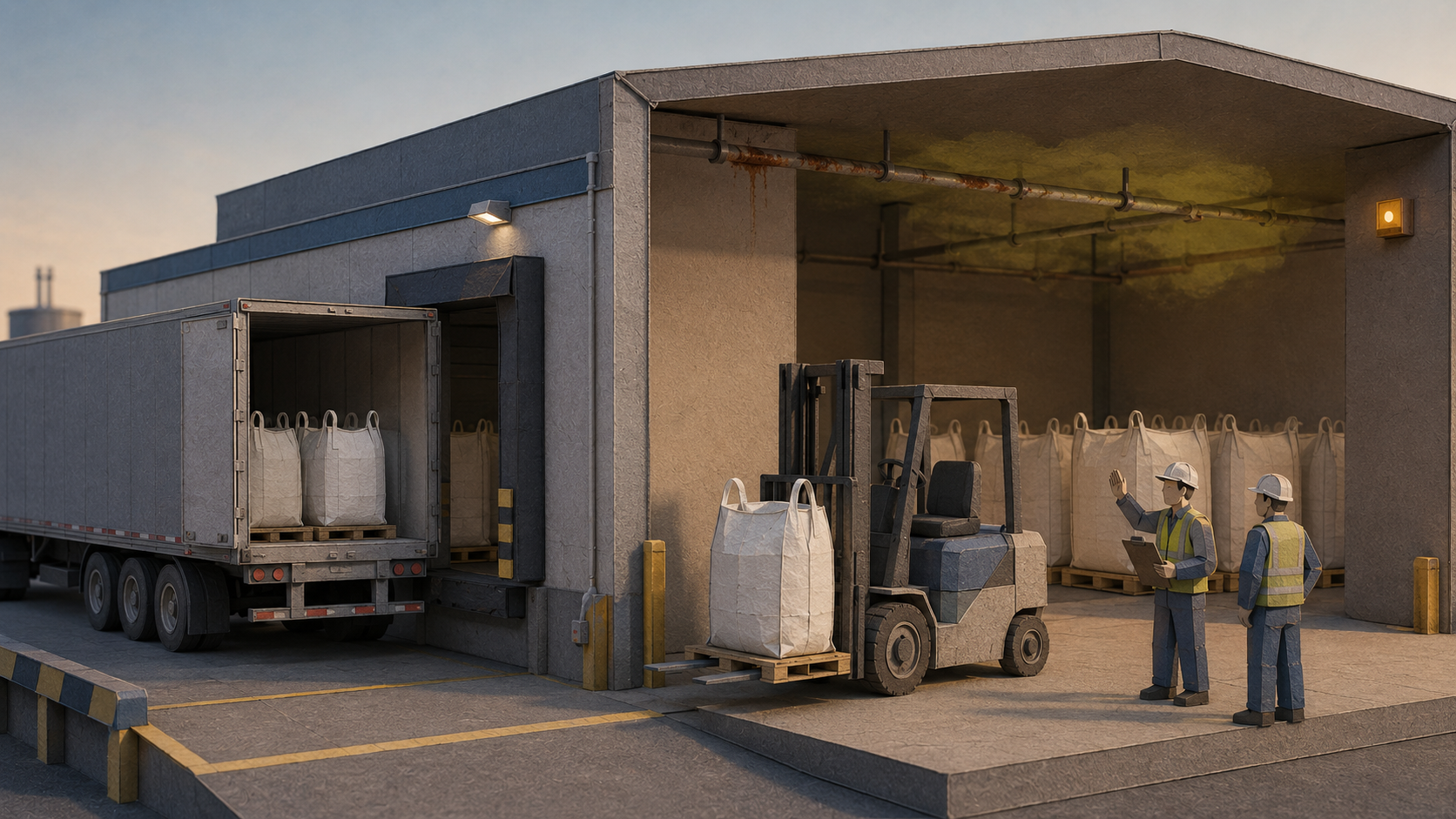
A stylized receiving-dock scene illustrates the report’s logistics lesson: visible storage hazards should trigger a stop-work and escalation response before unloading proceeds. (Original Tank Transport illustration)
Carriers nevertheless operate at the boundary where transport controls meet stationary-site controls. That makes the report relevant to the shared safety practices of chemical shippers and transporters, especially when a driver encounters a receiving location that does not match dispatch instructions, stages a load in an unexpected area, lacks an available emergency contact, or presents visible signs of leakage, off-gassing, heat, corrosion, or incompatible water exposure.
A practical fleet response is a clear stop-work and escalation protocol. Drivers and dispatchers should know whom to contact before unloading or leaving freight when observed conditions conflict with shipping papers, product-handling instructions, or the customer’s stated receiving plan. That is an operational safeguard, not a claim that drivers must perform code inspections.
Accurate hazard communication remains the foundation of transport. Tank Transport’s hazardous-material shipping guide explains the classification and documentation layers, while recurring hazmat training equips employees with the authority and knowledge to recognize discrepancies and escalate them before proceeding.
The sharper logistics finding concerns third-party storage. After the incident, remaining oxidizers were moved to a third-party warehouse in Texas. During a February 2025 visit, CSB investigators reported a strong smell of chlorine, visible corrosion on fire-protection piping, and rusty drip marks on the floor and on the super sacks below. One of the Board’s new recommendations, therefore, directs KIK to assess third-party facilities that manufacture or store its bulk pool-treatment chemicals and to correct NFPA 400 and NFPA 13 deficiencies.
For shippers, consignees and logistics providers, that recommendation moves warehouse qualification beyond available space, rate and location. The questions must also include material-specific construction, ventilation, corrosion resistance, inventory limits, segregation, emergency access and evidence that deficiencies are closed rather than normalized.
A regulatory gap shifts responsibility but does not reduce risk
The Bio-Lab fire report also identifies an important boundary in federal chemical regulation. The chlorinated isocyanurates involved are not covered by OSHA’s Process Safety Management standard or EPA’s Risk Management Program rule, even though their decomposition can generate toxic gases that are regulated in other circumstances.
The CSB, which investigates and recommends but does not issue fines or regulations, reiterated calls for OSHA and EPA to broaden coverage of catastrophic reactive hazards. It also issued new recommendations for KIK to establish corporate storage standards, assess third-party facilities and audit implementation, and for the National Fire Protection Association to strengthen NFPA 400’s treatment of multiple hazards and metal corrosion.
Those recommendations are not yet new legal requirements. As of July 27, the KIK and NFPA recommendations on the CSB’s Bio-Lab investigation page remained open while awaiting responses or evaluation. Separately, OSHA proposed $61,473 in penalties in April 2025 for four serious and two other-than-serious violations; OSHA cautions that proposed penalties and classifications may not reflect the final case status.
Bio-Lab said it cooperated with the investigation, completed the emergency response and site cleanup, and was reviewing the final report and its recommendations. KIK ended storage and manufacturing operations at the affected facility in May 2025, although nearby Conyers distribution centers continued to operate.
The gap between transportation rules, workplace rules, fire codes, and federal process-safety programs can create a false sense that another party has evaluated the entire chain. The Bio-Lab case demonstrates the opposite. Compliance layers overlap imperfectly, so a robust management system must identify the hazards left between them. The same principle applies when evaluating incidents such as the Valero Port Arthur refinery blast: an emergency’s transportation effects may be visible, but the underlying weaknesses often lie within stationary operations.
Bio-Lab chemical-storage Key Developments
- Recommendation responses: Watch for KIK and NFPA submissions, as well as the CSB’s evaluation of whether proposed corrective actions meet the seven new recommendations.
- Federal rulemaking: Any OSHA or EPA action on reactive-hazard coverage could expand formal process-safety duties beyond the chemicals currently listed in PSM and RMP rules.
- Third-party storage: KIK’s assessment of outside manufacturing and warehouse sites will test whether the Conyers lessons spread across the outsourced supply chain.
- Code revisions: Future NFPA 400 language may more explicitly require users to evaluate every applicable hazard classification and address pool-chemical corrosion of metal fire-protection components.
- Carrier controls: Chemical and dry-bulk fleets should review stop-work, escalation, and receiving-site discrepancy procedures without implying that drivers are responsible for facility engineering audits.