- PHMSA clarified that no general 40,000-pound limit applies to the organic-peroxide portable-tank shipment described in a recent inquiry.
- The agency also confirmed that the regulations contain no 925-gallon caustic-soda residue limit, while reaffirming hazardous-material transportation requirements.
- Product-specific restrictions, tank authorization and filling limits still govern the shipment.
PHMSA has clarified chemical tank rules in an October 6, 2026, interpretation addressing two claimed quantity limits: a 40,000-pound ceiling for an organic peroxide in UN portable tanks and a 925-gallon limit on caustic-soda residue. The agency said the Hazardous Materials Regulations (HMR) contain neither general restriction described in the request.
The Pipeline and Hazardous Materials Safety Administration’s interpretation 26-0062 responds to questions from FORTREX about outbound chemical loads and residual product, often called a heel, remaining after unloading.
For chemical carriers, ISO-tank operators and tank-cleaning facilities, the distinction matters when preparing a load or arranging a return movement. The letter clarifies existing requirements; it does not establish a new loading allowance or exempt tanks simply because most of their contents have been delivered.


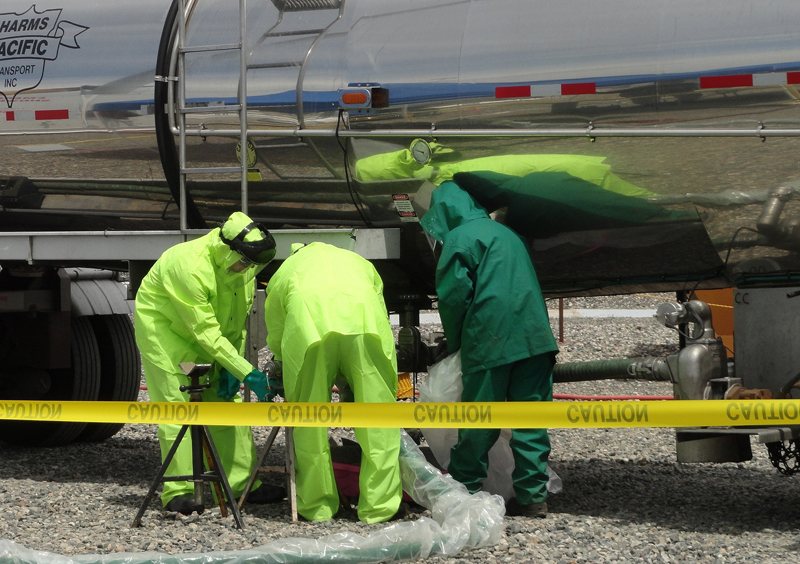
Workers handle a caustic-soda delivery during cleanup operations at the Hanford Site in Washington in this 2012 file photo. (Photo: U.S. Department of Energy; public domain)
Organic-Peroxide Loads Still Have Filling and Product Restrictions
FORTREX asked whether a 40,000-pound maximum applies to UN3119, an organic peroxide Type F liquid requiring temperature control, in UN portable tanks, including ISO tank containers. The request specifically concerned a peroxyacetic acid formulation.
PHMSA answered that no general maximum quantity limit of that kind exists. It immediately pointed to a continuing restriction: the degree of filling cannot exceed 90% at 15 degrees Celsius, or 59 degrees Fahrenheit, under 49 CFR 173.225(h)(3)(xi).
That percentage is a filling ceiling for the portable tanks addressed by the provision. It does not establish a universal payload allowance, authorize every formulation, or remove the need to match the chemical to an approved tank.
The organic-peroxide packaging requirements in Section 173.225 identify authorized formulations and applicable conditions, including temperature controls. Type F formulations outside the Organic Peroxide Portable Tank Table require approval from PHMSA’s Associate Administrator before transportation in portable tanks.
Product-specific quantity restrictions also exist. The table includes a 2,000-kilogram maximum per portable tank for a listed solid dicumyl peroxide formulation under UN3110. That is a different material from the UN3119 liquid in the inquiry, but it shows why the interpretation should not be summarized as eliminating all organic-peroxide weight limits.
Separate portable-tank use requirements continue to govern tank authorization, external inspection before filling, and maximum allowable gross mass shown on the tank’s identification plate. Applicable partial-fill restrictions also depend on the tank’s design and the liquid’s properties. A shipment must satisfy all relevant conditions, even when no general 40,000-pound commodity limit applies.
Caustic-Soda Residue Remains Subject to Hazmat Requirements

Interior cleaning is part of preparing tanks and vessels for subsequent service. (Photo: Hammelmann, “Tank cleaning”/Wikimedia Commons; CC BY-SA 3.0)
The second question concerned sodium hydroxide solution, commonly called caustic soda, identified as UN1824, Class 8, at concentrations of 32% to 50%. FORTREX asked whether the HMR limit its heel to 925 gallons, or another specific amount, in cargo tanks or portable tanks.
PHMSA said the HMR do not establish the claimed residue-volume limit. The agency then cited Section 173.29 on empty packagings: unless an applicable exception provides otherwise, a packaging containing hazardous residue must be offered and transported under the requirements that applied when it held a greater quantity.
Residue also has a defined meaning. Under 49 CFR 171.8, the term covers hazardous material left in a packaging after unloading to the maximum extent practicable, before the packaging is refilled or both cleaned of hazardous material and purged of hazardous vapors. Calling a partially delivered load a heel does not, by itself, establish that it meets that definition.
A low remaining volume therefore does not automatically remove shipping-paper, marking, or placarding obligations. Section 173.29 contains exceptions, including provisions for packagings sufficiently cleaned and purged to eliminate potential hazards, but their conditions must be met.
Operators should also distinguish tank returns from the separate relief for qualifying residue IBC movements. Intermediate bulk containers are a different packaging category. Their specific exception does not become a general exemption for ISO tanks or highway tank trailers.
Apply the Clarification Before Loading and Dispatch
A reach stacker lifts a tank container from a truck at the Port of Braunschweig, Germany. (Photo: TeWeBs/Wikimedia Commons; CC BY-SA 4.0)
The practical value of the interpretation is a clearer basis for reviewing loading instructions and return procedures. If a procedure cites either disputed number as a general federal limit, the shipper and carrier should identify its actual source before revising the procedure. The letter does not determine the origin or validity of any separate customer, facility, or equipment restriction.
For outbound organic-peroxide shipments, the review should cover the formulation’s authorization, tank specification, applicable approval conditions, filling percentage, and temperature requirements. For a caustic-soda return, it should establish the remaining material’s status and the requirements governing that movement.
Those decisions carry through to the shipping-paper and placard checks that fleets face roadside. Dispatch instructions should reflect the tank’s actual condition, rather than treating every post-delivery trip as an unregulated empty movement.
When a return involves cleaning or storage, confirm product acceptance and service arrangements with the receiving facility. Tank Transport’s coverage of ISO-tank depot operations explains why coordinating the tank’s cargo history, cleaning needs, and next movement matters.
Chemical Tank Rules: Key Developments
- PHMSA’s October 6 letter clarifies existing requirements rather than creating a new rule or exemption.
- No general 40,000-pound limit applies as described in the UN3119 portable-tank inquiry; filling and formulation restrictions remain.
- No general 925-gallon caustic-soda heel limit applies as described, but hazardous residue generally remains regulated.
- Portable tanks, highway cargo tanks, and IBCs must be evaluated under the provisions applicable to each packaging type.