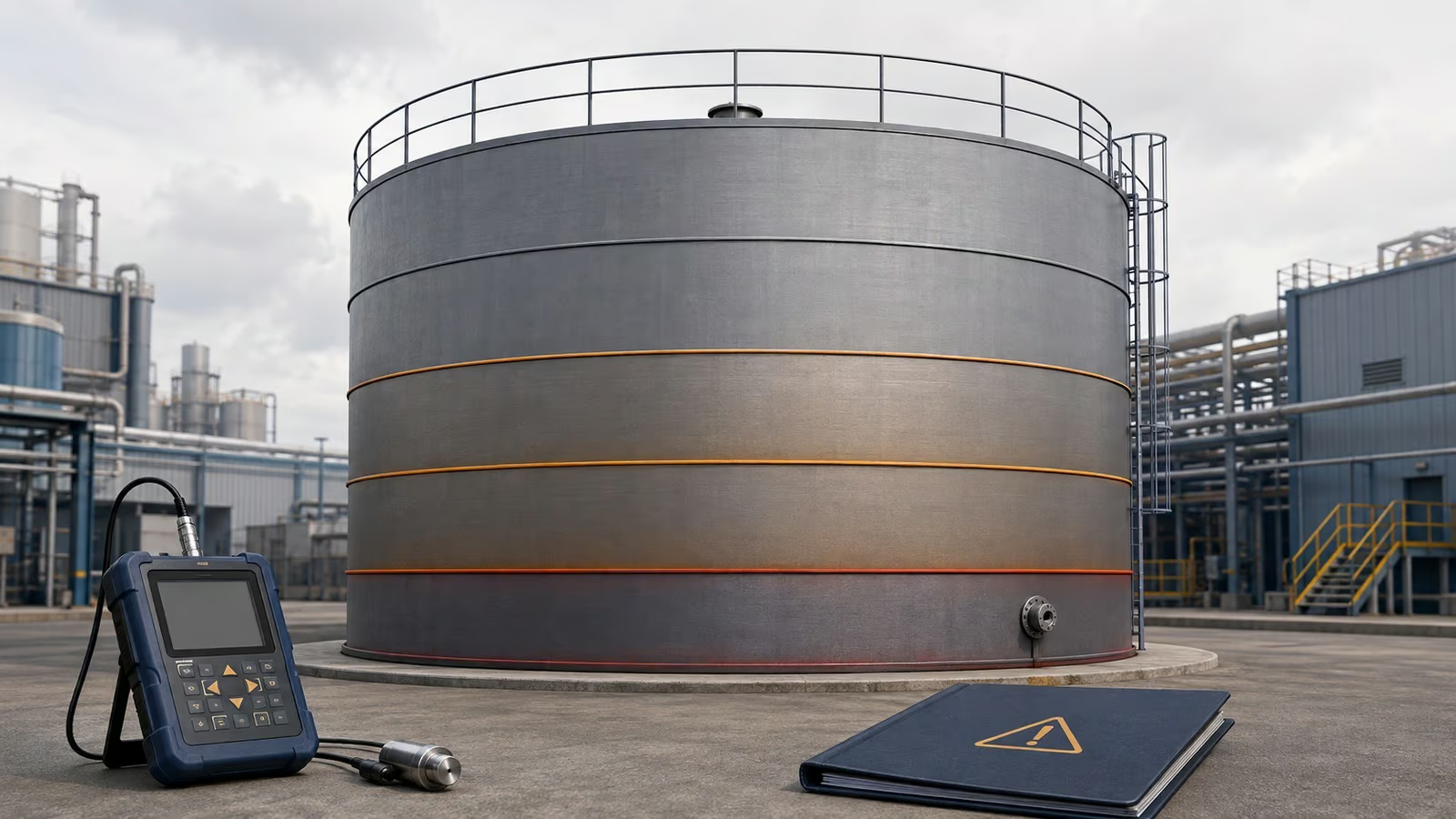
- A July 2025 inspection report said G Tank was “not fit for continued service” unless its deficient shell condition was corrected.
- CSB says two later inspections still found under-thickness areas, yet the tank was not repaired, internally inspected, removed from service, or formally derated before it failed.
- The failure mechanism, root cause, and any regulatory violations remain under investigation; the 90-percent liquid level is a confirmed condition, not a proven cause.
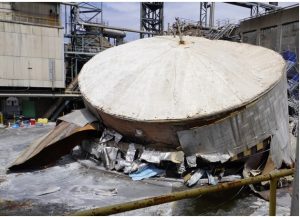
G Tank after its May 26, 2026 catastrophic failure at the Nippon Dynawave mill in Longview, Washington. CSB has not yet determined the failure mechanism. (Photo: U.S. Chemical Safety Board)
The Nippon Dynawave tank warning came nearly 10 months before the fatal failure. A contractor inspecting the white-liquor storage tank at the company’s Longview, Washington, pulp mill concluded in July 2025 that the vessel was “not fit for continued service” unless the identified condition was corrected, according to a U.S. Chemical Safety Board investigation update.
The 1.2-million-gallon atmospheric tank, known as G Tank, remained in normal service. CSB says the company did not internally inspect or repair its shell, remove it from service, or reduce its allowable fill level through a formal engineering derating. On May 26, 2026, the tank catastrophically failed, releasing approximately 900,000 gallons of caustic white liquor at about 200 degrees Fahrenheit. Eleven employees were killed, and three were seriously injured. Five other employees and one firefighter were also injured without requiring inpatient hospitalization.
This was a stationary process-storage tank, not a highway cargo tank governed by the rules discussed in PHMSA’s MC 331 inspection clarifications. But the case belongs squarely in the conversation about the safety of bulk transportation. Storage tanks are critical nodes in terminal and plant logistics, and carriers depend on the people who operate them to translate inspection findings into defensible operating decisions.


The central fact is not merely that wall thinning was measured. It is that repeated data indicating a tank was outside its calculated limit did not result in a repair, shutdown, or engineered reduction in service before the failure. CSB has not yet determined the failure mechanism, root cause, or final responsibility, so that decision chain must not be confused with a final causal finding.
Three inspections documented an unacceptable condition.
G Tank was built in 1987 to the seventh edition of API 650. Its carbon-steel shell consisted of 40 plates arranged in five courses, with the lowest courses carrying the greatest liquid head. The vessel had undergone shell repairs in 1999, 2002, 2006, 2011, and 2017, according to CSB’s detailed preliminary update.
In July 2025, Applied Technical Services performed an external visual examination and ultrasonic thickness measurements. CSB says the inspection found significant thinning in the lower shell, including areas below the contractor’s calculated minimum safe thickness. The contractor recommended an internal inspection and repairs to the first three shell courses, stating that there was a “high likelihood/consequence of failure.”
External thickness checks in October 2025 and February 2026 again found large areas below the calculated minimum. Reinspection documented the condition; it did not restore the metal or establish a new operating limit.
| Date | Confirmed finding or event | Operating status |
|---|---|---|
| July 2025 | Lower-shell areas measured below calculated minimum safe thickness; contractor recommended internal inspection and repair. | Tank remained in service. |
| October 2025 | Additional external measurements again identified extensive under-thickness areas. | No internal inspection or shell repair reported by CSB. |
| February 2026 | A third external inspection continued to find shell areas below the calculated minimum. | No removal from service or formal derating reported by CSB. |
| May 26, 1:55–6:22 a.m. | A process upset reduced and then stopped white-liquor outflow while reduced inflow continued; the level reached about 90 percent. | The significance of the operating level remains under investigation. |
| May 26, 7:09 a.m. | G Tank catastrophically failed, releasing approximately 900,000 gallons of hot white liquor. | CSB investigation remains open. |
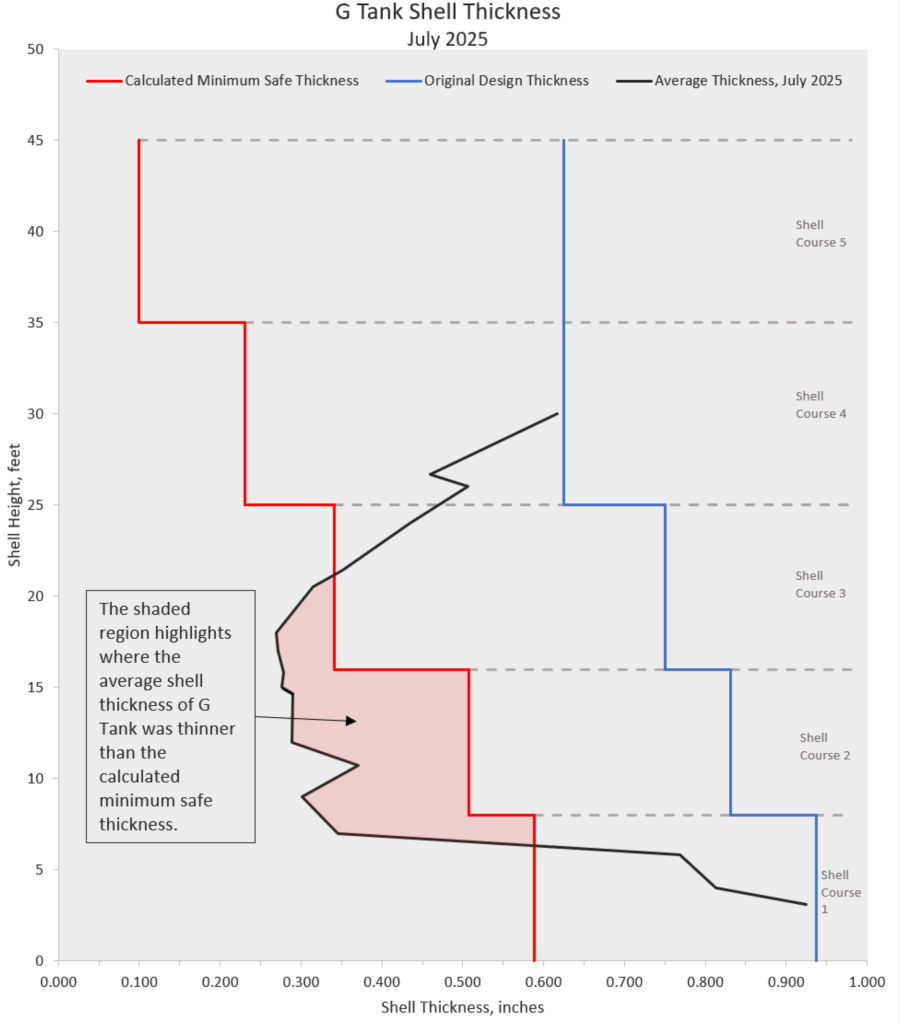
Average July 2025 ultrasonic measurements for G Tank compared with original design thickness and the calculated minimum safe thickness. The shaded region identifies measurements below the calculated minimum. (Graphic: U.S. Chemical Safety Board)
Taken together, the sequence shows a condition repeatedly measured below the contractor’s threshold. At the same time, CSB says the tank remained in normal service without any of the four disposition actions identified in its update.
Finding the defect was only the first half of the safeguard; the operating decision was the other half.
In an August 28 statement, Nippon Dynawave said the preliminary CSB update omitted important facts and context about the company’s actions and the timeline. The company emphasized that the update was not a final determination of the facts or the cause, and said it would continue to cooperate. The statement did not identify the omissions it alleged and said the company would not comment on individual findings or documents while the investigation remains ongoing.
Minimum safe thickness is an operating limit

The Nippon Dynawave mill site in Longview, Washington, on May 28, 2026, two days after G Tank failed and released approximately 900,000 gallons of hot white liquor. The failure mechanism remains under investigation. (U.S. National Guard photo by Sgt. 1st Class Adeline Witherspoon)
The phrase “minimum safe thickness” is not a generic description of a tank looking old. It is an engineering limit calculated based on factors such as shell material, tank dimensions, the stored liquid, and the pressure exerted by the liquid head. Lower shell courses generally require more strength because they support more of the liquid column.
API 653 covers the in-service inspection, repair, alteration, and reconstruction of aboveground steel tanks. CSB says the contractor used API 653 to evaluate G Tank, which had originally been constructed to API 650. The distinction matters: API 650 governed the tank’s construction basis, while API 653 supplied the framework for judging its condition in service.
When measured metal falls below the applicable minimum, the practical choices are not limited to “keep running” or “replace everything.” A qualified evaluation may support repair, replacement, removal from service, or a lower maximum fill height. That last option—derating—requires an engineered new limit and controls that keep the tank within it. Merely operating below full capacity is not the same thing.
A 90-percent level is a confirmed condition under investigation—not a confirmed cause of the tank failure.The measured wall loss also gives operators a reason to revisit Tank Transport’s broader guide to corrosion protection in carbon-steel tanks. That earlier article supplies general maintenance context; it is not evidence that corrosion caused G Tank to fail. Thickness measurements can identify wall loss, but the safety value comes from a management system that assigns authority, sets a deadline, and verifies the corrective action.
If Washington’s process-safety-management rule covers a process, then storage tanks fall under mechanical integrity, and deficiencies outside acceptable limits must be corrected before further use or addressed safely and promptly with measures that ensure safe operation. The public record does not yet establish whether that rule covered G Tank or whether any particular requirement was violated. The state workplace-safety investigation remains open.
Location and emergency response are part of the investigation

Washington National Guard personnel decontaminate search-and-recovery teams at the Nippon Dynawave mill on May 28, 2026, following the release of caustic white liquor from G Tank. (U.S. National Guard photo by Sgt. 1st Class Adeline Witherspoon)
CSB’s timeline begins with a process upset in a nearby digestor at about 1:55 a.m. White liquor flow from the G Tank slowed and stopped by 4:08 a.m., while reduced inflow from the recausticizing area continued. By 6:22 a.m., the tank was approximately 90 percent full. Just before the normal 7 a.m. shift turnover, employees gathered in mechanical and electrical shops beside the tank courtyard.
When the shell failed at 7:09 a.m., a massive liquid wave crossed the courtyard, crushed vehicles, destroyed a roll-up door and one wall, and entered occupied buildings. G Tank had no secondary containment. CSB has not said that the absence violated a specific rule. Still, the physical result demonstrates why inventory, drainage, barriers, and occupied-building placement must be evaluated together rather than as separate checklist items.
The initial radio call for medical help did not identify the material as white liquor. One volunteer responder entered the liquid believing it was water and suffered serious chemical burns. That communication failure links tank integrity to emergency planning: responders need the product identity, any corrosive or thermal hazards, the safe approach direction, and decontamination needs in the first message.
The event and failure mechanism differ from the Bio-Lab chemical-storage disaster. The narrower editorial comparison is the systems question each case poses to operators: how inspection or storage warnings are escalated across maintenance, operations, and emergency planning. That comparison is not evidence of a common cause.
What bulk operators should examine now?
Make the disposition explicit. An inspection report that exceeds a fitness limit should identify who can order a shutdown, who can approve repair or derating, and what written evidence is required before service is returned. A second measurement campaign should never be mistaken for corrective work.
Control interim operation as tightly as permanent operation. If qualified engineering supports temporary service, the reduced limit, alarm settings, inspection frequency, duration, and stop criteria should be documented and independently verified. Operators also need a trigger for escalating delayed capital work.
Connect tank condition to people and product movement. Mechanical-integrity reviews should include nearby occupied spaces, vehicle staging, transfer routes, drains, and first-responder access. Tank-truck drivers are not responsible for assessing a plant’s shell calculations, but they need a credible stop-work and notification channel when loading conditions, alarms, or leaks are abnormal.
Review the whole tank population. Washington Labor & Industries responded to the Longview failure by opening inspections at the state’s other kraft mills and a targeted program for seven non-kraft pulp and paper mills. Those reviews include tank maintenance, inspection and testing records, open repair items, operating procedures, spill history, injuries and near misses.
Washington Ecology separately issued initial determinations for 35 environmental violations, largely tied to the release and response. Those findings are not final penalties, and Ecology has said it did not regulate G Tank’s structural integrity. CSB, Labor & Industries, and other authorities are conducting separate inquiries with different mandates. CSB is nonregulatory and cannot issue citations or fines.
Nippon Dynawave Tank Key Developments
- CSB cause: Investigators must still determine the shell’s failure mechanism, contributing causes, and the roles of inspection, repair, management-of-change, hazard-evaluation, and emergency-response decisions.
- State workplace findings: Washington Labor & Industries has until November 22, 2026, to complete its workplace safety investigation or issue citations within the statutory window.
- Broader tank reviews: Washington’s inspections at other pulp and paper mills may show whether delayed tank repairs or weak escalation systems are isolated or more widespread.
- Company response: Watch for Nippon Dynawave to identify the facts and timeline context it says the CSB update omitted.
- Final recommendations: CSB’s final report is expected to address mechanical integrity, operating decisions, and emergency protection, but no publication date or conclusions have been announced.
Sources and Further Reading
The CSB investigation remains open. These records provide the inspection evidence, regulatory context, company response, and state follow-up underlying this Drilldown.
- CSB investigation update: The agency’s official summary of the inspection findings, continued operation, release consequences, and unresolved investigation.
- CSB detailed technical update: The primary record for G Tank’s history, ultrasonic thickness measurements, process timeline, worker locations, and emergency response.
- CSB investigation docket: The continuing case page for future investigation documents, findings, and final recommendations.
- Washington Labor & Industries investigation status: Tracks the state workplace-safety investigation and explains the roles of the agencies responding to the failure.
- Washington pulp-and-paper tank inspection initiative: Describes the state’s broader review of tank maintenance, open repairs, operating procedures, and mechanical-integrity records at other mills.
- Washington Ecology enforcement notice: Lists the agency’s initial environmental findings related to the release and response; these are not final penalties or structural-cause findings.
- Washington mechanical integrity requirements: The state process safety provisions for storage tanks and other equipment in covered processes. The public record has not established whether these requirements applied to G Tank or were violated.
- API 653 overview: The American Petroleum Institute’s description of the standard used for in-service inspection, repair, alteration, and reconstruction of aboveground steel tanks.
- Nippon Dynawave response: The company’s August 28 statement saying the preliminary CSB update omitted important facts and context while declining to comment on individual findings during the open investigation.