- Canadian National would gain new Midwest access and Norfolk Southern’s interests in two major terminal railroads, but only if the merger wins approval and closes.
- A July 27 filing expands proposed gateway pricing to qualifying bulk unit trains while continuing to exclude traffic with toxic- or poison-inhalation hazards.
- New service and rate remedies offer measurable protections for some shippers, although contract traffic, unit trains and other categories retain important limitations.
A binding agreement with Canadian National and a 407-page supplemental filing have materially changed the competition case surrounding the proposed Union Pacific–Norfolk Southern merger. The proposal is no longer supported only by promises of faster coast-to-coast trains. It now includes specific terminal ownership transfers, new CN operating rights, a larger gateway pricing program, and measurable service remedies.
Those additions matter to chemical producers, petroleum and agricultural shippers, transload terminals, railcar users and the tank-truck fleets that handle first- and final-mile bulk movements. They could affect which railroad reaches a facility, how a cross-country move is priced, what remedy exists during a service failure and whether some long-haul traffic stays on the highway or shifts to rail.
They do not settle the case. The Surface Transportation Board accepted the revised application in May but held the proceeding in abeyance because competition, shipper access, service assurance, market share, and public benefit claims remained underdeveloped. Union Pacific and Norfolk Southern submitted their final requested supplement July 27. As of July 28, the Board was still reviewing the supplement and had not ruled that it satisfied the agency’s concerns.

Union Pacific and Norfolk Southern locomotives appear together in an official image issued for coverage of the proposed transcontinental railroad. The transaction remains subject to Surface Transportation Board approval. (Courtesy Union Pacific and Norfolk Southern)
CN Settlement Rewrites Two Critical Midwest Gateways
The July 22 CN settlement is the clearest structural change. CN agreed not to oppose the merger after Union Pacific committed to a package that would broaden CN’s reach through Illinois, St. Louis and Kansas City.
If the merger is approved and completed, CN would acquire Norfolk Southern’s ownership interests in the Terminal Railroad Association of St. Louis and Kansas City Terminal Railway. CN would also receive part of Union Pacific’s interest in the Peoria & Pekin Union Railway, leaving CN and the combined UP–NS system each with a 50% stake.
The operating package is more important than the ownership percentages alone. The agreement provides CN overhead trackage rights between Tuscola and East St. Louis, plus haulage and potential trackage rights between St. Louis and Kansas City. CN would lease all or part of Union Pacific’s Neff Yard in Kansas City, with an option to purchase it. The memorandum contemplates rights for all commodities and train types on the St. Louis–Kansas City corridor, including unit trains, and a 99-year term.
CN would also become Union Pacific’s preferred replacement carrier where a shipper would lose a Class I option—moving from two railroads to one or from three to two—if the Board requires access, finds CN suitable and determines that service is commercially and operationally feasible.
CN’s agreement removes one major railroad opponent, but every new ownership transfer and operating right remains contingent on regulatory approval and implementation.This is a meaningful answer to the Board’s concern that the combined railroad could hold 50% or more of key shared facilities. It is not universal open access. Individual remedies can still depend on track rights, physical connections, economics, and separate Board authorization. The settlement narrows one competition dispute; it does not address the broader objections from chemical shippers, other railroads, or customers already captive to a single carrier.
Bulk Unit Trains Enter the Pricing Program—With a Hazmat Boundary
The July 27 supplement also expands Committed Gateway Pricing, or CGP. The original proposal covered a limited set of manifest carload traffic moving through Chicago, St. Louis, Memphis, or New Orleans between facilities tied to the merged railroad and facilities tied to BNSF or CSX.
The new version broadens eligibility to competitively served BNSF and CSX origins and destinations and adds bulk unit trains. For this program, a bulk unit train consists of at least 67 connected railcars, tendered by a single entity from a single origin to a single destination, in non-manifest service. The route and facilities must be capable of handling that service.
Using 2024 traffic, the applicants calculate that the changes increase CGP-eligible traffic from 133,890 to 257,971 carloads. They estimate 41,477 bulk-unit carloads would become eligible and that traffic receiving an immediate pricing benefit would increase from 35,729 to 103,676 carloads. CGP rates would be capped at the 70th percentile of comparable UP–NS rates.
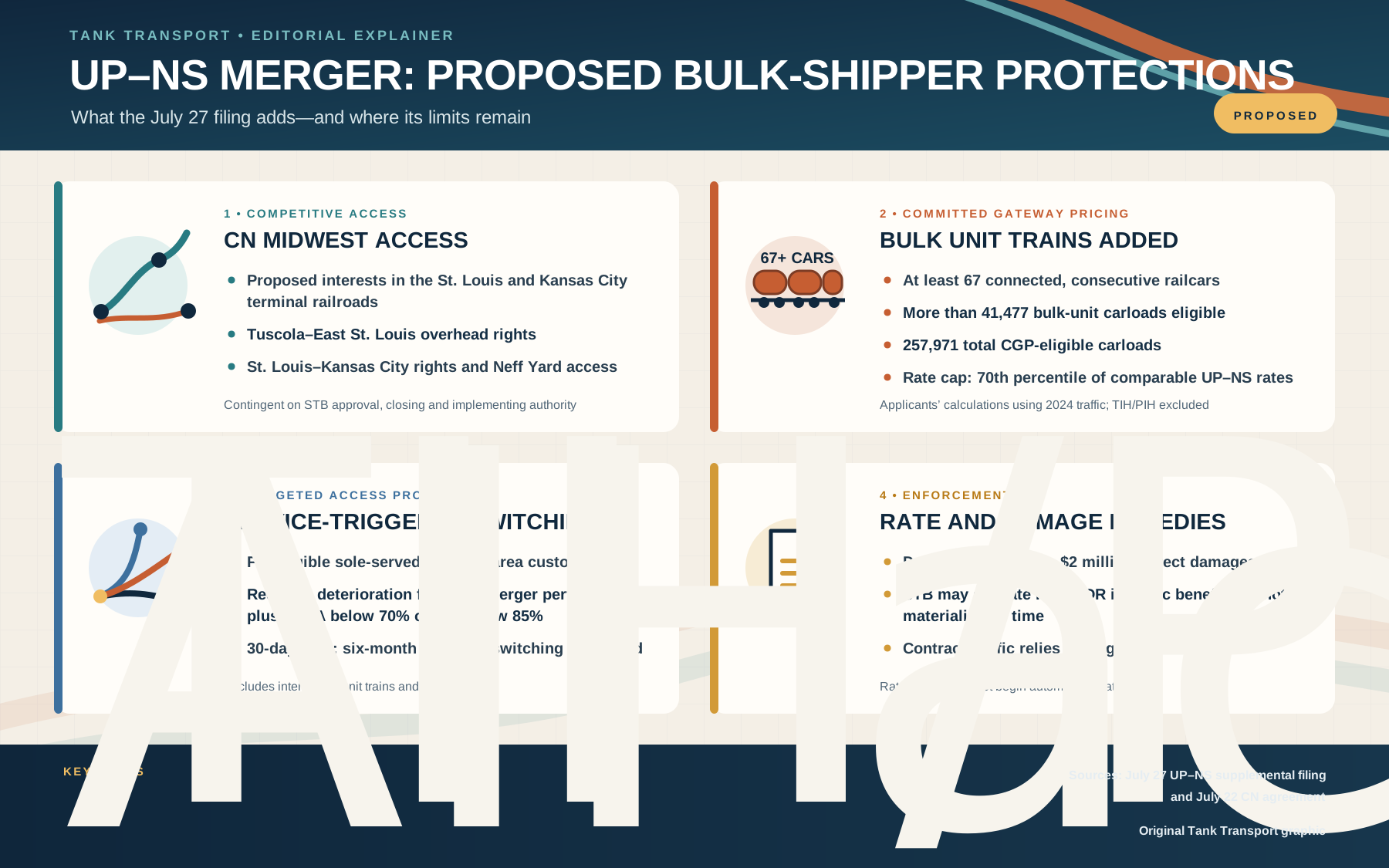
The July 27 filing expands pricing access but applies different limits to TIH/PIH, unit-train and contract traffic. (Graphic: Tank Transport; sources: UP–NS supplemental filing and CN)
That is potentially relevant to high-volume movements of grain, coal, sand, stone and some liquid-bulk commodities. It could also change the economics around rail-to-truck terminals, much as established dry-bulk fleets use rail access and transloading to combine long-haul rail efficiency with local truck delivery.
However, “bulk” does not mean every tank-car movement is covered. The filing continues to exclude toxic-inhalation-hazard and poison-inhalation-hazard materials from CGP. The applicants argue that allowing another railroad to market those movements over UP–NS lines without its concurrence could complicate safety controls and that a price cap could encourage additional movement of the materials. Intermodal, finished vehicles, and several specialized categories also remain outside the program.
For chemical logistics, that distinction is central. Non-TIH liquid-bulk unit trains may qualify when the lane and facilities meet the rules; TIH/PIH traffic would not. CGP is therefore a pricing and access mechanism for defined traffic, not a general right for every chemical or petroleum shipper to choose another railroad.
Service Remedies Protect Some Shippers, Not Every Movement
The applicants’ new Targeted Access Program is designed for merger-integration failures. A sole-served customer in a terminal area could seek expedited reciprocal switching when service falls below its pre-merger performance and also falls below either of two thresholds: 70% on the original-estimated-time-of-arrival measure or 85% on industry spot-and-pull performance.
The railroad would have 30 days to cure the deterioration or to establish an affirmative defense, such as an extraordinary weather event, a natural disaster, or an unusual traffic surge. If an arbitrator orders switching, the alternative access would last six months.
The measurable triggers are stronger than a general promise of “reasonable service.” Yet the program applies to common-carrier carload traffic and excludes unit trains, intermodal moves, and traffic moving under contract. That creates an unusual split for bulk shippers: qualifying unit trains can now receive CGP pricing, but unit trains are excluded from the proposed service-triggered switching remedy because the filing states that the selected performance metrics do not align with their operating model.
A separate damages program would cover direct damages up to $2 million for eligible common-carrier traffic. Contract shippers would rely on the remedies negotiated in their agreements. A proposed Rate ADR Program could also be activated if the Board later determines that promised public benefits are not materializing on time. Still, it would not automatically begin at closing and would exclude contract traffic and exempt commodities unless an exemption were partially revoked.
The STB warned that the consequences of past mergers “cannot be ignored, assumed away, or overlooked based on vague intentions or promises.”That warning explains why details such as thresholds, exclusions, cure periods and enforcement matter. A safeguard is only useful to a bulk shipper if its commodity, rate structure, facility and service pattern fall within the program.
What the Merger Could Mean for Tank Trucks and Transloads

A Coal City Cob terminal illustrates how rail-to-truck transfer supports regional bulk delivery. The facility is not connected to the proposed merger. (File photo courtesy Heniff/Coal City Cob)
Union Pacific and Norfolk Southern project that single-line service could divert approximately 2.1 million annual truckloads to rail and save shippers $3.5 billion a year. The STB has not accepted those forecasts as established outcomes. Its May decision noted that previous major-merger truck-diversion goals have fallen short and required the applicants to explain competitive responses, capacity needs, shipper investment and the timing of claimed benefits. Tank Transport’s earlier look at CPKC’s competitive challenge to trucking shows why merger forecasts must be separated from actual modal conversion.
Tank fleets should not read the 2.1-million figure as a forecast for lost tank-truck loads. Much of the modeled diversion is long-haul intermodal freight, and many chemicals are tied to dedicated rail infrastructure, specialized tank cars, transload points, or plant processes that cannot be shifted casually between modes. The competition between long-haul trucking and rail also changes by commodity, distance, service reliability, and the cost of handling the first and final miles.
The more defensible conclusion for Tank Transport readers is that the merger could change network design. Better single-line rail service could strengthen high-volume rail linehaul while increasing the value of tank-truck drayage, regional delivery and transloading at the ends of the trip. Conversely, an integration failure, car shortage or gateway delay could create short-notice demand for truck capacity—but only where equipment, product compatibility, permits and loading infrastructure make substitution possible.
The stakes are especially high for chemicals. The American Chemistry Council reports that Class I railroads originated 2.2 million chemical carloads in 2024 and earned $13.3 billion from chemical traffic. ACC remains opposed to the merger and argues that chemical producers need more rail-to-rail competition, not behavioral promises. Its position is advocacy, but the traffic data show why terminal access, switching and service remedies are not secondary issues for bulk logistics.
The proposed combination is more developed than it was a week ago. If approved and implemented, CN’s agreement would create tangible access to the Midwest, while the July 27 filing addresses several Board questions with numbers and enforceable mechanisms. Whether those measures genuinely enhance competition—and whether their exclusions leave important bulk shippers exposed—now becomes the center of the STB review.
Norfolk Southern Merger: UP–NS Review Key Developments
- Union Pacific and Norfolk Southern completed the requested supplemental filing July 27, but the STB had not yet lifted the proceeding’s abeyance or found the new package sufficient as of July 28.
- CN’s terminal interests, Midwest rights and withdrawal of opposition are contingent on STB approval and completion of the merger; they are not operating changes in effect today.
- Expanded CGP now includes qualifying bulk unit trains of at least 67 cars, while TIH/PIH traffic remains excluded and service-triggered switching does not cover unit trains or contract traffic.
- The next decisive event is the Board’s assessment of the supplement and its procedural schedule—not the applicants’ target of closing the transaction in mid-2027.