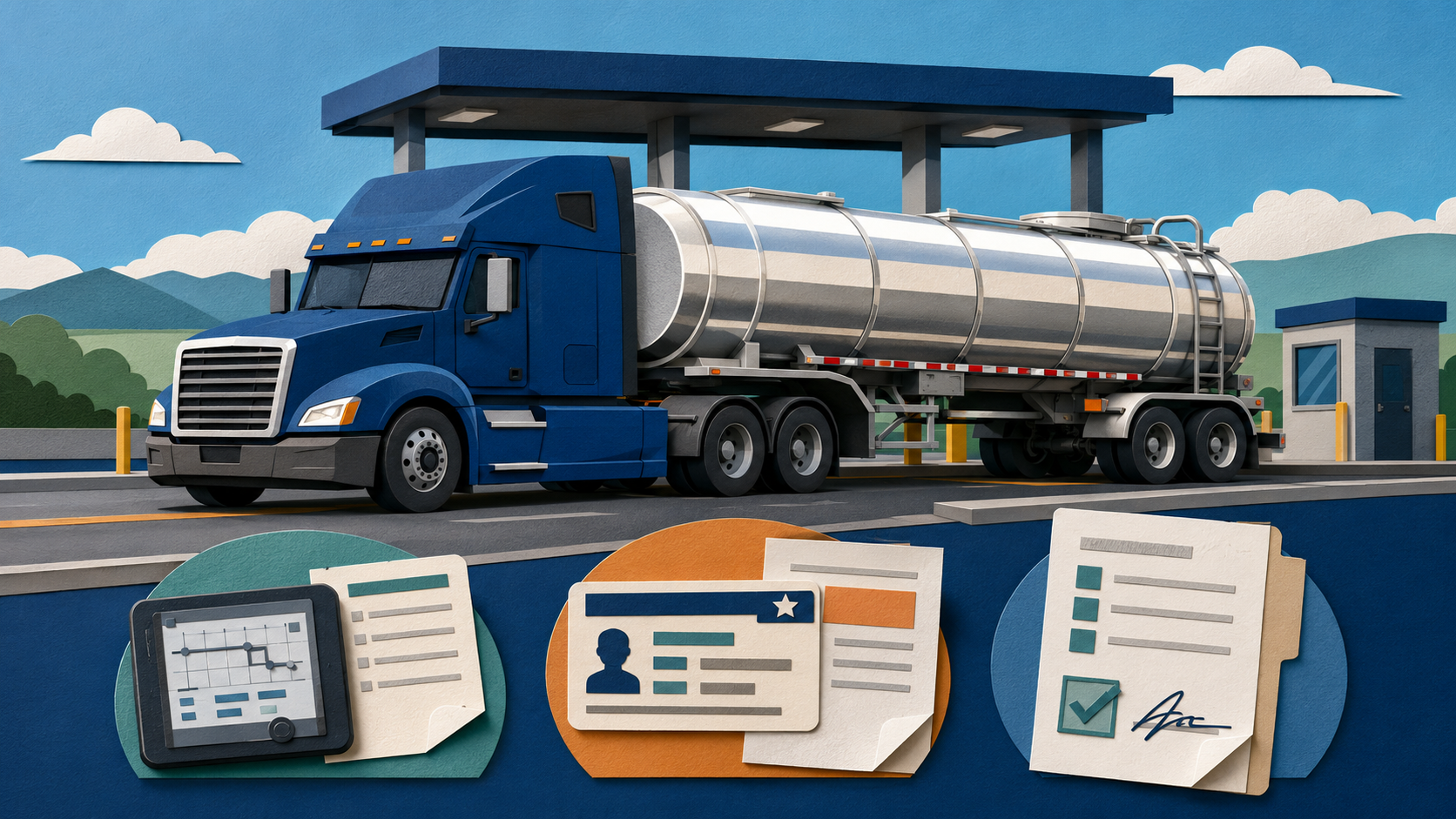
- ELD cab packet: Fleets may remove the operator’s manual, but three other items remain required.
- CDL reporting: The federal notice to a driver’s home state is gone; employer notices and possible state requirements remain.
- Roadside reports: A signed report is returned only when the issuing state requests it, while correction, certification, and retention duties continue.

Three narrow FMCSA rule changes affect ELD packets, CDL reporting, and roadside inspection paperwork. (Original Tank Transport illustration)
Three FMCSA paperwork rules that took effect July 22, 2026, narrow recurring documentation duties involving electronic logging devices, commercial driver’s licenses and roadside inspection reports. The final rules remove specific federal requirements that the Federal Motor Carrier Safety Administration now considers redundant.
For tank fleets, the practical job is not to discard every document connected to those subjects. Safety and compliance departments should revise cab-packet checklists, driver-reporting instructions and post-inspection procedures without disturbing the related duties that remain in force.
These rules do not change hours-of-service limits, hazardous-materials requirements, driver qualification standards or the obligation to correct vehicle defects. They are targeted administrative changes, not broad exemptions from federal safety rules.


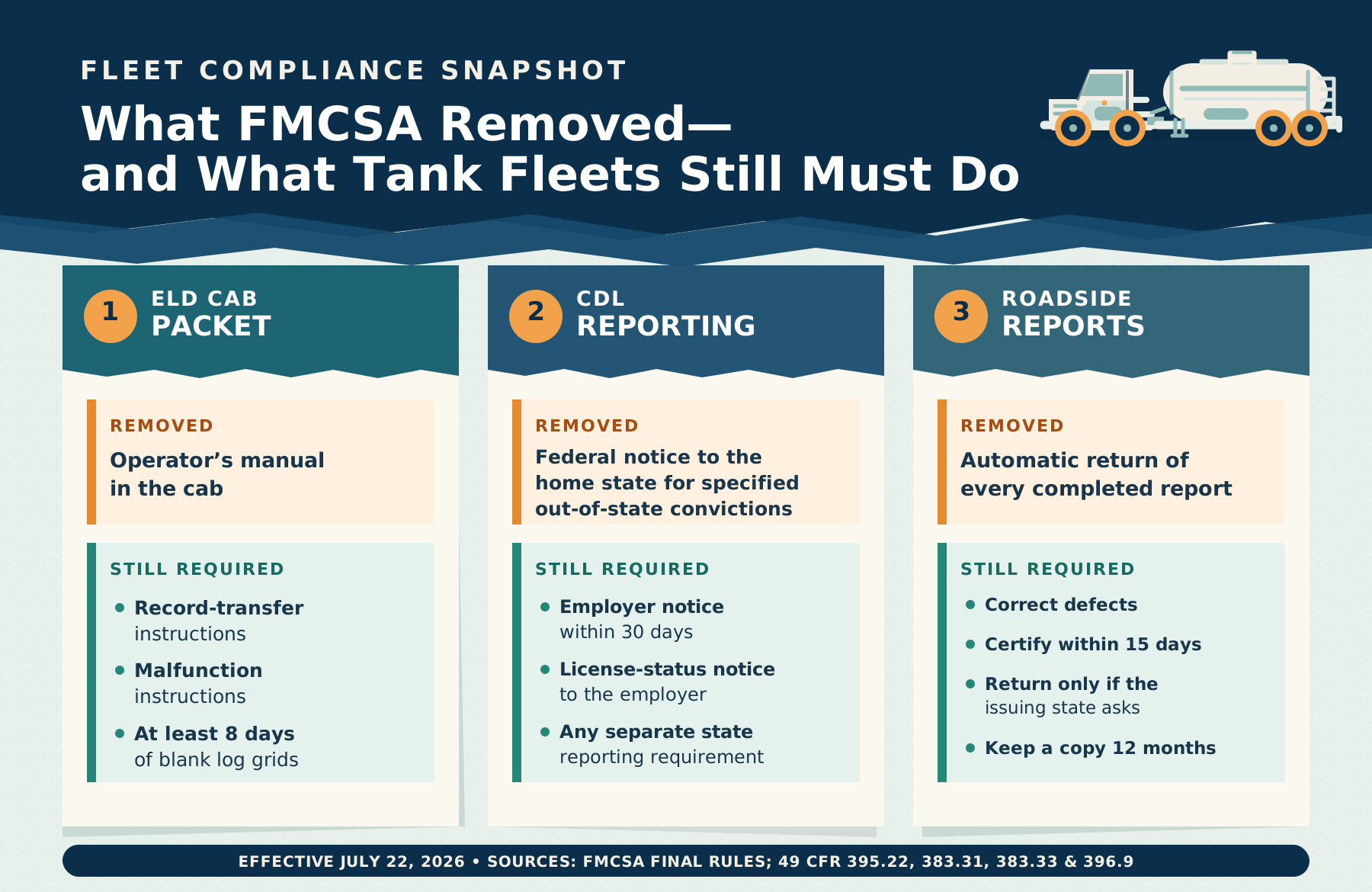
The new rules eliminate three narrow paperwork steps while preserving related correction, notification and recordkeeping duties. (Graphic: Tank Transport; sources: FMCSA)
The ELD Manual Leaves, but the Cab Packet Remains
FMCSA’s final ELD operator’s-manual rule eliminates the federal requirement to keep a copy of the manual in the commercial motor vehicle. FMCSA said electronic manuals are widely available and noted that more than 3,000 drivers were found in violation of the former manual requirement during 2024.
The change does not eliminate the ELD information packet. Under the current text of 49 CFR 395.22, drivers must still possess three onboard items: instructions for transferring hours-of-service records to an authorized safety official; instructions covering ELD malfunction reporting and recordkeeping; and enough blank records-of-duty-status graph grids for at least eight days.
Drivers also remain responsible for understanding how to operate the device and present records during an inspection. A fleet can voluntarily keep a manual in the cab, but removing it should not be grounds for overlooking the remaining instruction sheets or the paper-log backup. That distinction is especially important as Roadcheck ELD enforcement places more attention on record integrity and a driver’s ability to produce auditable logs.
CDL Holders Lose One Notice, Not Every Reporting Duty
The second final rule removes the federal requirement that CDL holders notify their state of domicile of specified out-of-state traffic convictions. FMCSA said state driver-licensing agencies have exchanged information electronically since 2024, making the driver’s parallel-state notice unnecessary.
The CDL self-reporting final rule leaves two important limits. First, FMCSA advises drivers to check the law of their state of domicile because a state may maintain its own reporting requirement. The agency said it will not compile a national list of those state rules.
Second, the federal duty to notify a current employer remains. A CDL holder convicted of a state or local traffic-control violation—other than a parking violation—must provide written notice to the employer within 30 days. The separate duty to notify an employer of a license suspension, revocation, cancellation, loss of privilege, or disqualification also remains. Safety departments should therefore revise driver handbooks carefully: remove only the obsolete state-notification instruction, preserve employer reporting, and add a state-specific check where needed.
Inspection Forms Return Only When the State Asks

Fleets must still correct defects, certify reports within 15 days, and retain copies for 12 months, even when the issuing state does not request the completed form. (Original Tank Transport illustration)
The third rule changes what happens after the carrier receives a roadside inspection report. The driver must still deliver the report at the next terminal or facility, or transmit it within 24 hours when no such arrival is scheduled. The carrier must examine the report, correct noted violations or defects, and certify the corrections within 15 days.
What changes is the return step. The completed form must be sent back to the issuing state agency only if that agency requests it. FMCSA adopted the revision after the Commercial Vehicle Safety Alliance argued that returning forms to states that did not want them created unnecessary work.
The completed inspection report rule does not erase the carrier’s record. The revised 49 CFR 396.9 still requires a copy to be retained for 12 months at the carrier’s principal place of business or where the vehicle is housed. FMCSA also declined to create a list of states that request returned forms, so fleets need a reliable way to capture the issuing agency’s instructions.
A sensible implementation is to keep the existing correction and retention workflow, then make the outbound return conditional on the state’s request. That preserves the audit trail without treating the new rule as permission to close an inspection file early. Tank fleets can pair that review with the broader documentation checks outlined in Tank Transport’s Operation Safe Driver Week compliance guide, as well as ongoing regulations and compliance coverage.
FMCSA Paperwork Rules: Key Developments
- All three final rules became effective July 22, 2026.
- The ELD operator’s manual is no longer federally required in the cab, but the transfer and malfunction instructions and 8 days of blank graph grids remain.
- CDL holders no longer have a federal duty to report specified convictions to their state of domicile, but employer notification and any applicable state duties remain.
- Roadside inspection reports are returned to the issuing state only upon request; the correction, 15-day certification, and 12-month retention requirements remain in effect.