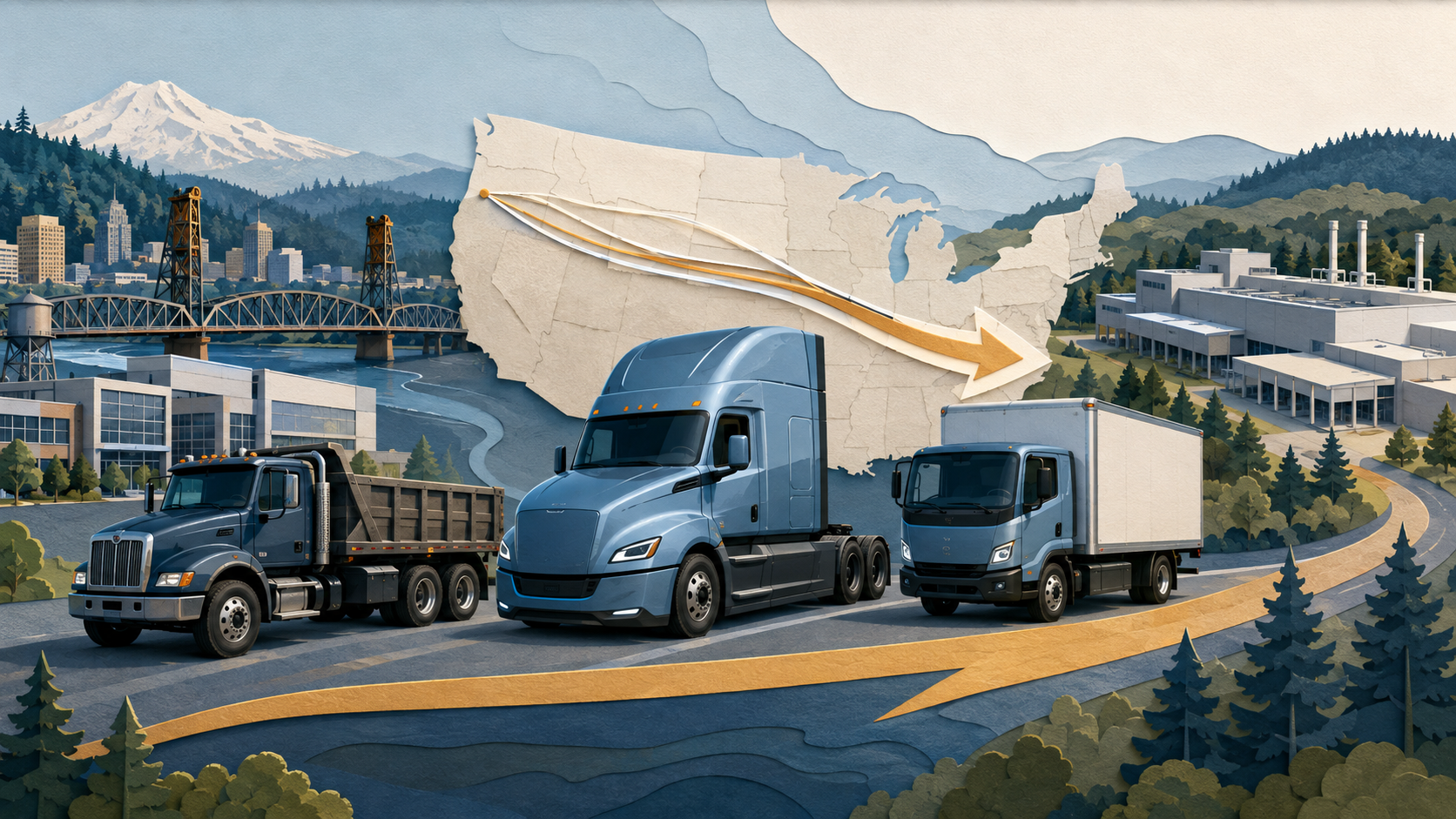
- Daimler Truck North America will permanently close four Portland-area manufacturing-related sites on October 30, affecting 387 jobs.
- Production of the Western Star X-Series, Freightliner eCascadia, and eM2 will move to existing operations in North and South Carolina.
- The company is retaining its Portland headquarters, engineering, product-development, testing and validation operations.
Daimler Truck North America will close its Portland truck manufacturing plant and three nearby support sites on October 30, according to an Oregon WARN notice. The Daimler Portland plant closure is classified as permanent and will affect 387 positions.
For tank and bulk fleets, the immediate equipment message is continuity rather than cancellation. Daimler says production of the Western Star X-Series and the battery-electric Freightliner eCascadia and eM2 will shift to the Carolinas. It has not announced the end of any of those product lines.
The relocation nevertheless puts a major production transition into Daimler’s North American network while fleets are already navigating a weak freight cycle, changing emissions requirements and uncertain equipment demand. The company has not disclosed any resulting change to truck prices, order banks, delivery schedules, warranties or dealer support.

A 387-job permanent closure across four Portland sites
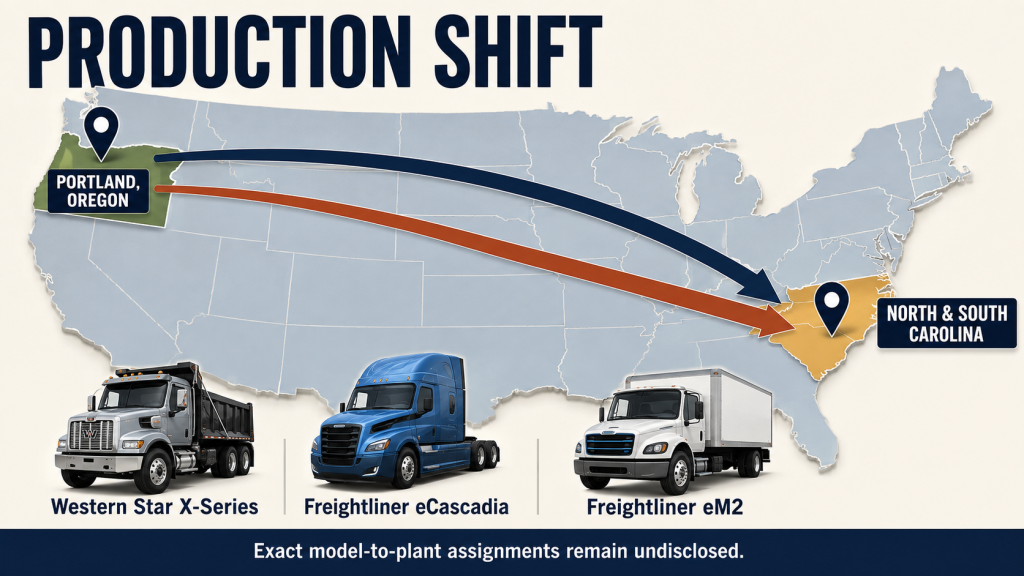
Daimler says three Portland-built product lines will move to North and South Carolina, but it has not disclosed exact model-to-plant assignments. (Graphic: Tank Transport; sources: DTNA and Oregon WARN #9549)
The official state record lists the Portland action as a permanent closure, with operations expected to cease on October 30. Oregon’s official WARN listings also record the July 30 notice under Daimler Truck North America. The total includes the main Portland Truck Manufacturing Plant at 6936 North Fathom Street and three nearby locations used for functions that include drop-lot and warranty-recovery work.
Of the 387 affected employees, 343 are union-represented, and 44 are nonrepresented office employees, according to the notice and related reporting. The positions span production and support work, including mechanics, material handlers, supervisors, local cartage employees and test-fleet drivers.
Daimler has said it will provide severance benefits, transition assistance, access to support resources and opportunities to explore other openings within the company. The International Association of Machinists confirmed that it represents affected Portland employees and is preparing for closure-related bargaining. The closure does not include DTNA’s North American headquarters in Portland or its local engineering, technology, testing and validation operations.
The move ends a long manufacturing chapter. Daimler’s corporate history dates Freightliner’s resumption of truck production in Portland to 1947. The current Portland Truck Manufacturing Plant was established in 1969, according to the company’s location records.
Three truck lines move east, but plant assignments remain undisclosed
DTNA told Trucking Dive that the Portland plant produces Western Star X-Series trucks and the Freightliner eCascadia and eM2 electric models. The company said that work will be relocated to manufacturing operations in North and South Carolina as part of a broader effort to optimize its production network and align resources with future business needs.

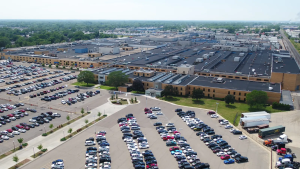
Daimler Truck North America’s Portland manufacturing plant is scheduled to cease operations on October 30, affecting 387 positions. (Photo: Daimler Truck North America)
Daimler has not publicly assigned each Portland model to a specific destination plant. Its North American location list identifies heavy- and medium-duty truck plants in Cleveland and Mount Holly, North Carolina, and a Freightliner Custom Chassis plant in Gaffney, South Carolina. Cleveland already assembles Freightliner Cascadia and Western Star 47X and 49X trucks, while Mount Holly builds Freightliner products.
That existing footprint gives Daimler places to absorb production, but the company has not disclosed transition volumes, added shifts or capital spending tied specifically to the Portland transfer. It also has not said whether the three model lines will move on the same schedule.
The Western Star change matters to specialized fleets because the X-Series includes vocational platforms used in demanding applications. Tank Transport previously examined the brand’s 47X and 49X vocational-truck expansion. The electric side of the transfer intersects with Daimler’s broader manufacturing strategy, including a separate $285 million Detroit powertrain investment supporting eCascadia and eM2 components.
For fleets with trucks already in service, nothing in the closure announcement changes warranty coverage, replacement-parts channels or dealer service. For fleets with pending orders, the practical questions are build location, cutover timing and whether a scheduled unit remains in its original production slot. Those answers will need to come from Daimler and its dealers on an order-specific basis.
Weak truck demand frames the move without proving its cause

Freightliner eM2 trucks on the Portland production floor in 2023. Daimler plans to end manufacturing at the facility on October 30, 2026, and relocate eM2 production to the Carolinas. (Photo: Daimler Truck)
The closure arrives during a difficult North American truck market. In its first-quarter investor release, Daimler reported 29,432 Trucks North America unit sales, down 25% from a year earlier. Segment revenue fell 29% to 3.838 billion euros, and adjusted EBIT declined 73% to 209 million euros.
The same report also showed an 86% increase in North American incoming orders, and Daimler reaffirmed its 2026 outlook. That mixed picture is important: weak recent sales and profitability provide market context, but they do not prove why Portland was selected for closure. Daimler’s stated rationale is network optimization and aligning resources with future business needs.
Tank carriers have experienced the same uneven freight environment. Tank Transport’s updated freight-recession analysis found improving rates alongside soft volumes and continued cost pressure. OEM production decisions can reflect that broader cycle, but the Portland announcement alone does not establish a coming shortage or a broad retreat from conventional or electric commercial trucks.
Daimler is scheduled to discuss second-quarter results on August 7. That presentation may provide additional North American demand and cost context, although the company has not promised plant-specific disclosures.
Daimler Portland Plant Closure Key Developments
- Closure date: Four Portland-area manufacturing-related locations are scheduled to cease operations on October 30.
- Workforce: The permanent closure affects 387 jobs, including 343 union-represented positions.
- Production: Western Star X-Series, Freightliner eCascadia and eM2 work will move to North and South Carolina; exact model-to-plant assignments have not been disclosed.
- Portland presence: DTNA will retain its North American headquarters and engineering, product-development, testing and validation functions in the region.
- Fleet impact: No model cancellation, supply interruption, price increase or dealer-support change has been announced.