- Oil transportation is entering a new risk cycle as the Hormuz disruption pushes tanker rates higher, tightens deliverability, and raises fresh questions about diesel costs and domestic fuel logistics.
- A commercial chokepoint in the Gulf is now rippling through tanker fleets, fuel haulers, private fleets, and refined products logistics across the U.S. market.
- The article breaks down how Basrah export risk, diesel volatility, freight margins, and tank trailer demand could reshape the operating environment for bulk liquid carriers in 2026.
Oil transportation is now tied directly to one of the most important energy logistics shocks of 2026. As of March 2, the strongest public evidence does not support a casually stated, formally verified total shutdown of all Basrah exports. What it does support is an effective commercial disruption in the Strait of Hormuz: Iranian warnings to ships, reduced traffic in the main lanes, insurers and shipowners pulling back, and Platts changing how it handles Gulf loadings that depend on safe Hormuz passage.
That distinction matters. A declared legal blockade is one kind of story. A commercial deliverability crisis is another. In the current phase, the market is already behaving as though logistics are broken: tankers are clustering near the waterway, some major shipping lines have suspended passage, and price-reporting agencies are treating certain Gulf-origin cargoes as operationally compromised. That is exactly how a geopolitical event turns into pressure on freight, insurance, scheduling, and terminal rack pricing.
The real domestic angle is not whether the United States suddenly runs out of crude. It is whether diesel climbs faster than surcharge formulas, whether fuel haulers see more erratic dispatch patterns, whether private fleets keep more freight in-house, and whether tank trailer buying decisions accelerate or pause while the regulatory picture remains unsettled. Those are the levers that convert a Gulf conflict into a U.S. oil tank transportation story.

For broader sector coverage, see tank transportation coverage.
“This is not simply a crude price story. It is a deliverability crisis that is already spilling into freight, insurance, scheduling, and terminal rack pricing.”
Oil transportation after the Hormuz shock
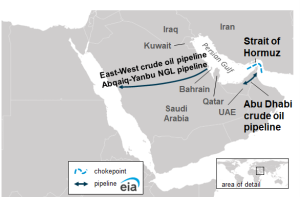
One narrow waterway can reshape tanker flows, freight costs, and fuel market expectations far beyond the Gulf. (Source: U.S. Energy Information Administration (EIA), “World Oil Transit Chokepoints” – Strait of Hormuz map/figure.)
Enjoying our insights?
Subscribe to our newsletter to keep up with the latest industry trends and developments.
Stay Informed
Start with scale. EIA says 20.9 million barrels per day of oil moved through the Strait of Hormuz in 2023, equal to about 20% of global petroleum liquids consumption and more than one-quarter of global seaborne oil trade. Around one-fifth of global LNG trade also uses the route. Saudi Arabia and the UAE have limited bypass routes, but EIA and the Congressional Research Service put their combined available alternative capacity at only 2.6 million barrels per day.
For related reporting across the energy market, browse oil and gas industry coverage.
That gap is why markets move so violently when Hormuz traffic falters. S&P Global reported that tanker traffic through the main shipping lanes was disrupted to the point that, on March 1, data showed no crude or product tankers entering the main traffic separation scheme channels, with roughly 240 ships clustering near the waterway and activity down an estimated 40% to 50%. On March 2, Persian Gulf-to-China VLCC rates jumped 35% in a day to $62.07 per metric ton, while Persian Gulf-to-UK/Continent product tanker rates rose 19% to $68.89 per metric ton.
For more market-specific reporting, visit the tankers coverage.
Platts also suspended bids and offers in parts of its Middle East refined-products Market on the close process when those cargoes required transit through Hormuz. That is an unusually concrete signal because it means deliverability itself, not just outright price, has become uncertain. Once price-reporting agencies start excluding operationally impaired loadings, the freight shock is already real.
Oil prices responded immediately, but not in a straight line. Reuters market coverage showed Brent up 4.5% to $76.07 on March 2 after briefly topping $82, while WTI rose 3.9% to $69.59. That intraday swing matters. It shows a market pricing both genuine logistics risk and the possibility that naval protection, diplomatic de-escalation, strategic stocks, or rerouting could stop the disruption from becoming a prolonged physical outage.
OPEC+ did not stand still, but its move was too small to resolve a shipping bottleneck. On March 1, the eight countries unwinding voluntary cuts agreed to add 206,000 barrels per day in April and explicitly retained the option to increase, pause, or reverse that schedule. In practical terms, that means upstream policy is flexible, but logistics still dominate.
“Extra barrels on paper do not calm markets if shipowners, charterers, and insurers do not want to move them.”
There is another underappreciated point here. CRS noted that the IEA estimated about 5.4 million barrels per day of spare crude capacity as of May 2025. Still, more than 90% of that spare capacity sits in Middle East countries that themselves depend on Hormuz. So even “spare capacity” sounds bigger than it behaves in an actual shipping emergency. This is why deliverability, not just nominal production, is the operative word in oil tank transportation right now.
A prolonged disruption would also reopen the emergency-stocks conversation. DOE said in November 2025 that the U.S. Strategic Petroleum Reserve held just over 400 million barrels, well below total capacity but still large enough to matter in a coordinated response. That does not solve the tanker crisis on its own, yet it remains one of the few levers available if crude and fuel prices remain elevated.
What does the Hormuz disruption mean for U.S. oil tank transportation?

Maritime risk becomes a freight story the moment safe passage starts to look uncertain. (Credit: U.S. Navy / U.S. Naval Forces Central Command (NAVCENT). Public domain image via DOD media.)
The United States is structurally stronger than import-dependent Asian buyers in a crisis like this. EIA’s February 2026 STEO forecasts U.S. crude production at 13.6 million barrels per day in 2026. EIA weekly data show crude exports around 4.16 million barrels per day on a late-October four-week average, and EIA’s February 2026 export coverage shows refined-product exports carried on clean product tankers at 6.3 million barrels per day in January, with total petroleum product exports averaging 7.0 million barrels per day. That means the U.S. is not entering this event as a fragile import-only market.
But U.S. pricing remains globally tethered. Before the current shock, EIA expected Brent to average $58 in 2026 and U.S. gasoline to average $2.91 per gallon. By February 26, AAA already had the national gasoline average at $2.98 because of the normal seasonal transition to summer blend. Reuters and GasBuddy then said the national average was poised to move back above $3 on March 2 as the Iran-Hormuz conflict interrupted global oil flows.
For tank truck carriers, the more immediate pain point is diesel. EIA’s February 23 reading showed U.S. on-highway diesel at $3.809 per gallon, up 9.8 cents in one week. The Lower Atlantic was up 9.6 cents week over week, the Midwest 13.4 cents, the Gulf Coast 7.7 cents, and the West Coast 8.2 cents. Those are not theoretical numbers. They are the kind of weekly moves that compress margins when fuel surcharge resets lag reality.
For added context on price management, read the diesel fuel cost management analysis.
ATRI’s latest cost benchmark explains why that matters even in a soft freight market. In 2024, fuel still averaged 48.1 cents per mile, total operating cost averaged $2.26 per mile, and non-fuel marginal cost hit a record $1.779 per mile. Truck and trailer payments rose 8.3% to a record $0.390 per mile, and insurance premiums rose 3.0%. So the industry got a brief break from cheaper fuel, but its underlying cost base kept climbing.
Specialized tanker fleets held up better than most other sectors, but they did not gain much room for error. FleetOwner’s summary of ATRI data showed tanker fleets posting the second-best average operating margin in 2024 at 1.9%, versus -2.3% for dry van truckload. That relative resilience says specialized work still commands a premium. It does not mean tanker carriers can absorb a sudden geopolitical diesel jump without consequence. A 1.9% margin is still thin.
The likely domestic transmission path is regional and operational. The first pressure points are Gulf Coast and Texas refinery-linked lanes, Louisiana chemical corridors, Lower Atlantic retail replenishment, airport fueling networks, and local or regional bulk liquid hauling tied to daily terminal pulls. Those are the lanes where on-highway diesel prices, rack spreads, dispatch density, and working capital can move faster than the retail gasoline headline suggests.
Oil tank transportation and the Basrah reality check
The original claim that Basrah exports were “completely halted” is stronger than what public reporting currently proves. The better-supported description is that Iranian warnings, insurer caution, and shipowner risk aversion sharply disrupted movement through Hormuz, with Iraq’s southern exports affected by shipping delays and impaired transits, rather than a fully documented federal export reading of zero. That is the more accurate and defensible line.
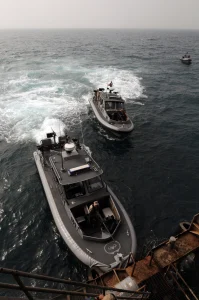
Export dependence is not abstract—it runs through offshore terminals, patrol zones, and uninterrupted marine access. (Credit: DVIDS / U.S. Navy. Public domain.)
Iraq’s own recent export data show why the market reacted so fast. The Oil Ministry said January 2026 crude and condensate exports totaled 107.6 million barrels, or about 3.47 million barrels per day. Of that, 101.16 million barrels came from central and southern Iraq, while only 6.46 million barrels moved from Kurdistan via Ceyhan. That means southern Basra-linked flows represented roughly 94% of January exports.
For more on upstream flows and hauling activity, see crude oil coverage.
The full-year picture tells the same story. Iraq exported 1.243 billion barrels in 2025, averaging 3.454 million barrels per day, and 1.114 billion barrels of that total came from central and southern fields through Basra ports. That works out to about 89.6% of annual exports. In other words, southern deliverability is not just important to Iraq. It is the core of the system.
That gives a useful value metric. At January’s southern export run rate of roughly 3.26 million barrels per day, every $1 per barrel move changes the gross daily value of those exports by about $3.26 million. Using March 2 pricing, that implies about $248 million per day at $76 Brent and about $267 million per day at $82. That is a calculation based on reported export volumes and market prices, not an official Iraqi revenue estimate. Still, it shows why any disruption to Basrah-linked liftings commands instant global attention.
Buyer mix also explains why tanker traffic is the immediate story. Iraq said January flows were heavily Asia-oriented, including roughly 996,000 barrels per day to India and 949,000 barrels per day to China, while U.S. purchases were about 186,000 barrels per day. When Asia-facing voyages become harder to insure or schedule, the first shock is freight and replacement sourcing, not necessarily a same-hour collapse in Iraqi production at the wellhead.
Northern relief is too small to compensate fully. AP reported that the Baghdad-Erbil-Ceyhan arrangement was expected to restore roughly 180,000 to 190,000 barrels per day of Kurdish exports plus local use. That is useful, but it is nowhere near Basra scale. So if Hormuz-linked southern cargoes are impaired, the northern outlet is a pressure valve, not a substitute.
Oil tank transportation and Brent, diesel, and retail fuel transmission
For U.S. markets, the key downstream question is how a Hormuz freight shock transmits into domestic fuel prices. The pass-through is never instant or perfectly linear because refiners, pipelines, terminals, marketers, and retailers all absorb or passcostst at different speeds. But the direction is clear: if Brent holds materially above pre-crisis assumptions, gasoline, diesel, and jet fuel follow.
That process was already visible before the headlines fully settled. AAA said on February 26 that spring-blend gasoline had pushed the national average to $2.98. EIA’s week-of-February-23 data showed Gulf Coast gasoline up 5.0 cents week over week and West Coast gasoline up 6.6 cents, while national diesel was already at $3.809. Reuters then reported on March 1 that the national average was set to move back above $3 as global oil flows were disrupted.
Diesel hit the oil tank twice during transport. It raises the direct cost of operating tractors and changes shipper behavior. When wholesale fuel and on-highway diesel prices move quickly, fuel marketers tend to prioritize service continuity. At the same time, some industrial shippers start rebidding lanes, pressing surcharge terms, or tightening purchase timing. That creates dispatch volatility even before end-user demand changes meaningfully. This is an inference from current diesel moves, export patterns, and cost data, but it is exactly how short-term freight stress usually appears.
The export side matters too. EIA’s February 17 export coverage said U.S. refined petroleum product exports carried on clean product tankers reached 6.3 million barrels per day in January 2026, near record highs and about 10% above January 2025, driven by diesel, gasoline, and LPG. When global marine flows are reshuffled on that scale, U.S. terminal economics and refined products logistics can tighten even with strong domestic crude production.
Global marine disruption usually becomes a domestic tank-truck story through timing rather than outright shortage. If waterborne flows slow, terminals replenish unevenly, branded marketers may prioritize critical accounts, and local fuel haulers can see sharper swings in dwell, dispatch density, and payment timing than the public pump price alone would imply. That is an inference, but it follows directly from the current mix of tanker disruption, freight inflation, and regional diesel volatility.
For broader pricing pressure across trucking, follow freight rates coverage.
Why should oil transportation fleets watch private fleets and fuel haulers?
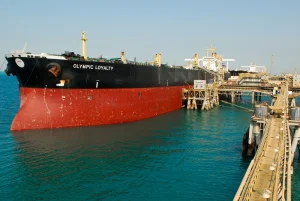
This is the physical handoff point where Iraqi export volumes meet the global tanker market. (Credit: DVIDS (U.S. Department of Defense visual information). Public domain.)
One of the strongest structural shifts in U.S. freight is the continued rise of private fleets. NPTC’s 2025 benchmarking data show private fleets now handle 70.4% of outbound shipments and 43% of inbound shipments for participating companies. Shipments rose 11.7%, volume rose 8.2%, and value rose 6.6%. Most importantly for capacity planning, 76% of fleets expect to grow by adding equipment or handling more company freight.
That matters especially in oil tank transportation because the shippers most sensitive to service failure—fuel marketers, propane distributors, chemical manufacturers, utilities, and food-grade liquid shippers—also have the clearest business case for dedicated or captive capacity during periods of instability. In volatile conditions, the argument for private or dedicated tank capacity gets stronger, not weaker.
Labor economics reinforce that trend. NPTC says average heavy-duty private-fleet driver compensation is now $91,081, annual turnover is 18.4%, and average tenure is 8.7 years. Average annual mileage per heavy-duty unit fell to 80,400 miles, and Class 8 units were traded at about 568,000 miles. Those metrics describe a model built around retention, predictability, and younger equipment—all attractive traits when outside capacity becomes more expensive or less certain.
Technology adoption is similarly telling. NPTC members report 88% in-cab cameras, 83% collision warning, 79% adaptive cruise control, 76% lane departure systems, and 77% disc brakes. For tanker fleets competing in hazmat trucking, that is the benchmark. Specialization alone no longer differentiates a fleet. Visibility, safety technology, and auditability do.
This is why fuel haulers deserve close attention in the current environment. Even if general freight remains soft, the combination of service urgency, hazmat complexity, and private-fleet expansion can tighten the effective labor and capacity market for petroleum and chemical carriers faster than dry-van indicators suggest. Specialized tanker fleets recruit, price, and retain drivers in a different market.
How are oil tank transportation economics changing in 2026?
A rough market-size marker helps frame the opportunity. Mordor Intelligence estimates the U.S. tank trucking market at $55.39 billion in 2026, rising to $66.23 billion by 2031, with petroleum products accounting for 46.3% of 2025 revenue. That is a market-research estimate, not an official government count. However, it aligns with what industry participants already know: petroleum still anchors the revenue base even as chemical, food-grade, and specialty liquid freight continue to diversify the sector.
The broad cost backdrop remains difficult. ATRI’s 2025 update puts the 2024 average operating cost at $2.26 per mile, with truck and trailer payments up 8.3% to a record $0.390 per mile, driver wages up 2.4% to 79.8 cents per mile, insurance premiums up 3.0%, capacity down 2.2%, and empty miles up to 16.7%. The headline drop in total cost came mainly from cheaper fuel, not from a healthier expense structure.
Insurance remains one of the hardest constraints. AM Best’s commercial auto review showed a $4.9 billion underwriting loss in 2024, the 14th straight year of losses, with liability severity still running well above general inflation. For tank carriers, that broad market stress helps explain continued hard renewals, close underwriting scrutiny, and the premium placed on cameras, telematics, formal safety programs, and disciplined claims management.
Labor supply is large in absolute terms but specialized in practice. BLS says heavy, and tractor-trailer truck drivers earned a median of $57,440 in 2024, or $59,570 in truck transportation, and the occupation employed about 2.235 million people with roughly 237,600 openings projected each year through 2034. ATRI and FleetOwner also found average driver turnover at 48% in 2024, with specialized sectors generally less affected than large truckload fleets. That means the labor issue for tank fleets is often not raw headcount; it is qualified, insurable, hazmat-ready headcount.
The equipment cycle is mixed rather than dead. ACT Research said December 2025 trailer orders reached 25,300 units, up 112% from November and roughly 5% from a year earlier, bringing full-year orders to 172,100. Yet Wabash said on February 4 that fleets remain cautious, backlog stood at $705 million, and management was looking for better demand in the second half of 2026 rather than declaring a full rebound now.
For related OEM and equipment reporting, browse tank trailer industry coverage.
That mix—improving orders, cautious fleet sentiment, soft generic freight, and resilient specialized demand—is classic tank-market territory. Tank trailers are usually bought because a shipper has a compliance-heavy, margin-critical, or dedicated need. In a geopolitical fuel event, that tends to favor fleets with dense contractual networks, disciplined maintenance, and enough balance-sheet strength to absorb temporary fuel and insurance shocks.
What regulations matter most for oil tank transportation fleets now?

Price shocks begin at the wellhead, but their effects extend far beyond the oil patch, affecting freight costs, fuel markets, and fleet planning.
Three regulatory tracks matter right now. First, FMCSA and CVSA restored real consequences to the enforcement of English-language proficiency. Since June 25, 2025, drivers who do not satisfy the federal English requirement can be placed out of service. For fleets moving hazardous or sensitive bulk liquids, this is not merely symbolic. Clear roadside communication and document comprehension matter in a hazmat environment.
Second, FMCSA finalized a rule effective March 23, 2026, removing the old requirement that vehicle fuel tanks be designed so they cannot be filled beyond 95% of liquid capacity in normal operation. The rule does not rewrite cargo-tank rules, but it still matters to fleet engineers and spec writers because it removes an outdated vehicle-fuel-system requirement and aligns the U.S. framework more closely with Canada’s.
Third, the emissions landscape is now unusually unstable. EPA’s Clean Trucks Plan still anchors the 2027 heavy-duty NOx rule. Still, the EPA finalized the rescission of the 2009 greenhouse-gas endangerment finding and the repeal of federal highway vehicle GHG standards on February 12, 2026. At the same time, California withdrew its Advanced Clean Fleets waiver request and says it is evaluating next steps, while the state and local government portion remains in place. For buyers, that creates genuine uncertainty around model-year strategy, depreciation, and powertrain timing.
That uncertainty matters disproportionately in oil tank transportation because tank fleets often run specialized bodies, pumps, PTO configurations, compartment layouts, and compliance workflows that make speculative propulsion changes expensive. Many operators are likely to keep prioritizing safety technology, telematics, maintenance productivity, and proven diesel platforms while the legal and commercial picture settles.
Which companies and products matter to oil tank transportation buyers?
The equipment side of this story is moving. TerraVest acquired EnTrans International in March 2025 for $546 million plus potential earnout, bringing Heil Trailer, Polar Tank Trailer, Kalyn Siebert, and Jarco into a larger specialized-equipment platform. That matters because EnTrans serves petroleum, chemical, food-grade, cryogenic, and LPG transport—the exact high-compliance cargo classes that define much of specialized tank transport.
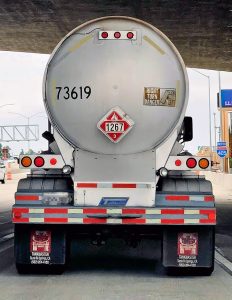
Global oil volatility does not stay offshore for long—it moves into domestic hauling economics and fleet decisions.
Heil is especially relevant. In April 2025, it won a 10-year, $588 million contract from the U.S. Army Tactical Fuel Distribution System. In January 2026, Tennessee announced that Heil would invest $9.8 million to expand its Athens manufacturing base, including warehousing, automated paint and welding systems, testing capacity, and training infrastructure. That is concrete evidence that fuel-handling trailer demand and manufacturing investment remain strong, even in a cautious freight cycle.
Tremcar’s U.S. moves tell a similar story about service footprint. In 2025, the company partnered with BigDuty in California, expanded with Mid America Trailers in Kentucky, added Universal Truck Service in Minnesota, and later announced the acquisition of Pacific Truck Tank in Sacramento. Those moves are significant because tank buyers do not just buy trailers. They buy parts,s support, certified repair access, and uptime close to the customer.
Overlay those OEM and dealer developments with Wabash’s $705 million backlog and cautious 2026 outlook, and the message is clear. The tank market is not in a broad speculative boom, but strategically important niches are still attracting capital, defense contracts, geographic expansion, and manufacturing spend. It is a market that is cautious overall, but still investing aggressively where service, compliance, and fuel handling remain critical.
“The Hormuz crisis has already become an oil tank transportation story: a deliverability shock hitting a market where Iraq’s southern exports dominate the country’s oil revenue base, tanker rates are spiking, and U.S. diesel is already near $3.81.”
The most important follow-up questions are practical. Are branded marketers changing replenishment cadence? Are private fleets pulling more freight in-house? Are diesel surcharges keeping up with weekly volatility? Are petroleum and chemical tank order boards improving even while general freight stays soft? And are 2027 equipment decisions being delayed by emissions-policy whiplash? Those are the questions most likely to turn the Hormuz disruption into a durable, U.S.-focused freight-and-fuel distribution story.
What the Hormuz Shock Means Next for U.S. Oil Tank Transportation
Key Developments
- Iraqi southern export flows remain the critical pressure point in global crude logistics, even without fully verified evidence of a formal zero-flow shutdown.
- The Strait of Hormuz disruption has already become a deliverability and freight story, not just a crude price story.
- Tanker traffic dislocation and higher marine freight costs are feeding uncertainty into global oil pricing and refined products logistics.
- U.S. crude supply remains comparatively strong, but domestic fuel prices are still exposed because oil is globally priced.
- Diesel cost volatility is emerging as one of the most immediate risks for oil tank transportation carriers and private fleets.
- Specialized tanker fleets continue to outperform much of the broader freight market, but their margins remain thin and vulnerable to sudden spikes in fuel and insurance costs.
- Private fleets are positioned to gain share if shippers prioritize service continuity, control, and dedicated bulk liquid hauling capacity.
- Regulatory uncertainty around emissions, enforcement, and equipment planning is complicating 2026 fleet purchasing decisions.
- Tank trailer manufacturers and service networks are still investing in petroleum, LPG, and specialty liquid equipment despite a cautious broader freight environment.
- The biggest questions now center on surcharge recovery, replenishment cadence, equipment demand, driver availability, and whether this disruption becomes a prolonged structural issue for U.S. fuel distribution.
Authoritative External Resources on Hormuz, Oil Markets, and Tank Fleet Operations
* For official data on chokepoint volumes, Hormuz transit risk, and alternative pipeline capacity, see EIA’s World Oil Transit Chokepoints analysis.
* For the latest U.S. and global oil price outlook, production forecasts, and petroleum market assumptions, review EIA’s Short-Term Energy Outlook.
* For current U.S. on-highway diesel and gasoline pricing benchmarks, check EIA’s Gasoline and Diesel Fuel Update.
* For emergency stock infrastructure, distribution capacity, and strategic supply context, visit the U.S. Strategic Petroleum Reserve page at DOE.
* To understand the latest OPEC+ production decision tied to market stability, read OPEC’s March 1, 2026, production adjustment statement.
* For a technical look at trucking cost pressure, margins, and operating benchmarks, explore ATRI’s Operational Costs of Trucking.
* For private-fleet benchmarking, equipment trends, and fleet growth planning, review NPTC’s Benchmarking Report.
* For the enforcement change on English-language proficiency and out-of-service criteria, see CVSA’s English language proficiency enforcement update.
* For the federal rule on the fuel tank overfill restriction, read FMCSA’s Fuel Tank Overfill Restriction rule page.
* For the current federal emissions framework affecting heavy-duty equipment planning, visitthe EPA’s Clean Trucks Plan overview.