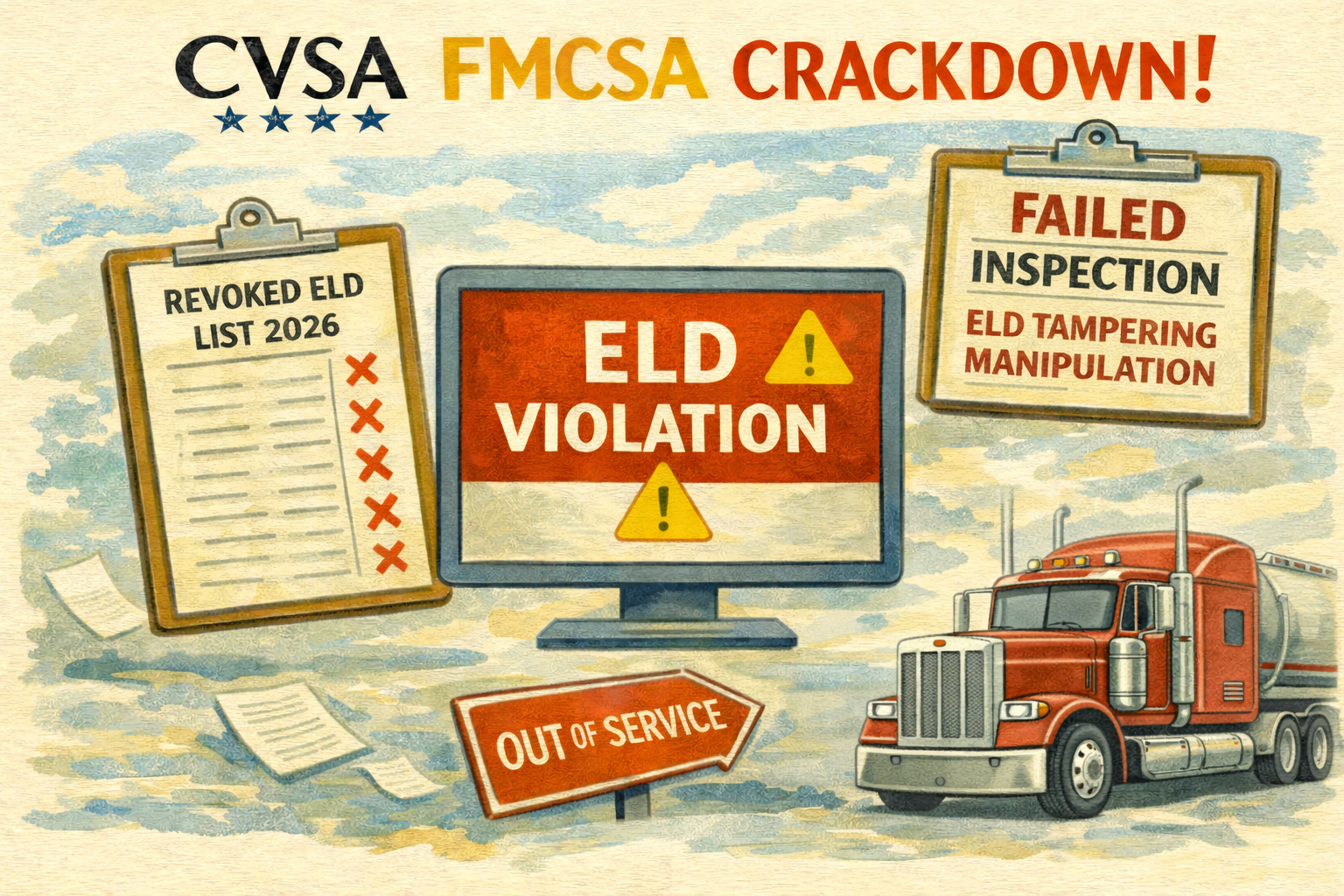
- Roadcheck ELD enforcement is entering a tougher phase as CVSA sharpens scrutiny on tampering, falsification, and manipulated records ahead of the May inspection blitz.
- FMCSA’s revoked ELD deadlines are already creating fresh compliance pressure, raising the risk of citations and out-of-service orders before Roadcheck even begins.
- For fleets, the 2026 message is clear: clean logs, compliant devices, and stronger cargo-securement discipline are now central to roadside survival.
Roadcheck ELD Enforcement Tightens as CVSA and FMCSA Raise the Stakes Ahead of May Inspections
Inspection season is no longer just another annual checkpoint for fleets. In 2026, Roadcheck ELD enforcement has become a far more consequential issue because the compliance landscape shifted before the inspection blitz even began. CVSA’s 2026 Out-of-Service Criteria took effect on April 1. International Roadcheck is scheduled for May 12–14, and FMCSA has already set multiple revoked-device replacement deadlines that begin hitting in mid-April. The result is a more aggressive enforcement window in which inspectors are directed to scrutinize electronic logging device tampering, falsification, and manipulation. At the same time, carriers are also being forced to remove devices that regulators say no longer meet minimum technical requirements.
For more coverage on electronic logging rules, revoked devices, and fleet log technology, browse our ELDs news archive.
For fleets, this is not just a “be ready for Roadcheck” story. It is a broader story of operations and risk management. Carriers that are still using a revoked ELD, relying on sloppy account controls, or assuming manipulated records will escape notice may be walking into an inspection environment that has become much less forgiving. For broader federal enforcement and rule developments affecting carriers, see our coverage of the FMCSA.


“This is no longer just a routine seasonal compliance story. It is a tightening enforcement environment in which log integrity, device status, and roadside auditability all matter at once.”
Why Roadcheck ELD Enforcement Matters More in 2026

A commercial truck approaches a weigh station used for weight and compliance screening. Photo credit: Kevin Rutherford / Wikimedia Commons.
The reason this year feels different is simple: CVSA did not merely announce a topical emphasis on ELD tampering. It also moved the enforcement framework closer to real roadside consequences.
CVSA made electronic logging device tampering, falsification, and manipulation the driver focus area for International Roadcheck 2026. At the same time, the alliance updated its Out-of-Service Criteria to include a more explicit enforcement path when ELD tampering makes it impossible for an inspector to determine what actually happened on the road. That means a log problem is no longer just a paperwork problem in every case. In some scenarios, it can become an immediate out-of-service event.
That harder line is tied to what CVSA says enforcement officers are already seeing. The alliance has pointed to roadside data showing that falsification of record of duty status ranked among the most common driver violations in 2025 and that multiple top driver violations were tied to hours-of-service and ELD compliance. In other words, the 2026 focus is not theoretical. It is being shaped by a pattern of violations that regulators believe is already widespread enough to justify a sharper response. For additional reporting on carrier rule changes, enforcement exposure, and documentation risk, explore our compliance archive.
The timeline fleets need to watch for Roadcheck ELD enforcement
The compliance calendar is critical because the deadlines stack together.
April 1, 2026: CVSA’s 2026 Out-of-Service Criteria became effective.
April 14, 2026: FMCSA’s February 12 revoked-device batch becomes an out-of-service issue if carriers have not replaced those units.
May 4, 2026: FMCSA’s March 4 revoked-device batch becomes an out-of-service issue if still in use.
May 12–14, 2026: International Roadcheck takes place across North America.
June 2, 2026: HERO ELD becomes an out-of-service issue if carriers continue to use it.
That timeline matters because fleets do not have the luxury of separating these into neat categories. By the time Roadcheck begins, some carriers will already be inside an enforcement period tied to revoked ELDs. At the same time, every carrier will also be exposed to heightened scrutiny over whether the record of duty status can be trusted.
What International Roadcheck looks like during Roadcheck ELD enforcement
International Roadcheck is CVSA’s annual 72-hour high-visibility enforcement campaign across North America. Inspectors primarily conduct the North American Standard Level I Inspection, which combines driver- and vehicle-focused reviews into a single roadside process.

Workstations and screens inside a weigh station overlook truck traffic and inspection activity. Photo credit: Oregon Department of Transportation / Wikimedia Commons.
On the driver side, inspectors examine qualifications, licensing, record of duty status, medical certification, seat belt use, and, in the United States, Drug and Alcohol Clearinghouse status. They also watch for signs of impairment. On the vehicle side, inspectors review brakes, cargo securement, tires, steering, suspension, lighting, coupling devices, fuel and exhaust systems, wheels, rims, hubs, and more.
This year, the declared driver focus is ELD tampering, falsification, or manipulation, while the vehicle focus is cargo securement. That pairing is important because it turns Roadcheck into a two-front compliance event. A fleet may have a clean-looking log and still lose time to securement-related violations. Likewise, a mechanically sound vehicle can still be delayed or shut down if inspectors determine the duty-status record is false, manipulated, or impossible to reconstruct.
What Has Changed in Roadcheck ELD Enforcement
The key change is not just that inspectors are being told to “look harder.” The more important development is that CVSA revised its 2026 Out-of-Service Criteria so that certain ELD-related scenarios map more directly to roadside consequences.
CVSA says one of the 2026 revisions updated the language around false records of duty status and ELD tampering. It also added a new out-of-service condition for situations in which a driver or motor carrier tampers with an ELD in a way that makes it impossible to determine which events occurred.
That distinction matters because it creates an enforcement fork.
If an inspector can still determine when the driver was driving or resting, the case may remain a false-RODS violation with consequences that depend on whether the driver is already over their limits at the time of inspection.
If the record has been manipulated so severely that the inspector cannot reconstruct what happened, the enforcement response becomes more serious. In that circumstance, CVSA’s framework now supports a ten-consecutive-hour out-of-service order.
“If the record cannot be reconstructed, the issue is no longer merely whether the log is inaccurate. The more serious question becomes whether the driver can remain in service at all.”
How Inspectors Are Being Told to Look for Roadcheck ELD Enforcement Issues
That is the real shift in Roadcheck ELD enforcement. The question is no longer just whether a driver’s log is accurate on its face. The more consequential question is whether the record is auditable.

The interior of a highway tractor shows the controls and instrumentation that drivers manage on the road. Photo credit: ErgoSum88 / Wikimedia Commons.
A log that contains an improper personal conveyance use, a missed login, or another false entry may still allow an inspector to reconstruct actual driving and rest. But a log that has been altered, shifted, compressed, or manipulated without preserving a valid trail can cross into a different category entirely.
This is why CVSA’s messaging matters so much. The alliance is signaling that enforcement officers are being coached not only to spot hours-of-service violations, but also to determine whether the underlying ELD data can be trusted at all.
How Inspectors Are Being Told to Look for ELD Tampering
CVSA’s 2026 inspection bulletin offers one of the clearest looks yet at how enforcement personnel are being told to identify false records and ELD tampering.
The bulletin says inspectors are seeing more cases in which records appear to have been altered or shifted by days, with no clear indication in the event detail that any changes occurred. It also says officers often uncover the problem only by comparing supporting documents to the record of duty status.
That is a crucial operational detail. It means a manipulated log may not be exposed by looking at the grid alone. The log may appear plausible until the inspector compares it with fuel receipts, toll records, bills of lading, appointment times, scale tickets, or other trip evidence.
What “tampering” can look like in practice
CVSA’s guidance shows that ELD problems do not all look the same.
Some cases are relatively familiar, such as the misuse of a personal conveyance to advance the load or a driver failing to log into the ELD, which creates unrecorded driving time.
Other cases are more technically deceptive. CVSA says inspectors are encountering records that appear to have been shifted backward by days, compressed, or otherwise changed in ways that hide actual driving time or manufacture a false break or reset.
That means Roadcheck ELD enforcement is now as much about record integrity as it is about hours. An inaccurate log can still matter even when the current day’s graph looks tidy.
The difference between false logs and non-auditable logs
This is where fleets can misunderstand the risk.
A false record does not always produce the same roadside result. If an inspector determines that the driver falsified the record but can still reconstruct enough information to know the driver is compliant at the moment of inspection, the driver may be cited and allowed to proceed.
But if the inspector cannot determine when the driver actually drove or rested because the data has been disabled, altered, or manipulated beyond reconstruction, the enforcement response becomes far harsher.
That distinction is why carriers should stop thinking in terms of “Will this get caught?” and start thinking in terms of “Can this record survive document matching and reconstruction?”
Why Revoked ELDs Are Part of the Same Story in Roadcheck ELD Enforcement
Technically, an FMCSA-revoked ELD is not the same thing as an intentionally tampered ELD. But in the field, the two issues now overlap in a way that matters to carriers.
FMCSA’s recent removal notices are clear. Once the grace period expires, continued use of a revoked device is treated as operating without a compliant ELD. The agency tells carriers to discontinue the device, temporarily revert to paper logs or logging software during the transition, and replace the unit with one from the registered list.
After the replacement deadline passes, FMCSA says safety officials should cite the driver under 49 CFR 395.8(a)(1) and apply CVSA out-of-service criteria. For more stories tied to carrier rules and roadside enforcement standards, visit our Federal Motor Carrier Safety Regulations coverage.
So even though revocation and tampering are not identical, they can both fall under the same roadside enforcement environment. During a Roadcheck year focused on log integrity, fleets still using revoked units are in a more exposed position from the outset. For related fleet-readiness and rulemaking stories, follow our Regulations & Compliance News section.
The Revoked ELD Deadlines Fleets Cannot Ignore
April 14 deadline: the February 12 batch
On February 12, 2026, FMCSA removed nine devices from the registered list for failing to meet minimum ELD technical requirements:
- GTS ELD — Global Telecommunication Services, Inc.
- UTRUCKIN — UTRUCKIN INC
- ELD365 ELOG — ELD365
- IRONMAN ELD — IRONMAN ELD
- FACTOR ELD — HOST ELD LLC (f/k/a FACTOR ELD)
- AirELD — Aireld Technologies (Android & Xirgo 6300 Series)
- Air ELD — Aireld Technologies (iOS & Xirgo 6300 Series)
- AirELD — Aireld Technologies (Android & PT30)
- AirELD — Aireld Technologies (iOS & PT30)
FMCSA gave carriers until April 14, 2026, to replace them. Before that date, officials were encouraged to avoid citing no-RODS or non-registered-ELD violations and instead review backup records. After April 14, continued use becomes an out-of-service issue.
For prior reporting on revoked devices and carrier obligations, read our FMCSA ELD compliance update.
May 4 deadline: the March 4 batch
On March 4, 2026, FMCSA removed 14 additional devices:
- Club ELD / Android — Club ELD
- Club ELD / iOS — Club ELD
- SAFERLOGS — DENDRA INC
- EGREEN ELD — Egreen ELD
- Canada & US by Gorilla Safety — Gorilla Fleet Safety, LLC
- Patriot ELD — Gorilla Fleet Safety, LLC
- ClearPath ELD — Gorilla Fleet Safety, LLC
- SimpleX 2 Go — Gorilla Fleet Safety, LLC
- LB Technologies FleetTrack ELD — Gorilla Fleet Safety, LLC
- HCSS Pro — Gorilla Fleet Safety, LLC
- ELDX Pro — Gorilla Fleet Safety, LLC
- AllwaysTrack ELD — Gorilla Fleet Safety, LLC
- Gorilla Safety Express — Gorilla Fleet Safety, LLC
- Command Alkon Powered by Gorilla Safety — Gorilla Fleet Safety, LLC
Carriers have until May 4, 2026, to replace these devices before continued use becomes an out-of-service problem.
This list is especially notable because it includes multiple units associated with Gorilla Fleet Safety, LLC, making the March revocation batch one of the more closely watched ELD developments this year.
June 2 deadline: HERO ELD
On April 2, 2026, FMCSA removed HERO ELD from the registered list and gave carriers until June 2, 2026, to replace it. After that date, continued use becomes an out-of-service issue under the same enforcement logic.
FMCSA also said in the HERO action that it has removed more than 56 devices from the registered list since January 2025. That is a striking figure because it shows the agency’s ELD compliance cleanup is not slowing down.
The January deadline has already passed.
Another point worth stressing is that FMCSA’s January 13, 2026, action is no longer theoretical. The replacement deadline attached to those removals passed on March 15, 2026.
That batch originally included PREMIERRIDE LOGS, DSGELOGS, STATE ELOGS, and STATE ELOGS 2. However, the FMCSA portal later showed that not all of those January devices remained in the same status. By early April, STATE ELOGS and STATE ELOGS 2 still appeared revoked, while some other January-affected devices appeared on the registered list again.
That is a subtle but important detail for industry readers. Fleets cannot assume that every device named in an earlier removal notice remains in the same status indefinitely. Carriers need to verify the current status of the FMCSA portal rather than rely solely on the first headline they see. For another example of FMCSA enforcement activity with nationwide carrier implications, see our report on the crackdown on the FMCSA training provider registry.
Why Tank Fleets Should Pay Particular Attention
For tank fleets, the 2026 story is not just about recordkeeping. The vehicle-side focus on cargo securement creates a second compliance front, especially relevant in liquid and bulk-hauling operations.

A branded tanker truck moves along the highway in a side-profile road shot. Photo credit: Nachoman-au / Wikimedia Commons.
CVSA’s own numbers show inspectors continue to cite thousands of violations for cargo not being secured to prevent leaking, spilling, blowing, or falling, as well as for components or dunnage not being secured. For tank carriers, that creates a straightforward editorial angle: this year’s inspection season is not just about hours-of-service and log credibility. It is also about whether the equipment, attachments, closures, and securement-related conditions can withstand closer inspection. For another 2026 federal-rule package affecting tank carriers, see our HM-265 fuel compliance analysis.
That does not mean every tank carrier will face the same risks as an open-deck operation. But it does mean fleets should resist the temptation to prepare only on the log side. Roadcheck ELD enforcement is arriving in the same campaign that will also place special attention on the vehicle’s cargo-related integrity. For a broader look at recent tank-fleet rule changes beyond ELDs, read our tank fleet compliance update.
What Fleets Should Be Doing Right Now
The most practical way to prepare is to think in terms of auditability.
First, verify that every ELD in use is currently on FMCSA’s registered list. That is no longer a procurement formality. With multiple revocation deadlines now live or imminent, it is a minimum compliance control.
Second, review carrier account controls. CVSA’s guidance makes it clear that inspectors may encounter manipulated or suspicious account structures. Carriers should ensure driver accounts are unique, driver license information matches the actual operator, and login discipline is being enforced.
Third, look at edit history and annotations. If a system has been used in ways that leave unexplained gaps, unexplained unidentified driving time, or suspiciously clean records where edits should exist, that should be resolved before Roadcheck.
Fourth, pre-audit supporting documents against the ELD timeline. Compare fuel receipts, tolls, bills of lading, delivery windows, scale tickets, and similar documents against the record of duty status. A record that looks fine in isolation may fail quickly when matched to trip evidence.
Fifth, do not neglect the vehicle side. Cargo-securement-related defects, loose components, compromised tiedown conditions, and other preventable issues can still turn a Roadcheck stop into a delay or worse. For additional context on how FMCSA actions can reshape carrier operations and compliance planning, read our FMCSA non-domiciled CDL rule update.
“The safest posture heading into May is simple: verify the device, verify the log, verify the supporting documents, and do not assume a clean screen means a clean inspection.”
A close-up perspective captures the truck mirror, cab edge, and pneumatic tank hardware. Photo credit: Ted Gresham / Wikimedia Commons.
The Bottom Line for 2026
The strongest way to understand this year’s enforcement environment is not to say simply that Roadcheck is coming. The more accurate view is that the framework has already changed.
CVSA’s revised out-of-service criteria took effect on April 1. FMCSA’s revoked-device deadlines are already arriving. International Roadcheck then takes place in May, with ELD tampering, falsification, and manipulation as its central focus.
That combination makes Roadcheck ELD enforcement a much bigger story than a normal annual inspection preview. It is a layered compliance event in which record integrity, device status, and vehicle readiness all matter at once.
For fleets that have already cleaned up their devices, tightened account discipline, and matched their logs to supporting records, this may be a manageable inspection season.
For carriers still using revoked devices, relying on weak log controls, or assuming inspectors will not dig beyond the surface, the risk is much higher now than it was a year ago.
Key Developments in 2026 Roadcheck ELD Enforcement
- CVSA’s 2026 Out-of-Service Criteria took effect April 1, tightening how inspectors handle false records of duty status and ELD tampering.
- International Roadcheck is scheduled for May 12–14, with ELD tampering, falsification, and manipulation as the driver focus area.
- Cargo securement is the vehicle focus area, making this year’s enforcement push a dual compliance challenge for fleets.
- CVSA guidance indicates inspectors are being urged to compare ELD records against supporting documents such as fuel receipts, tolls, and shipping paperwork.
- A manipulated log that cannot be reconstructed can now lead to a more serious roadside outcome, including a 10-hour out-of-service order.
- FMCSA’s revoked-device deadlines are arriving in waves, beginning April 14 and continuing through May 4 and June 2.
- Carriers still operating revoked ELDs after those deadlines risk being treated as operating without a compliant ELD.
- FMCSA’s February 12 device removals affected nine ELDs, creating the first major 2026 replacement deadline for fleets.
- FMCSA’s March 4 action removed 14 additional devices, expanding the compliance risk for carriers using affected units.
- FMCSA’s April 2 HERO ELD removal added yet another compliance deadline ahead of the May inspection blitz.
- Tank and bulk carriers face added exposure because Roadcheck’s cargo-securement emphasis also intersects with leak, spill, and load-integrity concerns.
- The broader takeaway for fleets is that 2026 is not just another Roadcheck cycle; it is a tighter enforcement environment shaped by both roadside scrutiny and device-registration crackdowns.
Authoritative External Sources on Roadcheck ELD Enforcement and Revoked Device Compliance
- Review CVSA’s official announcement on this year’s inspection campaign, focus areas, and enforcement dates at CVSA’s International Roadcheck, scheduled for May 12-14.
- See CVSA’s breakdown of the 2026 emphasis areas, including ELD tampering and cargo securement, at 2026 Focus Areas.
- Understand when the latest CVSA out-of-service changes took effect and why they matter at CVSA’s 2026 Out-of-Service Criteria Now in Effect.
- Read the official CVSA changes summary detailing the revised out-of-service language in the OOSC Changes Letter PDF.
- Examine CVSA’s enforcement guidance on false records of duty status and ELD tampering at Inspection Bulletin 2026-02 PDF.
- Compare the latest inspection focus with prior roadside enforcement trends at the 2025 Roadcheck Results.
- Reference CVSA’s official driver inspection checklist for roadside review details at the NAS Driver Inspection Cheatsheet PDF.
- Use CVSA’s vehicle inspection reference to understand the mechanical and cargo-related review points at the International Roadcheck Vehicle Inspection Cheatsheet PDF.
- Read FMCSA’s February 2026 notice removing nine ELDs from the registered list at FMCSA Removes Nine Devices from List of Registered Electronic Logging Devices.
- Review FMCSA’s March 2026 action removing 14 additional ELDs at FMCSA Removes Fourteen Devices from List of Registered Electronic Logging Devices.
- See FMCSA’s April 2026 notice on HERO ELD and its replacement deadline at FMCSA Removes HERO ELD from List of Registered Electronic Logging Devices.
- Track current federal ELD program updates and removal notices at ELD News and Events.
- Verify which devices currently remain approved for use through FMCSA’s Registered ELD List.
- Check which devices have been removed from the federal list through FMCSA’s Revoked ELD List.
- Read the federal rule governing driver records of duty status at 49 CFR 395.8.
- Review the carrier responsibility requirements tied to ELD use and oversight at 49 CFR 395.22.
- Consult the federal technical specifications that govern compliant ELD design and function at Appendix A to Subpart B of Part 395.
- See FMCSA’s guidance on whether automatically recorded driving time can be reclassified. Can a user edit or change automatically recorded driving time?.
- For referenced trade-context coverage on the March 2026 decertifications and related industry response, see Overdrive coverage of FMCSA’s 14-device removal.