- The Strategic Petroleum Reserve fell another 5.1 million barrels to 311.4 million barrels in the week ending July 17, reaching its lowest level since March 1983.
- Commercial crude, gasoline, and distillate inventories increased during the same week, but all three remained below their five-year seasonal averages.
- Exchange agreements could eventually return more crude than was released, potentially rebuilding the emergency reserve above 400 million barrels.
The U.S. Strategic Petroleum Reserve continued falling after this article was first published, declining by another 5.1 million barrels in the week ending July 17, 2026, to 311.4 million barrels, according to Department of Energy data reported by Reuters. That is the lowest inventory in the federal emergency crude stockpile since March 1983.
The Strategic Petroleum Reserve is not a rack-level fuel supply, but its physical storage network remains part of the emergency crude backstop behind U.S. refiners.

Aerial view of Department of Energy crude oil storage tanks at the Sunoco terminal near Nederland, Texas. (Image credit: U.S. Department of Energy / ENERGY.GOV; public domain, via Wikimedia Commons.)
The latest decline followed a 6.2-million-barrel draw in the week ending July 3, when the reserve fell to 319.5 million barrels. Reuters reported that SPR inventories had declined by approximately 104.04 million barrels between the beginning of the Iran conflict at the end of February and July 17.
The drawdowns are part of a U.S. commitment to release 172 million barrels from the reserve through an internationally coordinated effort intended to replace disrupted global supplies and relieve extreme pressure on fuel markets.


The Strategic Petroleum Reserve is not a rack-level supply of diesel or gasoline. It consists primarily of crude oil stored underground for emergency use. Its decline still matters because crude oil is the feedstock refiners need to produce diesel, gasoline, jet fuel, heating oil, and other finished products.
For broader coverage of petroleum markets, refinery risk, and fuel logistics, explore TankTransport’s Oil&Gas industry coverage.
The market backdrop is mixed rather than calm. Commercial crude and refined-product inventories increased in the latest EIA reporting week, providing some near-term relief. Retail fuel prices, however, moved sharply higher.
EIA data showed that the national average price for regular gasoline reached $4.001 per gallon on July 20, up 14.6 cents from the previous week and 88 cents above its year-earlier level. On-highway diesel reached $5.134 per gallon, increasing 33.8 cents in one week and standing $1.322 above the comparable 2025 price.
That combination illustrates why a low emergency reserve cannot be evaluated through a single price or inventory movement. Commercial stocks can rise during one week while the SPR continues falling, retail fuel prices accelerate, and international supply risks remain unresolved.
For fuel haulers, tank fleets, refiners, distributors, brokers, and over-the-road carriers, the Strategic Petroleum Reserve decline is not a stand-alone signal of shortage. It is a risk indicator. When emergency crude stocks are thin, the fuel system has less room to absorb another refinery outage, hurricane, export surge, pipeline interruption, shipping constraint, or geopolitical escalation.
The practical concern is not today’s barrel alone. The concern is what happens if another disruption arrives while the national oil cushion remains historically thin.
Strategic Petroleum Reserve Drawdown Reshapes the U.S. Fuel Backstop
The Strategic Petroleum Reserve was built as an emergency crude oil stockpile, not as a day-to-day price tool or a substitute for commercial fuel inventory. It was created after the 1973-74 oil embargo to reduce the effects of major petroleum supply disruptions and help the United States meet International Energy Agency emergency-stockholding obligations.
For more reporting tied to federal energy policy and emergency fuel infrastructure, follow TankTransport’s DOE coverage.
The Department of Energy stores reserve crude in underground salt caverns at four major Gulf Coast sites in Texas and Louisiana: Bryan Mound, Big Hill, West Hackberry, and Bayou Choctaw. Those locations connect to pipeline, refinery, and marine-terminal systems serving the country’s largest concentration of crude-processing capacity.
The SPR is a Gulf Coast crude logistics system as much as it is an emergency stockpile.

Map of Strategic Petroleum Reserve storage sites, refining centers, sales points, and crude oil pipeline distribution systems. (Map source: U.S. Department of Energy; public domain.)
DOE lists the reserve’s authorized storage capacity at 714 million barrels. At 311.4 million barrels, the Strategic Petroleum Reserve is holding approximately 43.6% of its authorized capacity.
That comparison matters because the SPR’s value is not limited to the number of barrels in storage. Its value also depends on whether emergency crude can be matched with refinery needs and moved through pipelines and marine terminals when ordinary supply channels are disrupted.
The lower the inventory falls, the smaller the volume available for the next event.
The latest figures extend a persistent drawdown. SPR stocks fell by 5.5 million barrels in the week ending June 26, by 6.2 million barrels in the week ending July 3, and by another 5.1 million barrels in the week ending July 17.
The reserve is no longer merely below recent norms; it has returned to inventory levels last seen during the SPR’s early buildout.
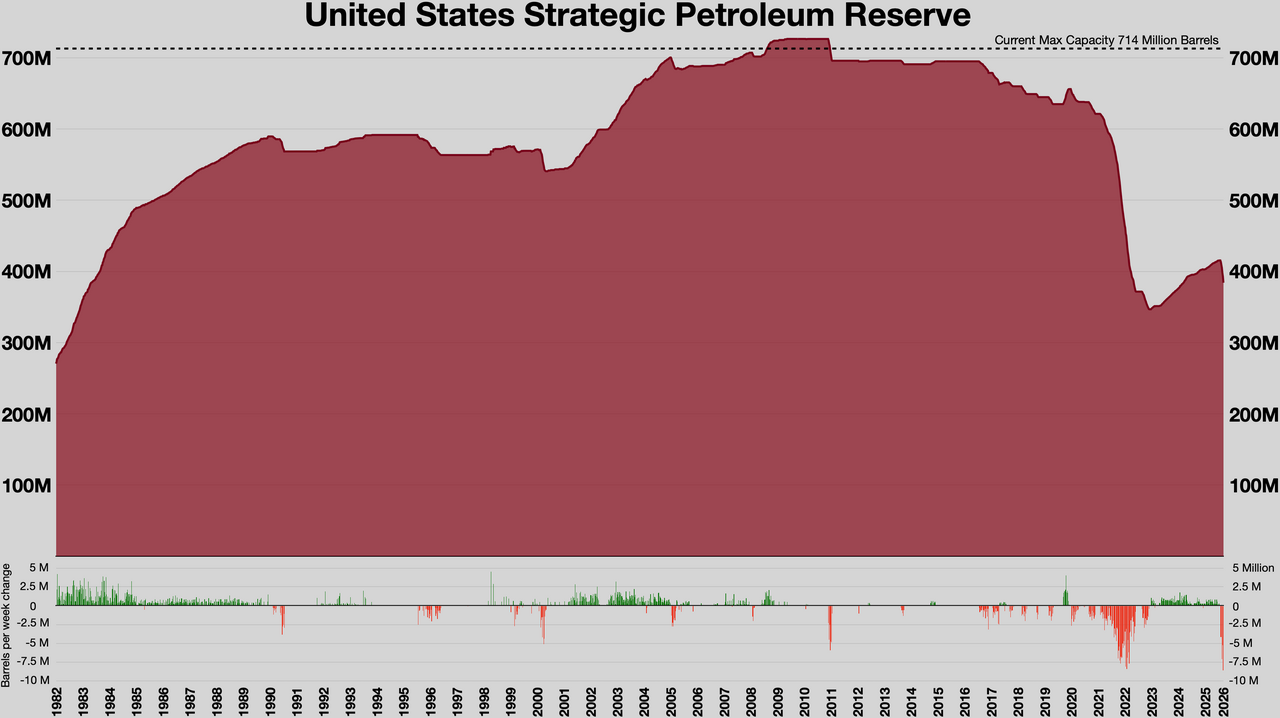
Historical chart of U.S. Strategic Petroleum Reserve inventory levels using EIA weekly data. The article’s latest figures extend through July 17, 2026. (Chart source: U.S. Energy Information Administration; graphic by Wikideas1, public domain.)
Reuters reported that combined commercial and SPR crude inventories had fallen by 129 million barrels to 726.2 million barrels as of July 10, the lowest level since 1984.
The July 17 data subsequently showed commercial crude stocks rising while the SPR continued declining. That prevented the commercial increase from translating into an equivalent recovery in the country’s combined crude cushion.
For related context on summer fuel-market pressure, see TankTransport’s U.S. Fuel Supply analysis.
The Strategic Petroleum Reserve drawdown therefore sits inside a broader domestic supply picture. Emergency crude remains historically low, commercial inventories are below seasonal norms, refineries are operating near capacity, and diesel and gasoline prices have accelerated.
The result is not an immediate fuel-shortage story. It is an energy-security, refinery-resilience, and fuel-supply-chain story.What Changed in the Latest Strategic Petroleum Reserve Data?
The most important update is that the Strategic Petroleum Reserve moved from 319.5 million barrels on July 3 to 311.4 million barrels by July 17.
That latest figure is significant for three reasons.
First, it is the lowest SPR inventory since March 1983. The historical comparison reaches back to a period when the reserve was still being expanded into a major national energy-security asset.
Second, approximately 104.04 million barrels left the reserve between the beginning of the conflict at the end of February and July 17. The drawdown is not a routine inventory adjustment. It is part of an emergency international response to a major supply disruption.
Third, the reserve has moved closer to statutory and operational thresholds relevant to future drawdown decisions.
According to the Department of Energy’s explanation of the Energy Policy and Conservation Act framework, a limited drawdown cannot be conducted when fewer than 252.4 million barrels remain in the reserve. At 311.4 million barrels, the SPR is approximately 59 million barrels above that threshold.
That does not make the reserve unusable once the threshold is reached. Full presidential drawdown authority is governed separately under emergency conditions. It does mean that continued releases reduce the flexibility available for certain limited-response actions.
The Strategic Petroleum Reserve remains a substantial emergency asset. It retains hundreds of millions of barrels and significant physical distribution capability. DOE materials describe a maximum nominal drawdown capability of approximately 4.4 million barrels per day, with oil capable of entering the market within about 13 days of a presidential decision.
The concern is not that the reserve has disappeared. The concern is that a large portion of the country’s emergency oil insurance policy has been used while the commercial fuel system continues to face high refinery runs, elevated retail prices, export demand, and geopolitical uncertainty.
Why Strategic Petroleum Reserve Levels Matter for Diesel and Gasoline Markets
The Strategic Petroleum Reserve stores crude oil, not finished diesel or gasoline. That distinction is essential.
A lower SPR level does not mean diesel racks are automatically short. It does not mean gasoline terminals are empty. It does not mean fuel haulers should expect immediate allocations or emergency dispatch conditions.
The connection is indirect but important. Refineries convert crude oil into finished fuels. When crude supply becomes less reliable, refiners may need to adjust feedstock plans, buying patterns, processing rates, maintenance decisions, and regional distribution.
Those changes can eventually affect wholesale rack prices, terminal replenishment, fuel-surcharge negotiations, and delivery patterns.
For continuing updates on weekly petroleum data, market balances, and inventory signals, see TankTransport’s EIA reporting.
The latest commercial data provide a more balanced picture than the SPR decline alone.
According to the U.S. Energy Information Administration, commercial crude inventories excluding the SPR increased by 2 million barrels to 411.7 million barrels for the week ending July 17. Even after that increase, stocks remained approximately 6% below the previous five-year seasonal average.
EIA also reported that gasoline inventories increased by approximately 800,000 barrels but remained 7% below the five-year average. Distillate inventories increased by 1.4 million barrels to approximately 109.6 million barrels but remained 10% below the seasonal average.
Total commercial petroleum inventories increased by 11.6 million barrels during the week.
When commercial crude and emergency crude move in different directions, the fuel system gains some near-term inventory without rebuilding its emergency backstop.

Historical chart of U.S. commercial crude oil stockpile levels using EIA weekly data. The latest reported commercial inventory was 411.7 million barrels for the week ending July 17, 2026. (Chart source: U.S. Energy Information Administration; graphic by Wikideas1, public domain.)
EIA data also showed that U.S. refineries remained near capacity. Refinery utilization was approximately 96.1% for the week ending July 17, while crude inputs averaged about 17.1 million barrels per day.
High utilization supports finished-fuel production because refineries are processing substantial volumes of crude into gasoline, diesel, jet fuel, and other products.
High utilization also limits flexibility. When the refining system is already operating near capacity, an unplanned outage can have an outsized effect because there is less unused processing capacity available elsewhere to offset the disruption.
The July 20 EIA retail-price update reinforced that point. The national diesel average reached $5.134 per gallon, up 33.8 cents in one week. Gulf Coast diesel averaged $4.942 per gallon, while West Coast diesel averaged $5.877 and California diesel reached $6.471.
Regular gasoline averaged $4.001 nationally, including $3.588 on the Gulf Coast and $3.546 in Texas.
For additional insight into diesel-market pressure, fleet costs, and distillate supply, browse TankTransport’s DieselFuel updates.
For fleets, the issue is not only the possibility of physical shortage. Rapid price increases affect fuel-surcharge timing, customer negotiations, carrier cash flow, and the lag between buying fuel and recovering the added expense.
What Commercial Crude and Product Stocks Add to the Picture
Commercial crude inventories are the first operating cushion behind refiners. The Strategic Petroleum Reserve is the emergency cushion behind that commercial system.
The July 17 increase in commercial crude interrupted the earlier sequence of inventory declines, but it did not eliminate the broader supply concern.
EIA attributed the commercial build partly to higher imports and lower exports. Crude imports rose to approximately 5.8 million barrels per day, while exports fell to about 3.4 million barrels per day.
Domestic crude production was estimated at approximately 13.8 million barrels per day. Crude inventories at Cushing, Oklahoma, the Nymex delivery hub, declined to about 19.4 million barrels.
Those figures show a system balancing domestic production, refinery demand, imports, exports, and emergency releases simultaneously. The result is more complex than an “inventory down, prices up” formula.
Commercial stocks can rise because exports decline or imports increase. Retail fuel prices can still climb because refined-product markets, global freight, geopolitical risks, and refinery constraints operate on different timelines.
Gasoline demand was approximately 8.9 million barrels per day during the latest week. Distillate demand remained important to freight, agriculture, construction, rail, marine, and industrial users.
A thinner SPR may not move diesel prices by itself, but it can magnify the market reaction if another disruption occurs while refined-product inventories remain below normal.
A reserve barrel only matters if the system can move it, schedule it, and deliver it into the refinery network when disruption hits.

Crude oil pipelines at the SPR Bryan Mound site near Freeport, Texas. (Photo credit: U.S. Department of Energy / ENERGY.GOV; public domain.)
How the Strategic Petroleum Reserve Connects to Gulf Coast Refineries
The Strategic Petroleum Reserve is physically designed around Gulf Coast crude logistics. Its four storage sites are positioned near the country’s most important refining and petrochemical corridor.
DOE describes three primary SPR distribution systems: Seaway, Texoma, and Capline.
The Seaway system includes Bryan Mound and connects to refinery hubs in Houston, Texas City, and Freeport.
The Texoma system includes Big Hill and West Hackberry, with connectivity to Beaumont-Port Arthur, Lake Charles, New Orleans-area refineries, and parts of the Houston market.
The Capline system includes Bayou Choctaw and connects to Baton Rouge-area refineries and one New Orleans-area refinery.
That geography is central to the fuel-market story. The Gulf Coast is not only where emergency crude is stored. It is where much of the country’s refining, marine export, crude blending, pipeline movement, and petrochemical activity is concentrated.
For deeper coverage of refinery outages, utilization pressure, and Gulf Coast fuel logistics, explore TankTransport’s Refineries archive.
The SPR also connects to commercial marine terminals. DOE materials identify Seaway terminals operated by Enterprise Products in Freeport and Texas City, the Energy Transfer terminal in Nederland, Texas, and the DOE-owned St. James terminal in Louisiana, which is leased to ExxonMobil Pipeline Company.
Those connections matter because the reserve’s usefulness depends on moving crude to refineries and terminals, not merely storing it underground.
The presence of Enterprise Products, Energy Transfer, and ExxonMobil Pipeline Company in the distribution network illustrates how federal emergency storage relies on commercial infrastructure.
The Strategic Petroleum Reserve therefore sits at the intersection of public policy and private logistics. The crude is federally owned, but its movement depends on pipelines, marine terminals, refinery demand, crude quality, shipping schedules, and regional infrastructure.
Crude quality also matters. The SPR holds both sweet and sour crude, historically in a mix designed around Gulf Coast refinery requirements. Nearly all refiners can process sweet crude, while sour crude generally requires more complex refinery equipment.
DOE describes the reserve’s crude mix as approximately 40% sweet and 60% sour.
SPR storage is underground, but its market value depends on surface systems capable of moving the correct crude grade to the correct refinery.

A technician inspects a wellhead assembly at the SPR West Hackberry site near Lake Charles, Louisiana. (Photo credit: U.S. Department of Energy / ENERGY.GOV; public domain.)
Not every reserve barrel can replace every disrupted barrel. Refiners are configured for specific crude slates. A reserve barrel has the greatest value when its quality matches available refinery units, logistics routes, and product-market needs.
How OPEC+, Hormuz, and Export Flows Changed the Risk Balance
The Strategic Petroleum Reserve decline must also be considered alongside changing international supply conditions.
OPEC+ approved an August production-target increase of 188,000 barrels per day, continuing a series of monthly increases. Participating countries included Saudi Arabia, Russia, Iraq, Kuwait, Kazakhstan, Algeria, and Oman.
The ability to deliver additional barrels still depends on field operations, shipping access, buyer demand, and the security of major maritime routes.
For more reporting on production policy, crude-output shifts, and global supply coordination, see TankTransport’s OPEC coverage.
The United Arab Emirates also became a larger supply variable after leaving OPEC and OPEC+ on May 1. Reuters reported that UAE crude production rose above 3.8 million barrels per day in June, while Abu Dhabi National Oil Company used expanded capacity and discounted tenders to increase distribution.
The global picture has not remained consistently calm. Renewed tension around the Strait of Hormuz, threats to Red Sea shipping, disruptions to Russian diesel exports, and limited spare refinery capacity have increased concern about refined-product availability.
The International Energy Agency estimated that Gulf exports in July were below their late-June highs but remained considerably higher than the levels recorded between early March and mid-June.
For related coverage of Middle East shipping risk and crude-market deliverability, review TankTransport’s Hormuz Supply Risk update.
The declining U.S. reserve does not mean the broader international emergency-stock system has been exhausted.
The IEA reported that member countries had released approximately 290 million barrels since coordinated action was announced on March 11. Even after that record release, members collectively retained more than 1 billion barrels of emergency oil stocks.
That international cushion adds resilience, but it is not perfectly interchangeable. Crude quality, geographic location, government release procedures, pipeline access, marine capacity, and delivery timing can determine whether emergency barrels meet the immediate needs of a particular refinery system.
The lower the Strategic Petroleum Reserve falls, the more important each remaining site, cavern, valve, crude grade, and distribution route becomes.

Technician checks a valve on a wellhead assembly at the SPR Big Hill site near Beaumont, Texas. (Photo credit: U.S. Department of Energy / ENERGY.GOV; public domain.)
Why Low Strategic Petroleum Reserve Inventory Is Not the Same as a Fuel Shortage
A low Strategic Petroleum Reserve inventory is a supply-risk signal, not proof of a current fuel shortage.
The SPR is crude oil. It is not gasoline at retail stations. It is not diesel in a terminal tank. It is not jet fuel in an airport hydrant system.
The crude must be sold or exchanged, scheduled, transported, refined, and distributed before it becomes finished fuel.
That timeline is why the latest SPR level must be interpreted carefully. It is accurate to say the U.S. emergency crude cushion is at its lowest level since March 1983. It is not accurate to say the United States is running out of oil.
The United States remains a major crude producer. EIA estimated domestic output at approximately 13.8 million barrels per day in the week ending July 17.
The domestic market also continues to import and export crude depending on grade, refinery requirements, pipeline geography, shipping economics, and regional infrastructure.
The critical distinction is market sensitivity. When inventories are low, a smaller disruption can produce a larger price reaction.
A refinery outage during high utilization can tighten product supply. A Gulf Coast hurricane can interrupt offshore production, ports, refineries, pipelines, power supply, and terminal operations.
A renewed shipping threat in the Strait of Hormuz can change crude availability, tanker routes, insurance costs, and freight rates. Strong exports can pull barrels away from domestic storage, while lower exports can temporarily rebuild commercial stocks.
In that environment, the Strategic Petroleum Reserve functions as a shock absorber. The lower the stockpile, the less shock absorption remains.
For diesel markets, the concern is not limited to outright shortage. It includes sharper regional price movements, fuel-surcharge disputes, tighter carrier margins, more volatile wholesale rack prices, and greater urgency around replenishment loads.
For gasoline markets, the concern is similar. Summer demand, high refinery utilization, and below-average inventory levels can accelerate price movement when supply confidence weakens.
A thin SPR does not create a finished-fuel shortage on its own, but it reduces the emergency margin available to protect the broader fuel supply chain.
What Happens When the Strategic Petroleum Reserve Refill Debate Returns?
Refilling the reserve is not only a policy decision; it is a crude-procurement, storage, logistics, and market-timing challenge.

A technician inspects a pipeline valve at the SPR Bryan Mound site near Freeport, Texas. (Photo credit: U.S. Department of Energy / ENERGY.GOV; public domain.)
The Strategic Petroleum Reserve drawdown creates a second major issue: replenishment.
The rebuilding process may begin sooner than a conventional federal purchasing program would suggest because much of the emergency release was structured through exchange agreements.
Under those arrangements, participating companies borrow crude from the SPR and later return the barrels with additional oil as a premium.
Reuters reported that the federal government had contracts covering approximately 133 million barrels of the planned 172-million-barrel release as of early July. Energy Secretary Chris Wright said the government expects an average return of approximately 1.28 barrels for every barrel released through the exchange agreements.
Those returns could eventually lift SPR inventories above 400 million barrels. Federal officials have also explored options for rebuilding the reserve beyond 500 million barrels.
That does not mean replenishment will be immediate.
Returned barrels are expected to arrive over time, beginning later in 2026 and extending into subsequent years. The schedule will depend on contract terms, crude prices, transportation availability, cavern capacity, infrastructure maintenance, and the quality of crude required at each site.
Exchange returns can reduce the amount of direct federal spending required to recover some of the released volume. A complete long-term rebuild would still involve policy decisions, congressional funding, procurement timing, salt-cavern integrity, and market conditions.
Replenishment itself can influence crude markets. Government and industry purchases add demand. Emergency-stock rebuilding across multiple countries could support crude prices and absorb part of the additional production expected as OPEC+ unwinds earlier supply restrictions.
Buying aggressively while prices are high can be politically contentious and may tighten the market. Waiting for lower prices leaves the emergency cushion thin for longer.
The reserve’s future path will therefore depend on four separate flows: whether additional barrels are released, when exchange barrels are returned, whether direct federal purchases resume, and whether mandated future sales are canceled or revised.
The emergency stockpile absorbed part of the initial supply shock. The next operational challenge is rebuilding it without creating another market imbalance.
For continued coverage of fuel hauling, tanker fleets, liquid bulk logistics, and petroleum transport operations, visit TankTransport’s TankTransport coverage.
What to Watch Next
- Whether another weekly draw pushes the Strategic Petroleum Reserve closer to 300 million barrels.
- Whether the latest increases in commercial crude, gasoline, and distillate inventories continue or reverse.
- When exchange barrels begin returning to the SPR and whether the average 1.28-to-1 return ratio is achieved.
- Whether refinery utilization remains near 96% as maintenance needs and unplanned outages emerge.
- Whether Gulf exports, Hormuz shipping, Red Sea routes, and OPEC+ production remain sufficient to contain price pressure.
- Whether elevated diesel prices trigger broader fuel-surcharge, freight-rate, or carrier-margin pressure.
- The next EIA Weekly Petroleum Status Report, scheduled for July 29, 2026.
Related TankTransport Coverage
- Explore TankTransport’s continuing FuelSupply reporting for domestic inventory, rack, and distribution developments.
- Review CrudeOil coverage for upstream production, storage, export, and refinery-feedstock updates.
- Follow FuelPrices coverage for diesel, gasoline, freight-cost, and fleet-operating trends.
- Read TankTransport’s Global Refinery Crunch analysis for more on outages, utilization, and refined-product logistics.
Strategic Petroleum Reserve Drawdown: Key Developments
- The Strategic Petroleum Reserve fell by 5.1 million barrels to 311.4 million barrels in the week ending July 17, the lowest level since March 1983.
- SPR inventories declined by approximately 104.04 million barrels between the start of the conflict at the end of February and July 17.
- The U.S. release commitment totals 172 million barrels as part of a broader IEA-coordinated emergency response.
- Combined U.S. commercial and SPR crude inventories had fallen to 726.2 million barrels as of July 10, the lowest level since 1984.
- Commercial crude inventories increased by 2 million barrels to 411.7 million barrels in the week ending July 17 but remained 6% below the five-year seasonal average.
- Gasoline inventories increased by approximately 800,000 barrels but remained 7% below average.
- Distillate inventories increased by 1.4 million barrels to approximately 109.6 million barrels but remained 10% below average.
- Refinery utilization remained near capacity at approximately 96.1%, with crude inputs around 17.1 million barrels per day.
- National on-highway diesel reached $5.134 per gallon on July 20, up 33.8 cents in one week and $1.322 from a year earlier.
- Regular gasoline reached $4.001 per gallon nationally, up 14.6 cents in one week.
- IEA countries had released approximately 290 million barrels since March 11 but still held more than 1 billion barrels in emergency stocks.
- U.S. exchange agreements are expected to return an average of 1.28 barrels for every barrel released, potentially lifting the SPR above 400 million barrels.
External Resources on Strategic Petroleum Reserve and Fuel Market Risk
- Learn how the federal emergency crude stockpile is structured, managed, and released through the U.S. Department of Energy’s Strategic Petroleum Reserve overview.
- Find official capacity, drawdown, and operational details at the Department of Energy’s SPR Quick Facts.
- Understand SPR releases, crude quality, statutory authority, and emergency drawdowns through the DOE’s Strategic Petroleum Reserve FAQs.
- Review the Gulf Coast salt-cavern network through the DOE’s SPR Storage Sites.
- Track weekly crude oil, gasoline, distillate, and refinery-utilization data through the EIA’s Weekly Petroleum Status Report.
- Follow retail gasoline and on-highway diesel prices through the EIA’s Gasoline and Diesel Fuel Update.
- Compare global emergency stocks, supply, demand, and inventory conditions through the International Energy Agency’s Oil Market Report.
- Monitor global production policy and crude-market balances through OPEC’s Monthly Oil Market Report.
Sources and Further Reading
- Reuters, July 20, 2026 — Reports the latest SPR decline of 5.1 million barrels to 311.4 million barrels, the March 1983 comparison, the 104.04-million-barrel decline since late February, and the 172-million-barrel U.S. release commitment. (Reuters SPR inventory report)
- U.S. Energy Information Administration, July 22, 2026 — Provides the 2-million-barrel commercial crude increase to 411.7 million barrels, gasoline and distillate builds, five-year-average comparisons, and the 11.6-million-barrel increase in total commercial petroleum inventories. (EIA petroleum inventory analysis)
- U.S. Energy Information Administration, Weekly Inputs and Utilization — Provides the 96.1% refinery-utilization rate, approximately 17.1 million barrels per day of crude inputs, operable refinery capacity, and weekly refining trends through July 17. (EIA refinery utilization data)
- U.S. Energy Information Administration, July 21, 2026 — Provides July 20 national, regional, and state gasoline and diesel prices and their weekly and year-over-year changes. (EIA gasoline and diesel price update)
- Reuters, July 9, 2026 — Reports the expected return of exchange barrels beginning later in 2026, the average 1.28 barrels returned for every barrel released, possible rebuilding above 400 million barrels, and potential replenishment beyond 500 million barrels. (Reuters SPR replenishment report)
- Reuters, July 21, 2026 — Reports the release of approximately 290 million barrels by IEA members, more than 1 billion barrels of remaining emergency stocks, and updated Gulf-export conditions. (Reuters report on IEA emergency stocks)
- U.S. Department of Energy, Strategic Petroleum Reserve resources — Provides reserve purpose, authorized capacity, storage locations, distribution systems, drawdown capability, crude-quality mix, statutory thresholds, and Gulf Coast infrastructure connections. (U.S. Department of Energy SPR overview)