Featured image: An illustrative milk tanker at Wanner’s Farm in Pennsylvania; it does not show DFA’s St. Albans operation or an involved carrier. (Photo: Beyond My Ken/Wikimedia Commons, CC BY-SA 4.0; cropped)
- Dairy Farmers of America idled its St. Albans, Vermont, plant on August 17 and says milk formerly received there will remain within its processing network.
- DFA has identified Maine, Massachusetts, and New York; a board member pointed to Garelick Farms and newer western New York plants as possible higher-value outlets, but exact load assignments, routes, mileage, and charges remain undisclosed.
- The plant is being preserved while a labor dispute moves to arbitration, but it remains dormant, making interstate milk movement the current operating reality.

A milk tanker outside a creamery in Enosburg Falls, Vermont, in September 1941. The archival photograph documents Franklin County’s milk-hauling history. (Photo: Jack Delano/Library of Congress; no known restrictions)
Milk that once reached a processor in St. Albans is now traveling deeper into Dairy Farmers of America’s Northeast network. For Vermont milk tankers, the August 17 shutdown is not simply a lost plant address. It changes where loaded equipment finishes the day, how quickly it can return to farm routes, and where the cost of added time and distance ultimately lands.
DFA’s closure statement says the cooperative idled the St. Albans processing plant and closed the adjoining Creamery & Supply effective August 17, affecting about 80 employees. It also says milk previously received there will continue to be processed elsewhere in DFA’s network so regional farmers retain a market.


That assurance establishes continuity of sale, but not continuity of transportation. DFA identified Maine, Massachusetts, and New York as part of the rerouting plan, according to Vermont Public’s reporting on the milk shift. In an August 9 Boston Globe report, board member Tom Bellavance pointed to Garelick Farms and newer western New York plants as possible higher-value outlets, while board member Harold Howrigan said farmers would pay the increased transportation costs. Those comments narrow the public record but do not establish load-by-load assignments. DFA has not published the Maine recipient, exact western New York facilities, plant allocations, routes, mileage, carrier assignments, or added charges.
St. Albans Turns a Local Delivery Into a Network Move
The St. Albans facility converted raw milk into cream, condensed products, and milk powder. Its idling removes a nearby manufacturing outlet from Franklin County, the center of much of Vermont’s conventional dairy production, while leaving the cows and daily pickup obligation in place.
The scale of the surrounding milk shed explains why transport matters. USDA’s 2025 Vermont agriculture overview reports 2.513 billion pounds of milk production statewide. That figure is not the volume handled by St. Albans—DFA has not published the plant’s recent intake—but it shows the density of a market in which processing capacity and tanker capacity must remain closely coordinated.
The most important dividing line is between what DFA has confirmed and what remains commercially private:
| Operating question | Confirmed through August 25 | Still not publicly disclosed |
|---|---|---|
| Milk destination | DFA identified Maine, Massachusetts, and New York. Board member Tom Bellavance pointed to Garelick Farms and newer western New York plants as possible higher-value outlets. | Plant-by-plant allocations, exact western New York facilities, the Maine recipient, product assignments, and each destination’s share. |
| Transportation | DFA says it will continue supporting Vermont through Northeast Logistics and its farmer-owner network. | Carrier assignments, daily loads, route miles, relays, backhauls, and equipment additions. |
| Farm economics | Board member Harold Howrigan said farmers themselves will pay the increased transportation costs. | Exact added amounts, pooling or allocation methods, and how the expense will appear on producer settlements. |
| Plant status | St. Albans is dormant. DFA committed not to sell the property, remove machinery, or take other irreversible steps while arbitration proceeds. | Arbitration timing, reopening conditions, or a future sale or operating plan. |
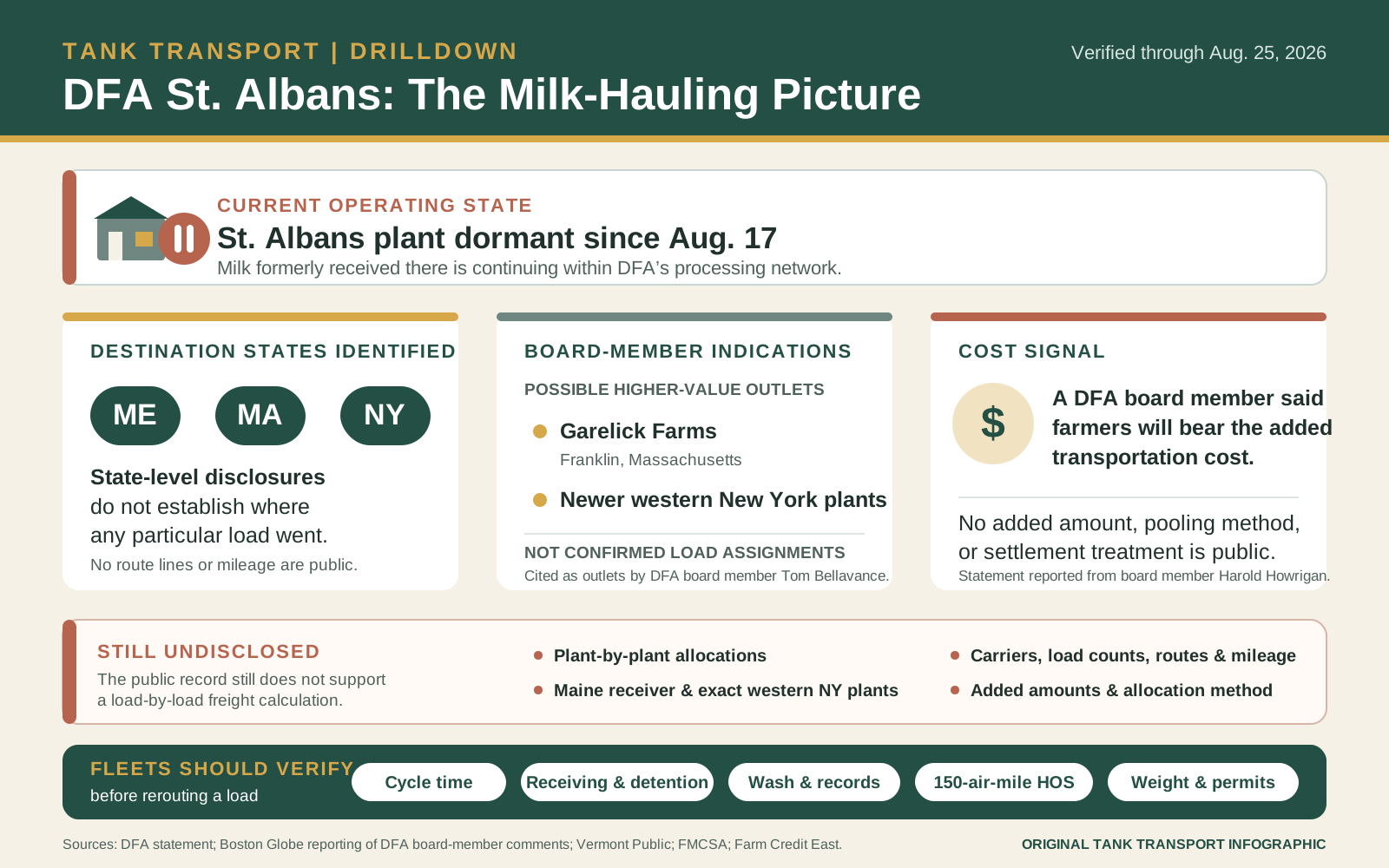
Confirmed disclosures, remaining unknowns, and fleet operating checks following the idling of DFA’s St. Albans dairy plant. (Original Tank Transport infographic)
One Massachusetts outlet and a western New York signal are public, but there is still no basis for assigning a credible per-load or per-hundredweight cost. Without farm-to-plant assignments, miles, rates, and volumes, the disclosure remains a planning range rather than a freight calculation.
“Milk currently received at the St. Albans facility will continue to be processed within DFA’s network.” — Dairy Farmers of America
Longer Routes Change the Math for Vermont Milk Tankers
Milk is produced and collected every day, regardless of whether the nearest processing gate is open. A longer linehaul can reduce the number of farm pickups a tractor and driver can complete in a shift, extend the interval before a tanker returns, and create more dependence on receiving appointments, wash availability, and dispatch coordination. Those pressures mirror the cost and capacity problems described in Tank Transport’s earlier analysis of rising milk-hauling costs.
Not every out-of-state load will require another tractor or trailer, and a longer route can sometimes be offset through relays, reassigned farm groups, larger receiving windows, or better network balancing. DFA has not described which of those tools it is using. The proper near-term test is therefore operational: whether pickups remain on schedule, tanks return fast enough for the next cycle, and destination changes occur with enough notice to avoid loaded equipment waiting for instructions.
The compliance line is also more precise than “interstate” versus “intrastate.” Under FMCSA’s agricultural-commodity guidance, qualifying transportation can use the hours-of-service exception within 150 air miles of the commodity’s source during the applicable state-defined period. Once a driver goes beyond that radius, Part 395 applies for the remainder of the outbound trip and until the driver returns within the original radius. On a multiple-pickup route, FMCSA measures from the first loading point.
Crossing a state line does not by itself establish that the boundary has been crossed, and DFA’s incomplete plant-by-plant routing makes a public determination impossible. Carriers need the actual first farm, receiving plant, and operating calendar before deciding how a reroute affects logs, relief eligibility, or driver scheduling.
Payload can also become a border problem. A Farm Credit East review of Northeast milk transportation found that differing state weight limits can force a partial load or partial unload, and that a late reroute can leave an already-loaded tanker facing an incompatible corridor. That does not show that any St. Albans load has been reduced. It means dispatch must check gross and axle limits, permits, bridge restrictions, and the full replacement route before shifting a load collected for one plant into another state.
Longer movement also raises the value of disciplined handoffs. FDA’s Interstate Milk Shippers program ties listed farms, receiving stations, transfer stations, and plants to the sanitation framework of the Grade “A” Pasteurized Milk Ordinance. The interstate move does not create a looser standard; it makes temperature control, sampling, seals, records, unloading authorization, and wash coordination more exposed to delays. Tank Transport’s guidance on why cleaning and sampling are part of milk hauling remains directly relevant.
Farmers Bear the Added Freight, but the Amount Remains Unknown
Vermont farmers have reason to watch their settlement statements. Vermont Public reported in June that transportation costs are commonly deducted from monthly milk checks and that DFA had not said whether the St. Albans change would increase farmers’ costs. By August, however, DFA board member Harold Howrigan told the Boston Globe that farmers themselves would pay the increased transportation costs while higher product returns flow back to them. That answers who is expected to bear the added freight in general, but not how much it will cost or how DFA will allocate it among members.
Added distance is only one input. The final effect depends on truck utilization, contract rates, fuel, driver pay, plant detention, wash positioning, whether a load can be balanced with another movement, and how the cooperative allocates logistics expenses among members. A simple mileage estimate would miss most of that structure. DFA has not published data showing whether the higher returns Howrigan described will offset the added transportation cost for any individual producer.
The absence of a public amount does not mean there is no consequence. The first reliable evidence of scale will likely appear in route sheets, carrier invoices, detention records, and producer hauling deductions—not in the closure announcement. Fleets should compare pre- and post-August 17 cycle time by farm group and destination. In contrast, farmers should compare hauling and marketing deductions over several checks rather than treating a single month as conclusive.
That monitoring also matters for capacity. Tank Transport has previously documented how a processor disruption can force dispatchers to verify destinations, preserve manual records, and establish diversion authority before a tanker reaches the gate. The fairlife continuity case involved a different cause, but the control principle is the same: perishable milk needs an accepted destination before the normal receiving path disappears. A persistent shortage of qualified drivers, explored in Tank Transport’s coverage of the milk-hauler labor constraint, leaves less spare capacity for longer cycles.
The Court Preserved the Plant, Not the Old Route
The labor case briefly complicated the shutdown timeline. On August 17, U.S. District Judge William K. Sessions III granted a five-day temporary restraining order after Teamsters Local 597 alleged that the closure violated its collective bargaining agreement and retaliated against workers who struck in 2025. The court’s written order stressed that its findings rested on a limited record and were intended to prevent arbitration from becoming meaningless if the plant were dismantled.
DFA rejects the retaliation allegation and says the shutdown followed a review of regional dairy markets, operations and long-term business needs. The union says it has evidence connecting the decision to labor activity; DFA says a purported internal memo at the center of the dispute is fraudulent. Those claims remain unresolved and should not be treated as findings of fact.
At an August 20 hearing, the judge declined to issue a longer injunction after DFA committed not to sell the property, remove machinery, or take other irreversible steps while the dispute proceeds to arbitration. Current reporting on the agreement says plant operations had already ceased. Hazardous materials can be removed, but the facility is to remain capable of a potential remedy.
For milk haulers, that distinction is decisive. A preserved building is not an operating receiving plant. Unless DFA reopens St. Albans, an arbitrator orders a remedy that restores operations, or another operator eventually takes over, dispatch must plan around the out-of-state network rather than the possibility of a local restart.
Vermont Milk Tanker Rerouting — Key Developments
- Current operating state: DFA idled St. Albans on August 17, and milk formerly received there is being redirected within its Northeast network.
- Reported geography: DFA identified Maine, Massachusetts, and New York. A board member cited Garelick Farms and newer western New York plants, but exact assignments, routes, volumes, carriers, and charges remain undisclosed.
- Fleet test: Watch cycle time, receiving detention, wash positioning, trailer availability, and whether any route extends beyond the applicable 150-air-mile agricultural-commodity boundary.
- Producer test: A DFA board member says farmers will bear increased transportation costs; compare hauling and marketing deductions over successive milk checks because no defensible public estimate of the added amount is available.
- Legal test: The plant is being preserved during arbitration, but the labor allegations are disputed, and the court agreement has not returned St. Albans to service.
Sources and Further Reading
Review the primary records and reporting behind the plant status, milk rerouting, operating requirements, and producer-cost questions discussed above:
- DFA statement on the St. Albans plant idling — June 17, 2026 (PDF)
- USDA/NASS 2025 Vermont agriculture overview
- FMCSA agricultural-commodity hours-of-service guidance
- FDA Interstate Milk Shippers program
- Official federal court record: Teamsters Local 597 v. St. Albans Creamery
- Boston Globe reporting on milk destinations and producer costs — August 9, 2026 (subscription may be required)
- Vermont Public update on plant dormancy and arbitration — August 20, 2026
- Farm Credit East report on Northeast milk-transportation challenges (PDF)