- SEMO Tank marks 50 years in 2026, with dairy transportation still central to a business serving several bulk-hauling markets.
- Four locations support equipment sales and leasing, parts, maintenance, fabrication, and pump and blower rebuilding.
- Its development shows how a tank-trailer supplier’s role can extend through the equipment’s working life.
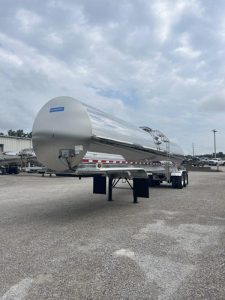
A Wabash 7,000-gallon sanitary trailer listed by SEMO Tank illustrates the food-grade equipment that remains part of its broader business. (Photo: SEMO Tank)
The SEMO Tank anniversary marks 50 years of a business that began in dairy transportation and developed into a broader source of equipment and support for tank fleets. Founded in 1976, Semo Tank/Baker Equipment Co. now serves sanitary, food-grade, dry-bulk, fertilizer, and chemical applications from four U.S. locations.
The Perryville, Missouri-based company has acknowledged the milestone in its 50th anniversary message. Its present operation combines new and used equipment with leasing, repair, parts, and component rebuilding.
For carriers, that combination connects two decisions that often arrive at different times: which trailer fits a hauling assignment, and how to support it once it enters service. SEMO’s evolution brings those questions into the same business, while retaining the sanitary-equipment foundation on which it started.
Dairy roots remain visible in a broader equipment range
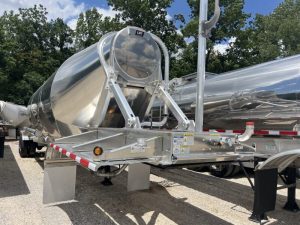
An LBT 1,040-cubic-foot dry-bulk trailer listed by SEMO Tank illustrates its equipment offerings beyond dairy and liquid food transportation. (Photo: SEMO Tank)
Milk and liquid food transportation remain an identifiable part of SEMO’s business. The company describes a long-standing role supplying Walker sanitary equipment, while its current listings include both used food-grade trailers and new sanitary transports.
The FDA’s 2025 Grade “A” Pasteurized Milk Ordinance requires milk-tank interiors, hoses, pumps, and fittings to remain in good repair, and recognizes equipment built to 3-A Sanitary Standards as meeting its sanitary design and construction requirements. That connects a trailer’s original specification with the fabrication, component replacement, and upkeep needed throughout its working life.
SEMO’s equipment inventory includes 2026 Wabash 7,000-gallon sanitary trailers and an STE 8,000-gallon sanitary transport. Those sit alongside dry-bulk equipment, including a 2027 LBT 1,040-cubic-foot trailer and Capacity yard trucks. Individual units and availability change, but the range illustrates how far the offering now extends beyond milk hauling.
The September company profile also identifies fertilizer and chemical transportation among SEMO’s markets. Across those applications, the company says its sales team considers capacity, configuration, intended use, and budget when helping customers select equipment.
SEMO’s leasing options cover new and used equipment through lease-purchase and straight lease or rental plans. That gives customers more than one way to obtain equipment; the appropriate arrangement depends on the unit, expected use, and agreed terms.
Four locations connect equipment sales with shop support
SEMO’s geographic footprint includes two Missouri locations, an operation in Florida, and another in New Mexico. Its website identifies the businesses as follows:
| Location | Operation |
|---|---|
| Perryville, Missouri | Semo Tank/Baker Equipment Co.; headquarters |
| Springfield, Missouri | Rogersville Tank Repair |
| Ocala, Florida | Gator Tank Trailer |
| Portales, New Mexico | Semo West |
In its profile in Tank Transport Trader’s September 2026 edition, SEMO reports 3-A certification at all four locations. It identifies an ASME U Certificate of Authorization at Perryville and National Board R stamps at Perryville, Springfield, and Ocala.
Those credentials concern different types of work. The National Board explains that its R Certificate of Authorization covers repairs or alterations to pressure-retaining equipment. The program requires a documented quality system and an authorized inspection arrangement. For a fleet assigning a repair, the relevant question is the specific facility’s authorization and scope for that job.
Parts, rebuilding and the life of the trailer
The breadth of SEMO’s support work is central to its development. The company lists mobile hydraulic systems and components, pump and blower sales, and rebuilding alongside trailer sales and parts. Its service operation describes work ranging from routine maintenance to complete rebuilds, with custom fabrication also available.
For dry-bulk fleets, unloading performance also depends on how the blower, trailer, and receiving system work together, as Tank Transport explores in its dry-bulk loading and unloading analysis.
The September profile adds troubleshooting, custom modifications, and stainless fabrication to that picture. These services address equipment already working in a fleet, as well as units being prepared for an upcoming assignment. The company’s parts department serves sanitary, chemical, and dry-bulk customers.
FMCSA’s guidance on systematic inspection, repair and maintenance describes a scheduled program to keep vehicles safe, with upkeep intervals tailored by the carrier to its fleet and individual vehicles. Specialized shops can support that planned work as well as larger repairs.
That emphasis has a documented history. In April 2019, Tank Transport reported on SEMO’s Perryville parts and service expansion, including a new parts warehouse and hose assembly station. The company also described a specialty bay intended to accommodate blower, power-takeoff, and hydraulic pump installations.
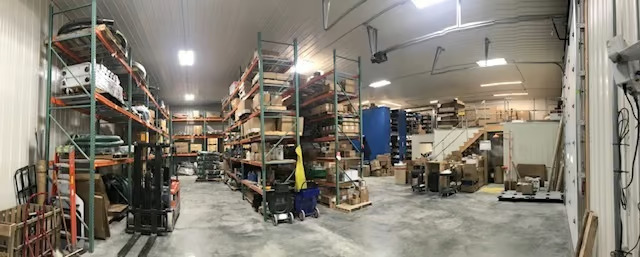
SEMO Tank’s Perryville parts warehouse appeared in Tank Transport’s April 2019 coverage of the company’s expansion. (Photo: SEMO Tank)
The same report outlined plans for an in-house blower rebuilding and testing facility. Today, the company lists blower rebuilding among its services, providing continuity between that earlier investment direction and the present business.
For fleets, the practical value of this model is the ability to discuss replacement equipment, component work and trailer repairs with a supplier familiar with several parts of the operation. Whether rebuilding or replacement makes sense remains a decision about the individual asset, its condition and its intended service.
At 50, SEMO’s story is therefore about the range of work surrounding the tank trailer: selecting it, equipping it, supplying its parts and maintaining it over time. Dairy transportation remains part of that identity, with a broader group of bulk operators now represented in the company’s equipment and service offerings.
SEMO Tank at 50: Key Developments
- Five decades: SEMO’s 1976 start places its 50th anniversary in 2026.
- Broader applications: Dairy and food-grade equipment are joined by dry-bulk, fertilizer, chemical, and yard-truck offerings.
- Four locations: Perryville and Springfield, Missouri; Ocala, Florida; and Portales, New Mexico form the company’s operating footprint.
- Support through the equipment’s life: Sales and leasing are accompanied by parts, repairs, fabrication, and pump and blower rebuilding.