Image note: The featured photograph is a representative stock image. It is not intended to depict or imply involvement by any carrier, terminal, vehicle, driver or other party discussed in this article.
- EPA will allow location-specific wintertime gasoline volatility treatment beginning September 1, 15 days before the federal summer control period ordinarily ends.
- From August 29 through August 31, gasoline containing 9% to 15% ethanol may enter a common federal 10-psi RVP pool under coordinated waivers.
- State enforcement and non-RVP requirements remain important, and the allowable limit as of September 1 is location-specific—not a single nationwide RVP number.
The EPA winter gasoline waiver will move the federal transition to wintertime gasoline forward to September 1, giving refiners, terminals, marketers and fuel haulers additional flexibility 15 days before the federal summer volatility control period ordinarily ends.
The U.S. Environmental Protection Agency issued the temporary nationwide action on August 20 after consulting with the Department of Energy. At the terminal and tank-truck level, however, the change should not be read as permission to load one 10-psi gasoline grade everywhere. The applicable specification still depends on the date, destination, ethanol content, state requirements, and the product represented on transfer documents.


EPA framed the action as a supply measure amid reduced refining capacity and limited refinery slack. EIA’s weekly supply data put U.S. motor-gasoline stocks at 208.7 million barrels and refinery utilization at 96.2% for the week ending August 7; EPA described the inventory as 6% below its five-year seasonal average. Those pressures follow the finished-product constraints examined in Tank Transport’s fuel supply crunch analysis.
The Federal Gasoline Waiver Uses a Two-Step Transition
The signed August 20 waiver letter creates two main operating periods. A short common-pool period begins August 29, followed by an early move to location-specific wintertime limits on September 1.
| Period | Federal treatment | Distribution-chain reading |
|---|---|---|
| Aug. 29–31 | E0 may use a 9.0-psi federal limit, while gasoline containing 9% to 15% ethanol may be produced, distributed, and sold at a common federal RVP limit of 10 psi. | Confirm ethanol designation, destination and any state or commercial limits before changing rack product codes. |
| Sept. 1–15 | The federal volatility limit moves to the location-specific ASTM D4814 limit listed for September 16. | There is no single nationwide winter RVP. Terminals and dispatchers must use the correct location-specific specification. |
| Sept. 1–17 in cited Arizona and Texas areas | EPA applies the waiver to referenced ASTM D439-89 limits where State Implementation Plan controls extend beyond September 15. | Federal relief does not decide whether the state will maintain its own enforcement. |
| After an applicable waiver element expires | Qualifying gasoline introduced into a domestic pipeline or certified at a manufacturing or import facility before expiration may continue through the system. | Product transfer documents or certificates of analysis must demonstrate eligibility, and only the identified volume receives runout treatment. |
Under ordinary federal rules, EPA generally limits summer gasoline to 9.0 psi RVP, with lower limits in certain areas and specific ethanol provisions. RVP measures gasoline volatility, and the summer program reduces evaporative emissions that contribute to ground-level ozone. EPA’s gasoline volatility overview explains that the control period normally runs through September 15.
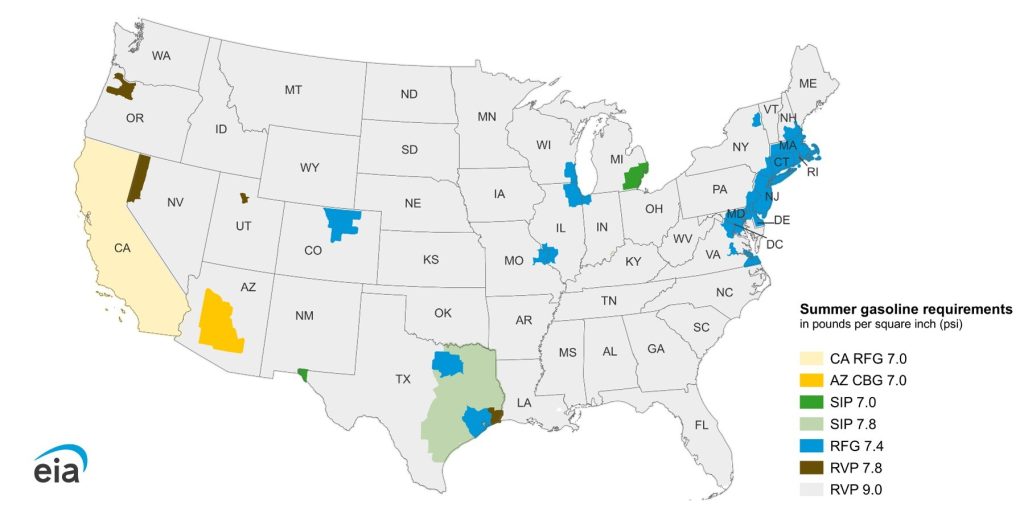
Normal summer-grade gasoline vapor-pressure specifications vary by region. EPA’s August 20 waiver temporarily changes the federal treatment described in this article; state requirements and terminal acceptance still require separate confirmation. (Graphic: U.S. EIA, April 15, 2026; data source: U.S. EPA)
EPA said the earlier winter transition could add hundreds of thousands of barrels per day to gasoline supply. That is the agency’s projected supply effect, not a guarantee of a uniform rack-price reduction or a fixed increase in tank-truck demand. The direct change is broader flexibility to produce and distribute gasoline without removing as many higher-volatility blending components during the first half of September.
One National Waiver Does Not Create One National Grade
The most important operational boundary is the split between federal and state enforcement. EPA is waiving federal enforcement of covered state “boutique” fuel provisions. Still, the agency’s fuel-waiver record and signed letter leave each state free to waive or maintain state-level enforcement.
For State Implementation Plan volatility controls that continue beyond September 17, EPA said it intends to issue another waiver while the cited supply conditions persist or until the applicable control period ends. That follow-on action was an announced intention, not a waiver already issued by the August 20 letter.
That means suppliers, terminal operators and marketers should confirm current state notices and destination-specific specifications before changing inventory designations, blending instructions or loading permissions. Terminal acceptance and customer contracts may also remain tighter than the federal ceiling. A legal federal grade is not automatically the grade a particular rack, branded program, or receiving account will accept.
The waiver also does not turn E15 into an unrestricted gasoline grade. Parties producing, selling or distributing E15 must continue meeting requirements unrelated to RVP, including EPA’s conditions limiting E15 to model-year 2001 and newer light-duty vehicles. The relief changes volatility treatment; it does not erase labeling, compatibility, or other Part 1090 obligations.
The gasoline action is also distinct from EPA’s geographically narrow Arctic diesel waiver. The national gasoline waiver concerns volatility and ethanol-blend flexibility, while the Alaska action concerns diesel sulfur limits for compatible legacy equipment above the Arctic Circle.
PTDs and COAs Control Post-Expiration Runout
The waiver provides a document-based path for qualifying inventory to continue moving after the relevant expiration date. Gasoline that entered a domestic pipeline or was certified at a manufacturing-facility gate or import facility before expiration may be distributed and sold until the volume identified on its product transfer documents or certificate of analysis is depleted.
For the hauling chain, accurate product identity and document continuity are more important than the calendar alone. The federal gasoline PTD rules continue to apply, and the waiver does not say every driver must carry a separate certificate of analysis. It says a PTD or COA must be able to establish the qualifying volume and timing.
Through September 15, certified butane or pentane blenders using the waiver’s additional relief still face conditions. EPA requires an inline analyzer, weekly oversight and records under API 1640, continued reporting—although production may be aggregated into batches as large as one per month—and prescribed waiver language in the RVP test-method field. All Part 1090 requirements not expressly waived remain in force.
EPA based the waiver on what it described as continuing extreme and unusual supply circumstances, including disruptions in the Middle East, lower U.S. refining capacity, and limited spare refinery capacity. Tank Transport’s earlier review of U.S. fuel supply conditions explains why a national inventory total can still conceal regional product and logistics constraints.
September Gasoline Waiver Key Developments
- From August 29 through August 31, gasoline containing 9% to 15% ethanol may use a common federal 10-psi RVP limit under the coordinated waiver.
- Beginning September 1, the allowable federal volatility limit becomes the location-specific ASTM D4814 limit listed for September 16—not one national RVP number.
- States may maintain their own enforcement, and all non-RVP requirements governing E15 and other gasoline remain applicable.
- Qualifying pre-expiration inventory may continue to move once PTDs or COAs establish the covered volume and timing.