- Eligible inland tank barges could receive four inspection credits through documentary verification during each five-year certificate cycle.
- The Coast Guard would retain authority to board a vessel, and renewal inspections, drydocks, cargo-tank internals, and required witnessed tests would remain physical.
- The draft would nationalize a regional tank-barge model, encourage digital compliance systems, and recognize approved third-party evidence; comments close September 23, 2026.
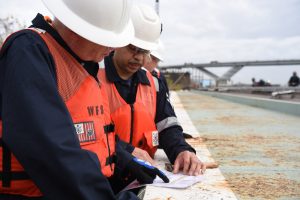
Coast Guard officials review printed materials during a 2020 annual barge inspection near Houston. The draft NVIC would encourage digital compliance systems and risk-based document verification for eligible SIP vessels. (U.S. Coast Guard photo by Petty Officer 2nd Class Johanna Strickland)
The U.S. Coast Guard’s proposed tank barge inspection flexibilities could move much of the annual inspection work for qualifying inland tank barges from the deck to the document file—but only for operators that earn and keep the agency’s confidence.
The Coast Guard released draft NVIC 02-99, Change 1 through an August 24 Federal Register notice. The proposal is voluntary guidance, not a rule, waiver, or immediate operating change. It would update the existing Streamlined Inspection Program, or SIP, and extend inspection methods developed for tank barges in the Eighth and Ninth Coast Guard districts into a national framework.
For tank-barge operators, the important distinction is between when an inspection is due and how the Coast Guard may conduct it. The draft does not lengthen the five-year certificate-of-inspection cycle. It would allow an Officer in Charge, Marine Inspection, or OCMI to grant annual inspection credit after reviewing an enrolled vessel’s records, either remotely or shoreside, when the operator’s performance and supporting evidence justify that treatment.


A Nationwide Model Built From Regional Tank-Barge Practice
SIP is not new. Federal regulations in 46 CFR Part 8, Subpart E establish SIP as a voluntary alternative, allowing an approved company to conduct much of the inspection activity through trained personnel while Coast Guard marine inspectors verify compliance. The 2026 draft would supersede the 1999 NVIC and, if finalized substantially as written, cancel the joint Eighth and Ninth District tank-barge SIP instruction issued in 2019.
The Coast Guard draft’s national inspection-method matrix specifies four documentary inspection verifications and one onboard certificate-renewal inspection during a five-year cycle for SIP Select inland tank barges under Subchapter D or O. The matrix provides cargo vessels, offshore supply vessels, and seagoing barges—including listed Subchapter D and O vessels—with three documentary reviews and two onboard inspections during the mid-cycle periodic inspection and renewal.
| Draft inspection group | Documentary reviews | Onboard inspections | Five-year pattern |
|---|---|---|---|
| Inland tank barges, Subchapter D or O | 4 | 1 | Documentary verifications in years 1–4; onboard COI renewal in year 5 |
| Cargo vessels, OSVs and seagoing barges, including listed D/O vessels | 3 | 2 | Documentary reviews in years 1, 2 and 4; onboard periodic and renewal inspections |
| What does not change | The inspection interval and the Coast Guard’s authority to require an onboard examination | ||
The scale of the broader barge sector explains the proposal’s significance, but not its eligibility. The Coast Guard’s 2024 Flag State report counted 4,922 active inspected barges across three subchapters, or 28% of the inspected domestic fleet. That total is not a forecast of SIP participation: only approved companies and qualifying vessels would receive the proposed flexibility.
The proposal changes the inspection method for eligible SIP vessels—not the five-year certificate cycle or the Coast Guard’s authority.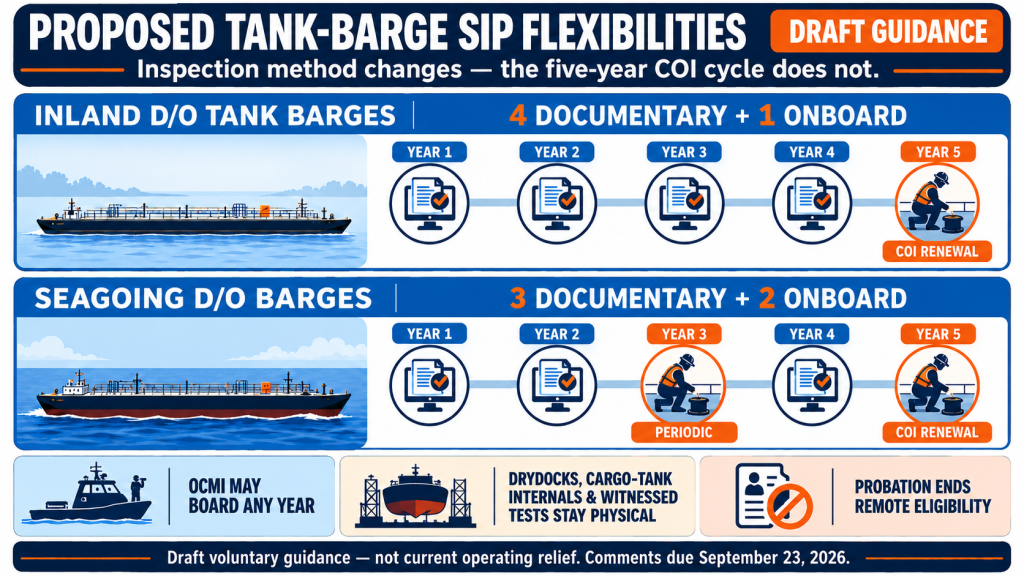
Under the Coast Guard draft, qualifying SIP-enrolled inland Subchapter D/O tank barges could satisfy annual inspection requirements through documentary verification in years 1–4 of a five-year COI cycle, with the COI-renewal inspection onboard in year 5. Drydock and cargo-tank internal examinations and tests requiring Coast Guard witnessing would remain physical. (Graphic: Tank Transport; source: U.S. Coast Guard draft NVIC 02-99, Change 1)
Remote Verification Would Be Earned—and Reversible
Performance is the entry ticket. The Coast Guard draft lists three consecutive years of operation, payment of civil penalties and user fees, accepted company and vessel action plans, and a successful performance evaluation among the general participation prerequisites. A vessel generally would need three years under an eligible operator without a revoked certificate or specified serious deficiencies. The District Commander could waive certain history requirements for good cause when doing so would not adversely affect safety.
Even then, “high-performing” is not reduced to a numeric score. The OCMI would judge the operator’s record, including casualty and deficiency history, correction reporting, overdue items, essential-system notifications, and execution of the approved plans. That discretion lets inspectors respond to actual risk, but it also makes consistency among ports one of the most important questions for commenters.
The Coast Guard draft says a documentary inspection could use a secure data export, read-only system access, screen sharing, or a shoreside records review. The evidence would have to show that an authorized company inspector examined required items and that deficiencies were identified, tracked, and corrected. If records are incomplete, performance declines, or the Coast Guard has clear grounds for concern, the OCMI could require an onboard inspection at any time.
Several high-consequence activities remain outside the streamlined method. Drydock examinations, alternate hull examinations, internal structural and cargo-tank examinations, casualty inspections, major modifications and traditional repair approvals would continue through their existing processes. Machinery, boiler, lifesaving, stability and other tests that regulations require the Coast Guard to witness would still be witnessed. SIP Probation would immediately end remote-inspection eligibility and return the vessel to physical inspections.
Digital Systems and Third-Party Audits Could Cut Duplication

A Sector Houston-Galveston marine inspector conducts an annual barge inspection near Houston on January 9, 2020. This file photograph is illustrative and does not depict the Coast Guard’s 2026 Streamlined Inspection Program proposal. (U.S. Coast Guard photo by Petty Officer 2nd Class Johanna Strickland)
The draft encourages a Digital Compliance System, but it does not eliminate paper. Commercial software, a custom system, or even a controlled spreadsheet could qualify if the OCMI is satisfied that it preserves locked timestamps and signatures, an audit trail, version control, inspection schedules, objective evidence, deficiency workflows, backups, and continuity during an outage. The draft uses ISO 23323 as a functional benchmark rather than prescribing a single vendor.
An approved vessel action plan could also cross-reference evidence from recognized class surveys, third-party organization audits, SIRE inspections, or qualified marine surveyors. That could reduce repeated checks of the same item, particularly for fleets already maintaining several overlapping inspection and assurance programs. But the company’s authorized inspector must still sign the inspection report, and a third party could neither serve as the SIP inspector nor close the operator’s correction report.
The Coast Guard would verify the company’s process, not transfer its certificate authority. Operators would remain responsible for the vessel and the accuracy of the records. The draft provides no dollar estimate of savings, so reduced travel, scheduling disruptions, and duplicate evidence requests should be treated as potential benefits—not promised outcomes. Implementation may also require system controls, data cleanup, examiner training, and a clear crosswalk between company records and Coast Guard inspection items.
That record discipline matters at the interfaces that Tank Transport operates across inspection policy, compliance systems, and marine shipping. It also reaches multimodal facilities such as the Gulf Coast chemical network described in Tank Transport’s ENEOS–TPC acquisition analysis, where barge, pipeline, rail, and truck movements converge.
Remote reviews reward a working compliance system; they do not transfer the Coast Guard’s certificate authority to the operator or a third party.Repair Flexibility Is Narrow, Not a Hull-Repair Blank Check
The Coast Guard draft describes a three-level method for temporary hull repairs on enrolled vessels. It states that Level 1 would cover minor, nonstructural conditions that do not affect primary structure, watertight integrity, or an essential system; the operator could manage those internally without advance notice. Level 2 would cover more consequential nonstructural conditions. Under the Coast Guard draft, the operator would notify the OCMI within 48 hours, submit a repair plan, and proceed only if the agency does not object, then provide a permanent-repair plan within 45 days unless another schedule is approved.
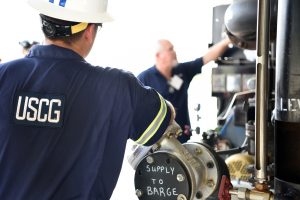
A Coast Guard marine inspector stands beside equipment marked “Supply to Barge” during hands-on training with industry partners in Channelview, Texas, on September 10, 2019. The image is illustrative and does not depict the Coast Guard’s 2026 SIP proposal. (U.S. Coast Guard photo by Petty Officer 2nd Class Johanna Strickland)
Level 3 would remain in the traditional survey-and-approval channel for primary structure, an active watertight breach, or conditions affecting propulsion, navigation, or safety. Casualty-reporting duties would override the streamlined process. The draft’s Level 2 size language is also ambiguous enough that operators, surveyors, and Coast Guard units would benefit from a clearer test before final guidance is issued.
A related correction-report process would distinguish an operator’s timely self-discovery from a deficiency first found by the Coast Guard. An essential-system deficiency reported by the company within 48 hours would be entered into the Coast Guard’s MISLE system but flagged against public display in PSIX. If the Coast Guard first finds the condition, it may issue a CG-835V, which is publicly visible. Only the Coast Guard could clear the deficiency, including when it accepts remote evidence of correction.
That creates a deliberate incentive to find and report problems early. It is not permission to defer unsafe work, and the OCMI remains the final decision-maker. The strongest industry comments will therefore address measurable eligibility, consistent port-to-port administration, secure data access, the boundary between repair levels, and how documentary credit works when records or vessel condition give the inspector cause to board.
Coast Guard Tank-Barge Proposal: Key Developments
- No operating change yet: NVIC 02-99, Change 1 remains draft voluntary guidance, and the current inspection program stays in force unless the Coast Guard finalizes the revision.
- Four documentary credits proposed: Eligible SIP Select inland Subchapter D and O tank barges could receive documentary inspection verifications in four years of a five-year certificate cycle, with renewal onboard.
- Physical safeguards remain: The OCMI could require an onboard inspection at any time, while drydocks, cargo-tank internals, casualty work, and required witnessed tests would not become remote.
- Digital and third-party evidence is conditional: Operators could use approved systems and audit crosswalks, but company responsibility and Coast Guard certificate authority would remain intact.
- Comment deadline: The Coast Guard’s proposal summary directs stakeholders to docket USCG-2026-0041; comments are due September 23, 2026.