- EPA expects to award approximately $180 million through a Diesel Emissions Reduction Act (DERA) competition closing January 22, 2027.
- Private tank and bulk fleets can participate through eligible public agencies and nonprofits, with truck-replacement funding shares tied to certified emissions.
- Ownership, operating history, replacement technology, and scrappage requirements determine whether a project qualifies.

Trucks of the Centerport Milk Hauling Cooperative parked in Centerport, Pennsylvania, in June 2015. (Photo: Shuvaev/Wikimedia Commons; CC BY-SA 4.0)
DERA fleet funding is available through a new national competition that could help tank and bulk carriers replace qualifying diesel trucks or upgrade eligible engines. The U.S. Environmental Protection Agency opened the round September 24, with approximately $180 million in anticipated awards and an application deadline of January 22, 2027, at 11:59 p.m. Eastern.
The opportunity reaches beyond one fuel-hauling segment. Petroleum delivery trucks, chemical-hauling tractors, milk trucks, and pneumatic bulk tractors may fit the program’s heavy-duty vehicle categories. Qualification depends on the equipment and proposed project, rather than the cargo carried.
For fleet owners, the first decision is whether an eligible replacement can justify the remaining capital expense and retirement of existing equipment. Next, they must find an organization that can sponsor and administer the project. Private carriers cannot apply directly to EPA under this competition.
The 2026 national funding round is a separate development from the DERA reauthorization debate covered in 2024. This announcement supplies an application window and project requirements, although final awards remain subject to funding availability, application quality, and agency priorities.
Private fleets need an eligible applicant
Eligible applicants include public agencies and port authorities with jurisdiction over transportation or air quality, as well as qualifying nonprofits. A trade association’s nonprofit status alone does not settle eligibility; it must meet the program’s purpose or service criteria.
EPA’s participant-support guidance provides a route for grant recipients to help fleet owners buy eligible equipment through rebates or subsidies. The carrier can own the replacement vehicle while participating in a recipient’s emissions-reduction project. A subaward is a different arrangement, carrying additional responsibilities; it should not be treated as interchangeable with a rebate.
That makes the early conversation with a prospective partner concrete: which trucks would be included, where they operate, what replacement is proposed, who supplies the required contribution, and how purchases and payments would be handled. The fleet should establish those responsibilities before treating a possible award as part of its equipment budget.
EPA’s regional diesel collaboratives can help identify potential partners. A useful first approach is a short equipment inventory and operating summary, rather than a request for an unspecified grant. VINs, engine information, annual mileage, operating areas, and replacement plans give an applicant something it can evaluate.
For a private fleet, the starting point is an eligible project partner and a documented equipment plan.
Match the project to the truck and engine
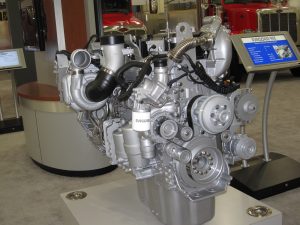
A PACCAR MX diesel engine photographed in October 2009. (Photo: Mahanga/Wikimedia Commons; CC BY 3.0)
The 2026 funding notice includes Class 5–8 diesel highway vehicles and qualifying nonroad equipment. For a tractor-trailer fleet, the relevant opportunity is truck or engine replacement; the announcement should not be read as a general subsidy for buying tank trailers.
Existing equipment must be operational and currently owned and operated by the participating fleet. It must have two years of ownership and operation before its upgrade or replacement, with at least three years of remaining useful operation at that point absent the grant-funded upgrade. Highway vehicles generally must have accumulated at least 7,000 miles annually during the two years before upgrade. Certain predominantly nonroad uses can be considered under an operating-hours exception requiring EPA review.
These conditions favor accelerating retirement of working equipment. A disabled truck bought for a grant application, or a unit with less than three years of remaining operation, does not meet those conditions. EPA’s eligibility statement requires the owner to attest to the vehicle’s condition, ownership, and remaining life.
The engine model year also affects replacement options. Table 5 permits broader replacement choices for engines from 2009 and earlier. For 2010 and newer engines, the replacement pathway requires qualifying zero-emission technology or an engine certified at 0.10 grams of nitrogen oxides per brake-horsepower-hour or lower. Replacement engines generally must be model year 2024 or newer. For replacements outside the low-NOx or zero-emission category, the table permits model year 2019 or newer for drayage trucks.
Bulk carriers should examine the drayage definition. It includes Class 8 trucks moving bulk or break-bulk cargo through port or intermodal rail-yard property, as well as container movements. Under EPA’s drayage guidance, recipients must document frequent prior drayage use and continued qualifying use of the replacement. The sample’s trip counts and dates are examples, not universal requirements.
A chemical or dry-bulk operator serving a port may therefore have a relevant project. Operating near a port alone does not establish eligibility. Gate records, dispatch histories, and customer routes can help explain the actual work.
Certified emissions set the funding share
For internal-combustion highway replacements, EPA ties the maximum contribution to the replacement engine’s certified nitrogen-oxide limit. The following tiers apply to eligible vehicle costs; they are funding ceilings, not promised awards.
| Certified engine NOx limit g/bhp-hr | EPA share, up to | Recipient cost share |
|---|---|---|
| 0.11–0.20 | 25% | 75% |
| 0.036–0.10 | 35% | 65% |
| 0.035 or lower | 45% | 55% |
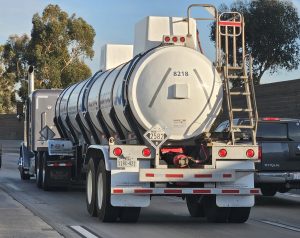
A chemical tanker displaying a ferric chloride placard on State Route 60 in Monterey Park, California, on December 1, 2023. (Photo: Epolk/Wikimedia Commons; CC BY-SA 4.0)
EPA’s certified-engine guidance explains why the engine family matters. Two newly manufactured engines can have different certified limits. Applicants seeking a higher contribution must identify a suitable potential replacement engine family in the application; omitting that information generally leaves an internal-combustion vehicle project at the 25% tier.
Engine-only replacements have separate maximum shares of 40%, 50%, and 60% across the same emissions bands. EPA’s FAQ also confirms a 45% contribution for eligible fully electric vehicle replacements, but it excludes charging equipment. A fleet must compare the entire project cost, including expenses outside the grant.
Consider a hypothetical truck with $200,000 in eligible replacement cost. The three vehicle tiers would provide up to $50,000, $70,000, or $90,000, leaving $150,000, $130,000, or $110,000 to be funded from other allowable sources. This is an illustration, not a truck-price estimate or award prediction.
A higher percentage does not necessarily produce a lower fleet outlay. If one eligible truck costs $200,000 at the 25% tier and another costs $280,000 at the 45% tier, the remaining shares are $150,000 and $154,000, respectively. Financing, maintenance, energy costs, and route suitability still determine the better purchase.
For tank operations, that comparison should include payload, power-takeoff requirements, unloading equipment, range, and service support. The changing heavy-duty emissions policy adds another reason to confirm a proposed engine’s certification rather than assume every truck from a particular model year earns the same grant share.
Scrappage and timing shape the business case
Under the normal replacement process, the old vehicle or engine must be permanently disabled within 90 days after the replacement becomes operational. EPA’s 2026 questions and answers reinforce that requirement. The notice also allows a limited alternative, with prior EPA approval, in which a 2010-or-newer highway vehicle replaces a pre-2009 unit that is then scrapped.
The practical effect changes the replacement calculation. A fleet generally cannot count on both grant assistance and ordinary resale proceeds from scrapped equipment. Before selecting units, compare the grant benefit with the lost trade-in value, required contribution, and delivery schedule.
EPA requires scrappage evidence, including identification records and photographs. Keeping the engine label, VIN, mileage history, and disposal documentation together reduces the risk that an otherwise sound project becomes difficult to verify.
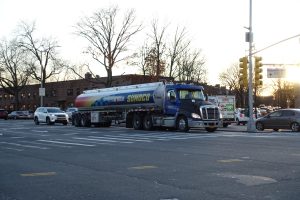
A Sunoco fuel tanker at Woodhaven Boulevard and Metropolitan Avenue in Queens, New York, on January 4, 2022. (Photo: Tdorante10/Wikimedia Commons; CC BY-SA 4.0)
Purchase timing deserves equal attention. The FAQ directs candidates to wait for the award before entering purchase agreements. A selection notice does not authorize work. Fleets should not assume that an order already placed will qualify for reimbursement.
EPA currently anticipates selections in May 2027 and awards in July 2027. Those dates are planning expectations. An operator needing an immediate replacement should weigh that schedule against downtime and customer commitments.
The remaining contribution also competes with everyday working capital. As with tank-fleet fuel expenses and collection timing, a favorable total-cost calculation does not eliminate the need to fund invoices when they come due. Confirm the partner’s payment process before relying on grant proceeds.
DERA Fleet Funding: Key Developments
- Application window: The national competition opened September 24; applications are due January 22, 2027, at 11:59 p.m. Eastern.
- Private-fleet route: An eligible public agency or nonprofit applies; carriers can participate through an approved project arrangement.
- Equipment decision: Assess operating history, existing engine age, replacement certification, and scrappage conditions together.
- Next checkpoints: EPA lists overview webinars for October 13, October 28, and November 12. Questions are due November 24. Fleets should use that interval to identify a partner, assemble records, and compare eligible replacements.