- U.S. retail diesel reached $6.285 per gallon in the September 14 federal benchmark, up 31.8 cents in one week.
- Surcharge coverage depends on the agreement, including eligible miles, fuel-efficiency assumptions, and how unloading work is treated.
- Even a surcharge that ultimately recovers the increase can leave a fleet financing fuel purchases before customers pay.
Diesel fuel surcharges face a sharper test as the national retail benchmark moves above $6 a gallon. For tank and bulk carriers, the question reaches beyond how much the next fill-up costs: How much of that increase will the freight agreement recover, and when will the money arrive?
EIA says the September 14 benchmark set a nominal record for its series, which began in 1994. Adjusted for inflation, it was the highest since 2022.
The U.S. Energy Information Administration’s September 14 on-highway diesel benchmark reached $6.285 per gallon, compared with $5.967 a week earlier. That 31.8-cent increase adds $318 to every 1,000 gallons purchased at those respective prices.


A chemical tanker returning empty, a milk hauler repositioning for another pickup, and a pneumatic bulk truck running its unloading equipment can have fuel requirements that differ from the mileage shown on a customer’s invoice. The agreement determines how those requirements are paid for. Payment timing determines how long the carrier must fund them.
Diesel’s rise puts the whole trip under scrutiny
A tanker truck stands beside a fuel pump, with storage tanks in the background. (Illustration: Tank Transport)
EIA’s September 18 analysis of diesel prices attributes the rise to elevated crude costs and tight global distillate supplies. It reports that U.S. distillate inventories were 13% below their five-year seasonal average in the week ending September 11, even as refineries operated near capacity.
Regional exposure also differs. EIA’s September 14 diesel readings were $6.027 on the Gulf Coast and $7.250 on the West Coast, including California. A national index provides a common reference, but it does not describe every carrier’s purchasing geography, negotiated discounts, or bulk-fuel arrangements.
Those distinctions extend the issues examined in Tank Transport’s earlier diesel trucking-cost coverage. The immediate operating test is whether the actual fuel bill, the surcharge calculation, and customer payments move together.
That test should start with the full movement: loaded miles, empty positioning, diversions for cleaning, and fuel consumed during loading or unloading. A fuel surcharge can address those costs through several structures. Its presence on an invoice does not, by itself, establish either complete recovery or a shortfall.
What diesel fuel surcharges actually recover
EIA publishes diesel prices but does not set surcharge formulas. The carrier’s agreement with its customer controls the calculation. A percentage applied to freight charges and a cents-per-mile adjustment can produce different results even when they reference the same index.
The Owner-Operator Independent Drivers Association’s calculator explains one per-mile method: subtract the baseline fuel price already allowed for in the rate from the current index, then divide the difference by assumed miles per gallon. Under that approach, the surcharge addresses the increase above the baseline; it is not meant to reimburse the entire fuel bill.
Consider an illustrative trip covering 600 road miles, with a surcharge payable on only 500 loaded miles. Assume the truck averages 6 mpg across those road miles, the surcharge formula also uses 6 mpg, and both its purchase price and reference index rise by 31.8 cents. Assume an immediate, exact formula adjustment with no rounding or price bands.
| Trip calculation | Result |
|---|---|
| Road fuel: 600 miles ÷ 6 mpg | 100 gallons |
| Additional road-fuel cost: 100 × $0.318 | $31.80 |
| Surcharge increase: $0.318 ÷ 6 mpg | $0.053 per eligible mile |
| Additional surcharge: 500 × $0.053 | $26.50 |
| Increase not covered by this surcharge calculation | $5.30 |
The $5.30 is an incremental difference for this assumed trip, before stationary fuel use. It is not the trip’s total fuel cost or proof of an operating loss. Another charge or the negotiated freight rate may cover it. Applying the same adjustment to all 600 miles would recover the modeled $31.80 road-fuel increase.
Actual tank-carrier terms demonstrate why that qualification matters. Quality Carriers’ rate and policy guide, effective September 18, 2026, applies a percentage surcharge to linehaul, minimums, and tractor-movement charges, including specified deadhead movements. It also includes certain empty positioning within continuous-trip rates.
These are examples of published terms, subject to the applicable customer agreement. They show that empty mileage can be addressed explicitly. The useful comparison is between the fleet’s actual work and its own compensation terms.
Bulk unloading adds a separate fuel demand.
Road mileage is only part of the fuel picture when the truck engine powers a pump, compressor, or blower. That work continues while the truck is stationary, so a road-only mileage calculation can miss it unless the rate or accessorial arrangement accounts for it.
For example, Paragon’s P657 blower manual specifies power requirements that vary with speed and pressure and describes the relationship between engine speed, power-takeoff ratio, and blower speed. That is why you should measure unloading duty separately, not assign every pneumatic truck the same gallons-per-hour estimate.
The distinction also matters for dry-bulk loading and unloading: fuel per completed load depends on the equipment and transfer conditions. A stationary engine working under load should not automatically be treated as ordinary idle time.
Quality Carriers’ guide separately lists charges for pumping and air equipment, as well as detention provisions. These charges create a compensation mechanism, but their existence does not determine whether every customer’s rate covers every gallon consumed.
For a fleet reviewing a lane, engine-hour and fuel records can help separate road consumption, unloading work, and waiting. Keeping those categories distinct also prevents double-counting costs already included in an equipment charge or a rate built around the full trip.
Recovering the cost still leaves a cash-flow question

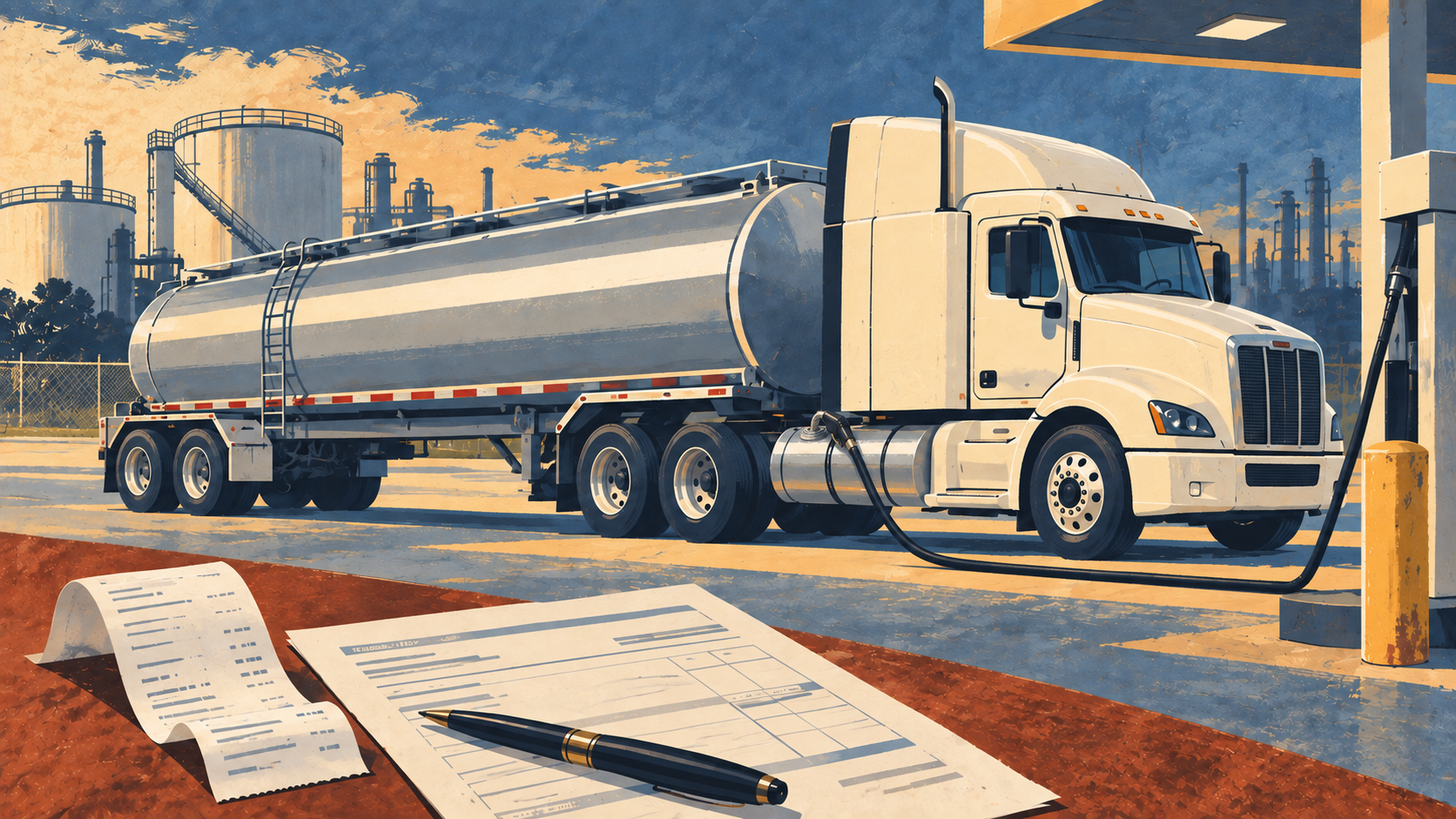
Tracking fuel expenses alongside freight invoices helps fleets distinguish cost recovery from payment timing. (Illustration: Tank Transport)
Two different delays matter. Index lag arises when fuel prices change before the surcharge adjusts. Collection lag is the interval between when freight revenue is billed and when it becomes cash. A faster surcharge reset can reduce the first without eliminating the second.
In its 2025 annual report, Schneider says it has historically recovered most fuel-price increases through surcharges, while identifying lag and incomplete recovery as risks. That disclosure illustrates the mechanism; it does not establish a measured September 2026 loss for its bulk business.
Quality Carriers’ published guide provides another concrete distinction. Its regular fuel-index schedule takes effect the day after Tuesday publication, while freight bills are due 30 calendar days after billing when credit is extended. Those provisions describe billing terms, not the company’s actual collection performance or fuel-payment schedule.
For a separate cash-flow illustration, assume a fleet purchases 10,000 gallons evenly each week. A sustained 31.8-cent increase adds $3,180 to its weekly fuel spending. Assume the carrier ultimately recovers the entire increase, with no index lag, but pays for the fuel 30 days before receiving the corresponding customer payment.
Once that cycle fills, approximately $13,629 in additional working capital would be tied up: $3,180 multiplied by 30/7 weeks. This is a hypothetical funding requirement, not a recurring weekly loss. Supplier credit, customer payment timing, and changes in gallons purchased would alter it.
Recovering a fuel increase on the invoice does not eliminate the cash needed before the customer pays.That makes billing accuracy part of the operating response. Applying the agreed index date, documenting eligible movements, and submitting complete delivery and accessorial records promptly can reduce avoidable delays. A correctly calculated surcharge still provides little immediate cash relief while an invoice waits for missing documentation.
Tank-Fleet Fuel Recovery: Key Developments
- The benchmark moved sharply: EIA’s September 14 national diesel reading increased 31.8 cents to $6.285 per gallon.
- Coverage varies by agreement: Eligible mileage, percentage-based charges, baseline prices, and efficiency assumptions determine the adjustment.
- Stationary work needs recognition: Pumping, blower operation, and waiting can affect fuel use beyond road mileage.
- Recovery and cash timing differ: A carrier can recover the increase and still need additional funds between paying for fuel and collecting revenue.
The next federal diesel update is scheduled for September 22. Tank Transport’s Tank & Bulk Markets provides national and regional benchmarks. For individual fleets, the decisive comparison remains closer to home: gallons purchased, compensation earned, and the dates cash leaves and returns.