- BTI’s AutoLoad and AutoWeigh address filtration interruptions and consistency at the loading end of a dry-bulk move.
- Paragon’s P858e broadens the airflow range available during pneumatic transfer, including applications that benefit from lower blower speeds.
- Faster, more predictable deliveries depend on matching those capabilities to the product, trailer, and receiving system.

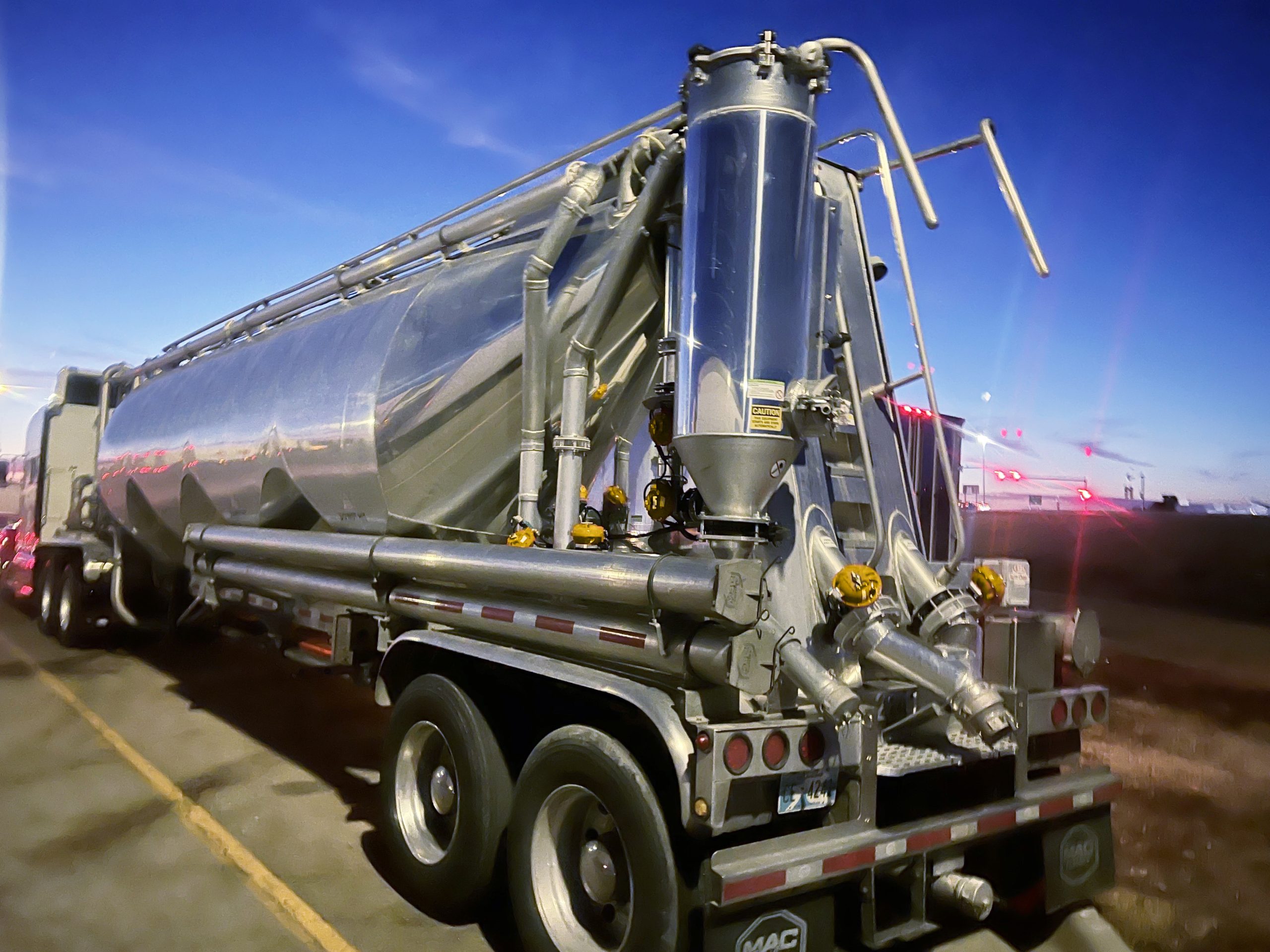
BTI’s AutoClean filtration-system rendering shows the canister, piping, valve actuators and controls arranged at the end of a tank trailer. (Rendering: Bulk Tank Inc.)
Dry bulk loading and unloading can consume productive truck hours even when the highway portion of a delivery runs to plan. A filtration system that needs repeated attention, an inconsistent loading endpoint, or a poorly matched airflow setting can extend the transfer and make the next appointment harder to predict.
Equipment featured in Tank Transport Trader’s September edition illustrates two ways suppliers are addressing that problem. Bulk Tank Inc., or BTI, focuses on loading automation, filtration, and weighing. Paragon Tank Truck Equipment focuses on the air supply that moves dry material through pneumatic systems.
Their products address different parts of the same delivery cycle. For carriers hauling powders and granules, the operational opportunity is to reduce interruptions and make transfer times more repeatable. Whether that produces another revenue load depends on the route, customer schedule, and time saved across the entire trip.
BTI Targets the Stops Inside the Loading Process
BTI’s AutoLoad system brings automatic operation to pneumatic vacuum-trailer loading, transfer, and dust collection. Its filtration technology has an established history: Tank Transport covered BTI and Tremcar’s automatic vacuum-filtration work in 2023. The current equipment story is how those functions fit into a fleet’s loading process.

BTI’s diagram shows filtered air flowing toward the blower during vacuum loading and collected product returning to the trailer during the automatic cleaning cycle. (Graphic: Bulk Tank Inc.)
The company’s AutoLoad operating diagram shows air from the trailer passing through filtration before reaching the blower. The system automatically switches to AutoClean/Recycle mode and returns collected product to the trailer. BTI presents the arrangement as a way to reduce the interruptions and cleanup associated with plugged filtration canisters.
That mechanism matters where filter attention repeatedly breaks up an otherwise straightforward load. Recovering collected material within the system can also reduce handling around the canister. The practical value is the amount of intervention removed from that particular application, along with its effect on the time needed to finish loading.

Ee-Jay Motor Transports is featured in BTI’s AutoLoad customer testimonials. (Logo: Ee-Jay Motor Transports)
BTI pairs that function with AutoWeigh, which it describes on its AutoLoad product page as an addition intended to deliver consistent load weights automatically. In a manufacturer-published testimonial, an Ee-Jay Motor Transports operator reports that the displayed weight matches the trailer’s weight and describes easier loading.
For a fleet already monitoring payload closely, the potential benefit is a more repeatable endpoint and fewer pre-departure corrections. Weight verification, load distribution, and customer acceptance requirements still need to be accounted for in the installation and operating plan.
Application fit comes first. AutoLoad’s vacuum-loading function belongs on equipment designed for that service. Beall’s pneumatic-trailer instructions, for example, distinguish vacuum-capable trailers from units that cannot be loaded that way. A loading-automation upgrade therefore needs evaluation with the trailer builder and system supplier.
Paragon Expands the Useful Airflow Range

Cutaway view of the P858e truck blower and its coated rotors. (Rendering: Paragon Tank Truck Equipment)
At delivery, the task changes to moving product through the discharge route. Paragon’s P858e truck blower uses coated rotors that the company says improve usable airflow and cooling. Its advertised operating range extends from 600 to 3,000 blower rpm, with airflow capability up to 1,020 cubic feet per minute.
Paragon also reports an average 7.1% reduction in horsepower needed to produce the same airflow at 12–20 psi compared with a non-coated blower. That is a manufacturer performance comparison. Actual fuel use depends on the truck’s engine, drive arrangement, and operating conditions.
The lower end of the range is particularly relevant. In its application discussion of the P858e, Paragon describes cement transfer through a 4-inch pipe as an example where a lower airflow band can be useful. The wider range gives operators more scope to match air delivery to the material and piping. That example requires application-specific confirmation before being used as an operating target.
The company’s December 2025 installation and operation manual clarifies the limits. At 1,800 blower rpm and 20 psig, its tables list 504 CFM and 55 brake horsepower for the P858e, compared with 437 CFM and 55 brake horsepower for the P858. This demonstrates additional rated airflow at that operating point; it does not establish a matching increase in product throughput.
The manual’s P858e pressure table also leaves some low-speed, high-pressure combinations unrated. At 600 rpm, listed pressure performance stops at 14 psig; 20-psig entries begin at 900 rpm. The complete performance map therefore matters when specifying the unit. A blower’s maximum pressure rating must also be distinguished from the permissible pressure of the trailer and connected equipment.
A wider airflow range gives a fleet more room to match the blower to the job. The product, trailer, and receiving system determine how much of that capability becomes useful throughput.The Receiving System Can Set the Pace
Consider airflow alongside the material feed and the route to the receiving vessel. Gardner Denver’s pneumatic-conveying guidance explains that excess air volume can increase velocity, waste energy, and reduce capacity. It recommends examining actual transfer rate, pipe length, elbows, and pressure, along with the receiving filter’s condition and pressure differential.
This helps explain why two deliveries using the same tractor and trailer can produce different results. Differences in product behavior, piping, or air separation at the destination can change the useful operating range. A recurring restriction at one customer may require work at that facility as well as adjustments to the transport equipment.
Beall’s pneumatic-trailer operations manual provides a concrete example: an improperly vented receiving bin can leave pressure showing on the gauges after product discharge. Its instructions call for correcting the problem before proceeding. Venting is therefore part of completing the delivery, with consequences for both transfer performance and safe disconnection.
For fleet managers, the inference is that equipment comparisons should include the destinations the trucks actually serve. A blower with a wider range may suit a fleet rotating among several commodities and receiving arrangements. An established dedicated lane may instead benefit most from resolving one persistent restriction or loading interruption.
Where Saved Minutes Become Fleet Value
The two suppliers’ approaches suggest a useful way to separate the investment cases. Each stage has a different source of delay and a different measure of improvement.
| Stage | Potential improvement | Useful measure |
|---|---|---|
| Loading filtration | Automatic cleaning and product recovery | Interruption and cleanup minutes |
| Loading endpoint | More consistent target weights | Weight corrections and departure time |
| Pneumatic unloading | Airflow matched to the application | Tons per transfer hour and fuel per load |
| Receiving facility | Suitable piping and maintained vent filtration | Restrictions, stoppages, and time to release |
The strongest comparison follows similar loads through similar conditions. Recording product quantity, active transfer time, interruptions, and total time on site helps show where improvements occur. Comparing fuel per completed load can then reveal whether reduced transfer time offsets the energy needed to achieve it.
That distinction carries financial weight. Tank Transport’s analysis of bulk-carrier operating economics identifies terminal queues, delays, and equipment utilization as factors in earning capacity. Savings during transfer become more valuable when dispatch can use the released time or reduce the buffer built into a delivery schedule.
For example, a hypothetical 15-minute reduction across four comparable transfers would recover one truck-hour. That is scheduling arithmetic, not a BTI or Paragon performance forecast. The hour might support another movement, reduce overtime, or make the day more dependable; its value depends on where it falls in the schedule.
For future equipment purchases, the most useful evidence will connect the hardware to complete operating cycles: repeatable payloads, fewer interruptions, measured transfer performance, and predictable departure times. BTI and Paragon offer different tools toward those outcomes. The investment case becomes stronger when the fleet can identify the specific delay each tool is expected to remove.
Dry-Bulk Transfer: Key Developments
- Loading automation: BTI combines filtration cleaning, product recycling, and optional weighing functions.
- Airflow flexibility: Paragon’s P858e extends the available blower-speed range, subject to its operating map.
- System fit: Product characteristics, piping, trailer limits, and receiving filtration shape the result.
- Fleet economics: Measure defensible payback across comparable loads and complete delivery cycles.