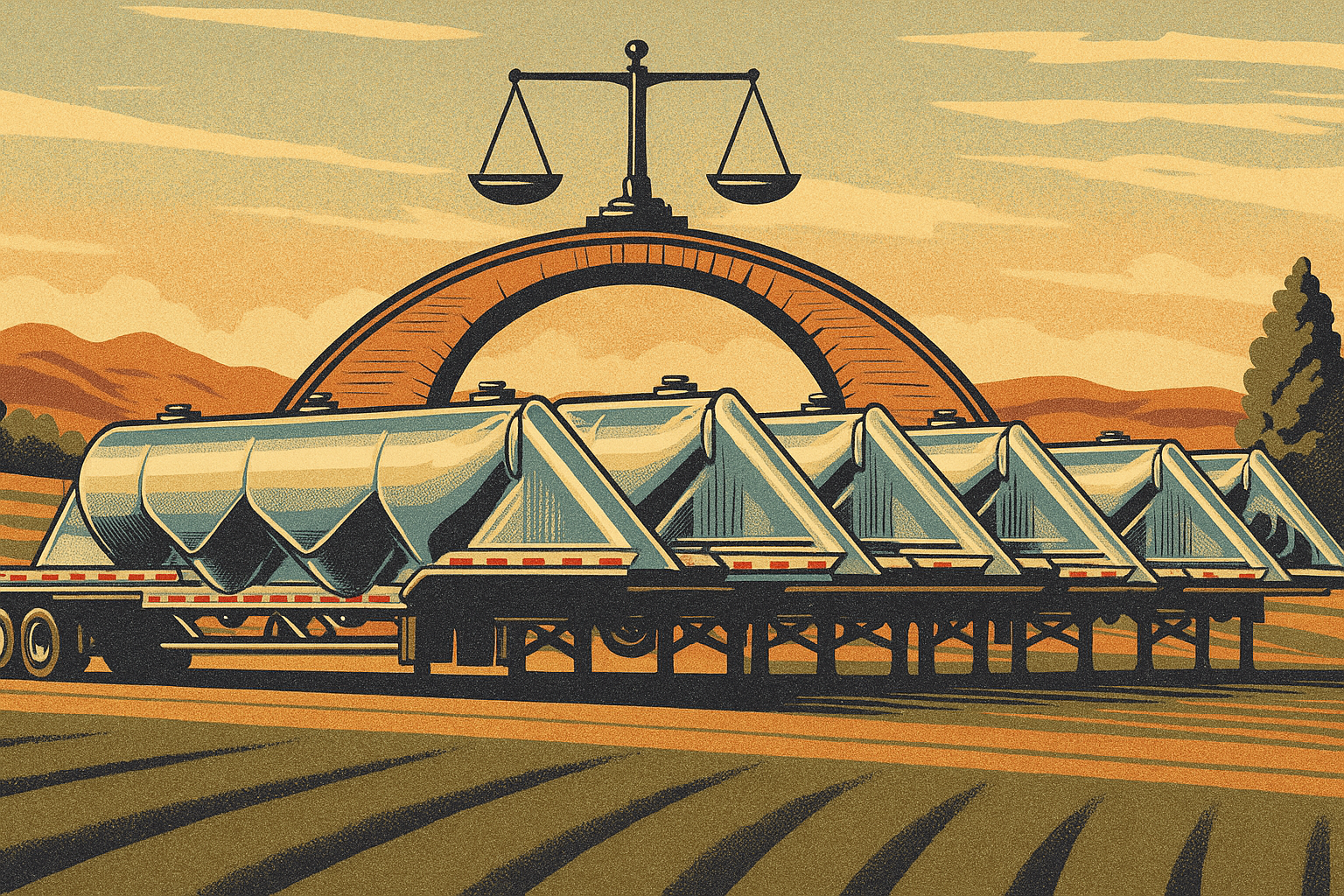
- Dry bulk axle weight variance: 10% tandem-axle cushion (to 37,400 lbs) with the 80,000-lb gross cap unchanged—aimed at physics‑driven load‑shift penalties.
- Bipartisan momentum: S.2108 (Ricketts–Schiff) and H.R. 2920 (Crawford–Carbajal) advance axle‑weight flexibility for dry bulk haulers; backed by ATA, NTTC, and NGFA.
- Tight scope, clear rules: Applies to homogeneous, unmarked, unpackaged, non‑liquid cargo in purpose‑built trailers; Senate EPW and House T&I have the measures in hand.
Dry Bulk Axle Weight Variance — What Changes and Why It Matters?

Tandem-axle group allowances rise from 34,000 to 37,400 pounds.
Trucking fleets that haul dry bulk goods could soon benefit from a 10% axle weight variance under proposed federal legislation. Introduced in June 2025, this bipartisan bill – officially titled the Vehicle Axle Redistribution Increases Allow New Capacities for Efficiency (VARIANCE) Act (S.2108) – aims to give bulk haulers more leeway in how weight is distributed across axles, without increasing the 80,000-pound gross vehicle weight limit. In practical terms, tandem-axle groups on dry bulk trailers would be allowed up to 37,400 pounds per axle group, instead of the current 34,000 pounds, as long as the total truck weight remains at or below 80,000 pounds.
For more news on trucking-related legislation moving through Congress, explore our Legislation news archives.
This dry bulk axle weight variance is designed to accommodate the natural shifting of cargo, such as grain, flour, plastic pellets, sand, and other loose commodities, during transit. Proponents argue that it’s a common-sense adjustment to federal truck weight regulations that could enhance efficiency and mitigate unnecessary penalties for bulk freight haulers. For more news on federal transport regulations affecting trucking, see our Transport Regulations coverage.
Below is a snapshot of the key details:
- 10% Axle Weight Tolerance: This allows axles on dry bulk trucks to exceed the standard limit by up to 10%, addressing load shifts (e.g., tandem axles, which can increase from 34,000 lbs to 37,400 lbs). Notably, the 80,000 lb gross weight cap remains unchanged, so overall weight doesn’t increase.
- Applies to Dry Bulk Cargo: Restricted to homogeneous, unpackaged dry bulk commodities (like grain, plastic pellets, flour, sand) hauled in specialized tank trailers. The variance acknowledges that even when properly loaded, these loose goods inevitably move around inside the trailer.
- Eases Operational Penalties: By permitting slight axle overweight due to shifting cargo, the bill would reduce fines and the need to “underload” trailers. Currently, drivers often leave space or lighten loads to avoid axle overweight tickets, even if the total weight is within legal limits. The variance offers relief in these scenarios.
- Bipartisan, Bicameral Support: The Senate bill was introduced by Sen. Pete Ricketts (R-NE) with Sen. Adam Schiff (D-CA) as a co-sponsor. A House companion bill (H.R. 2920) was introduced in April 2025 by Reps. Rick Crawford (R-Ark.) and Salud Carbajal (D-Calif.), also with bipartisan backing. This broad support indicates momentum across party lines.
- Industry-Backed “Commonsense” Fix: Major trucking and agriculture groups strongly endorse the change. The American Trucking Associations (ATA), National Tank Truck Carriers (NTTC), National Grain and Feed Association (NGFA), Agricultural Retailers Association, Agriculture Transportation Coalition, and The Fertilizer Institute are among the supporters calling it a “commonsense solution” for safer and more efficient bulk transport. They argue it will streamline supply chains and reduce costs without compromising safety or infrastructure.
By focusing on a niche segment (dry bulk tank trucks make up only a few percent of the trucking industry), the proposal targets a specific problem without overhauling general weight limits. In the sections below, we examine in more detail why a 10% axle weight variance is necessary and its implications for efficiency, safety, and the trucking industry as a whole. For more insights into changes across the trucking industry, check out our Trucking Industry coverage.
Enjoying our insights?
Subscribe to our newsletter to keep up with the latest industry trends and developments.
Stay Informed
How the 10% Axle Variance Works (and What It Doesn’t Change)
Why do dry bulk haulers need a 10% axle weight variance?
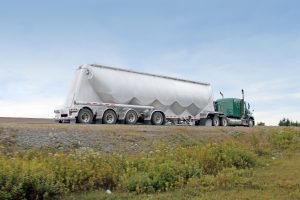
The variance is designed for dry bulk loads that inevitably shift.
Bulk carriers have long struggled with weight distribution rules that don’t fully account for physics. Under current federal law, a truck must not only stay under 80,000 lbs gross, but the load must be evenly distributed so that no tandem axle exceeds 34,000 lbs (and single axles ~20,000 lbs) at roadside weigh stations. This poses a challenge for dry bulk tank trailers hauling materials like grain, feed, plastic pellets, cement, or flour. These goods are loose and prone to shifting inside the tank during everyday driving – even when loaded correctly and sealed for transport.
Every time the driver brakes, for example, the forward motion packs material toward the front end of the trailer, often shifting a disproportionate amount of weight onto the front axle of a tandem set. On acceleration, the reverse redistribution is less effective, meaning the weight doesn’t fully even out again. Over the course of a trip, it’s common for the lead trailer axle to end up over the 34,000 lb limit due to this natural shifting, even though the total truck weight remains legal and unchanged.
For dry bulk drivers, this creates an unfair dilemma. They can load well under capacity – effectively “underloading” the trailer – to build in a safety margin, but that means hauling less product per trip (hurting efficiency and earnings).
Alternatively, they can load near the full 80,000 lbs gross weight and risk receiving an overweight citation on one axle if the load settles unevenly. Such citations can carry steep fines and force a truck off the road until the issue is corrected. It’s a no-win situation caused by physics rather than negligence. Industry experts note that these dry goods will inevitably shift in transit, and current law doesn’t account for that inevitability. The VARIANCE Act’s proposed 10% cushion is meant to solve precisely this problem. “
Most trailers transporting dry bulk goods are tandem axle… Bulk loads of dry goods regularly shift during transport and cause the front trailer axle to exceed its maximum 34,000 pounds,” Sen. Ricketts’ office explained in support of the bill. By allowing a limited 10% axle weight flexibility, the law would ensure that trucks loaded adequately at the origin remain compliant throughout the journey, even if weight distribution changes en route. Essentially, as long as the overall load is within 80k, a dry bulk hauler wouldn’t be penalized for one axle weighing up to roughly 37,400 lbs after normal shifting.
This variance is tightly defined, applying only to “homogeneous, unmarked, unpackaged, non-liquid” cargo in trailers designed for such goods – in other words, bulk tanks carrying a single type of loose product. It would not open the door for general freight or liquid tankers to run overweight on axles, keeping the scope narrow and targeted.
This targeted policy fix highlights the intersection of industry needs and legislation. For further insights into the politics and laws shaping trucking regulations, explore our Politics, Laws & Policies section.
Efficiency Gains and Safety Benefits for Bulk Fleets

The 10% axle variance keeps the 80,000-lb gross limit unchanged.
One of the most significant anticipated benefits of the dry bulk axle weight variance is improved operational efficiency for carriers, especially those in the agriculture and chemical industries. By trusting that a properly loaded dry bulk trailer has a 10% buffer, fleets can maximize payloads without fear of axle tickets, eliminating the practice of leaving part of a trailer empty “just in case.” This means fewer trips needed to haul the same amount of product, which can translate into lower transportation costs and even reduced fuel usage and emissions (fewer runs for the same tonnage).
As the National Grain and Feed Association put it, this legislation provides “long-overdue flexibility to improve trucking efficiency, reduce transportation costs, and enhance the safe movement of essential agricultural commodities.” Grain elevators, feed mills, and plastic pellet producers all stand to gain from more efficient shipping of bulk products. In fact, industry analysts estimate that only ~3% of trucks are tank carriers and just 2% haul dry bulk. Still, those specialized runs are critical links in the supply chain for food, fertilizer, and industrial materials. Optimizing these niche hauls can have outsized benefits downstream – for example, getting grain and feed to market faster and with fewer trucks.
Crucially, supporters stress that safety will not be compromised. The maximum gross weight stays at 80,000 lbs, so bridges and roads won’t see heavier trucks than they do today. The axle variance is modest (10%) and accounts for the weight that’s already on the truck (just not perfectly balanced). “We aren’t asking for an overall weight increase, just flexibility,” proponents say. By preventing arbitrary overweight violations, the change could actually improve safety: drivers won’t be pressured to take backroads or avoid scales to dodge a possible axle citation.
With the variance, they can operate on regular routes confidently, knowing that a shift in their load won’t suddenly put them out of compliance. Enforcement would also be smoother, as weigh station officers could focus on truly overloaded trucks instead of flagging dry bulk haulers a few thousand pounds over on one axle, despite being under gross weight.
How would a weight variance save money for haulers?
A 10% axle weight tolerance lets bulk carriers haul at full legal gross weight without spilling or leaving product behind, even if the load shifts. That means each run carries a higher average payload. Over time, fewer trips are needed to move the same volume of freight, directly saving fuel and labor costs for trucking companies. It also reduces overweight fines – currently, a driver can be ticketed for an axle at ~35,000 lbs, even if the total weight is 78,000 lbs (well under the gross limit).
With the variance, those fines largely disappear. Overall, fleets can boost revenue and reduce penalties by utilizing the full 80,000 lbs capacity more often, instead of running at 70–75k to play it safe. Increased efficiency per load is a win for carriers and their customers, who may see lower shipping costs as a result. For further updates on challenges and developments facing motor carriers, browse our Motor Carriers news section.
Will a 10% axle variance compromise road safety or infrastructure?
No – the proposal is designed to maintain existing safety limits. The total weight of the truck remains unchanged, which is crucial for minimizing wear on bridges and pavements. A truck with a gross weight of 80,000 lbs causes the same stress whether its axles are perfectly balanced or one is 10% over – the distribution shifts slightly. Still, the bridge formula and overall force on the road remain within current standards.
In fact, many states already allow tolerances or seasonal variances for certain commodities without spiking accident rates or damage. Engineers note that a 10% axle variance on a tandem (i.e., ~3,400 lbs extra on one axle, offset by 3,400 lbs less on the other) shouldn’t materially change pavement impact for a short span.

Carriers can move more payload with fewer trips and fewer axle citations.
Additionally, by reducing the need for extra trips (due to underloading), the act could even slightly reduce wear and congestion, as fewer trucks are needed to haul the same amount of goods. Safety advocates do caution against any weight policy changes. Still, because this bill does not raise the overall limit and only affects a small subset of trucks, opposition has been relatively muted compared to past proposals to increase gross weight limits. In sum, the variance seeks a balance: giving truckers the flexibility to handle inevitable load shifts while upholding the 80,000-pound safety threshold that protects roads and bridges. For more articles examining axle weight limits and their impact on infrastructure and trucking operations, read our Axles coverage.
Scope & Definitions for Dry Bulk Axle Weight Variance
- Covered commodities: Homogeneous, unmarked, unpackaged, non‑liquid dry goods (e.g., grain, flour, feed, plastic pellets/resin, cement, sand, fly ash) carried in trailers specifically designed (tank trailers) for dry bulk (e.g., pneumatic tanks).
- Not covered: Liquids; packaged/bagged/boxed goods; general freight vans or non‑purpose‑built equipment.
- Weight framework: 10% variance applies to the axle or axle‑group limit (e.g., tandem 34,000 → 37,400 lbs). Gross vehicle weight remains 80,000 lbs.
- Intent: Address inevitable load shift during standard braking/acceleration while keeping bridge formula protections intact.
Enforcement & Compliance — How the 10% Dry Bulk Axle Weight Variance Applies at the Scale
Scope of applicability (what roads, what law). The variance functions as a federal allowance tied to Interstate weight limits. It applies to the Interstate Highway System; states may mirror the relief on non‑Interstate routes by policy, but that is a separate state decision.
Who qualifies (tight definition). Only homogeneous, unmarked, unpackaged, non‑liquid dry bulk goods in purpose‑built dry bulk trailers. General freight, liquids, and packaged loads are out of scope.
What changes at the scale (and what does not). Axle/axle‑group variance: Up to 110% of the statutory maximum on any covered axle group (e.g., tandem 34,000 → 37,400 lbs; single 20,000 → 22,000 lbs). Gross stays put: The 80,000‑lb GVW limit remains unchanged. The variance cannot be used to exceed 80,000 lbs gross. About tolerances: Treat the 110% ceiling as inclusive (including any enforcement tolerance); do not assume you can stack additional state tolerances“including any enforcement tolerance” on top of it.
Bridge Formula & axle groups (practical view). Apply the 10% to the relevant axle group value (single or tandem) as governed by federal limits/Bridge Formula. Group spans and GVW caps continue to govern overall compliance.
What to carry (scalehouse “go kit”).
- Bill text excerpt or internal compliance memo summarizing the variance and the dry bulk definition.
- Bill of lading naming a single homogeneous, unpackaged, non‑liquid commodity (e.g., polyethylene pellets, wheat flour).
- Equipment identifier (pneumatic dry bulk tank or equivalent), plus on‑board group scale readouts or recent scale tickets if available.
- Company policy note confirming GVW ≤ 80,000 and axle‑group monitoring steps.
At‑the‑scale handshake (driver script).
- Present BOL and state: “This is a covered dry bulk load in a specialized bulk trailer; under the variance, the axle group may be up to 110%; our GVW is ≤ 80,000.”
- Offer a one‑pager with the variance summary and definition highlighted.
- If an axle group is flagged, request group verification and share on-board or group-scale evidence if available.
- If local tolerance rules are cited, note that the variance ceiling should be treated as inclusive, not additive.
Explicit exclusions & edge cases. Not covered: liquids, packaged goods, and general freight vans. For non‑Interstate mileage, confirm the state’s policy. Do not assume relief for special configurations (e.g., spread tandems, tridems, A/B‑trains) beyond how the relevant axle group is defined under federal limits.
Fleet SOPs to Capture the Variance Safely
- Loading discipline: Standardize fill sequence and flow rates; verify trailer is level; use target set‑points by commodity to minimize front‑axle spike after braking.
- Pre‑trip verification: Capture axle‑group readings via on‑board scales or scalehouse tickets; document tare, payload, and group weights in the dispatch record.
- Documentation pack: Keep BOL, equipment ID, variance one‑pager, and latest scale ticket in the driver’s binder or ELD document wallet.
- Driver script & coaching: Practice the at‑scale script; coach on calm presentation, group‑weight terminology, and when to escalate to safety/compliance.
- Mixed‑network routing: For routes with non‑Interstate segments or stricter local limits, retain a small post‑variance cushion (e.g., 200–400 lbs) until policies are confirmed.
- Post‑trip QA: Track citations/reworks; log commodities, lanes, and sites where shift behavior is higher; feed lessons back to loading targets.
- KPIs: Avg payload/trip, % loads ≥95% GVW, axle‑citation rate/100k miles, scale detention (min/load), reworks, net revenue per mile.
Economics — Underloading vs. Citation Risk: A Simple, Dry Bulk Axle Weight Variance ROI You Can Compute
What are these models? Quantify the benefit from (1) the regained payload you previously left as a cushion and (2) the reduced citation/rework exposure from the natural shift.

FHWA Bridge Formula — Quick Reference
Bridge Formula for axle-group limits (does not change the 80,000-lb gross cap)
Define your inputs.
- T = Tare (tractor+trailer+fuel), lbs.
- U₀ = Pre‑variance underload cushion, lbs/trip; U₁ = Post‑variance cushion, lbs/trip; Δp = U₀ − U₁ (payload regained per trip).
- P₀ = 80,000 − T − U₀; P₁ = 80,000 − T − U₁ = P₀ + Δp.
- V = Monthly shipping volume (tons) or N = trips/month.
- C_trip = Variable cost/trip; Fᵣ = avg overweight fine + downtime cost/event.
- R₀ = axle‑citation rate (events/100k mi) pre‑variance; R₁ = expected post‑variance rate; M = miles/month.
Volume‑fixed view (constant tons to move).
- Trips before: Trips₀ = (V × 2,000) / P₀
- Trips after: Trips₁ = (V × 2,000) / P₁
- Trips avoided = Trips₀ − Trips₁
- Cost savings = (Trips avoided) × C_trip
- Fine‑risk reduction = (R₀ − R₁) × (M/100,000) × Fᵣ
- Total monthly benefit = Cost savings + Fine‑risk reduction
Capacity‑fixed view (constant trips; more delivered with the same assets).
- Extra tons/month = (Δp × N) / 2,000
- Option A (revenue): Extra tons × your $/ton (or $/ton‑mile)
- Option B (utilization): Translate extra tons into avoided rentals/overtime or deferred capital
Worked example (illustrative).
- T = 32,000 lbs; U₀ = 1,200; U₁ = 200 ⇒ Δp = 1,000 lbs
- P₀ = 80,000 − 32,000 − 1,200 = 46,800 lbs (23.4 tons)
- P₁ = 47,800 lbs (23.9 tons)
- V = 4,000 tons/month ⇒ Trips₀ ≈ 171; Trips₁ ≈ 167 ⇒ ≈4 trips avoided/month
- If C_trip = $600 ⇒ cost savings ≈ $2,400/month (ex‑fine)
- Add fine‑risk reduction: (R₀ − R₁) × (M/100,000) × Fᵣ
Sensitivity bands (same lane/tare; vary Δp).
- Conservative (Δp = 600 lbs): Trips avoided ≈ 2–3/month
- Base (Δp = 1,000 lbs): Trips avoided ≈ 4/month
- Upper (Δp = 1,600 lbs): Trips avoided ≈ 6/month
State Harmonization: What to Expect at Scales
- Interstate vs. non‑Interstate: Variance applies to Interstate limits; verify state policy before relying on it off‑Interstate.
- Transition period: Expect staggered training/awareness; carry the variance one‑pager and BOL clarity.
- Mixed networks: Maintain a small cushion on routes with local constraints (such as ports and municipal roads) until confirmed.
- Communication: Proactively brief customers and drivers; annotate dispatch notes when the variance is being applied.
FAQs: Quick Answers for Dispatch & Drivers
- Does this exceed 80,000 lbs gross? No—gross remains capped at 80,000 lbs.
- Who qualifies? Homogeneous, unmarked, unpackaged, non‑liquid dry bulk goods in purpose‑built trailers.
- Are liquids or bagged loads included? No—those are excluded.
- How is the 10% measured? On the axle or axle‑group limit (e.g., single 20,000 → 22,000; tandem 34,000 → 37,400).
- Can I stack state tolerances on top of each other? Treat the variance as inclusive; don’t assume stacking.
- What about tridems/spread tandems/LCVs? Follow the applicable axle‑group definition and span rules; don’t assume additional relief.
- What should drivers carry? BOL, equipment ID, variance summary one‑pager, and recent scale ticket or on‑board group readout.
***Precision & rounding (worked example):
Using T=32,000; U₀=1,200; U₁=200; V=4,000 tons → P₀=46,800 lbs; P₁=47,800 lbs;
Trips₀ = 170.94; Trips₁ = 167.36; Trips avoided = 3.576/month;
Exact cost savings = $2,145.69/month at $600 per trip.
For planning/presentation, it’s reasonable to round to ~4 trips avoided and ~$2,400/month (4 × $600), while keeping the exact values in your model/footnote.
***Bill status caveat (as of August 27, 2025):
The 10% axle-weight variance for qualifying dry bulk is outlined in the VARIANCE Act and has not yet been enacted nationwide. Scope is tied to Interstate operations; adoption off the interstate depends on state policy. Treat as pending during rollout, carry a one-pager with BOL details to mitigate enforcement confusion, and verify state implementation before relying on it.
Bipartisan Support and Legislative Progress
The dry bulk axle weight variance concept isn’t coming out of nowhere – it’s the result of years of advocacy by industry groups and has gained notable traction in Congress. The National Tank Truck Carriers (NTTC) has, in particular, pushed for this reform as a top priority, arguing that it would allow carriers to “maximize payloads of materials such as grains, feeds, and plastics, without raising the federal maximum weight or disrupting the bridge formula.” After campaigning on the issue, NTTC members helped rally bipartisan sponsors. In April 2025, Representatives Rick Crawford (R-AR) and Salud Carbajal (D-CA) introduced the VARIANCE Act (H.R. 2920) in the House.

VARIANCE Act Timeline (S.2108/ H.R.292) – Key milestones & current status (as of Aug 27, 2025)
Just two months later, Sen. Pete Ricketts (R-NE) – whose home state’s economy relies heavily on agriculture – teamed up with Sen. Adam Schiff (D-CA) to bring the companion bill (S.2108) to the Senate. Lawmakers from farm states and freight-heavy districts are naturally interested, but the effort’s appeal cuts across party lines, focusing on efficiency and fairness rather than heavier trucks. “American truckers want to carry the same-sized load in loose dry bulk that they can for any other freight,” Sen. Ricketts noted, calling the act “commonsense policymaking” that will boost productivity “at every step along the supply chain.”
Crucially, a broad coalition of stakeholders has lined up in support of the bill. Agricultural shippers, trucker associations, and even some safety advocates see it as a reasonable tweak. The American Trucking Associations (ATA) lauded the House Transportation & Infrastructure Committee when it approved a similar measure in 2023, noting it would help “address some root causes of supply chain challenges”. The NGFA (grain and feed dealers) applauded the 2025 introduction, emphasizing that “by allowing modest axle variances for dry bulk shipments, this legislation supports more efficient and sustainable supply chains while maintaining safety standards.”
Other supporters, such as the Agricultural Retailers Association and The Fertilizer Institute, highlight that essential products (fertilizer, feed, etc.) could be transported at a lower cost and with less hassle, ultimately benefiting farmers and consumers. Even the National Grain & Feed Association’s CEO framed the act as “a commonsense solution” to transportation bottlenecks in their sector. Such endorsements underscore a rare consensus: the bill addresses a niche issue that most agree needs to be fixed.
Legislative status: As of this update, the VARIANCE Act is progressing through Congress. Upon introduction, S.2108 was referred to the Senate Environment and Public Works Committee (which oversees federal highway weight limits). In the House, H.R. 2920 went to the Transportation & Infrastructure Committee. Lawmakers plan to hold hearings in late 2025* to examine the proposal in detail, and supporters are urging swift action. There is precedent for progress – in the previous Congress, a virtually identical provision (dubbed the Dry Bulk Weight Tolerance Act) cleared the House Transportation and Infrastructure Committee in 2023 with bipartisan support. That earlier bill (H.R. 3318 in 2023) didn’t become law before the session ended, but it laid the necessary groundwork.
* supporters expect hearings/markups pending committee calendars
The committee’s 2023 report cited benefits like “lower consumer costs, higher operational efficiency, lower emissions, and improved infrastructure preservation – all without compromising safety.” Those findings bolster the case for the current VARIANCE Act. Now, with both a Senate and House bill alive in 2025 and vocal backing from industry, the odds of enactment appear better than ever. Still, nothing is guaranteed on Capitol Hill. Opponents of truck weight reforms (such as the Coalition Against Bigger Trucks) could raise concerns about any relaxation of axle rules, even a limited one. Lawmakers will weigh those arguments, but so far, the fact that gross weights remain unchanged and only dry-bulk haulers benefit has kept criticism relatively limited.
Current Outlook: What’s Next for the VARIANCE Act?

The proposal has bipartisan backing in both chambers of Congress. (Dry Bulk Axle Weight Variance Infographic)
As the year progresses, attention will be on Congressional committees to take the following steps. Fall 2025 is expected to bring House subcommittee hearings where experts and stakeholders testify on the pros and cons. Senators on the EPW Committee may hold a hearing or consider inserting the provision into a larger transportation bill. Given the bipartisan sponsorship and broad industry support, the bill stands a solid chance of advancing to a floor vote if it clears committees.
One possible vehicle could be upcoming infrastructure or appropriations legislation – sometimes such policy tweaks get rolled into larger packages for easier passage. Industry groups are actively lobbying in Washington to keep the momentum. The NGFA, for instance, has urged “swift congressional action” to ensure timely relief for agriculture shippers. ATA and NTTC are also communicating with lawmakers that this modest reform could help alleviate supply chain delays and driver strain in bulk transportation.
Observers note that if enacted, the 10% variance would align federal law a bit more with practices already allowed in some states (many states have axle tolerances or harvest-season weight allowances). It would also mark a noteworthy win for the tank truck sector. “The future is bright for our industry. It really is,” said NTTC’s Will Lusk at a recent tank trucking summit, referring to regulatory initiatives like the axle variance gaining traction. Still, until the bill is passed, bulk fleet operators must continue managing loads carefully. Tanker carriers are watching closely, and many are optimistic that 2025 could finally be the year this long-sought flexibility becomes law.
Bottom Line: The dry bulk axle weight variance proposal offers a targeted solution to a specific quirk in trucking regulations. It has strong bipartisan support and the backing of key industry players, who view it as a pragmatic and impartial solution to improve efficiency without endangering infrastructure. By allowing a 10% axle weight variance for dry bulk goods – and only those goods – the VARIANCE Act seeks to let truckers haul vital commodities like grain, feed, and plastic pellets more effectively, while respecting the 80,000 lb limit that keeps our roads safe.
All eyes will be on Congress in the coming months to see if this common-sense change rolls forward. The trucking community, especially dry bulk haulers, will want to stay tuned to the bill’s progress, as its passage could directly impact how they load and operate their businesses in the near future. With an impartial lens, the evidence suggests this 10% weight tolerance is a modest tweak with meaningful upside for bulk logistics – a rare win-win scenario in freight regulation if it comes to fruition.
To stay informed on general developments across the tank transport industry, visit our Tank Transport news section.
Key Developments — Dry Bulk Axle Weight Variance (VARIANCE Act S.2108/H.R. 2920)
- What the bills do: Authorize a 10% axle variance for dry bulk CMVs; the practical effect is to lift the tandem-axle limit to 37,400 lbs while maintaining a gross weight of 80,000 lbs.
- Who is covered: “Dry bulk goods” are defined as homogeneous, unmarked, unpackaged, non‑liquid cargo in trailers specifically designed for that purpose.
- Senate status: S.2108 introduced June 18, 2025 (Sen. Pete Ricketts; co‑lead Sen. Adam Schiff) and referred to Senate EPW; status Introduced as of August 27, 2025.
- House status: H.R. 2920 introduced April 17, 2025 (Reps. Rick Crawford & Salud Carbajal); referred to the Subcommittee on Highways and Transit the same day.
- House co-sponsors noted by NGFA: Morgan Luttrell (R-TX) and Josh Harder (D-CA) have joined as co-sponsors.
- Industry support: Public endorsements from ATA, NTTC, NGFA, Agricultural Retailers Association, and The Fertilizer Institute; supporters frame it as a targeted, safety‑neutral efficiency fix.
- Rationale from advocates: Variance addresses inevitable load shift under braking that can spike a single axle while total GVW remains legal—reducing underloading, citations, and trips.
- Operational scope: Applies to dry bulk tank trailers (e.g., grain, feed, plastic pellets, aggregates); this does not apply to general freight or liquid tanks.
- Opposition watch: Groups historically opposed to heavier trucks (e.g., CABT) have flagged concerns broadly; bills emphasize no increase to gross weight.
- Next checkpoints: Both bills remain at Introduced status as of Aug. 2025; next steps are expected to include committee hearings and markups, subject to scheduling by Senate EPW and House T&I.
Authoritative References on the VARIANCE Act (Dry Bulk Axle Weight Variance)
- Understand the legislation’s overview, sponsors, and tracker at Congress.gov – S.2108 (VARIANCE Act) overview.
- Read the authenticated bill language at Congress.gov – S.2108 full text.
- Follow every formal action, referral, and update at Congress.gov – S.2108 all actions.
- Access the House companion bill’s summary and tracker at Congress.gov – H.R. 2920 overview.
- Review the official House bill language at Congress.gov – H.R. 2920 full text.
- See official short and long titles for the Senate bill at Congress.gov – S.2108 titles.
- Check cosponsors, committees, and related details at Congress.gov – H.R. 2920 all info.
- Read the sponsor’s announcement and rationale at Sen. Pete Ricketts press release.
- See industry perspective from grain shippers at NGFA statement on the VARIANCE Act.
- Get reported context and quotes at Land Line Media: axle-variance bill coverage.
- Review trade analysis on tanker/dry-bulk implications at FreightWaves: proposed bill for tankers/dry bulk.
- For prior-Congress background, read Bulk Transporter: House committee approves 10% dry-bulk variance.