- Water tank transport demand is shifting from a niche hauling service to a broader infrastructure issue tied to data centers, drought, and municipal water reliability.
- New water reuse policy, PFAS scrutiny, and wastewater compliance rules could reshape demand for potable water hauling, wastewater hauling, sludge transport, and vacuum truck services.
- For tank fleets, the opportunity is not simply to haul more water—it is to understand equipment dedication, contamination risk, emergency response, and regulated disposal routes.
Why water tank transport demand is becoming a real infrastructure story
Water tank transport demand is becoming a real infrastructure story because the pressure points are stacking rather than appearing one at a time. Texas remains under drought classifications ranging from abnormally dry to exceptional drought on the current U.S. Drought Monitor. At the same time, the Texas Water Development Board’s draft 2027 State Water Plan says the state’s recommended water projects and strategies now total about $174 billion in 2023 dollars, more than double the 2022 plan, and Texas 2036 notes that the draft plan recommends roughly 6,687 water management strategies and 3,036 water supply projects.
In other words, the long-term problem is not whether more water infrastructure is needed; it is how quickly permanent infrastructure can be financed, permitted, and built, and what fills the gap in the meantime. For more reporting on infrastructure issues affecting transportation and utilities, explore our Infrastructure coverage.

Water Tanker Truck 20, operated by U.S. Air Force Fire Protection at MacDill AFB, Florida. (Walter via Wikimedia Commons, CC BY 2.0)
“Water hauling becomes most visible when fixed systems are strained, delayed, offline, or unable to meet short-term demand.”
That gap is where transport enters the story. The draft state water plan says regional planners identified about 1,108 existing emergency interconnects between water systems and another 552 potential new emergency connections. Those permanent and semi-permanent links are the ideal resilience answer. Still, they do not eliminate the need for short-term water movement when utilities lose pressure, treatment plants undergo maintenance, industrial customers need continuity, or wastewater systems require bypass support.


”In practice, pipes and trucks are not substitutes in every case. They are complementary resilience tools.”
The Texas data-center story makes that complementarity sharper. UT researchers describe water not as a secondary input but as a core engineering, environmental, and policy issue for digital infrastructure, because direct cooling water is only part of the footprint. The report also includes indirect water use from electricity generation, which is especially relevant in a grid with significant thermal generation. That means water tank transport demand is not just about hauling potable water to a site. It can also show up in construction water, temporary cooling support, recycled-water distribution, wastewater return flows, sludge movement, and the residual stream created when reuse systems expand.
For more coverage of water-hauling equipment and service trends, see our WaterTruck updates.
What is driving water tank transport demand right now
Three developments are now pushing water tank transport demand from a marginal specialty toward a more visible bulk-hauling vertical. First, data centers are shifting the public conversation from abstract growth to quantifiable water capacity pressure. Second, federal and state policy is moving toward industrial water reuse rather than unlimited freshwater withdrawals. Third, wastewater compliance is tightening at the same time PFAS and biosolids management remain unsettled, increasing the odds of more complicated liquid and solids routing.
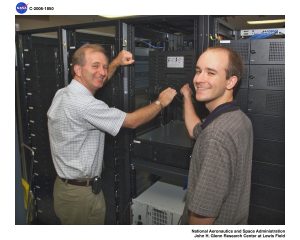
Networking check for the new GX cluster in the Advanced Computational Concepts Laboratory (ACCL) (NASA via Wikimedia Commons, public domain) NASA Identifier: C-2006-1850
“Data centers turn water into a planning issue because cooling, power generation, and site selection are increasingly connected.”
The most important update since the attached draft is that the reuse story is no longer just advocacy language. On May 13, 2026, Senators Ben Ray Luján and Katie Britt introduced the Senate version of the Advancing Water Reuse Act. The bill would create a 30% investment tax credit for qualifying water reuse projects and explicitly covers on-site recycling systems at industrial entities, including data center facilities, as well as projects that replace freshwater with recycled municipal water. Separately, EPA released Water Reuse Action Plan 2.0 on April 16, 2026, and one of its featured actions is support for states expanding recycled-water permitting for industrial and data-center cooling applications.
For updates on federal environmental rules and agency actions affecting carriers, see our EPA coverage.
The wastewater side is just as important. EPA’s biosolids pages show the agency is still in a risk-assessment and research phase for PFAS in sewage sludge: the draft PFOA/PFOS sewage sludge risk assessment was released in January 2025 and its public comment period ended on August 14, 2025; EPA is planning a new National Sewage Sludge Survey focused on PFAS concentrations; and the 2026 interim PFAS destruction-and-disposal guidance adds a technology evaluation framework but does not establish binding requirements or endorse a single disposal technology. That is precisely the kind of regulatory ambiguity that can make hauling markets more active and less predictable, because disposal routes can change faster than a treatment plant can rebuild itself.
For additional stories on environmental compliance and transportation impacts, browse our Environmental reporting.
National research also reinforces the concern, though with a necessary caveat. A March 2026 arXiv paper from researchers at UC Riverside, Caltech, and UT Austin estimates that if 2024 water-use intensity persists, U.S. data centers could require 697 million to 1.451 billion gallons per day of new water capacity by 2030, with a water-capacity valuation on the order of $10 billion to $58 billion. That paper is materially useful, but it is still a manuscript under review rather than a finalized peer-reviewed journal article. The implication for transport is still valid: water capacity, not only power capacity, is becoming a site-selection constraint.
How data centers are changing water tank transport demand
Data centers are changing water tank transport demand in two related ways. They increase total water demand in some markets and force greater sophistication about which water is needed, when it is needed, and whether it must be potable. The UT white paper says total Texas data-center water use could climb to roughly 3% to 5% of statewide demand under lower-capacity futures and 5% to 9% under high-capacity futures by 2030 to 2040. The report also says thermal-heavy grid mixes raise indirect water use, while renewable-heavy mixes reduce it.
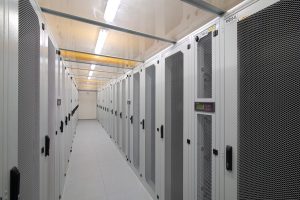
Cold aisle inside the Technology Center Písek data center. (Eclipse55 via Wikimedia Commons, CC BY-SA 4.0)
“The tank transport opportunity is not simply hauling water to data centers, but supporting the wider water strategy around cooling, reuse, and resilience.”
For carriers, that means the opportunity is not merely “haul more water.” It is to understand direct cooling water, indirect power-linked water stress, and the role of reclaimed or non-potable alternatives.
The company’s response is also more developed than it was when the attached draft was assembled, but the disclosures are uneven and self-reported. Oracle says its New Mexico Project Jupiter campus will not use the local public drinking-water system for cooling, will rely on non-potable industrial well water under contract, and will use direct-to-chip, closed-loop, non-evaporative cooling. Oracle also says Bloom Energy fuel cells for the project require a one-time 960,000-gallon startup fill and then are designed to operate without additional water under normal conditions.
Those are significant claims, and they show that some operators are designing to avoid continuous water consumption. But they remain company statements, and UT researchers still emphasize the broader lack of standardized operator-reported facility data.
Microsoft is making a similar argument from a different operating model. Microsoft says it launched a new data-center design in August 2024 that uses chip-level closed-loop cooling to consume zero water for cooling, and that each such data center can avoid more than 125 million liters of water per year compared with evaporative designs. In its newer public-facing explanations, Microsoft also says it has expanded the use of reclaimed and recycled water in Texas, Washington, California, and Singapore, and that its operational data centers have achieved an 18% reduction in water intensity relative to the 2022 baseline.
Again, the logistics implication is not that trucking disappears. It is that water hauling becomes more segmented: less reliance on public potable water in some places, but more reliance on construction fills, reclaimed-water systems, and periodic specialized servicing.
Amazon Web Services is pursuing another variant. Amazon says it already uses recycled water for cooling at 24 data centers globally and plans to expand water recycling to more than 120 U.S. locations in states and counties where it operates by 2030, preserving more than 530 million gallons of drinking-water supply annually. AWS also says it was 53% of the way toward its water-positive goal by the end of 2024. Google reports that it replenished about 4.5 billion gallons in 2024, or roughly 64% of its freshwater consumption, and that its water stewardship portfolio grew to 165 projects as of the end of 2025.
Those disclosures show real movement toward reuse and replenishment, but they are not harmonized metrics, so fleet operators should read them as directional indicators rather than directly comparable operational benchmarks.
”The best near-term opportunities are not likely to come from a simple ‘potable tanker to hyperscale campus’ model. They are more likely to come from enabling infrastructure.”
What does this mean in plain language for water tank transport demand? It means the best near-term opportunities are more likely to come from site construction, one-time system fills, non-potable source movement, municipal reclaimed-water connections, wastewater residuals, backup service during outages, and temporary support when utilities or cooling systems are modified. The more operators move away from evaporative potable-water cooling, the more the transport opportunity shifts toward specialized, lower-frequency, higher-compliance work rather than commodity hauling.
For broader news on tanker operations and liquid bulk movement, follow our Tankers section.
What wastewater compliance means for water tank transport demand
Wastewater compliance is the second major driver of water tank transport demand because aging plants, tighter discharge requirements, and emerging contaminants increase the complexity of liquid handling. A current local Texas case is Beaumont. Recent local reporting says Beaumont’s 74-year-old wastewater plant still handles roughly 16 million to 20 million gallons per day. Still, the city is considering a roughly $20 million to $25 million upgrade because of looming ammonia discharge pressure, and consultants from Black & Veatch recommended a moving-bed biofilm reactor. The city’s FY 2026 capital planning page also indicates that wastewater projects are dependent on the updated wastewater master plan.

The Jones Island Water Reclamation Facility in Milwaukee, Wisconsin. (Michael Barera via Wikimedia Commons, CC BY-SA 4.0)
“As wastewater systems age and compliance pressure rises, tank and vacuum carriers can become part of the infrastructure response.”
For additional reporting on treatment systems, hauling demand, and compliance pressures, browse our Wastewater coverage.
That combination is exactly the kind of local stress point that can create bypass, cleanout, sludge, and bridge-treatment hauling work before permanent improvements are finished.
It is also important that the recommended treatment technology is not speculative. Veolia markets AnoxKaldnes MBBR as a biological wastewater treatment process for the municipal and industrial sectors, emphasizing BOD, ammonia, and nitrogen removal, retrofit potential, a compact footprint, and suitability for tertiary use. Xylem markets a mobile MBBR system for temporary or rental deployment, explicitly positioning it as a bridge solution during retrofits, maintenance turnarounds, failed-equipment replacement, pretreatment compliance, and ammonia treatment. Black & Veatch’s wastewater-treatment practice is built around reclaiming water, nutrients, and energy resources while meeting increasingly stringent standards.
So when a Texas utility like Beaumont looks at MBBR, it is choosing from a mature commercial playbook rather than testing an unproven concept.
PFAS and biosolids add a different layer of uncertainty. EPA says PFAS continue to enter wastewater treatment plants from industrial, commercial, and household sources, and the agency currently recommends states monitor biosolids for PFAS contamination, identify likely industrial discharges, and impose pretreatment requirements where appropriate. EPA is also planning the next National Sewage Sludge Survey to obtain updated PFAS concentration data in sewage sludge. At the same time, EPA’s 2026 interim destruction-and-disposal guidance states that it is not setting requirements and is not endorsing one technology over another. The relevant state and federal rules can vary and change over time.

Aerial view of the Deer Island Waste Water Treatment Plant in Boston Harbor. (Doc Searls via Wikimedia Commons, CC BY 2.0)
“Large treatment plants show why wastewater logistics extend beyond pipes, touching sludge, residuals, compliance, and disposal networks.”
To follow developments involving liquid waste handling and regulated disposal, visit our LiquidWaste reporting.
For carriers, that translates into a messy but familiar commercial reality: more sampling, more documentation, more jurisdiction-specific routing, and less confidence that last year’s disposal outlet will still be the best next year.
Transport demand increases whenever wastewater systems cannot operate normally. University of Virginia’s 2024 sanitary bypass pumping SOP is a useful public example of what serious bypass work looks like: a formal bypass plan, maximum flow estimates, emergency contacts, approved system sketches, daily inspection duties, backup pumps, protected haul routes, an emergency spill plan, use of licensed disposal facilities, manifests, and demonstration testing for pump-and-haul systems. It also states that discharging pump-and-haul flow into a nearby manhole is not acceptable.
”This is not a ‘spare truck on standby’ business. It is engineered contingency logistics.”
That is the right mental model for wastewater hauling in an era of tighter enforcement and aging assets.
For more on vacuum truck services and specialized liquid-handling work, see our VacuumTrucks coverage.
Which companies and products are shaping water tank transport demand
The companies and products named around this topic matter because they show where the market is commercializing. Black & Veatch is not a casual consultant in this field; it publicly positions wastewater treatment around resource recovery, advanced treatment, reclamation, and emerging regulations. That supports the attached draft’s use of Black & Veatch as a credible signal that local wastewater upgrades are moving from concept to concrete engineering scope.
On the treatment-technology side, MBBR is one of the clearest examples of a “product category” that matters to transport operators even when they are not the buyer. Veolia’s AnoxKaldnes MBBR platform is explicitly marketed for municipal and industrial wastewater, with high efficiency for BOD, ammonia, and nitrogen removal and strong retrofit suitability. Xylem’s Biosphere Mobile MBBR is explicitly marketed for temporary deployment, rapid replacement, pretreatment compliance, and bridge service during downtime or retrofit windows. Those features matter because every time treatment is containerized, mobilized, or bridged, complementary transport demand often follows for inflow, side streams, sludge, or specialty liquids.
Several water-technology vendors are also now visible in the policy process itself. In Senator Luján’s release on the Advancing Water Reuse Act, Xylem’s senior director of government and industry relations praised the bill as a step toward scaling industrial water reuse for advanced manufacturing and AI-related growth industries. That does not prove immediate freight volume, but it does show that leading equipment firms now see data-center reuse as a market category worth shaping at the federal level. For transport, that is usually an early sign that more projects will move from pilot language into procurement language.
The data-center operators themselves now also serve as practical market signals. Oracle is pushing direct-to-chip, closed-loop, non-evaporative systems; Microsoft is pushing zero-water cooling designs and greater use of reclaimed water; AWS is scaling up recycled water use; and Google is emphasizing replenishment and watershed projects. The exact systems differ, but all four point in the same direction: the next phase of data-center infrastructure is less about unlimited freshwater access and more about engineered water strategy. That shift should increase demand for carriers who can handle dedicated potable service, non-potable industrial water, residuals, and regulated wastewater without crossing contamination boundaries.
How can fleets enter the water tank transport market without incurring mispricing risk?
The first rule is that equipment is not interchangeable. Texas requires public water-system haulers to obtain TCEQ approval before hauling drinking water. Tanks must be dedicated to drinking water only, surfaces and hoses must meet specified sanitary standards, including ANSI/NSF 61, tanks must be disinfected monthly, each truck or trailer needs regular microbiological sampling, hauled water must maintain disinfectant residual, and operators must keep records on volumes, sources, sampling, and disinfection. That is not “just another bulk liquid” workflow. It is a sanitation-and-compliance workflow.
Texas’s sludge and waste side is equally specific. TCEQ says transporters must register if they haul sewage sludge or biosolids, water-treatment residuals, domestic septage, chemical toilet waste, grit trap waste, or grease trap waste. In other words, a carrier trying to treat this market as a generic dump-and-go liquid service can run directly into a registration and reporting problem. This is especially relevant when PFAS scrutiny or local wastewater upgrades drive more material toward long-haul or alternative disposal routes.
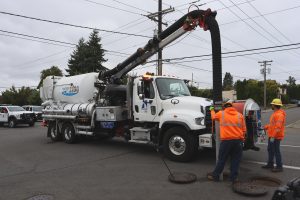
A Vactor 2100 Plus sewage vacuum truck operating in downtown Olympia, Washington. (OceanLoop via Wikimedia Commons, CC BY-SA 4.0)
“Wastewater hauling is not generic freight—it is regulated liquid logistics with equipment, routing, and disposal risks.”
For related stories on waste removal operations and environmental handling, explore our WasteRemoval news.
The second rule is that standby and risk need to be priced, not given away. The UVA bypass SOP shows why. Serious pump-and-haul work may require backup pump capacity, high-level alarms, protected staging and haul routes, spill containment, emergency response procedures, manifests, licensed disposal sites, demonstration tests, and proof that the system can actually maintain flow. Those requirements consume time, window capacity, crew attention, and customer patience. Fleets that underprice them may win the first invoice and lose the account on the first failure.
The third rule is to segment the market. Potable hauling, non-potable industrial hauling, municipal pump-and-haul bypass, and biosolids or septage transport are not the same sales call. They involve different equipment dedication, cleaning, paperwork, disposal relationships, insurance expectations, and emergency-response obligations. If a fleet wants to pursue water tank transport demand seriously, it should define which lane it is entering first and build operating discipline around that lane, not around a vague idea that “water is growing.”
Can water tank transport demand grow without emergency conditions?
Yes, and that is one of the most important updates to the original article idea. EPA’s emergency drinking water planning still treats tanker trucks as a critical option during service disruptions. Still, it also emphasizes the practical limits: approved sources, route restrictions, water-quality testing, distribution management, and sometimes federal motor-carrier considerations. Texas also allows temporary emergency hauling during low-pressure or outage events, and in narrow cases may consider food-grade equipment previously used for beverages such as juice or milk. Emergency hauling clearly remains part of the market, but the current opportunity is broader than that.
Water tank transport demand can grow in normal operating periods because water systems are being redesigned, not only repaired. Reuse projects need source balancing and side-stream management. Wastewater plants undergoing retrofit need temporary treatment and bypass logistics. Data-center construction requires one-time fills and site-stage water handling. Industrial customers want non-potable substitutes that may not align perfectly with pipeline or reuse-network timing. Even permanent interconnects do not erase these needs; they reduce some peaks while leaving many operational gaps that trucks are uniquely suited to fill.
”The strongest commercial framing is not that water hauling will explode because of disasters. It is that water is becoming a managed input across more industries.”
That shift creates recurring logistics work at the edges of fixed infrastructure. The fleets most likely to benefit are the ones that can operate as infrastructure partners rather than just overflow vendors.
Where water tank transport demand still has hard limits
There are still real limits, and they matter. The flagship Texas projection is scenario-based, and the authors explicitly say they lacked facility-level, operator-reported water-use data for Texas data centers. The headline national academic paper is still under review. Corporate water and replenishment metrics use different boundaries and methodologies, which limit apples-to-apples comparison. EPA’s PFAS biosolids posture remains partly draft risk assessment and partly nonbinding interim guidance. All of that means it would be premature to assign a precise nationwide freight-volume forecast to water tank transport demand.
But the direction of travel is no longer ambiguous. Texas has a bigger water-capital requirement than its last plan, data centers are being modeled as a major future water user in some scenarios, federal policy is moving toward industrial and data-center reuse, and wastewater compliance plus PFAS scrutiny are increasing the complexity of what must be moved, where it can go, and under what paperwork. The original article’s premise was right. The updated version should be firmer, more specific, and more operationally precise: water tank transport demand is becoming a genuine infrastructure lane, but the winning carriers will be the ones that understand compliance, equipment segregation, disposal strategy, and standby risk as deeply as they understand miles and rates.
For ongoing liquid and dry-bulk transportation coverage, visit our TankTransport news hub.
Key Developments Shaping Water Tank Transport Demand
- Data center growth is increasing scrutiny of water capacity, especially in Texas and other high-growth markets where cooling demand, power generation, and drought pressure intersect.
- Water reuse is moving into federal policy discussions, including proposed tax incentives for industrial water recycling systems that could support data centers, advanced manufacturing, and other water-intensive facilities.
- Municipal wastewater systems are facing tighter compliance pressure, with aging treatment plants, ammonia discharge limits, and infrastructure upgrades creating possible demand for bypass hauling, sludge movement, and temporary liquid handling.
- PFAS and biosolids concerns are changing disposal decisions, potentially affecting where wastewater solids are tested, treated, land-applied, landfilled, or hauled for alternative handling.
- Water hauling is not a single market; potable water, non-potable industrial water, wastewater, sludge, biosolids, and emergency water delivery each require different equipment, permits, procedures, and liability controls.
- Tank trucks and vacuum carriers may become more visible as backup infrastructure when permanent water systems are delayed, overloaded, under repair, or unable to meet short-term demand.
- The strongest fleet opportunities may come from specialized support work, including construction water, system fills, reclaimed-water logistics, wastewater bypass service, treatment-plant maintenance, and emergency response.
External Water Infrastructure Resources and Technical References
- For detailed research on how data centers are reshaping water planning, cooling demand, and infrastructure pressure in Texas, review the University of Texas data center water-use white paper.
- For a concise public summary of the Texas data-center water issue, see the University of Texas overview on why data-center growth is raising questions about water use.
- To understand the broader Texas water-infrastructure outlook behind the article, explore the Texas Water Development Board’s Draft 2027 State Water Plan.
- For federal guidance on emergency water supply planning and tanker-truck limitations during service disruptions, review the EPA’s Emergency Drinking Water Supply Guidance.
- For insight into federal water-reuse policy, recycled-water planning, and industrial reuse applications, visit the EPA’s Water Reuse Action Plan 2.0.
- To follow federal guidance on PFAS, sewage sludge, biosolids, and wastewater-treatment risks, review the EPA’s resource on PFAS in sewage sludge and biosolids.
- For more information on PFAS destruction, disposal methods, and current federal guidance limitations, see the EPA’s 2026 interim PFAS destruction and disposal guidance.
- For Texas-specific potable water hauling requirements, including dedicated tanks, sanitation, sampling, and recordkeeping, review TCEQ’s Guidance for Public Water System Water Haulers.
- For Texas rules affecting sludge, biosolids, septage, grit trap waste, and grease trap waste transporters, see TCEQ’s sludge transporter registration guidance.
- For a technical look at moving-bed biofilm reactor systems used in municipal and industrial wastewater treatment, explore Veolia’s AnoxKaldnes MBBR treatment technology.
- For mobile wastewater-treatment options used during retrofits, maintenance, and temporary compliance needs, review Xylem’s Biosphere Mobile MBBR System.
- For an example of how major data-center operators are addressing water sourcing and cooling strategy, read Oracle’s explanation of Project Jupiter water use and sourcing.
- For details on closed-loop and chip-level data-center cooling designed to reduce water consumption, see Microsoft’s article on next-generation datacenters that consume zero water for cooling.
- For another major cloud operator’s approach to recycled water, cooling, and water-positive goals, review Amazon’s water stewardship initiatives.
- For information on Google’s operational water-use reporting, replenishment efforts, and data-center sustainability strategy, visit Google’s sustainable operations resource.