- NRC proposes an optional fivefold increase in the radiation limit measured 2 meters from a vehicle for certain Type B packages moving under exclusive-use controls.
- The proposal would not authorize a shipment by itself: packages using the higher limit could still require a DOT exception or special permit.
- Highway movements would remain subject to HRCQ routing, carrier permitting, Level VI inspection, communication and specialized driver-training requirements.
The Nuclear Regulatory Commission has proposed a new path for microreactor truck shipments that could reduce the shielding needed for packages carrying certain irradiated microreactors—but the path would add no shortcut around federal hazardous-materials transportation controls.

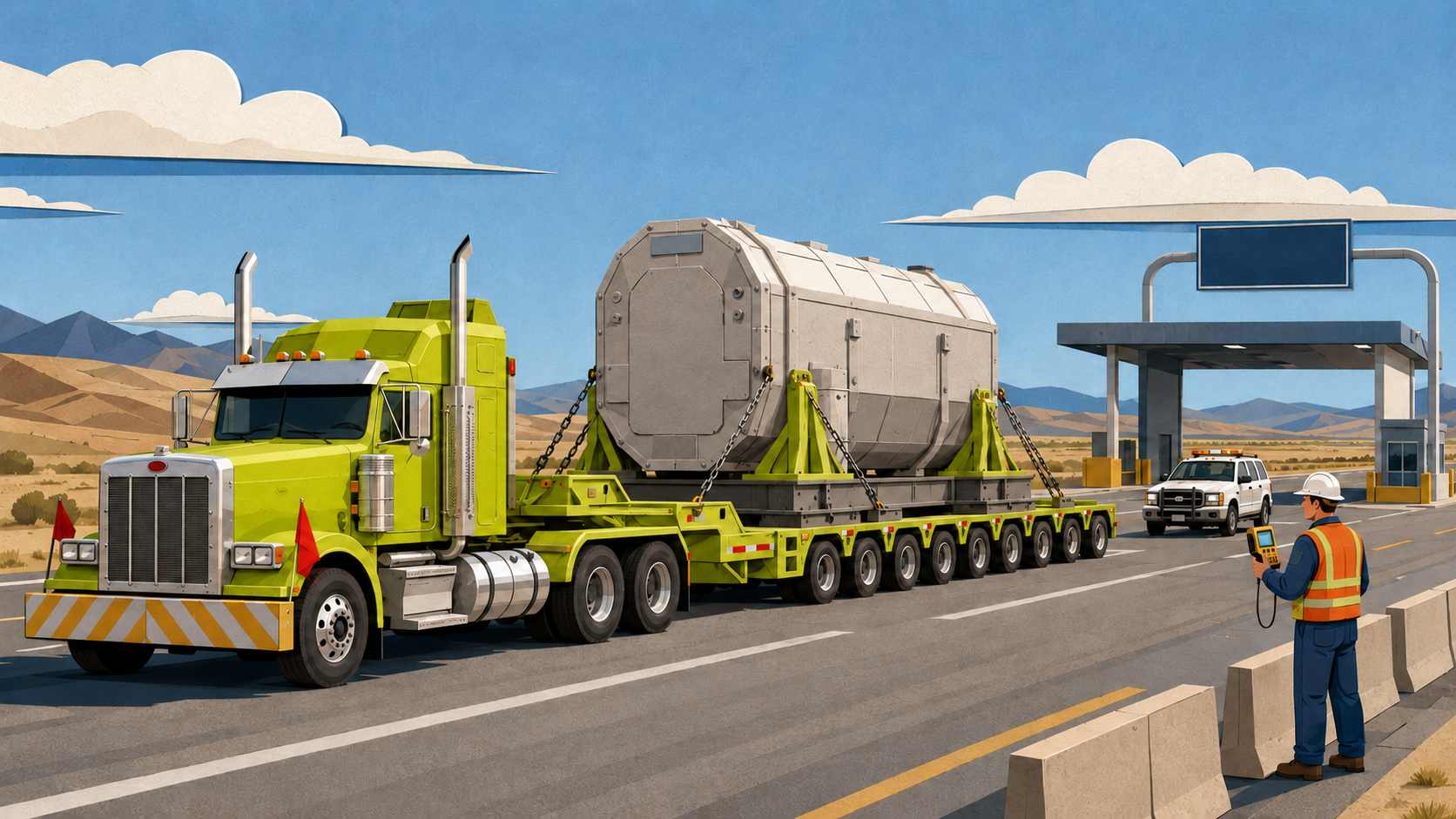
A U.S. Department of Energy illustration shows how compact, factory-fabricated microreactor components could be transported by truck. (Image: U.S. Department of Energy, Office of Nuclear Energy)
The Nuclear Regulatory Commission’s July 27 proposed rule says the agency could approve certain Type B packages at up to 0.5 millisievert per hour, or 50 millirem per hour, measured 2 meters from the vehicle. The current NRC and DOT limit at that distance is 0.1 mSv per hour, or 10 mrem per hour. Comments are due August 26, 2026.
That fivefold number is the attention-grabber. The more important distinction for carriers is that NRC certifies radioactive-material package designs, while the Department of Transportation governs how those packages are offered and moved. The proposal would change neither current law nor the carrier obligations already attached to a highway route controlled quantity, or HRCQ, of Class 7 radioactive material.

Why Microreactor Packages Strain the Current Limit
Microreactors are intended to be factory-built and transportable. According to the U.S. Department of Energy, microreactors are designed to be factory-fabricated and transportable by truck, rail, vessel, or aircraft. Most designs would produce 1 to 20 megawatts of thermal energy, with potential uses including remote sites, military installations, industrial heat, and emergency power.
The transportation problem becomes more difficult after a reactor has operated. Radiation levels decline while an irradiated reactor cools, but some deployment concepts may require a unit to move on a compressed schedule. Meeting the current 0.1 mSv-per-hour limit at 2 meters can then require more shielding, increasing the package’s weight and dimensions.
According to a Pacific Northwest National Laboratory assessment prepared for NRC, a microreactor prepared for highway shipment would likely weigh 50 to 70 tons before additional transport shielding, with a gross vehicle weight of 70 to 100 tons. Some concepts could be substantially heavier and qualify as superloads under state rules.
The study examined radiation limits of 0.1, 0.5, 1 and 2 mSv per hour at 2 meters, along with public and occupational exposure scenarios. NRC selected 0.5 mSv per hour for its proposal, saying the modeled exposures for a single transportation event remained within the existing annual public dose limit when combined with highway controls.
The evidence has an important boundary. PNNL’s principal model was a TRISO-based heat-pipe microreactor, not every possible reactor or Type B package. NRC acknowledges that the analysis may not bound spent-fuel packages, other contents, or future reactor designs with different radiation fields.
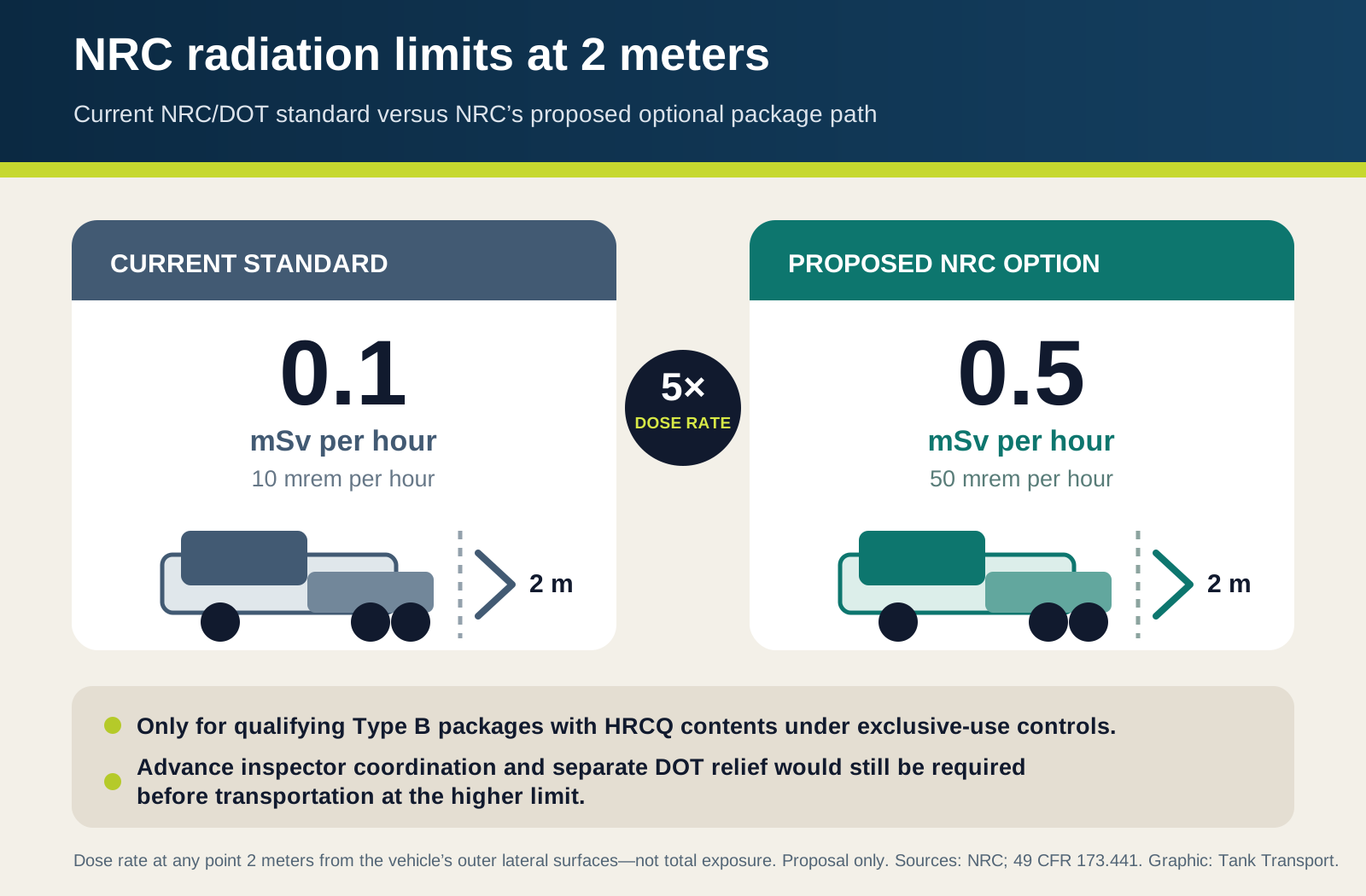
NRC would retain the current 0.1 mSv-per-hour standard while adding an optional fivefold limit for qualifying packages under specified controls. The values are dose rates measured 2 meters from the vehicle, not total exposure. (Graphic: Tank Transport; sources: NRC and PNNL)
A Fivefold Standard Would Not Remove DOT Approval
The optional standard would apply only when package contents meet DOT’s HRCQ definition and the licensee coordinates in advance with the appropriate federal, state, or local inspection authorities. Inspectors would have to know the radiological conditions and any controls needed to perform their work, including appropriate dosimetry.
It also would be limited to exclusive-use movements. Under DOT’s definition, one consignor has sole use of the conveyance, directs loading and unloading, and supplies written instructions for maintaining the controls. Personnel handling the consignment must have suitable radiological training and resources.
Even with NRC certification, however, a package operating at 0.5 mSv per hour at 2 meters could exceed DOT’s existing 0.1 mSv-per-hour transportation limit. NRC states directly that a shipper choosing the higher standard would need a DOT exception or special permit.
That is the same basic regulatory distinction Tank Transport emphasized in its analysis of pending PHMSA tank special permits: an application or package approval is not a blanket authorization to operate outside the Hazardous Materials Regulations. The higher NRC limit would create a possible certification path, not a general exemption.
NRC package certification would be only one gate. A shipper using the higher limit would still need DOT relief and a carrier qualified for HRCQ operations.The proposal is also effectively domestic. International rules do not contain an equivalent higher Type B package limit so that foreign movement would require revalidation by the relevant competent authority. It could not rely on the proposed U.S. provision alone.
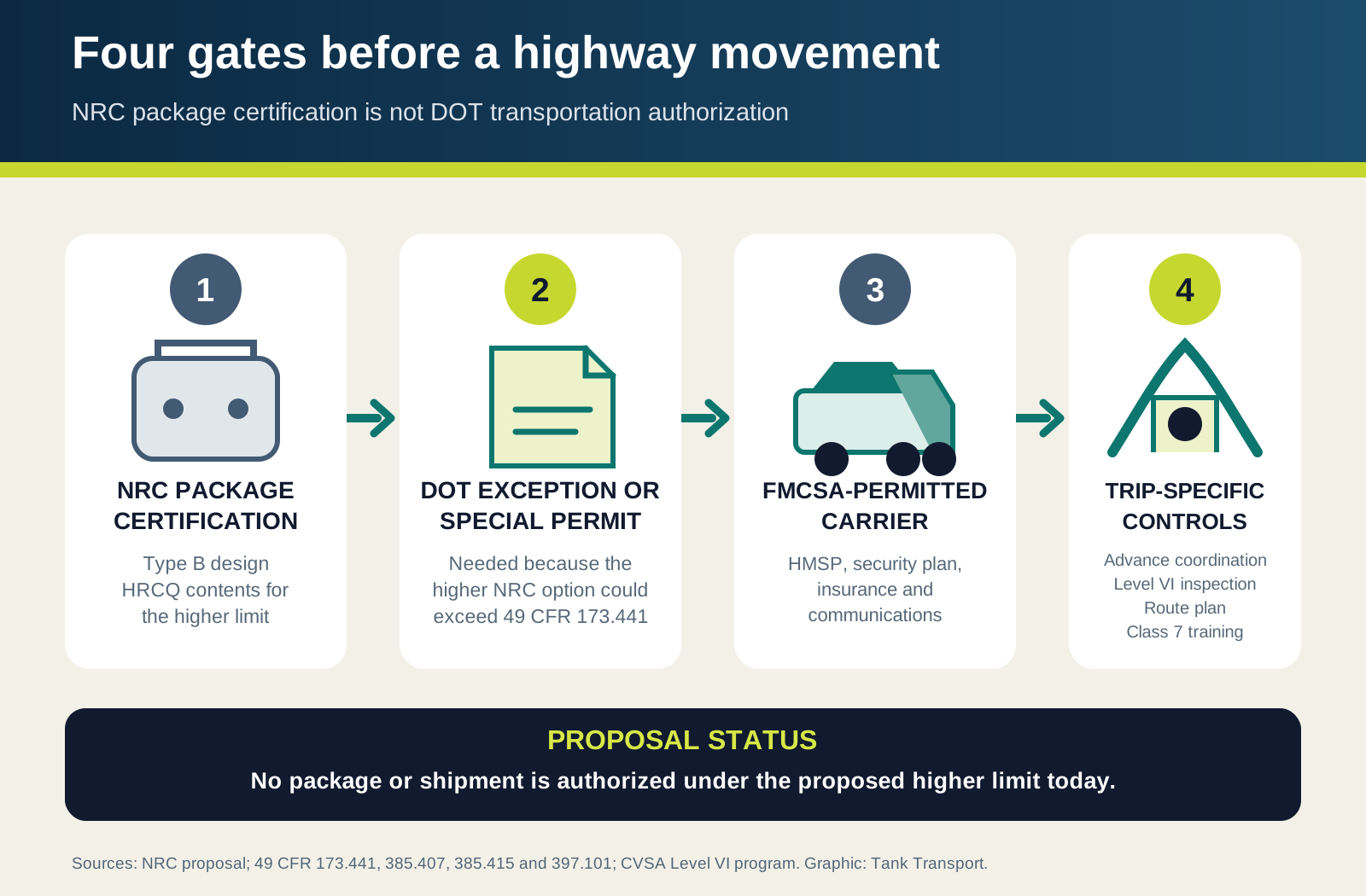
A higher NRC package limit would not replace DOT transportation authorization, HRCQ carrier qualification, Level VI inspection, or route controls. No package or shipment is authorized under the proposed higher limit today. (Graphic: Tank Transport)
What Highway Carriers Would Still Have to Do
For a motor carrier, the proposed package flexibility sits on top of an unusually demanding operating framework. FMCSA safety-permit regulations require qualifying carriers to maintain a satisfactory safety rating, certify a security and communications program, carry the required financial responsibility, register with PHMSA and remain within applicable crash and out-of-service thresholds.
Under 49 CFR 385.415, the vehicle must carry the safety-permit number, a written route plan and a telephone number answered directly by a carrier representative familiar with the route. Required communications occur at the beginning and end of each duty tour and at pickup and delivery, with records retained for six months.
The tractor, trailer, or heavy-haul combination also must pass a North American Standard Level VI inspection before departure. The Commercial Vehicle Safety Alliance describes Level VI as an enhanced inspection with radiological requirements and stricter out-of-service criteria. The vehicle, driver, and cargo must be defect-free at origin; the trip-specific Level VI decal is removed at destination.
Routing is equally prescriptive. 49 CFR 397.101 generally confines HRCQ movements to preferred routes, calls for Interstate bypasses around cities when available, and requires a written plan identifying the route, stops, timing, and emergency contacts. Drivers need specific Class 7 training within the preceding two years and must carry the training certificate and route plan.
Those requirements are more specialized than the baseline obligations summarized in Tank Transport’s hazardous-material shipping guide and hazmat training overview. Heavy-haul and superload permits may add state route surveys, bridge review, escort vehicles, travel windows and local law-enforcement coordination.
The proposal trades some package-design margin for a more controlled transportation operation—it does not create a lighter-regulation lane.The new NRC coordination requirement is particularly significant for roadside enforcement. PNNL calculated an estimated 58.6-millirem dose for an inspector working for one hour at 1 meter from a package modeled at the proposed limit. NRC says that is below the annual occupational limit but recognizes that inspectors may not all participate in radiation-protection programs. Advance notice, trained personnel, and dosimetry therefore become part of making an ordinary vehicle-safety inspection safe.
The Cost Case Is Promising but Still Hypothetical

Illustration of a heavy-haul truck transporting a sealed microreactor module under controlled highway conditions. HRCQ Class 7 highway shipments must pass a Level VI inspection before leaving their point of origin (Original Tank Transport illustration)
According to NRC’s regulatory analysis, use of the proposed higher standard would be voluntary. The agency modeled a hypothetical package with carbon-steel shielding reduced by half an inch on five sides and estimated approximately $25,000 in potential savings per package.
Across an assumed roughly 2,100 microreactors entering service over 40 years, NRC projects $52.5 million in undiscounted package savings, plus unquantified reductions in fuel use and vehicle wear from lower weight. Those figures are scenarios, not forecasts based on commercial orders. NRC says it lacks data showing how vendors would actually redesign packages.
The operational savings also cannot be isolated from the rest of the move. A lighter package may improve route feasibility, bridge compatibility or heavy-haul requirements, but specialized inspection, escorts, security, dosimetry and permit work remain. The separate DOT special-permit process could impose additional conditions or determine that a proposed movement does not provide an equivalent level of safety.
NRC is asking whether the higher limit should remain tied to HRCQ shipments and whether it should extend beyond the microreactor scenario studied by PNNL. That question may matter more than the initial cost estimate. A technology-neutral rule could eventually reach other Type B packages, but a broader scope would require a technical basis that the current microreactor model does not supply.
Microreactor Truck Shipments: Key Developments
- NRC proposes an optional 0.5 mSv-per-hour limit at 2 meters for qualifying Type B packages under exclusive-use controls; the existing 0.1 mSv limit would remain available.
- The package contents would need to meet the HRCQ definition, and the licensee would have to coordinate inspection conditions and dosimetry in advance.
- A package approved by NRC at the higher limit could still exceed 49 CFR 173.441, requiring separate DOT relief before transportation.
- HRCQ highway movements would retain FMCSA safety-permit, Level VI inspection, route-plan, communications, security and driver-training requirements.
- Comments on Docket NRC-2025-1667 are due by 11:59 p.m. Eastern on August 26, 2026.