- FMCSA’s five-year warning-beacon exemption expressly includes tankers in qualifying Level 4 automated operations.
- Operations requiring hazmat endorsements remain excluded, while the tank-only endorsement is outside the prohibited list.
- Beacon specifications, operating-domain limits and reporting requirements determine how carriers can use the exemption.

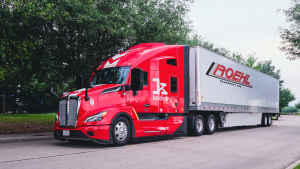
An Aurora-equipped Volvo VNL tractor pulls a dry van trailer on a highway. (Photo: Aurora)
FMCSA’s exemption for driverless truck beacons gives qualifying automated tanker operations a new way to satisfy federal roadside-warning requirements. The decision explicitly includes tankers while excluding hazardous-materials transportation covered by its terms, drawing an important line between the vehicle’s configuration and the cargo it carries.
The Federal Motor Carrier Safety Administration published its final exemption on October 9, effective October 7, 2026, through October 7, 2031. It allows Aurora Operations and other qualifying carriers using Level 4 automated driving system-equipped commercial vehicles to substitute specified cab-mounted warning beacons for traditional warning devices.
For liquid and dry-bulk carriers following automation, the significance is a defined solution to one roadside problem: warning approaching motorists when a truck stops unexpectedly. The exemption does not establish that autonomous tankers are commercially ready for every lane, commodity or customer site.

Tankers qualify, but cargo determines the boundary
FMCSA specifically addresses tanker geometry in its decision. The agency reasons that a tanker’s cylindrical shape and lower profile are reasonably likely to make cab-mounted beacons more visible than they would be behind a conventional 53-foot box trailer.. It also requires reporting that identifies tanker configurations when beacon malfunctions or other failures occur.
The cargo restriction is separate. Operations are prohibited under the exemption if a human driver would otherwise need an H, X, P, or S endorsement. Those codes cover hazardous materials, the combined tank-and-hazmat endorsement, passengers, and school buses. The N endorsement for a tank vehicle is not on that list.

Bealeton, Va. – Cool Lawn LLC is a five-generation, family-owned dairy farm in Bealeton, Virginia, on August 12, 2025. USDA photo by James Pinsky
The distinction follows the federal CDL endorsement codes: a tank vehicle and a tank vehicle carrying endorsement-triggering hazmat are different categories. A qualifying operation hauling a nonhazardous liquid, such as milk, could therefore fall within the beacon exemption if it meets every other condition. That is an eligibility example, not an announcement of a driverless milk-hauling service.
The notice also expressly prohibits transporting hazardous materials as defined in 49 CFR 383.5. That definition covers material designated hazardous that requires placarding, plus any quantity of a listed select agent or toxin. It is more specific than an everyday use of the word hazardous; cargo classification and required endorsements must be checked against the actual operation.
For conventional placarded fuel and chemical tanker movements, the exclusion is decisive. This exemption provides no route to substitute beacons for required warning devices in those operations. Wider questions about automated hazardous-materials transportation remain distinct, as Tank Transport explains in its coverage of PHMSA’s driverless-hazmat rulemaking questions.
Tanker eligibility depends on the cargo, the automated system’s operating limits and compliance with every condition of the exemption.
Driverless truck beacons must meet specific conditions

A close view of the cab and sensor assemblies on an Aurora-equipped Volvo VNL autonomous truck. (Photo: Aurora)
Under the ordinary stopped-vehicle warning rule, hazard flashers must activate immediately, and required warning devices generally must be placed as soon as possible, within 10 minutes. Placement varies with road layout, hills, curves, and sight obstructions.
The exemption addresses warning-device placement under Section 392.22(b), steady-burning lamps under Section 393.25(e), and warning-device types and quantities under Section 393.95(f). Its replacement system has detailed requirements; fitting a generic amber light to a tractor does not establish compliance.
These are the principal equipment and operating conditions:
| Requirement | What the exemption specifies |
|---|---|
| Light arrangement | At least one rear-facing light on each side of the cab and one forward-facing light on its front. |
| Mounting | At least 100 inches above ground, at or above the sideview mirrors’ upper edge and below the cab’s top edge. Total vehicle width, including lights and mountings, cannot exceed 122 inches. |
| Light performance | Amber lights meeting SAE J595 Class 1 photometric requirements, flashing at a different rate from the standard hazard flashers. |
| Power protection | Redundant power sources to prevent a single-point power failure from disabling the beacons. |
| Activation | As soon as possible, within five minutes of a qualifying stop; continued flashing until movement resumes or the vehicle is recovered. Standard hazard flashers must also remain active throughout the stop. |
| Operating area | Only roadways within the specific automated vehicle’s validated operational design domain. |
A qualifying stop is one on the traveled portion or shoulder of a highway for a cause other than a necessary traffic stop. The five-minute limit is a maximum, not permission to delay activation unnecessarily. The operational design domain confines use to the roadway and environmental conditions validated for that system.
Longer combination vehicles face an additional restriction: covered LCV operations are limited to doubles with two 28-foot trailers. LCV triples are excluded.
Carriers other than Aurora must notify FMCSA in writing before starting covered operations, demonstrate their equipment and ability to comply, and certify compliance under penalty of perjury. All other applicable Federal Motor Carrier Safety Regulations continue to apply.
Why FMCSA approved the exemption—and why concerns remain

An Aurora-equipped International LT tractor pulls a dry van trailer on a highway. (Photo: Aurora)
The decision follows an earlier application denied in December 2024 and subsequent temporary relief for Aurora. It also follows Aurora’s commercial driverless-trucking launch in Texas, placing roadside-warning requirements within a developing freight operation rather than a purely hypothetical deployment.
FMCSA cited Aurora’s reported experience between October 10, 2025, and January 9, 2026: 34 commercial vehicles traveled more than 500,000 miles under the waiver, with nearly 10 hours of beacon activation. Aurora reported no beacon faults or power issues and no collisions involving those vehicles or contributed to by them while stopped and using the beacons during that period.
Those figures measure different things. The mileage describes overall vehicle exposure; the nearly 10 hours describe actual beacon use. Neither figure alone establishes a tanker-specific crash-reduction rate, and the notice does not identify a separate tanker-only test program.
The agency also reconsidered studies from Aurora and the Virginia Tech Transportation Institute. FMCSA said the combined evidence supported equivalent or greater safety under the exemption’s conditions. Its analysis emphasized earlier responses in several test scenarios, visibility, and reduced time before supplemental warning becomes available.
Opponents raised substantive limitations. As summarized in the notice, the Owner-Operator Independent Drivers Association questioned whether the studies represented the range of weather, roads, lighting, and traffic encountered in service. Other commenters questioned obstructed sight lines, angled trailers, electrical failures, and the limited duration of beacon use.
FMCSA responded with specifications, redundant power, operating-domain restrictions, and monitoring. Its separate warning-device research program also acknowledges the difficulty of establishing a quantitative baseline for how warning devices affect motorists’ behavior. The exemption is a conditional regulatory safety finding, rather than evidence that every concern about stopped automated trucks has been resolved.
What bulk fleets should evaluate next
For nonhazardous bulk operations, the first assessment is whether the commodity, vehicle configuration, and proposed route fit the exemption. Tank-only endorsement eligibility answers one question; it does not establish the automated system’s ability to handle the load, the route, or work at the receiving facility.
Operationally, loading, unloading, inspections, customer access, and vehicle recovery still need assigned responsibilities. A warning-beacon exemption does not perform those tasks. Tank Transport’s earlier analysis of autonomous trucking expansion and fleet integration provides broader context for evaluating those interfaces.
Monitoring obligations deserve attention before service begins. Covered crashes must be reported to FMCSA within five calendar days when the beacons were active or should have been active. The notice uses a crash definition that includes property damage and certain alleged contributions to another vehicle’s impact; carriers should not assume only injury or tow-away crashes count.
Annual reports are due by November 1 in each year of operation, with additional reporting upon request or within 30 calendar days after operations under the exemption cease. Required information includes vehicle counts, mileage, beacon mounting details, equipment variations, and specified records of malfunctions, power issues, or other noncompliance, including vehicle configuration.
That creates a near-term reporting obligation for carriers beginning under the exemption this October. For the wider tank industry, the most useful evidence will be how the system performs across configurations and operating conditions. Public access may be limited because qualifying submitted information can receive confidential-business-information treatment.
FMCSA can revoke the exemption for an individual carrier or all covered carriers if its conditions are violated or safety deteriorates. The five-year term gives eligible operators a longer planning period, while continued use depends on compliance and performance.
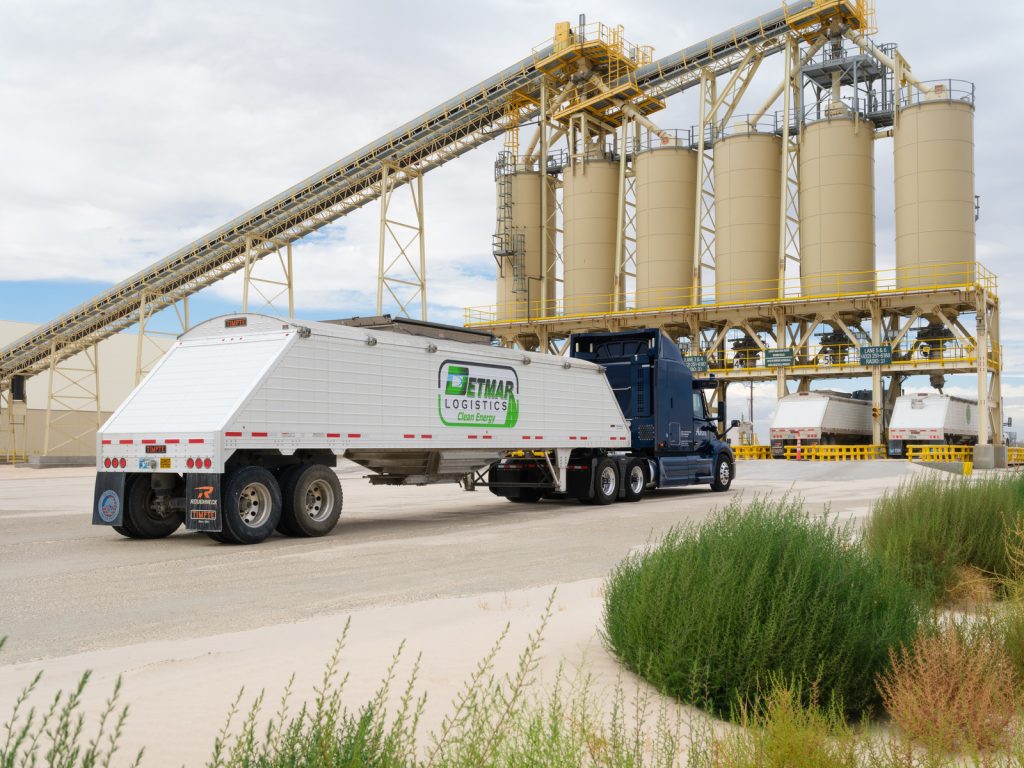
An Aurora-equipped tractor with a Detmar Logistics hopper trailer at a bulk loading facility. (Photo: Aurora)
Driverless Truck Beacons: Key Developments
- Five-year term: The exemption runs from October 7, 2026, through October 7, 2031, subject to its conditions and possible revocation.
- Tanker distinction: Qualifying tankers are included; H- or X-endorsement operations and hazardous materials under Section 383.5 are excluded.
- Specified warning system: Mounting, visibility, redundant power, and prompt activation requirements apply alongside standard hazard flashers.
- Continuing oversight: Prior notification for other carriers, crash reporting, and annual reports support FMCSA’s monitoring.