- C.H. Robinson says it has submitted merger filings in the United States, Canada, and Mexico; closing is still expected in the first half of 2027.
- RXO says customers can continue seeking competing bids from both companies before closing.
- For tank and bulk fleets, the value of a larger brokerage network will depend on compatible freight, service continuity and commercial terms.
The proposed C.H. Robinson RXO acquisition would bring two major freight intermediaries under common ownership, with consequences for how carriers find loads and how shippers buy transportation. Announced October 5, the transaction carries an implied enterprise value of approximately $5.8 billion. It remains subject to approvals and other closing conditions.
C.H. Robinson supplied a fresh progress report October 28. Its third-quarter investor presentation lists U.S. antitrust and Canadian and Mexican merger-control filings as submitted. The company continues to expect to close in the first half of 2027. Submitting those filings is a procedural step; it does not establish regulatory clearance.
For chemical, petroleum, food-grade, and dry-bulk transportation businesses, the central question is whether combining the networks would improve access to suitable freight while preserving the specialized knowledge needed to move it. Both companies already participate in bulk logistics. The opportunity therefore deserves attention, but the announcement alone does not establish additional tanker capacity, better rates, or shorter empty movements.


A proposed combination with several steps still ahead
The companies’ acquisition presentation distinguishes approximately $5.3 billion in implied equity value from the $5.8 billion enterprise value. The stock-and-cash agreement would combine brokerage and managed transportation operations with capabilities including global forwarding, expedited transportation and last-mile delivery.
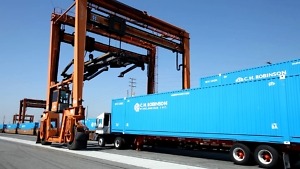
C.H. Robinson-branded intermodal containers at a freight terminal. (Photo: C.H. Robinson)
According to the October 28 timetable, C.H. Robinson still plans to file the Form S-4 registration statement and associated proxy statement/prospectus. Subsequent milestones include the registration statement’s effectiveness, an RXO shareholder meeting, and receipt of required regulatory approvals. The expected closing window remains a forecast, not a guaranteed completion date.
Those milestones matter to transportation planning because a signed acquisition agreement does not tell a shipper when account administration will change. A 2027 freight award could begin before closing, span the transition, or start afterward. Each scenario requires clarity on the contracting entity, operating contacts, and procedures that will apply to the award.
Ownership consolidation and physical fleet expansion also differ. Tank Transport’s coverage of Trimac’s California Freight acquisition described a transaction involving terminals and an established food-grade tanker operation. Here, the immediate analytical focus is on brokerage relationships, procurement, and the systems connecting shippers with transportation providers.
Shippers can keep the bidding process competitive
RXO’s customer and carrier guidance gives a clear answer on current procurement: companies will continue operating independently until closing. RXO says requests for quotations will be handled separately, information about those requests will not be shared before closing, and customers can continue having both businesses compete for spot freight.

RXO’s headquarters. (Photo: RXO)
That guidance also addresses bids scheduled to take effect after the expected closing. RXO says each company will respond on its own terms before completion. Shippers therefore have a basis to continue their existing bid process while requesting written clarification on how a future transition would affect any resulting award.
The practical distinction is between today’s operating arrangements and decisions that would need to be communicated later:
| Area | Current company guidance | Question for a future transition |
|---|---|---|
| Bids | Independent proposals continue before closing. | How would overlapping awards be administered? |
| Contacts | RXO reports no immediate contact changes. | Who would handle dispatch exceptions and claims? |
| Systems | RXO reports no immediate system changes. | Would tendering, tracking, or invoicing require migration? |
| Carrier relationships | RXO reports no immediate change in how it works with carriers. | Would onboarding, payment or accessorial procedures change? |
RXO has not provided a complete post-closing operating plan in that guidance. The questions above are planning considerations, not announced changes. For a shipper using both brokers, a useful preparation is to map overlapping lanes and identify alternative qualified providers. That preserves a clear view of procurement options without assuming how regulators or the companies will resolve the combination.
Bulk freight makes network compatibility the real test
RXO’s bulk transportation offering includes tank trucks, pneumatic equipment, hoppers, end dumps and ISO equipment. Its listed commodities span fuel and petroleum, chemicals, lubricants, food-grade products, and plastic pellets. C.H. Robinson’s carrier load-board guidance likewise identifies tanker and bulk freight and describes a bulk-equipment search filter.
These services connect directly to specialized carriers. They do not quantify the companies’ overlap in chemical tanks, food-grade liquids, or pneumatic trailers. Neither a broad carrier count nor a larger customer list shows how many suitable loads would become available to a particular bulk fleet.

C.H. Robinson’s Navisphere platform displayed on a laptop. (Photo: C.H. Robinson)
Consider a possible return load after a chemical delivery. Its usefulness depends on more than origin and destination: the trailer must suit the next product, the shipper must accept its cargo history and cleaning documentation, and loading and delivery appointments must fit the driver’s available time. A nearby posting that fails those checks does not solve an empty-mile problem.
For a pneumatic carrier, the same assessment would consider product restrictions, trailer configuration, and unloading requirements at the receiving site. These are examples of the operating details to preserve through any future system or account transition, rather than claims about either company’s current service performance.
For a bulk fleet, a larger load board becomes valuable when it produces freight the equipment can actually carry.C.H. Robinson’s October 5 carrier communication presents broader freight access and more efficient matching as expected benefits. A meaningful test would be measurable improvement on a fleet’s own lanes: compatible loads offered, empty miles avoided, time spent arranging freight, and payment received for the work performed.
Carriers can prepare by documenting who understands their equipment and customers, which lanes depend on those relationships, and where exceptions require a specialist’s decision. Preserving that knowledge could matter as much as combining digital platforms.
Cost savings and freight rates follow different paths
C.H. Robinson forecasts approximately $300 million in net run-rate cost synergies within two years after closing. That describes a targeted annual savings pace once the changes are implemented. It is not a promise of $300 million in immediate cash savings, shipper discounts, or higher carrier compensation.
The proposed efficiencies include automation, shared services, removing duplicate outside services, and other integration measures. In the company’s October 28 earnings release, Chief Executive Officer Dave Bozeman said its operating model and AI technology would support the planned RXO integration. That extends the strategy examined in Tank Transport’s reporting on AI in freight brokerage.

Dave Bozeman, president and chief executive officer of C.H. Robinson. (Photo: C.H. Robinson)
The same results show why market conditions need separate treatment. C.H. Robinson reported third-quarter North American Surface Transportation volume growth of approximately 3.5% from a year earlier. Average truckload linehaul rates charged to customers increased approximately 31.5% per mile from a year earlier, while purchased truckload linehaul costs rose 33.5% per mile; both measures exclude fuel surcharges. These are company-reported broad truckload measures, not tanker-rate benchmarks or effects of a transaction that has not yet closed.
For a bulk carrier negotiating freight, the relevant calculation remains the compensation for its particular work. Linehaul, cleaning, detention, empty positioning and unloading charges can affect the value of a load. Tank Transport’s examination of fuel-cost recovery and payment timing explains why an agreed rate and the timing of cash collection deserve separate attention.
A useful integration scorecard would therefore pair financial efficiency with service measures: whether tenders retain complete product requirements, billing disputes are resolved promptly, specialist contacts remain accessible, and qualified carriers can secure workable freight. Faster quoting would be valuable when it carries accurate specifications through to execution.
The next meaningful evidence will come from regulatory and shareholder milestones, followed by concrete operating instructions. Until those emerge, carriers and shippers can maintain today’s relationships while documenting the terms, contacts, and service standards they would expect any combined organization to preserve.
C.H. Robinson RXO Acquisition: Key Developments
- Pending transaction: Closing remains expected in the first half of 2027, subject to required approvals and other conditions.
- October 28 update: C.H. Robinson lists U.S., Canadian, and Mexican merger filings as submitted.
- Separate bidding: RXO says the companies continue competing independently before closing.
- Bulk-fleet implications: Compatible freight, specialist support, and commercial terms will determine operational value.
- Forecast savings: The $300 million cost-synergy target does not establish future freight rates or carrier payments.