- September truck-order reports show different results, while deliveries reflect purchases made earlier in the cycle.
- EPA’s proposed 2027 amendments leave important pricing and warranty questions unresolved.
- Tank fleets need equipment-specific quotes, confirmed delivery schedules, and a realistic cost of keeping existing trucks.
Class 8 truck orders are sending mixed signals as fleets prepare for model year 2027. ACT Research’s final September count fell from a year earlier, while FTR’s preliminary estimate increased. Both firms point to a market complicated by the emissions transition and the timing of manufacturers’ order books.
For petroleum, chemical, dairy and dry-bulk carriers, the purchasing question extends beyond whether the overall truck market is rising or falling. A replacement must match the cargo operation, fit the maintenance budget, and arrive in time to protect service. An available tractor with the wrong equipment can be less useful than a later delivery with the correct specification.
For tank fleets, a disciplined approach starts with three steps: establish which units need replacement, obtain comparable written offers, and identify which assumptions could change before delivery. September’s market totals provide context. They cannot set a universal deadline for buying, guarantee a price increase, or ensure the availability of a particular tank-fleet configuration.


Class 8 Truck Orders Measure a Different Stage Than Deliveries
ACT’s October 20 release reported final September North American Class 8 net orders of 19,172. That replaces ACT’s own preliminary estimate of 18,700. FTR’s public September release reports a separate preliminary estimate of 21,300.
| Research series | Status | Orders | Year over year | Month-to-month measure |
|---|---|---|---|---|
| ACT Research | Final | 19,172 | −7% | −15%; seasonally adjusted |
| FTR | Preliminary | 21,300 | +3% | +18%; as reported |
These are separate research series, not successive revisions of one count. Their monthly percentages also need care: ACT explicitly reports a seasonally adjusted decline; FTR’s release does not label its monthly increase as seasonally adjusted. Averaging the counts or treating the percentages as directly comparable would obscure those distinctions.
Deliveries tell another part of the story. ACT’s October 26 market update puts September North American Class 8 retail sales at 25,212, up 25% year over year, while reporting declining backlogs. Retail sales measure trucks reaching customers; they are not the same as factory production or new orders. A carrier can accept trucks ordered months earlier while delaying its next purchase.
Manufacturer results illustrate that timing difference. In its October 28 results presentation, TRATON reported International truck orders of 12,526 in the third quarter, down 45% from the second quarter, while truck unit sales rose 26% to 16,483. These are company figures with a different scope from the industry series, but they show why bookings and deliveries can move in opposite directions.
None of these totals isolates tank-truck demand. A fleet still needs a dealer’s answer on the exact engine, chassis, transmission, and delivery slot it intends to buy.
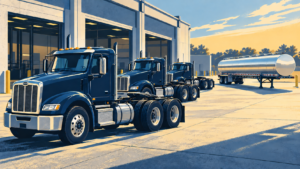
A truck order, chassis allocation, and completed tank rig represent different stages of a fleet purchase. (Original Tank Transport illustration)
What Remains Unsettled for 2027 Engines
As of November 2, EPA continued to describe its 2027 compliance amendments as proposed. The underlying 2027 nitrogen-oxide and other criteria-pollutant standards are already final. The July 14 proposal leaves those standards in place while addressing emissions warranties, regulatory useful life, compliance flexibility, and selective catalytic reduction system inducements.
The proposal would also make nonconformance penalties available to qualifying engine manufacturers. These are a manufacturer certification mechanism, not a roadside fine charged to a carrier. Tank Transport’s EPA 2027 diesel-rule analysis explains those proposed pathways and the distinction between reduced warranty costs and repair exposure transferred to owners.
FTR estimates potential fleet price pass-throughs of $6,000–$7,000 for the penalty pathway, compared with an $8,000–$12,000 increase for a fully compliant engine. Those are the research firm’s conditional estimates, not published prices available to every buyer. FTR also says surcharge-free model-year 2026 engine build slots are effectively sold out; that assessment does not establish whether a specific dealer still holds suitable inventory.
A quote therefore needs to identify its engine model year and certification basis, included emissions coverage, optional coverage, and price-adjustment clauses. A lower initial price can still leave the buyer with greater repair exposure. Likewise, a more expensive engine cannot be assumed to recover its premium through fuel savings without evidence for the intended operation.
Specify the Whole Tank-Truck Job
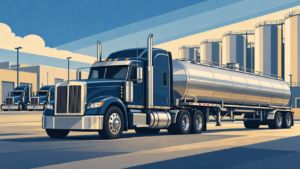
Tank-fleet purchases require a complete specification covering the tractor, tank trailer, discharge equipment, and operating weight. (Original Tank Transport illustration)
Ordering availability already differs by product. Daimler Truck North America announced August 27 that customers could begin specifying Detroit Gen 6 DD13 and DD15 engines in Freightliner and Western Star trucks on September 1. The company says its vocational aftertreatment arrangement fits within existing chassis space without additional back-of-cab impact. That is a supplier-specific design statement, not proof that every tank installation will fit unchanged.
For a tank-fleet purchase, the practical next step is written agreement among the dealer, engine supplier, and equipment installer on the complete specification. Where applicable, that includes transmission and power-takeoff compatibility, pump or blower requirements, hydraulic equipment, exhaust placement, frame space and access for service.
Weight deserves the same attention. Compare the quoted truck’s complete operating weight, including discharge equipment and normal operating fluids, with the intended trailer or tank body. Evaluate axle loading, axle spacing, and usable payload for the actual routes and configuration. FHWA’s bridge-formula guidance explains why allowable weight on the Interstate system depends on axle spacing as well as axle and gross-weight limits. A favorable base-chassis price has limited value if the finished truck carries less product than the operation requires.
Duty-cycle information should include highway mileage, terminal waiting, idle time, and stationary pumping or unloading. Ask the supplier how the proposed engine and aftertreatment package will operate in those conditions and what maintenance or driver procedures change. A highway fuel-economy claim alone does not answer those questions.
National Tank Truck Carriers’ comments to EPA underline the operational stakes. The association supported changes to mandatory diesel exhaust fluid (DEF)-related derates, arguing that severe speed reductions can create traffic conflicts, particularly for hazardous-materials tank trucks. That is an industry position in the rulemaking, not confirmation that a requested operating feature is available on a truck being quoted.
Finally, separate chassis availability from the date a completed truck can enter service. A chassis allocation, tank-body installation, wet-kit installation, and final acceptance can have different schedules. Ask who is responsible for each stage and what happens if one slips.
A production slot is only useful when the finished truck meets the fleet’s specification and can enter service when needed.Compare the Cost of Buying With the Cost of Waiting

Replacement timing depends partly on the repair costs and downtime expected from keeping existing equipment in service. (Original Tank Transport illustration)
Start the comparison with individual trucks. Review recent repairs, scheduled major work, downtime, substitute-equipment availability, and the consequences of a missed delivery. Separate routine maintenance from recurring faults that repeatedly interrupt service. FMCSA’s maintenance guidance makes the carrier responsible for setting inspection, repair, and maintenance intervals suited to its fleet and individual vehicles.
The new truck-parts price index provides purchasing context, but a fleet’s invoices and work orders establish its own cost of retention. Keeping a paid-off tractor can be economical when reliability remains acceptable. The proposition changes when repairs repeatedly displace revenue-producing work or require scarce replacement equipment.
Compare alternatives over the same period and expected utilization. Include acquisition cost, financing, warranty charges, maintenance, expected downtime, fuel, installation costs, and estimated resale value. Keep the cash-payment schedule visible alongside ownership cost; a workable long-term estimate can still create a difficult near-term cash requirement.
Fuel assumptions need particular care given the fuel-cost pressure identified in ATRI’s latest survey. Use the fleet’s routes, load profiles, and fuel records to evaluate supplier claims. Show how the result changes if fuel savings are smaller than expected, repair spending rises, or the new truck arrives late.
Three purchasing paths deserve consideration. Available earlier-model inventory may offer a firm delivery date, but its specification and warranty must be checked. A 2027 order may better match the required configuration, with pricing and completion terms established in writing. A controlled extension of existing equipment can preserve flexibility, provided inspection and maintenance records support continued service and a replacement trigger is defined.
Replacement and expansion also require different evidence. Replacing a costly, unreliable truck can protect an existing customer commitment. Adding a truck requires enough additional work, driver availability, and operating margin to support it. A stronger industry sales month does not supply that business case.
The decision becomes more defensible when the fleet can name the truck being replaced, the work it must perform, the acceptable cost range, and the latest useful delivery date. That is a stronger basis for committing capital than trying to time a national order headline.
Tank-Fleet Purchasing: Key Developments
- ACT’s final and FTR’s preliminary September order results remain separate series with different monthly comparison labels.
- Stronger deliveries can coexist with weaker new bookings; neither establishes tank-specific equipment availability.
- EPA’s proposed compliance amendments and supplier pricing require another check when a purchase is finalized.
- Compare complete specifications, written commercial terms, and the cost of retaining each existing truck before committing.