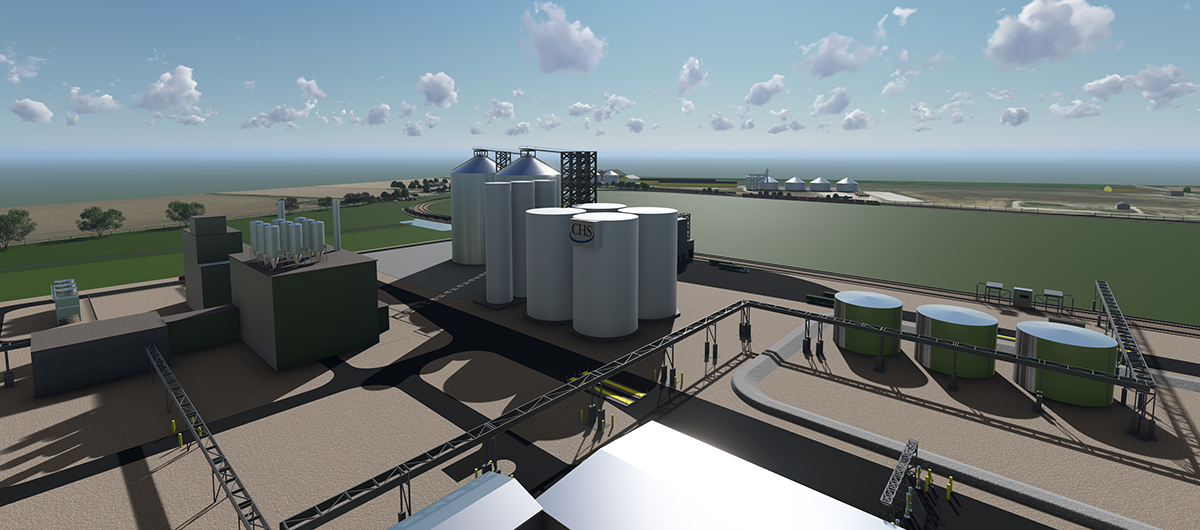
- CHS plans a $700 million Wisconsin plant that can produce about 1 billion pounds of soybean oil and 2 million tons of meal annually.
- The design includes soybean receiving and meal-truck loading facilities, plus three rail loops connecting with Union Pacific.
- The October 7 groundbreaking was ceremonial; construction remains tied to required permitting, with completion previously targeted for fall 2028.

CHS and public officials marked the Evansville project’s ceremonial groundbreaking on October 7, 2026. (Photo: CHS)
The CHS soybean project in Evansville, Wisconsin, reached a public milestone October 7 with a ceremonial groundbreaking for a planned $700 million processing facility. Its significance for bulk transportation extends across three movements: soybeans arriving for processing, liquid soybean oil leaving for downstream markets, and dry meal moving into livestock feed.
CHS says the plant is expected to process 80 million bushels annually. Its October 7 announcement projects about 1 billion pounds of oil and 2 million tons of meal each year, and says construction is expected to begin after required permitting is complete.
For carriers, those figures establish the scale of a prospective shipping location. They do not establish how much freight will be awarded to trucking companies, which routes will be served or how quickly production will reach planned capacity.


Soybean Oil and Meal Point to Different Freight Markets
The cooperative’s Evansville project information identifies renewable fuels and its Mankato, Minnesota, soybean-oil refinery as expected outlets for soybean oil. Meal is intended for local and regional livestock-feed markets. Those destinations give the project relevance to both liquid-bulk operators and agricultural dry-bulk carriers.

Soybean oil, meal and whole beans illustrate the products and raw material connecting soybean processing with liquid- and dry-bulk transportation. (Photo: United Soybean Board, CC BY 2.0)
The products serve different customers. Oil is a feedstock moving toward further processing, while meal supplies animal nutrition. The plant announcement therefore represents a potential source of several kinds of bulk freight, with transportation requirements depending on the buyer and product specifications.
The Wisconsin Soybean Association’s September 14 statement emphasizes proximity to the state’s dairy and livestock industries. Association President Doug Rebout, a Janesville farmer, said a nearby processor could shorten the distance to market and give growers another potential buyer.
That suggests a more varied freight effect than simply adding miles. Some soybean deliveries could move to a closer destination, while the resulting oil and meal would require outbound distribution. For regional fleets, changes in route length and customer locations may matter as much as the total volume processed.
The oil side also connects with the broader soybean-oil demand and renewable-fuel logistics covered by Tank Transport. Evansville would supply an upstream ingredient; the announced facility is a soybean-processing plant, not a finished renewable-diesel production site.
Truck Handling and Rail Access Shape the Opportunity
CHS specifies design capacity for 40 soybean truck dumps per hour and 17 meal trucks per hour at loadout. It also describes three separate in-plant rail loops connecting with Union Pacific.
Soybeans being loaded for transport during harvest. Incoming beans represent one of the freight streams associated with soybean processing. (Photo: Curt Dennison/United Soybean Board, CC BY 2.0)
Those truck figures describe handling capacity, not guaranteed daily arrivals, loading appointments, or individual vehicle turnaround times.
The Rock County Development Alliance’s project announcement places the facility at 400 County Road M on Evansville’s eastern edge and says it will receive soybeans by both truck and rail. The announcement also identifies rail-capacity improvements between Evansville and Janesville as part of the project’s transportation setting.
The City of Evansville’s CHS project records provide additional local planning context, including a traffic study, the 2024 development agreement and a 2026 agreement amendment.
Rail access matters when evaluating trucking prospects: the announced plant output should not be treated as exclusively road freight. CHS has identified product markets and handling capabilities. Still, the reviewed announcements do not specify the truck-versus-rail share of outbound oil or meal, named motor carriers, or an oil-truck loading rate.
For a carrier evaluating future work, the next useful details include shipment destinations, trailer requirements, receiving hours, and contract arrangements. As Tank Transport’s coverage of loading and unloading conditions illustrates, facility throughput and the time required to complete an individual delivery are different measures.
Permitting and the Completion Target Remain Important
CHS’s September 14 investment announcement targeted completion for fall 2028. The October 7 update described development activities underway and construction following required permitting. It did not provide a revised completion date.
That sequence supports treating fall 2028 as the company’s previously announced target, rather than a guaranteed opening or the start of a full year of shipments.
The project would also materially enlarge CHS’s processing network. The September announcement puts existing soybean throughput at approximately 119 million bushels annually across Fairmont and Mankato, Minnesota, and says Evansville would increase the cooperative’s soybean-processing capacity by more than two-thirds.
For bulk operators tracking the development, the next milestones are construction progress, a firmer operating schedule, and commercial shipping details. Tank Transport’s agriculture and feed-market indicators provide broader context while those project-specific facts develop.
CHS Soybean Project: Key Developments
- Investment: Approximately $700 million for a planned Evansville soybean-processing facility.
- Product flows: Oil for downstream processing and renewable-fuel markets; meal for local and regional livestock feed.
- Transportation: Truck receiving and loadout capacity alongside Union Pacific rail connections; modal shares and carrier awards remain unspecified.
- Timing: An October 7 ceremonial milestone, permitting-dependent construction, and a previously announced fall 2028 completion target.
Image credits: CHS (featured rendering and groundbreaking photograph); United Soybean Board (soybean oil, meal and beans); Curt Dennison/United Soybean Board (soybean loading).
Sources: CHS rendering, CHS groundbreaking photograph, soybean products photograph, and soybean loading photograph. Both United Soybean Board photographs are licensed under CC BY 2.0.