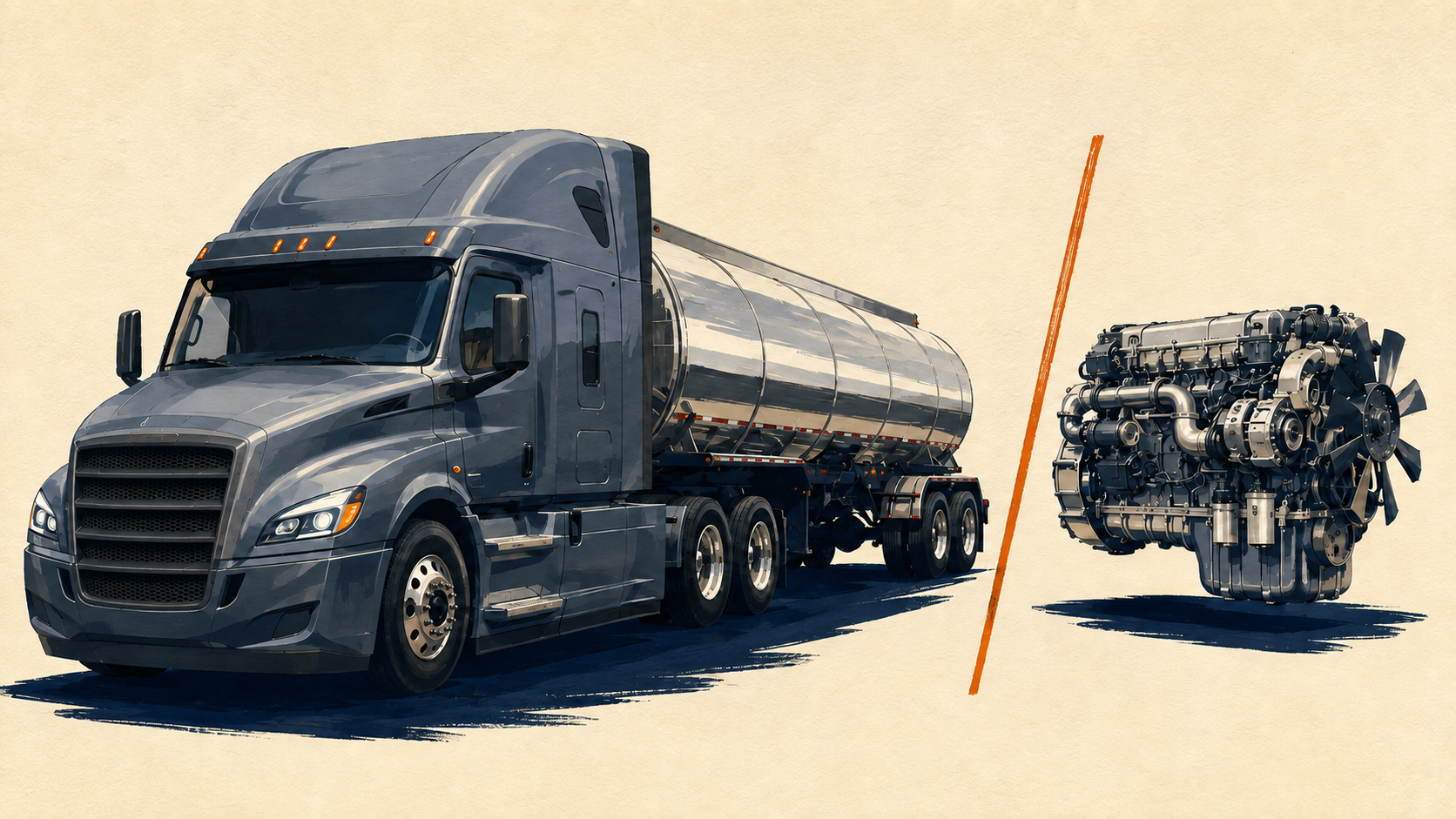
- NHTSA now says federal law authorizes fuel-economy standards for complete commercial vehicles, but not separate standards for heavy-duty engine families.
- The August 31 interpretive rule does not amend existing standards or change current rights and obligations; a separate rulemaking will determine the actual program reset.
- Tank and bulk fleets received no new retrofit, maintenance, or operating requirement, and any effect on truck prices or specifications remains unquantified.
NHTSA truck fuel economy policy is headed for a narrower legal framework after the agency concluded it may regulate complete medium- and heavy-duty commercial vehicles, but not engine families on a standalone basis.
The National Highway Traffic Safety Administration published the interpretive rule in the Federal Register on August 31, 2026, and made it applicable the same day. It covers the federal fuel-efficiency program for commercial on-highway vehicles rated at 10,000 pounds or more, as well as certain work trucks between 8,500 and 10,000 pounds.
For tank carriers buying Class 8 tractors or vocational straight trucks, the immediate message is restraint. The interpretation creates no requirement for fleet retrofits, engine replacements, drivers, maintenance, or fuel purchases. It also does not erase a current numerical standard or establish a new truck-purchase deadline.


Why NHTSA Says Its Authority Stops at the Complete Vehicle

NHTSA’s interpretive rule addresses its authority over complete commercial vehicles rather than standalone engine standards. (Source: NHTSA, 91 FR 55788)
Congress directed NHTSA to establish a fuel-efficiency improvement program for commercial medium- and heavy-duty vehicles and work trucks under the Energy Independence and Security Act of 2007. The law permits separate standards for different classes of vehicles, but NHTSA now says it does not authorize separate standards for an engine, transmission, tire, or other component.
That reverses the agency’s legal interpretation used in the joint federal Phase 1 rule adopted with the Environmental Protection Agency in 2011 and the Phase 2 rule adopted in 2016. Those programs combined complete-vehicle requirements with separate fuel-consumption standards for some engine families used in tractors and vocational vehicles.
NHTSA also relies on a 2021 federal appellate decision that invalidated fuel-economy and emissions standards for motorless trailers. The court did not decide the agency’s authority over engines. NHTSA is applying the court’s component-versus-vehicle reasoning by analogy, together with the Supreme Court’s later instruction that agencies must follow the best reading of their statutes.
The agency’s August 28 announcement described the action as a reversal of the engine rule. The published legal document is more limited: it establishes NHTSA’s interpretation and the foundation for a future regulatory change.
Existing Heavy-Truck Engine Standards Remain for Now
The interpretive rule expressly says it does not change existing standards or any rights or obligations under the medium- and heavy-duty program. The current text of 49 CFR 535.5 still contains separate engine-family fuel-consumption standards, including values for model years 2027 and later.

Tank and bulk fleets await a separate NHTSA rulemaking before any equipment or purchasing consequences become concrete. (Original Tank Transport illustration)
Those provisions primarily regulate manufacturers that certify engines and vehicles, submit compliance reports and manage credits. Motor carriers are downstream purchasers. Fleets therefore faced no new operating restriction or compliance requirement when the interpretation became applicable.
NHTSA says it will exercise its enforcement authority consistently with the new interpretation while the reset is pending. It did not announce a blanket suspension, identify every affected provision, or create a general safe harbor for manufacturers. The agency instead plans a separate notice-and-comment rulemaking to reconsider the engine standards, provide vehicle manufacturers with practicable compliance methods without them, and determine whether complete-vehicle standards also need adjustment.
No proposal date or completion deadline has been announced. NHTSA also assigns no costs or benefits to the interpretive rule itself; economic effects will be analyzed with the later substantive rule.
What Tank and Bulk Fleets Should Watch
A vehicle-centered program could eventually give manufacturers more latitude to balance engine efficiency against transmissions, aerodynamics, tires and other technologies. For tank fleets, that could influence the packages available for weight-sensitive tractors, high-idle vocational units, power-takeoff applications and other specialized duty cycles.
Those market effects remain possibilities, not current results. Fleets should continue to compare actual certified engine families, warranties, axle and transmission choices, payload effects, service support, and real-world fuel consumption, rather than assuming the August interpretation has already changed a model’s price or efficiency. Tank Transport’s heavy-truck fuel-economy coverage will follow the later vehicle proposal and its equipment consequences.
A future vehicle-centered fuel-economy program could affect truck specifications, but the August interpretation alone does not change any existing fleet obligation. (Original Tank Transport illustration)
Industry reaction also points in opposite directions. The Truck and Engine Manufacturers Association welcomed NHTSA’s review and argued that leaving the combined engine-and-vehicle framework unchanged would restrict customer specification choices. Public Citizen characterized the action as an attempted rollback and predicted higher fuel costs and emissions. Neither outcome is quantified in the interpretation.
The NHTSA action must also remain separate from EPA engine-emissions requirements. The Clean Air Act expressly authorizes EPA to regulate pollutants from new motor vehicles and engines. NHTSA’s interpretation does not amend EPA’s model-year 2027 nitrogen-oxide program or the compliance changes discussed in Tank Transport’s EPA 2027 diesel rewrite. NHTSA says the future fuel-economy reset may consider how EPA’s NOx requirements interact with fuel consumption, but the two agencies operate under different statutes.
NHTSA Truck Fuel Economy Reset: Key Developments
- Legal interpretation: NHTSA says it may set complete-vehicle standards but not separate fuel-economy standards for heavy-duty engine families.
- Current status: The interpretation applies as of August 31, 2026, while existing standards and program obligations remain unchanged.
- Fleet effect: Tank and bulk carriers received no immediate mandates for retrofitting, maintenance, operations, or procurement.
- Next action: NHTSA plans a notice-and-comment reset, but has not announced a proposal date.
- Separate authority: EPA’s criteria-pollutant engine standards are not canceled by the NHTSA action.
Until NHTSA publishes the substantive proposal, fleets have a legal signal—not a new equipment specification. The next measurable consequences will come from the regulatory text, manufacturer product plans, and pricing that follow. Tank Transport’s NHTSA coverage will track that reset.