- PHMSA proposes a default six-month threshold for qualifying mobile and temporary LNG facilities, with paths for longer operation.
- Updated standards would address personnel, transfers, security, and equipment, while retaining advance installation notice.
- Comments are due January 4, 2027; the proposal does not change current operating requirements.
Mobile LNG facilities used for pipeline repairs, peak demand, and other short-term applications would operate under a more explicit federal framework under a proposal published November 3. The Pipeline and Hazardous Materials Safety Administration would update the standards governing these installations and clarify which obligations accompany equipment as it moves between jobs.
The proposed rule would revise 49 CFR Parts 191 and 193, including incorporating the 2026 edition of NFPA 59A. Comments are due January 4, 2027, under docket PHMSA-2019-0091. These are proposed changes, with no new compliance deadline in effect.
For cryogenic carriers, equipment suppliers and temporary gas-service operators, the immediate value is a clearer view of what future jobs could require: determining facility jurisdiction, tracking deployment duration, coordinating transfers and documenting site arrangements. A portable vaporizer or trailer does not, by itself, establish that an operation qualifies for the temporary-facility provisions.


Where the proposed six-month threshold would apply
The proposal would move the mobile and temporary facility provisions from Section 193.2019 to Section 193.13. Qualifying operators would follow Chapter 14 of NFPA 59A-2026 together with Part 193’s general provisions in Subpart A. They would remain exempt from the other requirements of Part 193 when they meet that framework.
PHMSA describes Chapter 14 as establishing a default six-month duration criterion for distinguishing mobile and temporary installations from other facilities. The agency identifies two paths for extending that period: seeking a PHMSA special permit or meeting additional safety and security requirements for permanent, small-scale LNG facilities. Neither path should be treated as automatic permission to keep equipment at a site indefinitely.
Jurisdiction comes first—Part 193 concerns LNG facilities used in transporting gas through pipelines subject to the federal pipeline-safety framework. The proposal retains the exclusion for facilities used by ultimate consumers, but PHMSA’s LNG facility jurisdiction guidance explains that this is a limited exception. A production facility supplying LNG for sale and truck distribution does not qualify merely because customers eventually consume the gas.
Duration already matters in the agency’s interpretation of existing rules. In a June 2021 interpretation concerning mobile liquefaction, PHMSA distinguished short-term deployments from equipment installed for permanent use, even when production is sporadic. The proposed chapter reference would give that distinction a more explicit framework.
Deployment duration matters even when the equipment can be moved.The comparison below separates the current mobile-facility rule from the proposed approach.
| Issue | Current framework | Proposed framework |
|---|---|---|
| Referenced standard | Applicable sections of NFPA 59A-2001. | Chapter 14 of NFPA 59A-2026. |
| Deployment duration | Short-term applications; Section 193.2019 states no numerical duration limit. | Default six-month criterion through Chapter 14, with conditional paths for extension. |
| Installation notice | At least two weeks to the state pipeline-safety agency; emergency exception. | At least two weeks to PHMSA or the applicable state agency; retain the emergency exception. |
| Continuing obligations | Broadly worded Part 193 exception that PHMSA considers potentially ambiguous. | Explicitly retain Subpart A and state that Part 191 reporting applies. |
The practical change is greater specificity. Operators would have a named chapter and duration criterion to evaluate, while the advance-notice obligation would continue. The table does not establish that every LNG installation falls within PHMSA’s jurisdiction.
What would change before and during deployment?
PHMSA says Chapter 14 adds references to detailed requirements for personnel qualifications and training; equipment design, construction and installation; fire protection and physical security; transfer operations; maintenance; and corrosion protection. It also expressly allows cryogenic pipe-in-pipe systems within mobile and temporary facilities.

LNG vaporizers beside a storage tank at an industrial installation in France, April 2017. (Photo: François GOGLINS, CC BY-SA 4.0)
That combination would broaden deployment planning beyond delivering a tank and vaporizer. As an operational implication, operators and contractors should review how their procedures assign transfer duties, identify trained personnel, and maintain emergency arrangements when equipment is moved or a crew changes. The proposal does not establish a universal staffing number or a single procedure suitable for every installation.
Proposed Section 193.13(b) would require the operator to provide PHMSA or the applicable state agency with a location description at least two weeks before installation. The notice would include containment or leakage-control arrangements, firefighting equipment, and restrictions on public access. Where an emergency makes that timing impossible, as much advance notice as possible would still be required.
Keeping Subpart A applicable also matters for documentation. Proposed Section 193.11 would require reviewing and updating plans and procedures when a component is installed, replaced, relocated, or otherwise changed, and at least once every two calendar years, with no interval exceeding 27 months. Changes would be recorded in a log maintained for the facility’s life.
Existing equipment receives an important distinction. In footnote 92, PHMSA explains that Chapter 14’s design, installation, and construction requirements would not apply retroactively to existing mobile equipment simply because it moves between sites. However, the agency expects the referenced spacing requirements to apply each time the facility relocates. Equipment history and the suitability of its next location therefore require separate consideration.
Why delivery trucks and facility equipment need separate review
PHMSA’s jurisdiction guidance distinguishes LNG tank trucks engaged in transportation from mobile facilities that use a truck as both a delivery vehicle and a storage tank, connected to vaporizers and controls. It likewise distinguishes ISO containers in transportation from containers used for storage at an LNG plant connected to a regulated pipeline.
The equipment’s function matters. A carrier making a delivery and an operator keeping a trailer connected to supply pipeline gas may be participating in different regulatory activities, even if the hardware looks similar.

A transfer hose connects at the rear of an LNG trailer beside fixed storage equipment. (Photo: François GOGLINS, CC BY-SA 4.0)
Highway transportation remains subject to the applicable Hazardous Materials Regulations, including Part 177 requirements for carriage by motor vehicle. The LNG facility proposal does not waive shipping documentation, training, packaging, or applicable loading and unloading duties. Tank Transport’s coverage of PHMSA’s separate hazmat-rule changes provides context for that transportation framework.
This separation has commercial consequences worth addressing before a job begins. A contract should identify who operates the temporary facility, who handles required notifications and records, and who controls the transfer interface. These planning recommendations draw on the proposed division of responsibilities, not new contractual terms prescribed by PHMSA.
Tank Transport’s reporting on Arizona LNG production joining Sapphire’s delivery network illustrates how liquefaction, truck loading, and customer supply form different parts of an LNG service. A clearer temporary-facility framework could assist project planning, but the proposal provides no basis for projecting additional truckloads or guaranteed demand for trailers.
What should operators include in their comments?
Operators can make useful submissions by documenting how temporary projects work in practice: expected versus actual deployment duration, reasons jobs overrun, equipment moves, crew handoffs, and the effort involved in updating procedures. A pipeline-repair job extended by construction delays presents different questions from a portable installation intended to remain in place for years.
The six-month criterion and extension paths deserve particular attention. Comments could identify where additional clarity is needed on recurring deployments, treatment of existing equipment, or the transition to permanent, small-scale requirements. Concrete examples and documented costs would make those questions more useful to the agency than general statements about regulatory burden.
For fleets tracking LNG supply and infrastructure developments, the near-term task is to review prospective service commitments against the published proposal while continuing to comply with current requirements. PHMSA will consider comments before deciding on a final rule; the final wording and implementation schedule remain unsettled.
Mobile LNG Facilities: Key Developments
- Published proposal: PHMSA issued its LNG-facility NPRM November 3, 2026; comments are due January 4, 2027.
- Duration and eligibility: Chapter 14 of NFPA 59A-2026 would introduce a default six-month criterion with conditional extension paths.
- Site obligations: Advance installation notice would remain, alongside clearer general-procedure and reporting provisions.
- Relocated equipment: PHMSA distinguishes protection against retroactive construction requirements from spacing expectations at each new location.
- Carrier responsibilities: Facility provisions and highway hazmat duties require separate review; the proposal changes neither current obligations nor freight demand on its own.
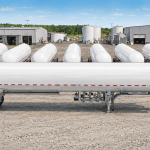
Featured photo: LNG delivery truck beside factory storage tanks and vaporizers, April 2017. (Photo: François GOGLINS, CC BY-SA 4.0)