- The Second Circuit set aside FMCSA’s $73.5 million highway-funding penalty against New York.
- The dispute concerned CDL expiration dates under regulations predating September 2025.
- Current licensing rules and individual driver qualifications remain separate considerations for tank fleets.
The New York CDL ruling issued November 13 by the U.S. Court of Appeals for the Second Circuit set aside a Federal Motor Carrier Safety Administration determination that withheld approximately $73.5 million in federal highway funding. The court’s decision concerns how New York issued non-domiciled commercial driver’s licenses under earlier federal regulations.
For tank carriers employing drivers with New York credentials, the immediate distinction is between the state’s funding dispute and a driver’s present authority to operate. Fleet managers still need to establish current license status, required endorsements, and eligibility for upcoming licensing transactions.
Why the Funding Determination Failed
FMCSA’s April 16 funding announcement said New York had failed to revoke non-domiciled commercial learner’s permits and CDLs the agency considered improperly issued. FMCSA identified licenses extending beyond immigration-document expiration dates as a central problem and demanded corrective action.

The withholding totaled $73,502,543, representing 4% of New York’s National Highway Performance Program and Surface Transportation Block Grant Program funds. The penalty applied to fiscal year 2027. New York challenged the determination on April 24, arguing that the agency had imposed a new interpretation of longstanding requirements.
The Second Circuit found that the earlier regulations required applicants to present specified unexpired documents but did not require states to match CDL expiration dates to those documents. The majority also found support in the regulations’ structure and history. Because expiration matching was the sole basis for the determination, the court set it aside.
Judge Schwartz agreed with the result in a separate concurrence, favoring resolution on the regulatory text alone.

The opinion’s opening summary explains why the court set aside the funding determination under the earlier regulations. (Source: U.S. Court of Appeals for the Second Circuit, November 13, 2026, p. 2)
The Newer Non-Domiciled CDL Rules Remain Separate
The court expressly declined to decide whether the newer regulations are lawful. Those regulations are the subject of separate litigation.
FMCSA’s February 2026 final rule, effective March 16, contains an explicit expiration limit. For applicants domiciled in a foreign jurisdiction, the credential cannot extend beyond the applicable I-94/I-94A admit-until or expiration date, or one year, whichever comes first.
The newer framework also restricts the qualifying employment-based immigration classifications to H-2A, H-2B, and E-2 for those foreign-domiciled applicants. State agencies must verify the required status documentation and conduct covered issuance, transfer, renewal, and upgrade transactions in person. The rule’s definition of issuance includes reinstatement and replacement documents.
That creates an important planning distinction: holding an existing credential does not establish eligibility for its next renewal or replacement. FMCSA’s current FAQs also distinguish merely updating medical-certification information from reinstating commercial driving privileges after a downgrade; reinstatement triggers the newer eligibility checks.
The D.C. Circuit denied requests to stay the February final rule on May 5 while allowing the challenge to proceed. That was a decision on temporary relief, rather than a final merits ruling. Tank Transport’s earlier coverage of the 2025 non-domiciled CDL rule and initial litigation provides background on the preceding interim rule.
What Tank Fleets Should Check Now
As of November 17, New York DMV’s CDL application page still stated that offices were temporarily unable to accept CLP or CDL document applications from people who are neither U.S. citizens nor lawful permanent residents. That posted restriction concerns application processing; it does not establish the status of every previously issued license.

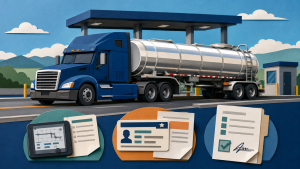
Tank fleets still need to verify individual driving privileges, required endorsements, and upcoming licensing transactions. (Illustration: Tank Transport)
For an affected employee or applicant, a useful review starts with the current state driving record, any individual suspension or downgrade notice, and the next transaction the driver will need. A carrier arranging a renewal, transfer, or reinstatement should confirm the state agency’s current instructions before building a dispatch plan around completion of that transaction.
For interstate operations subject to 49 CFR Part 391, the carrier must still use a driver who meets the applicable qualification requirements, including physical qualification, English-language proficiency, a valid license, and freedom from disqualification. Under 49 CFR 383.93, tank-vehicle and hazardous-materials endorsements remain required when applicable to the vehicle and cargo.
Safety departments should also retain procedures for drivers to report licensing actions to their employers. As Tank Transport’s coverage of FMCSA’s revised CDL reporting requirements explains, the separate employer-notification duty survives the removal of a federal reporting requirement directed to the driver’s home state.
The practical task is to connect each driver’s current record with the operation being assigned. The funding decision, the rules governing a new licensing transaction, and the qualifications needed for a particular tank movement answer different questions.
New York CDL Ruling: Key Developments
- The November 13 decision set aside New York’s funding determination under the earlier regulations.
- The February 2026 final rule has an explicit expiration limit and separate eligibility requirements.
- New York DMV continued to post its temporary application restriction as of November 17.
- Tank fleets should verify individual driving privileges, upcoming transactions, and required endorsements.
Featured photo: Thurgood Marshall United States Courthouse by Ajay Suresh, licensed under CC BY 2.0; cropped for header display.