- FMCSA’s November announcement combines 121 agency revocations and 12 voluntary withdrawals.
- Official notices list conflicting dates; fleets should confirm instructions for their specific device.
- A replacement plan must preserve driver records and prepare dispatchers and drivers for the changeover.
FMCSA ELD removals announced November 12 cover 133 electronic logging device registrations, including 121 agency-revoked devices and 12 voluntary withdrawals. The Federal Motor Carrier Safety Administration’s announcement puts affected carriers on notice to change systems. Still, its replacement instructions contain a date conflict that fleets should resolve before relying on a deadline.
For tank and dry-bulk carriers required to use ELDs, the immediate task is to identify affected equipment, maintain accurate hours-of-service records, and organize the transition. An out-of-service driver can disrupt a fuel delivery, chemical shipment, or scheduled bulk unloading. Finding a problem before dispatch gives the carrier more options than discovering it with a loaded truck at an inspection site.
Match the exact ELD registration.
Start with the FMCSA-registered and revoked device lists. Compare the device name, model, ELD identifier, and provider against the system actually used in each truck. Check the software version where listed. A company name or familiar app icon alone is not a sufficient match: the registry contains separate product and platform entries.

For a practical fleet audit, record the truck number, assigned driver, device details, current registry status, and the date checked. Include spare tractors and owner-operators whose logging arrangements differ from company equipment. Assign one person to resolve uncertain matches with the provider and FMCSA.

A Teletrac Navman ELD screen illustrates in-cab logging technology. The pictured product is not identified here as a revoked device. (Tank Transport file image)
The registry consists of devices providers have self-certified; listing does not mean FMCSA endorses a product. A working screen or a vendor’s assurance should not substitute for checking the current entry.
FMCSA’s announcement describes anonymized examples of log manipulation. It does not establish that every removed device or every customer participated in those cases. The immediate compliance question is each product’s registration status. Tank Transport’s earlier Roadcheck ELD enforcement coverage provides background on record integrity and roadside scrutiny.
Resolve the conflicting replacement dates.
The agency’s November 12 notice listing 121 revoked ELDs directs affected users to discontinue those devices, record required hours using paper logs or logging software, and install a registered replacement. Its January deadline conflicts with the date in the broader press release.
| Official source | Devices described | Published timing |
|---|---|---|
| FMCSA ELD portal notice | 121 agency-revoked devices | Replace before January 12, 2027; out-of-service enforcement from that date. |
| FMCSA press release | 133 total removals | Says up to 60 days, but names November 24, 2026, for enforcement. |
| CVSA regulatory update | 133 total removals | Replace before January 12, 2027; enforcement from that date. |
The Commercial Vehicle Safety Alliance’s November 13 update supports the January timing. However, the reviewed notices do not reconcile the discrepancy. Carriers should seek device-specific clarification from FMCSA before November 24 and arrange replacement promptly. The January date in the detailed notice does not permit continued use of a revoked ELD.
The 12 voluntary withdrawals also require individual checks. Do not automatically apply the 121-device notice to a different registry entry. Check its revocation information and obtain the applicable instructions. Likewise, rely on a verified return to the registered list, rather than a promised software fix, before treating a previously revoked product as eligible again.
Preserve records and test the changeover.
Treat replacing a device as both a records transition and an equipment purchase. Before ending service with the old provider, export the available driver records and confirm that the fleet can retrieve and read them independently. Keep the required supporting documents as part of the retention process.
FMCSA requires carriers to retain records of duty status and supporting documents for six months. The current ELD carrier-responsibility rule separately requires a six-month backup on a device apart from the original storage, with driver privacy protected. Canceling a subscription should not leave those records inaccessible.
Drivers also need continuity during the switch. FMCSA’s guidance for using two ELD systems that cannot exchange records says drivers need printed records for the previous seven days or must manually add that history. A new login should not leave the driver unable to account for work performed on the previous system.
Before assigning the replacement-equipped tractor to a delivery, have the driver demonstrate logging in, reviewing the duty-status record, and producing or transferring it for an inspection. Confirm that the correct driver and vehicle are associated with the account. Schedule installation and practice around terminal appointments so the first attempt does not happen during a loading queue or roadside stop.
Tank Transport’s earlier Operation Safe Driver Week guide outlines additional replacement-ELD training checks, including annotations, unidentified driving, inspection mode, and backup procedures.

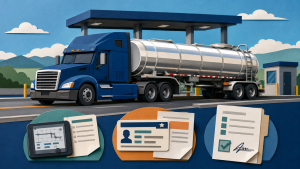
Drivers should be ready to produce duty-status records after changing ELD systems. This scene illustrates a tanker driver reviewing documents with a commercial-vehicle inspector. (Original Tank Transport illustration)
Check the cab packet at the same time. Data-transfer instructions, malfunction instructions, and enough blank log grids for at least eight days remain required. The federal requirement to carry the operator’s manual was removed in July, as explained in Tank Transport’s FMCSA paperwork-rules update.
Safety staff, dispatchers, and drivers should share one transition record showing which trucks are affected, how logs are being maintained, and when each replacement is ready. These practical checks help prevent a technology change from becoming a missed delivery or an incomplete hours-of-service record.
FMCSA ELD Removals: Key Developments
- The announced total is 133 device registrations: 121 agency revocations and 12 voluntary withdrawals.
- The detailed 121-device notice gives January 12, 2027; the press release’s November 24 date remains inconsistent.
- Affected fleets should confirm device-specific instructions, maintain required logs, and promptly arrange registered replacements.
- Preserve six months of required records and backups, maintain driver history during the switch, and verify inspection readiness before dispatch.