- The bipartisan SAFE Act would require FMCSA to build a registration-screening tool for suspected chameleon carriers while keeping final decisions with agency personnel.
- S. 5058 would create a specific federal offense for intentionally causing or arranging staged collisions with commercial motor vehicles.
- Neither proposal changes fleet obligations today, but both signal greater federal attention to carrier identity, crash fraud, insurance exposure and evidence preservation.

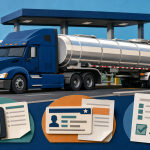
The SAFE Act would use shared identity, contact and equipment signals to flag suspicious carrier registrations for human review. The proposal is not current law. (Original Tank Transport illustration)
Two trucking fraud bills introduced in the Senate would attack different points of risk for motor carriers: one at the federal registration desk and the other after a crash has been deliberately engineered. For tank fleets, the significance is direct. According to National Tank Truck Carriers, tank carriers are attractive targets for schemes that exploit the legal system and drive up insurance costs. Meanwhile, chameleon carriers can return under a new identity after safety or enforcement problems.
The proposals remain legislation—not current operating rules. Sens. Todd Young, R-Ind., and Andy Kim, D-N.J., announced the Safety and Accountability in Freight Enforcement Act on July 28. Sen. Ashley Moody, R-Fla., introduced S. 5058, the Staged Accident Fraud Prevention Act of 2026, on July 21.
SAFE Act Would Screen Chameleon Carriers at Registration
The bipartisan Senate SAFE Act targets operators that attempt to escape federal orders, penalties, enforcement actions, negative compliance histories or insurance consequences by reopening under a different identity or affiliated entity. Its definition reaches motor carriers, brokers, freight forwarders, intermodal equipment providers and affiliated parties—not only the company name printed on a truck.


The SAFE Act focuses on suspicious registration continuity; S. 5058 focuses on intentionally caused or arranged commercial-vehicle collisions. Both remain introduced legislation. (Graphic: Tank Transport; sources: Senate bill texts)
If enacted, the measure would give FMCSA one year to develop, test, and implement an advanced automated tool for USDOT-number applications. The system would look for continuity between a new applicant and an earlier operation through ownership, managers, addresses, telephone numbers, email addresses, equipment, insurance, drivers, facilities, operating scope, company formation dates, and public-facing names or advertising.
The proposal builds on a problem documented long before today’s identity-verification technology. The Government Accountability Office found in a 2012 review that severe crashes involved 18% of new applicants with chameleon attributes, compared with 6% of applicants without those attributes. The bill would require GAO to update the national picture, including estimated prevalence, fatalities, serious injuries, property damage, evasion methods, and weaknesses in federal monitoring.
Automation would support—not replace—human decisions. FMCSA employees would retain final authority; applicants denied a USDOT number because of a flag would receive the factors behind it, and the bill provides a correction and redetermination process. The Transportation Department inspector general would audit the tool after implementation.
The proposal overlaps with FMCSA’s broader Motus registration modernization, which brings identity proofing, business verification and registration management into a new federal gateway. The SAFE Act is more targeted: it would require a screening mechanism designed specifically to connect suspicious new applications with prior entities. An identical House bill, H.R. 7539, was introduced in February.
S. 5058 Would Create a Specific Staged-Crash Offense
The second bill addresses a different fraud pathway. The introduced text of S. 5058 states that a person who intentionally causes a collision with a commercial motor vehicle could face a fine, imprisonment of up to 20 years, or both. If the collision causes serious bodily injury or death, the bill specifies a prison term of at least 20 years.
A person who arranges the staged collision would face the same penalty structure. The released text expressly covers the person causing the crash and the person arranging it. Supporters describe the measure as a way to reach organized schemes and knowing participants, but the facts and applicable federal law would still determine who could be charged. The bill also bars a federal prosecution for the same act after a conviction or acquittal on the merits under state, District of Columbia or territorial law.
Federal prosecutors already pursue staged-collision networks through conspiracy, mail fraud, wire fraud, obstruction and related statutes. On July 21, the U.S. Attorney’s Office in New Orleans reported that two participants were sentenced for a 2017 collision in which a vehicle intentionally struck a tractor-trailer, followed by false police reports, fraudulent lawsuits and unnecessary medical treatment. Tank Transport previously covered guilty pleas from the same broader Louisiana staged-accident investigation.
S. 5058 would add a direct federal prohibition centered on the act of engineering the commercial-vehicle collision itself. NTTC, American Trucking Associations, Owner-Operator Independent Drivers Association, U.S. Chamber of Commerce and multiple insurance and logistics groups have endorsed the proposal.
What the Two Proposals Mean for Tank Fleets Now

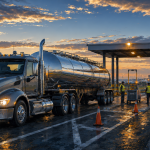
Camera footage, telematics, location records and driver statements can help fleets reconstruct suspicious roadside events and preserve evidence. (Original Tank Transport illustration)
Neither bill requires an immediate policy, registration or training change. The practical message is that federal lawmakers are treating carrier-identity evasion and collision fraud as connected threats to highway safety, fair competition and insurance costs.
If the SAFE Act advances, legitimate businesses with shared owners, transferred equipment, reused facilities or related companies may need clear records explaining those connections. The human-review, notice and appeal provisions matter because the same continuity signals that expose a shell operation can also appear in lawful acquisitions, restructurings and family-owned businesses.
For staged crashes, fleets still depend on existing controls: functioning forward- and side-facing cameras where permitted, preserved telematics and electronic logs, prompt post-crash reporting, documented driver statements, insurer notification and early coordination with law enforcement and counsel. Those practices are already relevant in a market where insurance and other operating costs remain elevated.
Trucking Fraud Bills Key Developments
- The Senate SAFE Act would require a GAO study and an FMCSA automated screening tool for chameleon-carrier indicators within one year of enactment.
- FMCSA personnel—not the automated system—would make final registration decisions, with notice, correction, and appeal protections for flagged applicants.
- S. 5058 would penalize intentionally causing or arranging a staged commercial-vehicle collision, with a minimum 20-year prison term when serious bodily injury or death results.
- Both bills are introduced proposals; neither has changed current carrier obligations or created a live FMCSA screening mandate.