Updated August 25, 2026: EPA renewed the Arctic diesel waiver for August 26 through September 14 and reported deeper national and PADD 5 distillate inventory deficits.
- EPA has issued a third consecutive 20-day Arctic diesel waiver, effective August 26 through September 14, 2026.
- Diesel containing as much as 5,000 parts per million sulfur remains limited to compatible older engines that are fueled and operated north of Alaska’s Arctic Circle.
- Modern engines and equipment with diesel particulate filters or catalytic emission controls still require 15-ppm ultra-low-sulfur diesel.

Engine certification and aftertreatment—not location alone—determine whether equipment can use the higher-sulfur fuel through September 14. (Original Tank Transport illustration)
The U.S. Environmental Protection Agency has renewed the Arctic diesel waiver that temporarily relaxes federal sulfur limits for a tightly defined part of northern Alaska, keeping emergency relief continuous through September 14, 2026.
EPA signed the second renewal on August 20. It begins August 26, immediately after the current window ends, and runs for the maximum 20 days allowed for this type of emergency waiver under the Clean Air Act.


The new action does not open Alaska’s entire diesel market to higher-sulfur fuel or broaden the equipment that can use it. Relief remains limited to qualifying highway vehicles and nonroad equipment that will be both fueled and operated north of the Arctic Circle.
For fuel distributors, tank fleets and equipment operators, the practical effect remains a two-product market. Limited volumes of locally produced higher-sulfur diesel can serve compatible legacy equipment, helping preserve trucked-in ULSD for newer engines that cannot safely use any other fuel. Distributors must keep the products segregated.
Sen. Dan Sullivan’s July 17 statement, citing industry estimates, said at least 56,000 gallons of ULSD per day were being moved from Fairbanks to the North Slope, rising to approximately 63,000 gallons during peak periods. Those figures describe the logistics exposure that prompted support for the waiver; EPA has not reported how much qualifying fuel has since been produced, how many tanker movements have changed, or whether prices have fallen.
A Third 20-Day Waiver Keeps Relief in Place
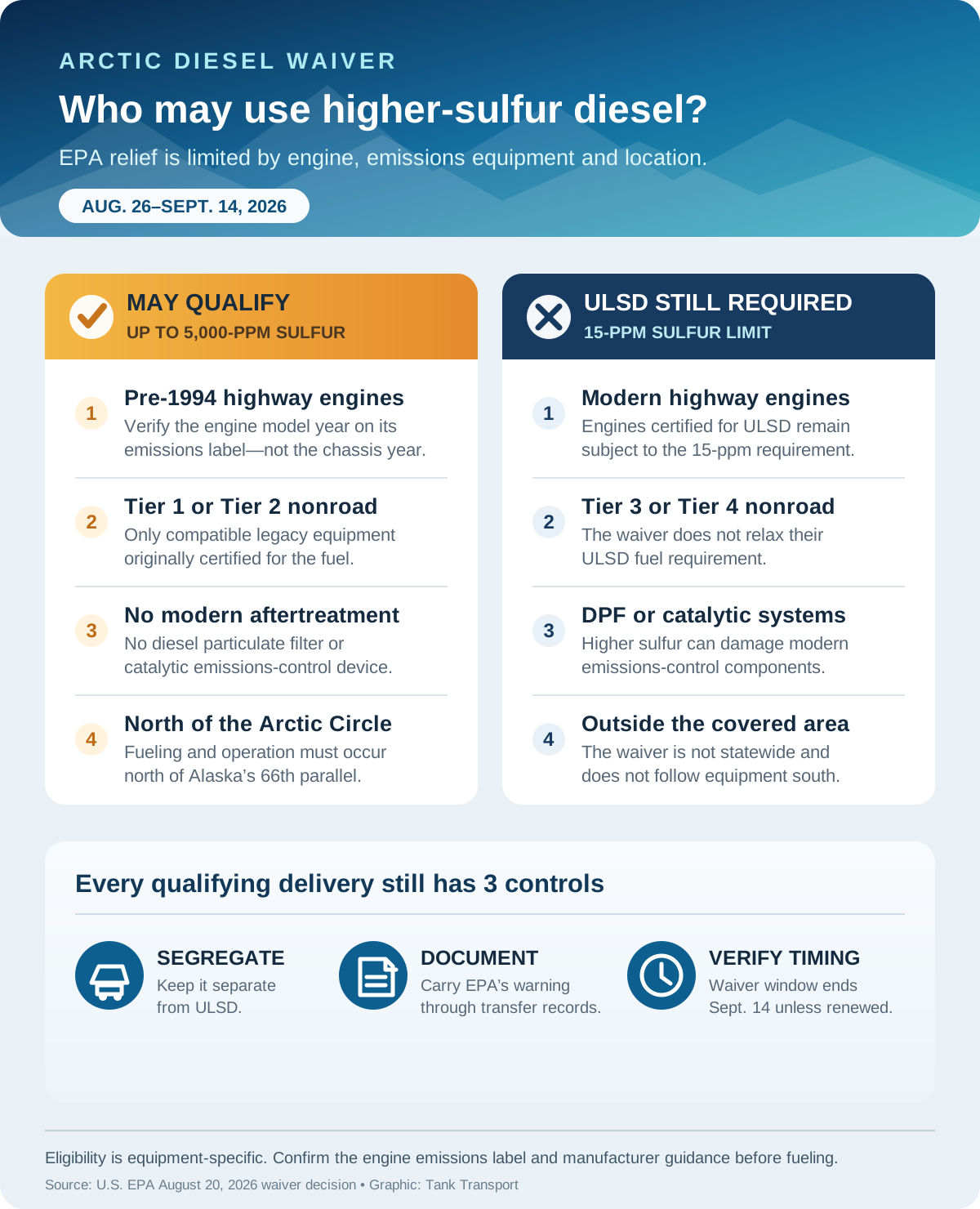
Eligibility depends on engine certification, emissions equipment and operation north of the Arctic Circle—not location alone. (Graphic: Tank Transport; source: U.S. EPA)
EPA issued the initial Arctic action on July 17, with relief lasting through August 5. The first renewal covered August 6 through August 25. The latest renewal covers August 26 through September 14, creating three consecutive 20-day windows without a gap.
Acting in consultation with the U.S. Department of Energy, EPA again found “extreme and unusual” conditions preventing an adequate supply of ULSD from reaching consumers in Petroleum Administration for Defense District 5. PADD 5 includes Alaska, Arizona, California, Hawaii, Nevada, Oregon and Washington, but the waiver itself applies only to the part of Alaska above the Arctic Circle.
EPA’s updated supply evidence is tighter than the data supporting the prior renewal. As of August 7, the agency reported national distillate inventories 11.5% below their five-year average and PADD 5 inventories approximately 10.1% below their five-year average. The July 30 decision had put those deficits at 8% nationally and approximately 4% in PADD 5 using July 24 data.
The August 20 letter also reported refinery utilization at 96.2% for the week ending August 7, 2.5% above its five-year seasonal average. EPA said that left refiners with little spare capacity to increase ULSD output during another disruption. The agency continued to cite Middle East supply disruptions, reduced U.S. refining capacity, and constrained West Coast distillate supply.
Those conditions reinforce Tank Transport’s analysis of the fuel supply crunch concentrated in refining and product logistics, the broader Hormuz supply risk confronting fuel logistics, and the vulnerabilities discussed in Tank Transport’s U.S. fuel supply outlook.
EPA issued a separate national gasoline action on the same date. Tank Transport’s winter gasoline waiver coverage explains that September 1 is a rack transition; it does not change the Arctic diesel-sulfur limits described here.
Which Trucks and Equipment Can Use Higher-Sulfur Diesel?
The renewed waiver allows diesel containing up to 5,000 ppm sulfur, compared with the 15-ppm ULSD standard that ordinarily applies. EPA says a small number of local topping refineries may again produce the higher-sulfur specification for older equipment. However, the agency does not identify participating refineries or disclose production volumes.
Eligibility depends on the engine’s original certification and emissions system—not simply the age or location of the vehicle. EPA identifies highway equipment with engines from before the 1994 engine model year as potential users. Most 1994 trucks may contain a 1993 engine, so operators should verify the engine model year on its emissions label rather than relying on the chassis year.
Nonroad engines labeled Tier 1 or Tier 2 may qualify. Tier 3 and Tier 4 nonroad engines are excluded, as is any highway or nonroad engine equipped with a diesel particulate filter or catalytic emissions-control technology. Those engines must continue using ULSD because higher sulfur levels can damage modern aftertreatment components.
The geographic limit is equally strict. EPA defines the Arctic Circle for this waiver as the portion of Alaska north of the 66th parallel. Qualifying equipment must be fueled and operated there; the fuel cannot be treated as a statewide substitute for ULSD or used in otherwise eligible equipment south of the covered area.
Fuel Distributors Still Face Segregation and Warning Duties

Distributors using the waiver must keep non-ULSD segregated and carry EPA’s required warning in product-transfer documents. (Original Tank Transport illustration)
Anyone producing, hauling, distributing, or dispensing the higher-sulfur diesel must segregate it from fuel sold or labeled as ULSD. The product-transfer documentation must carry EPA’s prescribed warning that using fuel above 15 ppm in an engine with a particulate filter or catalytic emissions device may cause serious damage.
The warning also assigns responsibility for equipment damage to the user and advises that higher-sulfur diesel may require high-total-base-number engine oil and more frequent oil changes. Operators should consult the engine manufacturer before changing fuel or maintenance intervals.
EPA waived other federal reporting requirements specifically tied to diesel sulfur under 40 C.F.R. Part 1090 for qualifying transactions, but the warning-bearing product-transfer document remains required. The action does not waive unrelated Part 1090 duties or other applicable federal requirements.
Alaska has separately addressed some facility-permit consequences. A July 31 Alaska Department of Environmental Conservation no-action assurance applies to air-permit conditions that require or may require ULSD where the EPA waiver or a renewal applies. It does not excuse violations of sulfur dioxide emissions standards or ambient air protections, and permit holders must continue with required monitoring, recording, and reporting.
Under EPA’s August 20 renewal, diesel meeting the waiver conditions that was introduced into a domestic pipeline or certified at the fuel manufacturing facility gate or import facility before the waiver expires may continue to be distributed and sold in the covered area until the volume identified on the PTDs or COAs is depleted.
The broader EPA diesel standards still require ULSD across the highway market and most nonroad applications. This Arctic exception is best understood as a controlled allocation measure: it can move compatible legacy equipment onto locally available fuel so imported ULSD remains available for engines that cannot safely use anything else.
What Happens After September 14?
EPA says it intends to issue additional waivers while the extreme and unusual supply circumstances remain. That statement is not an automatic extension. Relief after September 14 would require another signed EPA action, and all equipment, geographic, segregation, and documentation limits remain in effect unless a future letter changes them.
The agency’s fuel-waiver index is the primary indicator for confirming another renewal. Until then, fleets and distributors should plan around the September 14 expiration while separately identifying any documented volume eligible for post-expiration sell-through.